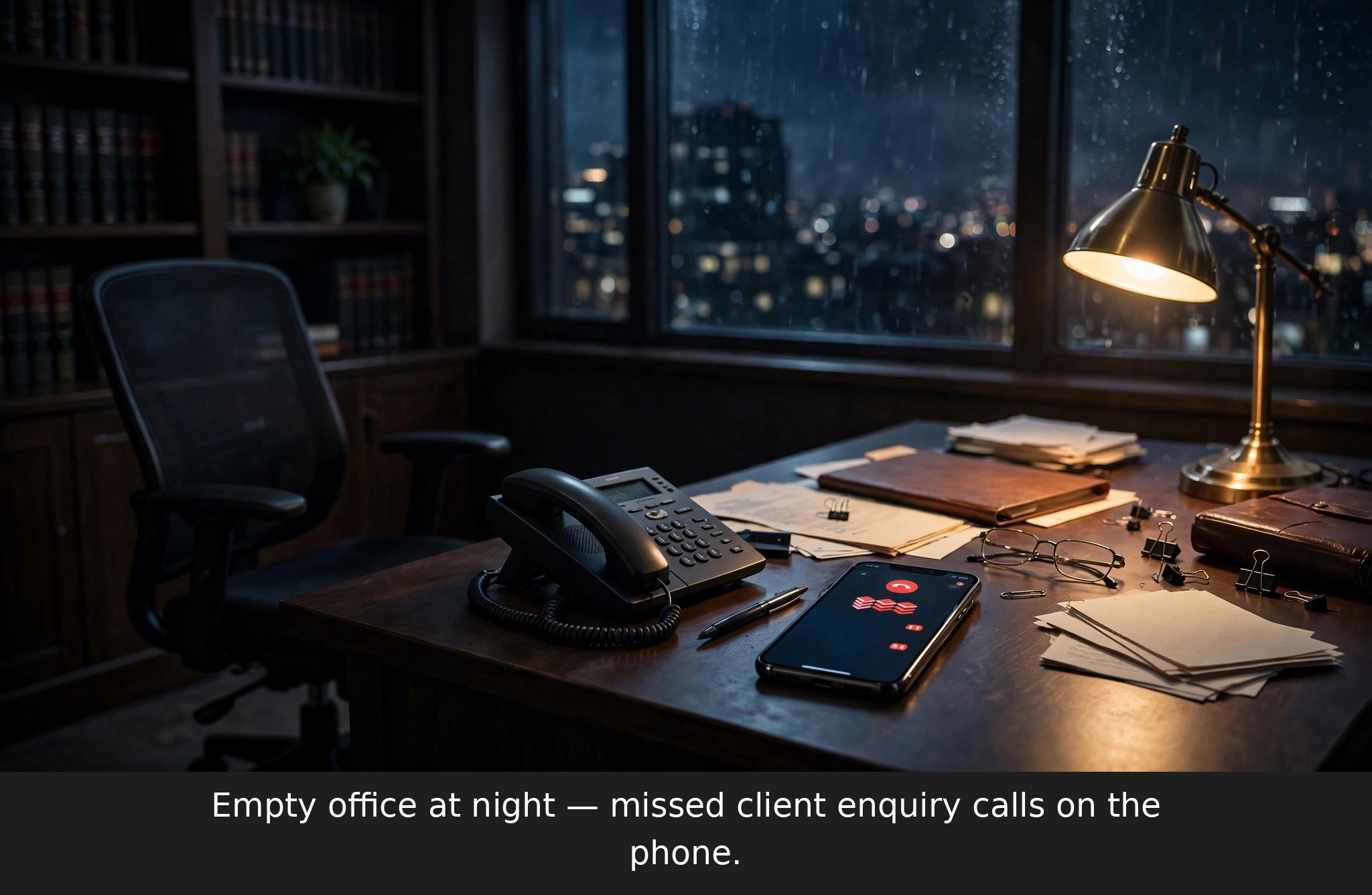
It's 11pm. Someone has just had a car accident, a landlord dispute, or a frightening letter from an employer. They search for a lawyer, find your firm's website, and send a message: 'I need help — can someone call me?' Nobody answers until morning. By then, they've called the firm that replied at 11:05pm. An AI chatbot for law firms answers that message instantly. It asks what the matter is about, how urgent it is, and where they're located — then books a consultation or routes the urgent case to a human immediately. One rule stays absolute: it never gives legal advice. It collects facts and connects people to lawyers.
Legal Enquiries Arrive at the Worst Possible Time
Legal problems don't keep office hours. Accidents happen at night, tenancy crises erupt on weekends, and employment shocks land whenever they land. People facing a legal problem usually contact the first firm that responds with a clear next step — they're stressed, and speed feels like care. But small firms can't staff a phone line around the clock, and every missed after-hours enquiry is a client who needed you and found someone else. After-hours enquiries are common in law precisely because legal problems ignore the 9-to-5. The firms that answer win the client.
What an AI Chatbot for Law Firms Actually Does
- Answers instantly at any hour and asks the basics: what the matter concerns, how urgent it is, and where the person is located.
- Pre-qualifies the enquiry — matter type, urgency level, location — so you know exactly what you're walking into.
- Books consultations into your diary with confirmations and reminders, collecting contact details along the way.
- Routes urgent matters to a human immediately, with the full conversation attached, instead of letting them wait.
- Politely declines what you don't handle — wrong practice area, wrong jurisdiction — and, where appropriate, suggests what kind of lawyer to look for.
Pre-Qualify Clients Without Practising Law
This is the line that matters most, so let's be completely clear: the chatbot must never give legal advice. Not 'you probably have a case', not 'the deadline is likely 30 days', not even well-meaning general guidance. Its job is intake, not counsel. It collects facts — what happened, when, where — asks about urgency, and books the consultation where a real lawyer gives real advice. This boundary protects your firm and your clients. It also makes the chatbot better at its actual job: a tool that tries to advise will eventually say something wrong; a tool that focuses on fast, accurate intake simply works. Write its limits into its instructions explicitly, and review transcripts regularly to make sure it stays inside them.
The Human Handoff Is Your Safety Net
Some matters can't wait for a morning callback — someone in custody, an imminent eviction, a deadline tomorrow. The chatbot should recognize urgency signals and escalate immediately: notify the on-call lawyer with the full conversation, and tell the client honestly what's happening ('I've flagged this as urgent — someone from the firm will call you shortly'). For everything else, a booked consultation with a clear summary is the right outcome. Plumbers handle emergency call-outs the same way — instant triage, then a human takes over, as shown in AI chatbots for plumbers and home services. Urgency respected, routine handled, nothing dropped.
Book Consultations Into Your Real Diary
A consultation booking should take sixty seconds, not six emails. The chatbot offers your actual availability, books the slot, confirms it, and sends a reminder — with a short note on what to bring (documents, timelines, the other party's details). Clients arrive prepared instead of spending half the consultation reconstructing basic facts. That preparation makes your consultations sharper and your conversion rate higher. Real estate agents run the same booking flow for property viewings — see AI chatbots for real estate agents. And for the bigger picture of turning website visitors into named enquiries, lead capture automation covers the fundamentals.
Trust Is Everything in Law — Sound Like Your Firm
Nobody hires a lawyer from a chatbot — they hire the firm behind it. So the chatbot should sound like your firm: professional, calm, reassuring, never casual or jokey. It should be upfront about what it is ('I'm the firm's intake assistant') and honest about response times for non-urgent matters. Include your real consultation policy — free or paid, how long, what it covers — because fee surprises destroy trust. Review the chat logs monthly: the questions people keep asking reveal what your website should explain better, and every improvement makes both the chatbot and the site stronger.
What Should the Chatbot Do When Someone Is in Crisis?
Some visitors are not browsing — they are panicking. Arrested at midnight. An eviction notice on the door. A court deadline tomorrow morning. These conversations need a different gear from everything else the chatbot does.
First, the chatbot must stay calm and simple. Short sentences, no jargon: "I understand this is urgent. Let me get you to someone right now." Second, it must escalate immediately — not after five qualifying questions. Crisis keywords should trigger an instant human notification with the full conversation attached. Third, it must never speculate: no "you should be fine," no "that's probably illegal." Reassurance without advice sounds like: "A lawyer needs to hear the details — I'm connecting you now."
Write the crisis script with your lawyers, not your web designer. Decide in advance which words trigger escalation, who gets notified, and what the chatbot says while the client waits. Then test it the way you would test a fire alarm — before you ever need it. The crisis conversation is rare, but it is the one that defines what your firm stands for.
Also decide what the chatbot says when no lawyer can respond quickly — at 3am, for example. Honesty beats silence: "I've flagged this as urgent and someone will call you first thing in the morning. If you are in immediate danger, please contact emergency services now." A client who knows exactly what happens next can wait calmly. A client left guessing will call the next firm on the list.
Intake Mistakes That Quietly Cost Firms Clients
Most firms do not lose enquiries because of bad lawyering. They lose them at the front door, in ways that are easy to miss:
- Asking for the whole life story before offering help. Get the matter type and urgency first; the details can follow.
- Slow follow-up on chatbot bookings. A consultation booked at midnight still needs a human confirmation in the morning — fast.
- A chatbot that sounds like a call center. Legal clients need calm professionalism, not chirpy sales energy.
- No jurisdiction check. Taking a detailed enquiry you legally cannot act on wastes everyone's time and feels careless.
- Hiding the fee policy. "We'll discuss fees later" makes people assume the worst. State it upfront.
Audit your own intake once a quarter. Pretend to be a stressed client at 11pm and walk through the whole thing: the greeting, the questions, the booking, the confirmation. You will find the leaks in ten minutes. Fix the biggest one first, then repeat next quarter.
Pay special attention to the first thirty seconds. That is when a stressed visitor decides whether your firm feels safe. A warm greeting, an instant response, and one clear question — "what happened?" — beats a menu of six options. Stressed people cannot navigate menus. Meet them where they are, not where your flowchart wishes they were.
Also check what happens after hours differently from daytime. The daytime chatbot can promise "someone will call within the hour"; the 2am chatbot must promise something true at 2am. Write separate expectations for open and closed hours, and make sure the chatbot knows which one it is. A promise the firm cannot keep is worse than no promise at all.
How to Write the Chatbot's Rules So It Never Gives Advice
"Don't give legal advice" is easy to say and hard to enforce. Make it concrete with a forbidden-phrases list: no "you have a case," no "the deadline is," no "you should sue," no "that's illegal." The chatbot gets safe redirect lines instead: "That's exactly what the consultation is for — a lawyer can give you a proper answer once they hear the details."
Build the boundary into the conversation flow, not just the instructions. When a visitor asks an advice-shaped question, the chatbot acknowledges the question, states its limit plainly, and moves to booking: "I can't advise on that — but I can book you a consultation where a lawyer will. Would tomorrow at 10 work?" The limit becomes a bridge, not a wall.
Then verify. Read transcripts every week for the first month, then monthly. Look specifically for advice-shaped answers — the almost-advice is where the danger lives. One slip is a training fix; a pattern is a configuration problem. This discipline is what separates a safe intake tool from a liability.
Keep a simple log of every correction you make — date, what the chatbot said, what it should have said. Over a few months this log becomes your training manual, and it shows any regulator or partner exactly how seriously you take the boundary. In law, the paper trail is the product.
What Your Law-Firm Chatbot Should Never Do
Put these in writing, review them with your team, and check the transcripts against them:
- Never give legal advice — not even "general information" that sounds like advice. When in doubt, book the consultation.
- Never predict outcomes. "You'll probably win" is a promise you cannot keep and a complaint waiting to happen.
- Never quote fees it is not sure about. State the consultation policy; leave case fees to the lawyer.
- Never discuss a client's matter with anyone else. Not a spouse, not a friend messaging "on their behalf." Privacy is absolute.
- Never keep an urgent matter waiting. Crisis signals jump the queue, every time, no exceptions.
Want this for your law firms?
ReplyPilot builds a custom ai chatbot setup for your law firms — answering customer questions instantly, taking orders and bookings, and handing off to you when a human is needed.
Ask on WhatsApp — it's freeClients hire firms they trust. A chatbot with visible boundaries builds that trust from the very first message — and protects the firm behind it. Boundaries are not limitations on the chatbot; they are the reason clients feel safe using it.
Share these boundaries with clients too, briefly, at the start of the chat: "I'm the firm's intake assistant. I collect details and book consultations — I don't give legal advice." Visitors respect the clarity. It also sets the right expectation, so nobody is disappointed that the chatbot will not answer "do I have a case?" on the spot.
A Day in the Life: Intake Without the Phone Chaos
8:00 AM — you arrive to find three overnight enquiries already qualified: matter type, urgency, location, and a consultation booked for each. No voicemails to decode, no "sorry I missed your call" callbacks eating the morning.
11:30 AM — a tenant facing eviction messages in a panic. The chatbot recognizes the urgency, notifies you instantly, and the client gets a call within the hour — while the competitor's chatbot is still asking for their email address. 3:00 PM — someone outside your jurisdiction gets a polite redirect to the right kind of lawyer, saving you a consultation that would have gone nowhere.
9:00 PM — a car accident enquiry arrives. Facts collected, consultation booked for the morning, urgent flag set because there is a deadline question. You review it all in two minutes before bed. Nothing slipped. Nothing waited. That is intake done right — quiet, complete, and humane.
Notice what the lawyers did not do all day: chase voicemails, retype enquiry details, or apologize for slow replies. The intake work happened; the admin work disappeared. That is the real return — not just more clients, but lawyers spending their hours lawyering.
How to Measure Whether Intake Is Actually Better
Billable hours are precious; do not spend them on dashboards. Watch four simple signals:
- Response time — every enquiry answered in seconds, including the 11pm ones. Compare that to your old voicemail turnaround.
- Consultation show rate — booked consultations that actually happen. Reminders should push this upward.
- Matter fit — are the consultations you take better matched to your practice? Fewer "wrong area" meetings means the pre-qualification is working.
- Urgent matters caught — count the crises the chatbot escalated that would have waited until morning before.
If all four move in the right direction, the chatbot has earned its place. If one lags, the transcripts will show you why — in the clients' own words. Small firms do not need analytics departments; they need to read their own chats once a month.
One more measure costs nothing: ask new clients how the first contact felt. "Was it easy to reach us?" takes ten seconds at the end of a consultation and tells you what no metric can. Clients remember the feeling of being answered quickly when they were scared. That feeling is your reputation, and the chatbot is now part of it.
Answering the Price Question Honestly
"How much will this cost?" is the question every visitor wants answered and every firm fears. The chatbot should not dodge it — dodging reads as hiding, and hiding reads as expensive.
State your consultation policy clearly: free or paid, how long, what it covers. For case fees, be honest about the range of possibilities without promising: "Fees depend on the complexity — the lawyer will give you a clear picture at the consultation, before you commit to anything." That sentence does three jobs: it answers, it is truthful, and it moves toward booking.
Firms that talk about money plainly sign more clients than firms that treat it as taboo. The chatbot gives you a safe, consistent way to do it — the same honest answer at 2pm and at 2am, never flustered, never evasive. Clients remember that steadiness when they choose who to trust.
Watch out for one trap: the "free consultation" that is not really free. If your consultation is free but limited — fifteen minutes, general guidance only — say so plainly. "The first consultation is free and lasts 20 minutes — enough for the lawyer to understand your situation and explain your options." Clear beats generous-sounding-but-vague, because vague creates the fee surprise that destroys trust later.
Want this working in your law firm?
Your clients need a lawyer's judgment — but first, they need someone to answer. An AI chatbot for law firms makes sure that answer comes in seconds, day or night, with proper intake, honest boundaries, and urgent matters routed to a human fast. If you want to see it handling intake with your practice areas and your voice — never giving advice, always connecting — request a free custom demo at https://replypilot-site.vercel.app/ and ReplyPilot will build you a working preview for your firm.
Can the Chatbot Do a First Conflict Check?
Every law firm knows the awkward moment: a consultation goes well, and then you discover you already represent the other side. An hour wasted, a client disappointed, and an ethical line you must not cross. A chatbot can run the first, simple version of a conflict check before anyone books.
During intake, after collecting the visitor’s name, it asks one more question: “Who is the other party in this matter?” The name goes into your conflict log for review — the chatbot flags it, a human decides. It never tells the visitor “we have no conflict” or “we can’t take your case because of a conflict.” Those are decisions for a lawyer, not software.
This early screen does quiet, valuable work. It catches the obvious conflicts before they eat a consultation slot. It shows the visitor that your firm is careful and professional. And it builds the paper trail — every check logged, dated, and reviewable. Just make sure the chatbot explains briefly why it is asking: “We ask so we can make sure we’re the right firm to help you.” People answer honestly when they understand the reason.
The limit to respect
The chatbot collects names and flags them. It does not search your full client database on its own, and it never shares any information about your other clients. Collection is the chatbot’s job. Judgment stays with the lawyers.
How Should the Chatbot Answer “Is My Information Private?”
This is one of the first questions a worried visitor asks, and the answer matters enormously. Someone describing a workplace dispute or a family matter needs to know their words are safe before they type a single detail. The chatbot should answer this question early, clearly, and in plain words.
The honest version sounds like this: “What you share here is kept private within our firm and handled under our data protection policy. Anything you tell our lawyers in a consultation is protected by lawyer-client confidentiality.” Notice what it does not say: it does not promise confidentiality for the chat itself — that is a legal question, and only a lawyer can answer it for your jurisdiction.
Train the chatbot to say this without being asked, too. A short line at the start of intake — what is collected, who sees it, how long it is kept — removes the fear that stops people from sharing the details you need. Visitors who trust the process give better facts, and better facts make better consultations.
- State what data you collect and who inside the firm sees it
- Never promise lawyer-client confidentiality for the chat itself — route that question to a lawyer
- Offer an alternative — “if you’d rather talk than type, here’s our number” — for the truly cautious
What Happens to the Enquiries That Never Book?
Not every visitor books a consultation on the first visit. Some are still deciding. Some got interrupted. Some meant to come back and forgot. Most firms lose these people forever — the enquiry sits in a spreadsheet and nobody follows up. A chatbot can run a gentle, respectful follow-up that costs you nothing.
A day or two later, one message: “Just checking in — would you still like to book that consultation? No pressure either way.” That is it. No daily nudges, no discount offers, no pressure tactics — this is a law firm, not a shoe sale. A surprising number of people reply to the single polite reminder, because the only thing stopping them was life getting busy.
The same care applies to consultation no-shows. When someone misses their slot, the chatbot offers to rebook once, kindly. If they go quiet after that, let them go. Chasing people damages the trust a firm runs on. One reminder is helpful. Three is harassment.
Getting the Paperwork Ready Before the First Meeting
The most expensive minutes of a consultation are the ones spent on admin — copying ID details, listing documents the client forgot to bring, reconstructing timelines from memory. A chatbot can move all of that before the meeting, so the lawyer’s time goes to advice instead of paperwork.
After booking, it sends a short checklist: what to bring, tailored to the matter type. For a tenancy dispute: the lease, the notices received, photos if relevant. For an accident: the police report number, medical notes, the other driver’s details. The client can upload photos or scans straight into the chat, and everything lands in one tidy file the lawyer reads before the client sits down.
Keep the list short — five items at most. A twenty-item checklist does not get done; a five-item one does. And always offer the alternative: “Don’t worry if you can’t find everything — bring what you have and we’ll go through the rest together.” The goal is a prepared client, not a stressed one.
Frequently Asked Questions
Can an AI chatbot do client intake for my law firm?
Yes. It asks the new client's name, matter type, urgency, and key facts, then books a consultation. For urgent matters — arrests, accidents — it can flag the chat for immediate human attention. Routine intake runs on its own.
Is a chatbot safe for a law firm to use with confidential enquiries?
Reputable providers use encrypted channels and never train public models on your data. You should still add a disclaimer that the chat is not legal advice. Ask your provider about their data policy before signing — this matters more for law than any other niche.
How much does a chatbot cost for a small law firm?
Typically a monthly fee for a law firm, based on volume. A single signed client usually covers a year of cost. Firms that do personal injury, family, or immigration law see the fastest return because enquiry volume is high.
Can the law firm chatbot route urgent cases to a lawyer immediately?
Yes. You define urgency triggers — "arrested," "court tomorrow," "eviction notice" — and those chats jump the queue to you or your intake team. Everything else gets scheduled normally. You never miss a genuinely urgent case.
Will the chatbot give legal advice to my firm's website visitors?
No — and it must be configured not to. It provides general information and books consultations, with a clear disclaimer. This protects your firm and keeps you compliant with bar rules about advice and advertising.