WhatsApp Automation for Window Cleaning Companies
Quick answer: WhatsApp automation for window cleaning companies answers every enquiry in seconds, asks for photos and window counts, gives a clear quote, books a slot, sends reminders, and reschedules rain days without phone tag. It suits small crews whose owner is usually on a ladder, not at a desk.
The ladder problem
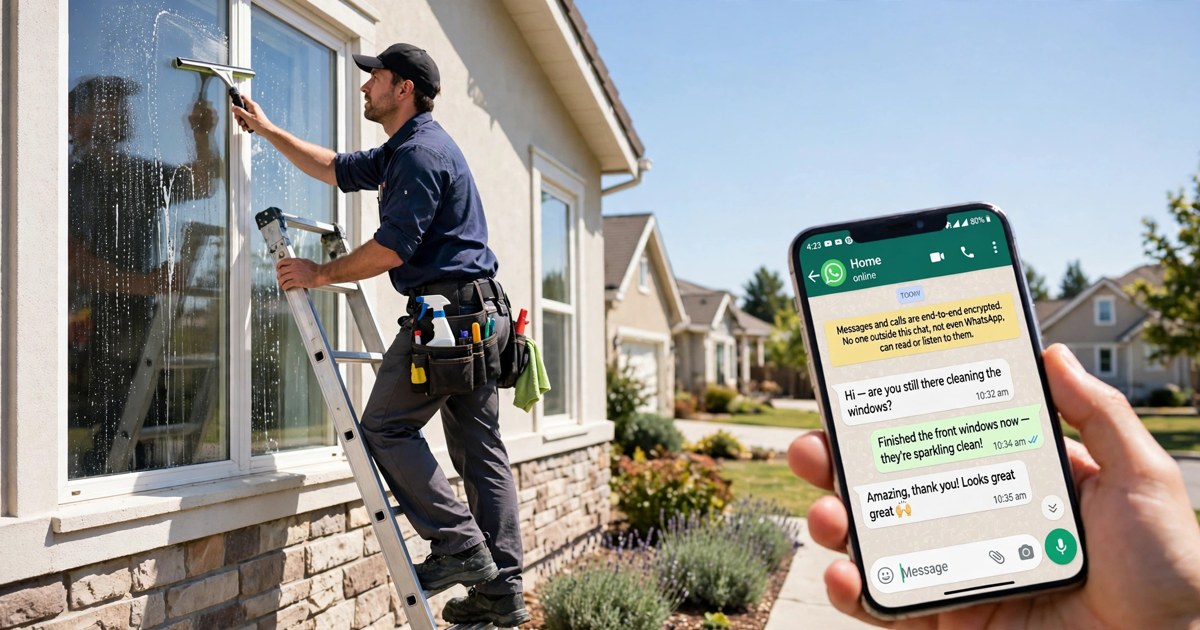
It is a Tuesday morning and Dan is halfway up a ladder, squeegee in one hand, when his phone buzzes in his pocket. He cannot answer. By the time he climbs down, wipes his hands, and calls back, the homeowner has already messaged two other window cleaners. The first one to reply with a price and a date gets the job.
This is the daily shape of window cleaning work. The owner is the salesperson, the scheduler, and the crew, all at once. Most enquiries arrive while the team is on a job, driving between houses, or cleaning glass in the rain. A missed message is rarely just a missed message. It is a lost route stop, a gap in next week, and a customer who now thinks of a rival first.
WhatsApp automation changes who answers first. It does not replace Dan. It answers in his voice, with his prices and his calendar, while he is still on the ladder. The customer gets a helpful reply in seconds, not a voicemail. Dan gets a booked job to confirm when he is back on the ground.
If you run a carpet cleaning business, the same first-reply problem plays out with stains and party deadlines, as covered in our guide to WhatsApp automation for carpet cleaning companies. Window cleaning has its own version, built around photos, storeys, screens, and weather.
What WhatsApp automation actually does for a window cleaning company
Strip away the jargon and it does four jobs. First, it greets every new message at once, day or night, and asks the right questions. Second, it turns those answers into a quote the customer can say yes to. Third, it books the job and keeps it booked with reminders. Fourth, it follows up after the clean so the next booking and the next review do not depend on memory.
None of this needs the customer to download an app, create an account, or fill in a long form. They already have WhatsApp on their phone. They message the way they message a friend. That low friction is why window cleaning enquiries suit this channel so well. A homeowner standing in front of dirty windows can photograph them, send the pictures, and get a price while the thought is fresh.
A good setup also knows when to step aside. A customer with a broken window, a bird strike, or a third-storey dormer that needs special access should reach a human quickly. Automation should hand over with the full conversation attached, so the customer never has to repeat themselves.
Why window cleaning leads go cold so fast
Window cleaning is a want, not an emergency, for most homes. That sounds like good news, until you see what it does to buying behaviour. A homeowner notices grubby glass on a sunny Saturday, feels motivated for about an hour, and then life takes over. If no one replies in that window, the motivation fades. The windows stay dirty for another month, and the enquiry quietly dies.
Commercial customers behave differently but just as fast. A cafe owner, a small office manager, or a letting agent is usually comparing two or three cleaners at once. They want a price, a first available date, and a sense that the cleaner will turn up. The cleaner who answers with all three wins, even if another cleaner is a little cheaper.
There is also the route problem. Window cleaners earn money by grouping nearby jobs on the same day. A slow reply does not just lose one house. It breaks the shape of a route. A confirmed job on Maple Street makes the next enquiry on Maple Street far more profitable, because the crew is already there. Fast, automated replies protect that route density in a way that callback lists never can.
The quote-by-photo flow that wins the job
Quoting window cleaning over the phone is guesswork. How many windows, the customer is asked, and the answer is usually "quite a few" or "the normal amount". Nobody counts their windows for fun. Photo quoting fixes this, and WhatsApp is the natural place for it.
Here is how a clean flow runs. The customer messages asking for a price. The assistant replies at once, thanks them, and asks for three things: a photo of the front of the house, a photo of the back, and a note about anything unusual, such as a conservatory, a skylight, or windows above a conservatory roof. It also asks whether they want inside and outside, or outside only, and whether screens and sills are included.
From those photos, the assistant can count the panes it can see, spot the awkward ones, and ask a follow-up question only where it matters. A typical exchange looks like this. The customer sends two photos. The assistant replies that it can see ten front windows plus a porch light panel, and asks whether the upstairs side window counts as one or two panes. The customer answers. The assistant gives a clear quote for outside-only and for inside-and-outside, names the next two available days, and asks which day suits.
This is an example flow, not a promise about any one business. Real prices depend on the area, the size of the home, and how the business charges, by pane, by window, or by job. The point is the shape: photo in, clear price out, date offered, all inside one chat. No "we will call you back with a quote" and no second chase.
For a window cleaner, the photos do a second job too. They show access problems before the crew arrives. A locked side gate, a gravel slope, a conservatory roof that cannot take weight, or a window over a thorny hedge all change the plan. Spotting them in the chat means the crew brings the right ladder and the right kit, instead of discovering the problem on the doorstep.
Booking, reminders, and the no-access problem
Every window cleaner knows the no-access job. The crew arrives, the gate is locked, nobody is home, and the dog is loose in the garden. The slot is wasted and the route is broken. WhatsApp automation cuts this down with simple, well-timed reminders.
Once a customer confirms a date, the assistant sends a short confirmation with the day, the arrival window, what is included, and what the crew needs: gate unlocked, cars moved from the drive, pets kept inside. The day before, it sends a reminder and asks the customer to reply yes if all is still fine. On the morning of the job, a short message says the crew is on its way.
Customers reply to WhatsApp far more readily than they answer unknown phone numbers. A one-word yes is easy. A changed plan is easy to report too. If the customer replies that they will be out, the assistant can offer the next nearby date on the same route, rather than leaving a hole in the day.
Payment can sit in the same chat as well. Some cleaners take payment on the day by card or bank transfer. Others send a payment link after the clean, with before-and-after photos attached. Either way, the customer does not need to hunt for an invoice in an email inbox. The link arrives where the conversation already lives.
Rain, wind, and rescheduling without phone tag
Weather is the window cleaner's permanent headache. A morning that starts clear can turn to rain by ten. High wind makes ladder work unsafe. A good business does not clean in driving rain and call it done, because the glass will spot and the customer will be unhappy.
The trouble is telling twenty customers, one by one, that today is off. Done by phone, that is an hour of calls, voicemails, and callbacks. Done by WhatsApp automation, it is a single broadcast to the affected route, sent only to customers who have agreed to receive messages, with a new date offered in the same message.
The wording matters. A blunt cancellation feels like a letdown. A helpful message names the reason, gives the next date, and lets the customer confirm with one reply. For example: rain is forecast all morning, so the crew cannot give a streak-free finish today, and the assistant offers Thursday on the same route instead. The customer taps yes, and the job moves. Nobody plays phone tag. The route stays full.
Want this for your window cleaning companies?
ReplyPilot builds a custom whatsapp automation setup for your window cleaning companies — answering customer questions instantly, taking orders and bookings, and handing off to you when a human is needed.
Ask on WhatsApp — it's freeSafety deserves a plain word here. Automation must never pressure a crew to work in unsafe wind or on a wet roof. The system should follow the business owner's weather rules, not override them. If the owner says no ladder work above a certain wind speed, the assistant reschedules. That rule protects the crew and the business reputation at once.
Recurring cleans: the six-month reminder that fills routes
One-off window cleans pay once. Regular customers pay for years. The difference between a business that survives and one that grows is often just a reminder system that actually runs.
Most homeowners do not remember when their windows were last cleaned. Six months pass, the glass dulls slowly, and nobody notices until a sunny day shows every mark. An automated reminder at the right moment turns that slow fade into a booking. It can say, simply, that it has been about six months since the last clean, that the crew will be in the area next Tuesday, and ask whether the customer wants the usual inside-and-outside service.
Commercial customers need a different rhythm. A shopfront may need cleaning every two weeks. An office may want monthly. A restaurant with a glass front may want weekly in summer. Automation can hold each customer's rhythm separately, so the cafe gets its fortnightly nudge and the office gets its monthly one, without the owner tracking it all in a notebook.
There is a quiet benefit here for pricing too. A regular customer is far less likely to haggle over a small price rise than a new customer comparing three quotes. Regulars trust the work. They know the crew. They value the fact that someone remembers their gate code, their dog, and their conservatory. Automation keeps that memory alive between visits.
Reviews, photos, and referrals after the squeegee dries
The best moment to ask for a review is right after the clean, while the glass is sparkling and the customer is pleased. Too many cleaners wait until the end of the month, by which time the feeling has faded and the ask feels awkward.
Automation makes the timing easy. An hour after the job, the assistant sends the before-and-after photos and a short thank-you, then asks whether the customer would leave a quick review, with a link. No long speech. No pressure. Customers who are happy usually say yes, because the work is fresh in their mind and the link is right there.
Referrals work the same way. A short message a few days later can ask whether a neighbour on the same street might want a quote while the crew is nearby. Window cleaning is a street-by-street business. One happy customer on a road often leads to two more, because neighbours see the clean glass and the crew van, and the recommendation feels easy. A referral message that names the street and the next route day makes that step concrete.
Photos deserve care. Only share a customer's home photos with their permission, and never post a photo of the inside of a home without asking. A simple question in the chat, asking whether the business may use the after photos on its page, keeps trust intact and still gives the business plenty of good material from customers who say yes.
What WhatsApp automation does not do
Honesty matters more than hype here. Automation will not climb a ladder. It will not judge whether a third-storey window is safe to reach from a conservatory roof. It will not spot a cracked pane that needs a glazier, not a cleaner. It will not calm an upset customer who found a scratched sill. Those jobs belong to people.
It also cannot fix a business that never answers its handover messages. If the assistant flags a tricky access question and nobody reads it, the customer still waits. Automation raises the floor of responsiveness. It does not remove the need for someone to check the inbox once or twice a day and handle the exceptions.
There are limits on messaging too. Businesses must only send marketing messages to customers who have agreed to receive them, and must follow WhatsApp's rules for business messaging. A reminder about a booked job is different from a sales broadcast to a cold list. A good setup keeps that line clear, uses approved message templates where required, and gives every customer an easy way to opt out.
Finally, automation is only as good as the information behind it. If prices change and nobody updates them, the assistant will quote the old price. If the calendar is wrong, it will book the wrong day. The owner still owns the prices, the calendar, and the weather rules. Automation carries them out faithfully, for better or worse.
DIY tools versus a done-for-you setup
A window cleaner choosing automation faces a real fork in the road. One path is a do-it-yourself tool, where the owner builds the flows, writes the replies, connects the calendar, and tests it all. The other path is a done-for-you service, where someone else builds and maintains it to the owner's prices and routes.
Do-it-yourself tools suit owners who enjoy tinkering and have quiet winter evenings to spend on setup. They usually cost less per month, but they cost hours, and the hours come from the same person who cleans windows all day. The common failure is not the tool. It is the half-finished setup, built in January, abandoned by March, still sending the old greeting in July.
A done-for-you setup suits owners who want the system working next week, not next quarter. Someone else writes the flows in the owner's voice, loads the real prices, tests the photo-quote questions, and watches the first live conversations. The owner checks the bookings, not the wiring. The trade-off is a higher monthly cost and less direct control over every word, though a good provider lets the owner approve the wording before launch.
Whichever path you choose, judge it on the same test. Send it a photo of a house with a conservatory and a locked gate. Does it ask the right follow-up questions? Does it quote clearly? Does it offer a date? Does it hand a hard question to a human without making the customer repeat themselves? If it fails that test, it will fail on real customers too.
For a broader look at how done-for-you automation compares with tool-only options, see our guide to WhatsApp automation for house painters, where the same choice plays out around colour choices and room-by-room quotes.
A simple 14-day setup plan
Week one is about facts, not technology. Write down your services: outside-only, inside-and-outside, screens, sills, conservatory roofs, gutter clearing if you offer it. Write down how you charge, and what counts as an extra. List the questions you always ask on the phone. Photograph three typical houses: a small terrace, a detached house, and a house with a conservatory, so you can test the photo flow against real examples.
Week two is about building and testing. Load the prices and the questions into the assistant. Connect the calendar, or at least the list of route days. Test it yourself with the three house photos. Test it with a friend who plays a difficult customer: a locked gate, a dog, a rain forecast, a request for a price for a shopfront. Fix every answer that sounds robotic or wrong.
Then go live quietly. Put the WhatsApp link on your van, your leaflets, and your business profile. Tell existing customers they can now message for a quote. Watch the first twenty conversations closely. You will learn more from those twenty than from any demo, because real customers ask messier questions than testers do.
Expect the first month to need tuning. A question you forgot will appear. A price edge case will surface. A customer will ask something nobody predicted. That is normal. A setup that cannot be tuned quickly is a setup that will slowly drift out of date, so keep the tuning loop short and regular.
What this costs, in plain terms
Costs vary, and any article that gives one fixed price for every business is guessing. In practice, a window cleaner pays for three things: the messaging tool or service, the WhatsApp business messaging fees, and the time to keep prices and calendars current. Do-it-yourself tools usually charge a monthly subscription. Done-for-you services usually charge a higher monthly fee that includes building and maintenance. WhatsApp itself charges businesses for certain message types, and those charges depend on volume and country, so check the current rates before budgeting.
The honest way to judge cost is against the jobs it saves. Count the enquiries that currently go unanswered, the no-access visits, and the hours spent on phone tag each week. If automation recovers even a few jobs a month and removes the evening callback session, most small crews find the maths works. If your phone is already quiet and every enquiry is answered by hand, you may not need it yet. Start with the busiest problem, usually first replies or rain reschedules, and expand from there.
Back to Dan on the ladder. With automation in place, the Tuesday morning message does not wait for him to climb down. The customer gets a warm reply, sends photos, gets a clear quote, and picks Thursday. Dan checks his phone at lunch and sees a confirmed booking on a street he is already visiting that day. The route is fuller, the customer is happier, and Dan never left the ladder.
That is the whole promise, without decoration. Faster first replies, clearer quotes, fewer wasted visits, steadier repeat bookings. The squeegee still does the work. WhatsApp just makes sure the work keeps coming, even while the cleaner is up a ladder, out of signal, or enjoying a rare evening off.
If you run a window cleaning company and your phone is your bottleneck, start with one flow: the photo quote. Get that right, and the rest, reminders, reschedules, and repeat bookings, follows naturally. For help setting it up with your own prices and routes, see our guide to the WhatsApp Business API setup and our notes on lead capture automation.
Frequently asked questions
Can WhatsApp automation quote window cleaning accurately from photos?
Yes, for most homes, as long as it asks the right follow-up questions. Photos show the number of panes, the storeys, and obvious access problems. The assistant should still ask about inside versus outside, screens, sills, and anything unusual, and should hand over to a human for anything it cannot judge, such as a fragile roof or a window over a conservatory.
Does it work for commercial window cleaning too?
Yes, with a different rhythm. Shops, cafes, and offices usually want a regular schedule, such as fortnightly or monthly, and a single contact for approvals. Automation can hold each customer's schedule, send reminders before each visit, and handle simple changes, while a human handles contracts and larger sites.
Will customers mind talking to an automated assistant?
Most do not, as long as replies are fast, helpful, and honest. Customers mind waiting, repeating themselves, and getting vague answers. An assistant that greets them at once, asks clear questions, and hands over smoothly to a human when needed feels like good service, not a barrier.
What happens when it rains on the day of a clean?
The assistant sends a message to the affected customers, explains that rain would leave a poor finish, and offers the next date on the same route. Customers confirm with one reply. The crew does not spend the morning on phone calls, and the route stays full instead of falling apart.
How long does it take to set up?
A focused setup takes about two weeks. The first week is gathering prices, services, and the questions you always ask. The second week is building, testing with real house photos, and fixing the answers that sound wrong. Going live quietly with existing customers first lets you tune the system before promoting it widely.