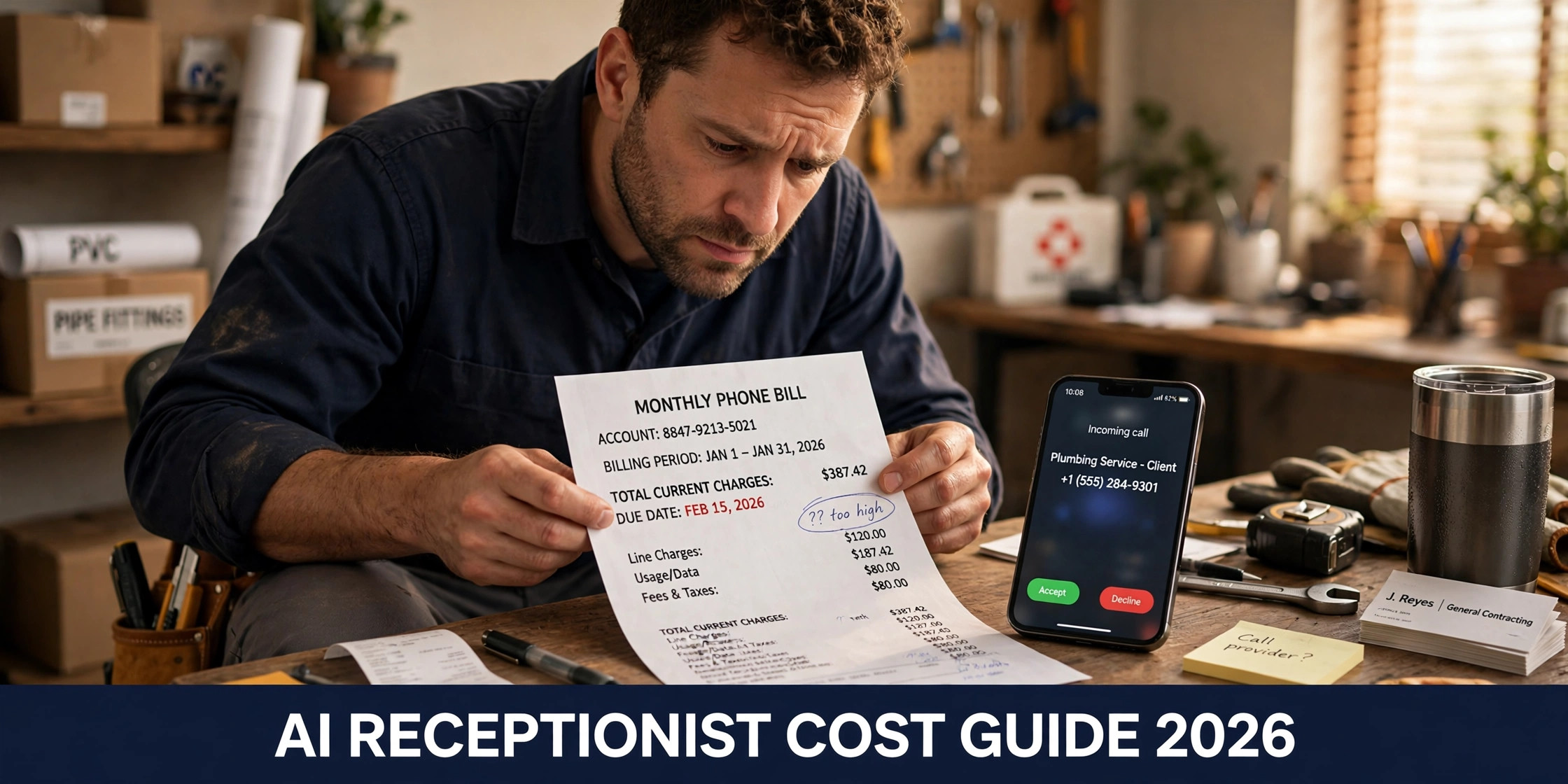
The quote said $79 a month. The first bill said $214.
That gap is the whole story of AI receptionist pricing in 2026. The headline number on a vendor's pricing page is a starting point, not a promise. What you actually pay depends on your call volume, your overages, your add-ons, and a handful of line items most vendors prefer you discover later. This guide closes that gap. Every price below comes from vendor pricing pages and independent cost guides checked in October 2026, and every worked example shows its math so you can rerun it with your own numbers.
Quick answer: In 2026, an AI receptionist for a small business costs $14 to $400 a month for most plans, with per-minute services starting near $0.07 a minute. A contractor taking 80 calls a month typically pays $80 to $250 all-in. The advertised price is rarely the real bill — overages, setup fees, and add-ons decide the true cost.
If you are still deciding whether an AI receptionist fits your business at all, read our AI phone receptionist for small business guide first — it covers what the technology does. This article is only about money: what it costs, where the traps are, and how the math compares to a human.
The Short Answer: What You Will Actually Pay
Most small businesses land in one of three bands. Entry plans from $14 to $50 a month cover light call volume — a few dozen calls, basic answering and message-taking. The middle band, $80 to $250 a month, is where most contractors, clinics, and home-service businesses end up: enough minutes for real volume plus calendar booking and CRM connections. Above $300 a month you are into high-volume or multi-location setups, or premium human-backed hybrid services.
Per-minute pricing tells the same story differently. Voice AI platforms charge roughly $0.07 to $0.25 per minute of talk time, plus a platform fee that is often small or zero. At 80 calls a month averaging three minutes each — 240 minutes — that is $17 to $60 in usage before the platform fee. The model suits businesses with spiky volume: quiet weeks cost almost nothing, busy weeks scale up on their own.
Human answering services sit well above all of this: entry plans start around $200 to $350 a month for limited call bundles, and real-world bills climb fast with overages. An in-house receptionist is a different universe — the U.S. Bureau of Labor Statistics puts median pay for receptionists at $38,010 a year as of May 2025 — wages alone, before the employer's extra costs on top. Keep those three anchors in mind. Everything below is detail.
The 2026 Price Table: What Vendors Really Charge
Prices checked October 2026 from vendor pricing pages and the independent cost guides ranking for this keyword. Treat every figure as a snapshot — vendors change prices, which is exactly why you should run the worked example in section five with today's numbers before you buy.
AI receptionist platforms, monthly plans:
- Voksha: from $14 a month entry, positioned as the budget start
- KaiCalls: $10 to $349 a month across tiers, per their published range
- Synthflow: $29 to $1,250 a month, wide range covering starter to scale
- Goodcall: $79 to $249 a month
- NextPhone: $199 a month flat-rate positioning
- Bland: $299 to $499 a month
- LegalClerk: around $400 a month, legal-niche positioning
Per-minute voice AI infrastructure (for the build-it-yourself crowd):
- Retell: usage from about $0.07 to $0.08 per minute on top of any platform fee
- Vapi-style DIY stacks: roughly $0.15 to $0.25 per minute all-in for voice, per independent testing
Human answering services, for comparison:
- Ruby, Smith.ai, AnswerConnect, Abby Connect, Davinci: entry plans in the low hundreds per month, with setup fees and per-call or per-minute overages on top. One independent guide documented a Phoenix HVAC company hit with an $874 overage on a human service — the kind of bill that converts owners to AI pricing research.
What the table hides: almost every vendor above sells the plan, not the bill. The next two sections are about the distance between them.
The Three Pricing Models, Translated
Vendors describe their pricing in three dialects. Learn to translate and the pricing pages stop being confusing.
Flat monthly. You pay one number for a bundle of minutes or calls. NextPhone's $199 positioning is the cleanest example: one price, stop thinking. This model wins when your volume is steady and predictable. It loses when you pay for 500 minutes and use 120 — or when the "unlimited" in the headline has a fair-use paragraph underneath it. Always ask what happens at 2x your normal volume.
Per minute. You pay for talk time, usually $0.07 to $0.25 per minute, sometimes with a small platform fee. This is the honest model for spiky businesses — a contractor who gets 40 calls one week and 5 the next pays for what actually happened. The trap is minute rounding: some platforms round every call up to the next full minute, so thirty 70-second calls bill as 60 minutes, not 35. Ask how they count.
Per call or per bundle. Human services love this one: 100 calls included, then a per-call overage. It looks predictable until a month of callbacks and wrong numbers burns the bundle by week two. For AI services this model is fading, but you will still see it on hybrid plans where a human backs up the AI.
The translation that matters: convert every plan to cost per month at YOUR volume before comparing. A $79 plan with $0.40 per-minute overages is cheaper than a $149 flat plan at 100 minutes a month and far more expensive at 400. Vendors show you the number that flatters them. Your volume is the only honest denominator.
The Hidden Fees Nobody Puts on the Pricing Page
Here is the line-item audit to run on any vendor shortlist. Not every vendor charges every fee — that is the point. The cheapest headline with five add-ons loses to the pricier headline with none.
Setup and onboarding fees. Some vendors charge a one-time setup fee from $100 to over $500; others onboard free. Human services are the worst offenders here. Ask for it in writing before the trial ends.
Phone numbers. A dedicated business number is often $2 to $10 a month. Toll-free numbers cost more. Porting your existing number is usually free, but some vendors charge for it — and switching vendors later can mean porting again.
Overage rates. This is where bills explode. Overage per-minute rates are routinely 2 to 4 times the in-plan rate. A plan that includes 200 minutes at an effective $0.20 becomes $0.50 to $0.80 per minute past the cap. Model your busiest month, not your average one.
SMS and texting. Appointment confirmations and follow-up texts are often billed separately — per-message charges that look tiny until you send 400 a month. Check whether two-way texting is included or metered.
Integrations. Calendar connection is usually included. CRM connections, custom webhooks, and multi-location support frequently sit on higher tiers. If your booking flow needs the CRM sync, price the tier that has it, not the tier in the headline.
Languages. Spanish or multi-language support is sometimes an add-on. If a third of your callers speak Spanish, this is not optional — price it in.
Annual lock-ins. Monthly billing might cost 15 to 25 percent more than the advertised annual price. That premium is worth paying for the first quarter — you are buying the right to leave. Never start annual with an unproven vendor.
Want this for your business?
ReplyPilot builds a custom ai automation setup for your business — answering customer questions instantly, taking orders and bookings, and handing off to you when a human is needed.
Ask on WhatsApp — it's freeSupport tiers. Priority support, dedicated onboarding, and custom voice training can be gated behind higher plans. For a contractor whose busiest season is three months away, the mid-tier support that fixes problems fast can be worth more than a cheaper plan with ticket-queue support.
Advertised Price vs the Real Bill: A Worked Example
Let us run honest math on a fictional but typical setup. Assumptions are stated so you can swap in your own: an electrical contractor, 80 calls a month, average call length 3 minutes, needs calendar booking and text confirmations, wants Spanish support.
Plan A: headline $79 a month, 200 minutes included, $0.50 per minute overage, SMS billed separately at $0.02 per message, Spanish add-on $29 a month.
240 minutes used minus 200 included leaves 40 overage minutes at $0.50: $20. Text confirmations: 80 calls times 2 messages at $0.02: $3.20. Spanish add-on: $29. Real bill: $79 plus $20 plus $3.20 plus $29 = $131.20. The $79 plan is a $131 plan for this contractor.
Plan B: flat $199 a month, minutes effectively unlimited within fair use, SMS included, Spanish included. Real bill: $199.
Plan A wins at this volume — but watch what happens in the busy season at 160 calls (480 minutes). Plan A: $79 base, 280 overage minutes at $0.50 = $140, plus $6.40 SMS, plus $29 Spanish = $254.40. Plan B is still $199. The flat plan wins the busy month by $55. This is why you model your peak, not your average: the pricing model that wins in February can lose in July.
Do this exact exercise with any two vendors on your shortlist. It takes ten minutes and it is the single highest-value step in this guide.
AI vs Human vs In-House: The Contractor's Math
Three options, one contractor, same 80 calls a month. All figures use the price bands from the table above.
The AI receptionist: $80 to $250 a month all-in for most contractors, per the worked example. Answers 24 hours a day, books into the calendar, texts confirmations, and does not take sick days.
The human answering service: $250 to $600 a month at this volume once overages and add-ons land. Humans handle nuance better — the angry customer, the complicated story — but coverage usually ends in the evening and every extra call has a price tag. Remember the $874 overage anecdote: human-service overages are where budgets go to die.
The in-house receptionist: $38,010 a year in median wages alone is $3,168 a month — and that is wages only, before the employer's extra costs on top. Coverage ends at 5pm. For a contractor doing $500,000 a year in revenue, that is a real hire with real value — but it is not a cost comparison, it is a different business decision.
The setup that pays off best pairs the two: let the software cover every hour, and let people handle the moments that need judgment. Give the software the night shift, the lunch rush, and the weekend — the predictable bulk. Keep your people for the calls where judgment matters: the furious customer, the unusual request, the big-ticket negotiation. Contractors who set it up this way stop losing the night-shift jobs, and their team stops flinching every time the phone rings.
One more consideration for contractors specifically: your calls are spiky by nature. Storm week, heatwave week, the Monday after a holiday weekend — volume can triple without warning. Per-minute AI pricing absorbs spikes gracefully. Flat plans need headroom. Human services punish spikes. Match the pricing model to your spike pattern, not just your average.
The Voice Plus WhatsApp Stack: What the Combo Costs
Here is the angle none of the ranking cost guides cover properly: calls are only part of the picture. Contractors get calls, but they also get WhatsApp messages, website chats, and Instagram DMs — and each channel has its own cost stack.
A voice AI receptionist handles the calls. A WhatsApp AI agent handles the messages: quotes, photo-based estimates, booking confirmations, review requests. WhatsApp automation typically runs on a platform fee plus Meta's per-conversation charges — modest for a small business, and our WhatsApp Business API setup guide walks through what onboarding actually involves.
Bought separately, the two systems can double your software bill and — worse — they do not talk to each other. The caller who hangs up and messages on WhatsApp gets treated as a stranger twice. The stack to price is the combined one: one system that answers the call, and when the caller prefers text, continues on WhatsApp with full context. Ask every vendor whether voice and messaging share one conversation history. If they do not, you are buying two receptionists who have never met.
For most contractors the combined stack lands in the same $150 to $350 a month band as a mid-tier voice plan alone — because the messaging side is cheap and the value is in the handoff, not the second subscription. Price the stack, not the channel.
What an AI Receptionist Does Not Do
Honesty first, because the vendors will not give you this section.
It does not handle genuine emergencies with human judgment. A gas smell, a sparking panel with someone hurt, a caller in panic — the AI should be trained to escalate instantly, not to troubleshoot. Write the escalation rules before launch: emergency keywords route to you immediately, no exceptions.
It does not know your regulars. A receptionist of five years recognizes a voice, remembers the dog's name, knows which customer always pays late but always pays. The AI starts every call as a stranger. For relationship-heavy businesses, that is a real loss — which is why the hybrid model (AI for coverage, humans for relationships) beats full replacement.
It still mishears things. Accents, background noise from a job site, a caller who rambles — modern speech recognition is far better than five years ago, but the first two weeks need tuning. The pattern is consistent: owners who audit the first fortnight of calls and correct the errors finish the month with a reliable system. Owners who never check the recordings are still apologizing for misbooked jobs in month three.
It does not negotiate, calm down a furious customer, or handle the truly weird request. Train it to recognize its limits and hand off fast. A quick, graceful handoff beats a confident wrong answer every time.
And it does not eliminate your phone bill's fine print. Everything in the hidden-fees section applies no matter how good the AI sounds on the demo call.
How to Buy One Without Regret
Five questions, asked of every vendor, in this order. Their answers are the real pricing page.
One: give me the total monthly figure at my busiest month's volume — base plan, overages, texts, number rental, every add-on. Make them do the worked example with your numbers. Vague answers are answers.
Two: can I start monthly, and what does it cost to leave? Month-to-month for the first quarter, always. The right vendor earns the annual commitment after three good months.
Three: can I listen to real call recordings from businesses like mine before I commit? Not the polished demo — real calls, with rambling callers and background noise. Voice quality varies enormously between providers.
Four: how does it count minutes, and what is the overage rate? Rounding rules and overage multipliers are where the real bill hides.
Five: what happens when it does not know the answer? You want a fast, graceful handoff to you — not a confident guess, not a loop of "I didn't understand that."
Then run the test that matters: a live trial with your real scenarios. Call from a noisy street. Ask the weird question your customers actually ask. Book, move, and cancel an appointment. Bring the sceptical person on your team into the test — the one who will live with the system daily spots what the buyer misses. And keep capturing the leads it generates properly: our lead capture automation guide covers turning after-hours interest into booked work.
Want this for your business?
ReplyPilot builds custom AI receptionist and messaging setups for contractors and small businesses — answering every call, booking the job, and handing off to you when a human is needed. Ask on WhatsApp — it is free: https://wa.me/
Frequently Asked Questions
How much does an AI receptionist cost per month for a small business?
Most small businesses pay $14 to $400 a month depending on call volume and features. Light users land under $50, typical contractors and clinics pay $80 to $250 all-in, and high-volume or multi-location setups go above $300. Per-minute plans run about $0.07 to $0.25 per minute plus any platform fee. Your peak-month volume, not the headline price, decides your real bill.
Is an AI receptionist cheaper than a human answering service?
Yes, in most cases, and the gap widens with volume. AI plans run $80 to $250 a month all-in for a typical contractor; human answering services run $250 to $600 at the same volume once overages land, with documented overage bills far higher. Humans still win on nuance — angry callers, complex situations — which is why many owners run AI for coverage and keep humans for judgment calls.
Do AI receptionists charge per minute or flat monthly?
Both models exist. Flat monthly plans give predictable bills and suit steady volume; per-minute plans (around $0.07 to $0.25 per minute) suit spiky volume like contractors' storm weeks. Watch minute-rounding rules and overage multipliers — a $79 plan with steep overages can out-bill a $199 flat plan in your busiest month.
What hidden fees should I watch for with AI receptionist pricing?
Setup fees, phone number charges, overage rates at 2 to 4 times the in-plan price, per-message SMS billing, paid integrations, language add-ons, and annual lock-in premiums. Ask every vendor for the all-in cost at your peak volume in writing before the trial ends.
Can an AI receptionist replace my front-desk hire?
It can replace the coverage, not the relationships. The AI covers every hour, books the appointments, and takes clean messages — the predictable bulk of the work. It does not recognize your regulars, calm a furious customer, or exercise judgment on the weird cases. Most contractors get the best return from AI handling after-hours and overflow while humans handle the moments that need a person.