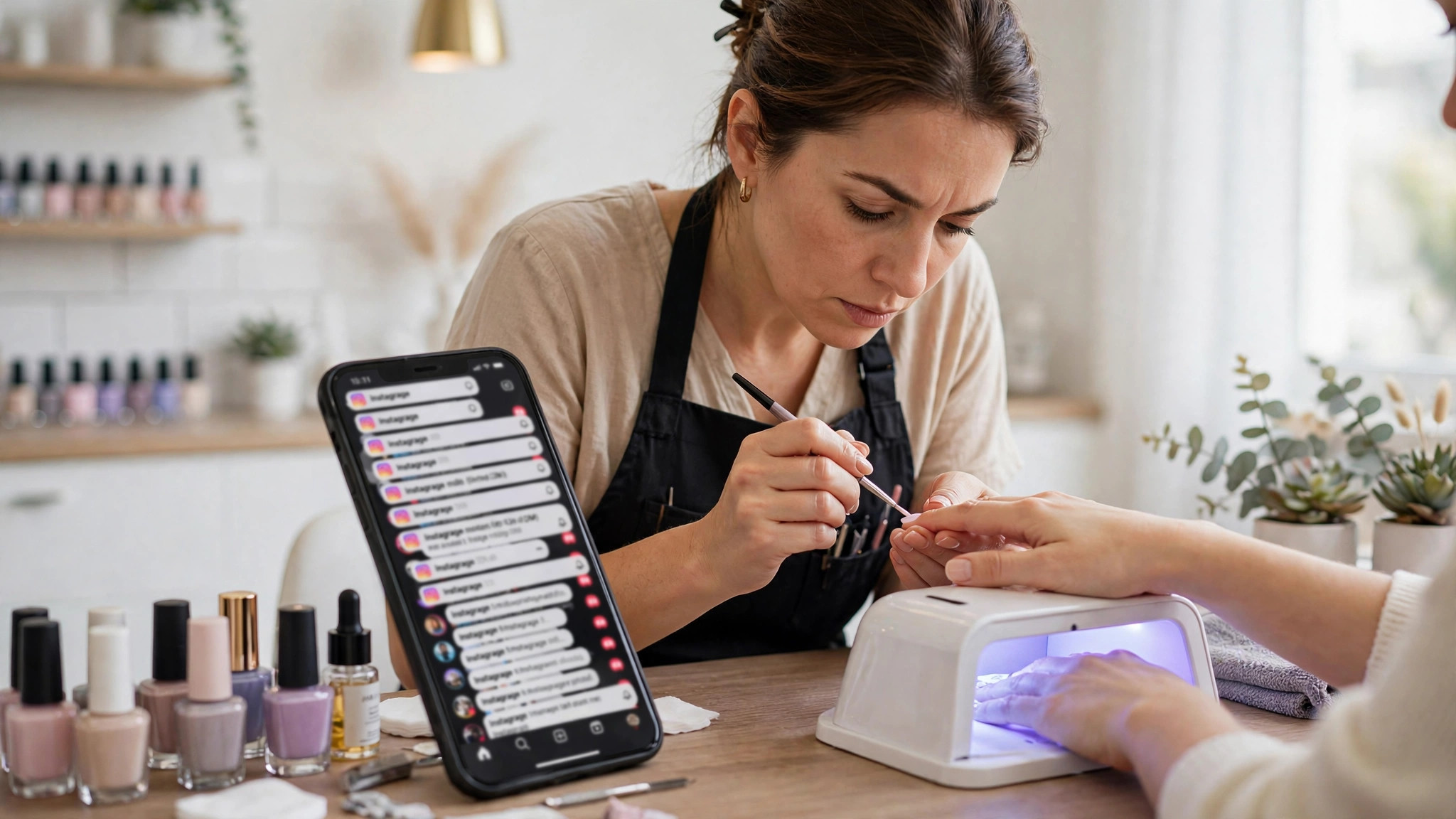
It is Saturday at 11am and every chair in your salon is taken. You are halfway through a full set with hand-painted art, the client's other hand is under the lamp, and your phone has buzzed eleven times in the last hour. "How much for acrylics?" "Do you have anything today?" "Can you do this design?" - with a blurry screenshot attached. "What colors do you have?" You cannot stop mid-nail to type. By the time the client leaves and you finally pick up the phone, three of those people have booked somewhere else, and one has written "??" and gone silent. This is the normal Saturday of a nail salon owner in 2026: your work is visual, so your clients live on Instagram, and your booking desk is a phone you cannot touch while you work.
Instagram DM automation for nail salons was built for exactly this shift. It answers the price questions, shows the design options, books the right length of appointment for the right service, and follows up when a client's nails are due for a fill - all while your hands stay exactly where they belong: on the client's nails. This guide covers what it handles, the booking logic that makes nail appointments trickier than they look, and how to set it up so it sounds like your salon, not a robot.
Why Nail Salons Get More DMs Than Almost Any Beauty Business
Nails are the most DM-driven service in beauty. Hair clients call. Lash clients book through apps. Nail clients send pictures. They screenshot a design from your reels, or from someone else's page entirely, and message it to you with "can you do this??" That message is a booking waiting to happen - but only if someone answers before the excitement fades. A nail design inquiry has a short shelf life. The client is picturing those nails on her hands right now. If she waits six hours for a reply, she has pictured them on someone else's booking page instead.
Then there is the rhythm of the trade. Nails are not a one-time purchase; they are a cycle. Gels need fills every two to three weeks, acrylics need maintenance, and every client who walks out today is a booking you need again in twenty days. Most salons lose a shocking number of these repeat visits simply because nobody reminds the client. She meant to rebook, life happened, and three weeks later she tries the salon near her office. The reminder is the cheapest booking your salon will ever make, and it is the one most salons forget to send.
Add the third pressure: appointment lengths that are not interchangeable. A simple gel polish change takes far less time than a full acrylic set with intricate art, and a soak-off plus new set is its own thing entirely. When clients book the wrong service online - or worse, when you squeeze a two-hour art set into a one-hour gap because nobody asked what she wanted - the whole day runs late. Instagram DM automation for nail salons earns its keep here: it asks what the client actually wants before the booking exists, and matches the service to the right length of time.
What Instagram DM Automation for Nail Salons Actually Handles
- Answers price questions instantly from your real menu - full sets, fills, gel polish, art add-ons, soak-offs - so nobody waits hours for a number.
- Receives design inspiration photos right in the chat and confirms whether your techs can do the look, before the client arrives expecting it.
- Books the right appointment length for the right service, because a fill and a full art set are not the same booking.
- Sends your booking link at the right moment in the conversation, after the service and design are clear.
- Confirms every appointment and sends reminders - the day before and the morning of - that quietly cut no-shows.
- Follows up two to three weeks after each visit with a fill reminder, timed to when that client's nails actually need attention.
- Refills cancellations automatically by messaging your waitlist, so a last-minute gap becomes someone else's appointment within the hour.
- Turns reel and post comments into private booking conversations - "comment NAILS" on a design video starts the DM flow while engagement climbs.
- Answers story replies about same-day availability, so the "anything open today?" messages get a real answer while you work.
- Handles bridal and group inquiries as one thread - party size, date, services per person - instead of five scattered DMs.
- Sends aftercare notes after each appointment: cuticle oil reminders, what to avoid in the first day, when to book the fill.
- Hands over to you with full context whenever it should - allergy concerns, damaged nails that need assessment, unhappy clients - so a human steps in at exactly the right moment.
The Booking Logic Most Guides Get Wrong
Here is the detail that separates a nail-salon setup from a generic booking bot, and it is the detail almost every general guide misses. A nail appointment is not one thing. A client who messages "I want an appointment Saturday" could need forty-five minutes or two and a half hours, and the difference matters enormously to your day. The automation's first job is to find out which one she is, with questions that feel like a friendly tech, not a form.
The conversation flows like this. The client asks about Saturday. The automation asks what she would like done - a fresh set, a fill, gel polish, or a soak-off and restart. If she says a full set, it asks about length and whether she wants nail art, and shows a few of your recent designs to pick from. If she sends her own inspiration photo, it confirms the style is something your team does and notes any art add-on. Only then does it offer times - real availability, matched to the right appointment length. The client books once, correctly, and your Saturday runs on time. Compare that to the old way: a name in a booking app, a surprise two-hour art request, and every appointment after it running twenty minutes late.
Design Galleries in the DM: Your Portfolio That Books
Your Instagram grid is already a catalogue; the automation turns it into a salesperson. When someone comments a keyword like "DESIGNS" on a nail-art reel, they get a DM with a small gallery of your recent work - French variations, chrome finishes, seasonal art, bridal sets - each with the service name and price beside it. Tapping a design starts the booking flow for exactly that service. This matters because nail clients often do not know the name of what they want. She knows she likes "the milky white ones with the thin gold line." Showing her the picture with the name and price attached removes the translation problem entirely.
The same gallery logic works for seasonal pushes. Before wedding season, before the holidays, before summer - the times when nail demand spikes - a broadcast to clients who opted in for updates shows the new seasonal designs with a booking link. These are not cold promotions. They go to people who already sat in your chair and asked to see what's new. It is the same idea behind lead capture automation: a warm conversation at the right moment beats a cold ad every time. Salon owners who run these seasonal design drops describe them as the easiest revenue of the quarter: familiar faces, fresh designs, full chairs.
Fill Reminders: The Quiet Money Nobody Talks About
Let us do the simple math of a nail salon. A client who comes every three weeks visits about seventeen times a year. A client who drifts - meaning to rebook, forgetting, trying somewhere convenient once - might visit eight times. The difference between those two clients is not your skill. It is a reminder. Repeat-visit trades all run on this logic - pet groomers, for instance, live and die by rebooking reminders too, as shown in AI chatbots for pet groomers. An automated message two and a half weeks after each appointment - "hey, your nails are probably due for some love, want me to hold your usual slot Thursday?" - with one-tap booking, turns drifting clients back into regulars without you lifting a finger.
The reminder also carries the aftercare that protects your work's reputation. A short message after each appointment - when to start cuticle oil, what to avoid in the first twenty-four hours, that picking at lifting gel makes everything worse - reduces the complaints that come from poor aftercare rather than poor application. Clients who follow aftercare come back with healthy nails, which makes your fills faster and your work look better for longer. It is a small message with an outsized effect on how your salon is perceived.
Cancellations, No-Shows and the Empty Chair Problem
A cancelled nail appointment is an hour of revenue gone - unless someone else takes it. The automation runs a simple waitlist: clients who wanted a slot you did not have get asked if they want first refusal when something opens. When a cancellation lands, the waitlist gets messaged in order, and the first to confirm takes it. On a busy Saturday, a 10am cancellation can be refilled by 10:15. Without the waitlist, that chair sits empty while you stare at a gap in the book.
No-shows get the prevention treatment instead. A confirmation message right after booking, a reminder the day before with the address and parking, a short morning-of nudge. Each message is also a quiet commitment device: the client who confirmed yesterday is far less likely to vanish today. And for the clients who do no-show repeatedly, the automation can flag the pattern to you - so you can decide, human to human, whether that client books with a deposit next time. The system handles the routine; you handle the judgment calls.
Bridal Parties and Group Bookings Without the Chaos
Bridal nail bookings are wonderful revenue and terrible admin. One bride, four bridesmaids, two mothers, everyone wanting something slightly different, the wedding six weeks out, and the whole thing negotiated across a dozen DMs. The automation corrals it into one structured conversation: how many people, what date, what service each person wants, and whether anyone needs art. It collects the details, confirms the total time block your salon needs to reserve, and sends one booking summary the bride can forward to the group. What used to be a week of scattered messages becomes a single tidy thread - and the bride, who is recommending vendors to every engaged friend she knows, remembers which salon made her life easy.
Setting Up Instagram DMs for Your Nail Salon, Step by Step
Want this for your nail salons?
ReplyPilot builds a custom instagram dm automation setup for your nail salons — answering customer questions instantly, taking orders and bookings, and handing off to you when a human is needed.
Ask on WhatsApp — it's free- Step one: write down your real service menu with prices and typical appointment lengths. Full set, fill, gel polish, art add-ons, soak-off, removal - each with its time. This becomes the automation's brain.
- Step two: gather your ten most-asked questions from your DMs. Price, availability, "can you do this design", parking, how long it lasts - write the answers exactly the way you would text them.
- Step three: build the service-finder flow. What do you want done? Fresh set or fill? What length? Any art? The automation must land on the right appointment length before showing times.
- Step four: connect your booking system. Whatever you use for scheduling, the automation hands the client there at the right moment - after the service is clear, not before.
- Step five: set up the design gallery keyword. Pick a word like "DESIGNS", attach it to your nail-art reels, and test the DM it sends. This one feature alone books appointments while you sleep.
- Step six: write the fill reminder and aftercare messages. Two to three weeks after each visit for the reminder; the evening of the appointment for aftercare. Keep both warm and short.
- Step seven: test as a client. Message your salon from a personal account, send a blurry design photo, ask a confusing question. Fix anything that sounds robotic before it goes live.
What Should a Nail Salon's First Auto-Reply Say?
One of the most searched questions in this space, and the answer is refreshingly simple. The first message should greet, reassure, and ask one easy question. For a nail salon, something like: "Hey gorgeous, thanks for messaging us! What are you thinking - a fresh set, a fill, or just some gel polish? Send me any inspo pics you have!" Notice what it does: it names the three things most clients want, it invites the photo they were going to send anyway, and it sounds like a friendly tech rather than a phone menu. Avoid the temptation to dump your whole price list in message one. The price lands naturally once you know what she wants - and by then, she is already in a conversation, not reading a menu.
Two Mistakes Nail Salons Make With DM Automation
The first mistake is skipping the service-length question. A bot that books every "appointment Saturday" into the same one-hour slot will wreck your Saturdays within a month - art sets running over, fills waiting, everyone unhappy. The appointment length is the load-bearing wall of a nail salon's schedule; the automation must get it right every time. Chair-based beauty businesses share this exact challenge - Instagram DM automation for salons covers how they solve it. The second mistake is sounding like a corporate helpdesk. Nail clients choose salons the way they choose friends - vibe matters enormously. If your automated replies read like a bank's, you have traded your salon's personality for speed, and that is a bad trade. Feed the system your actual messages, your emojis, your warmth. The goal is for a client to think "she's so quick at replying," not "she got a bot."
Is It Safe for Your Salon Account?
Yes - through the official channel. Instagram automation must run via Meta's official API: your account needs to be a professional account linked to a Facebook Page, and you connect any tool by logging in through Meta. No legitimate tool asks for your Instagram password, ever. That single rule filters out nearly every risky product in this space. For the broader picture of how salons use Instagram to drive bookings - profile setup, highlights, story strategy - DaySmart's Instagram marketing guide for hair and nail salons is a genuinely useful read. And if you want to understand the comment-to-DM mechanics and the rules around them, this plain-English explainer on comment-to-DM automation lays out what Meta allows and what cheap tools get wrong.
How Much Time Does This Actually Save?
Count it the honest way. Add up the minutes you spend each day answering "how much," "are you free Saturday," and "can you do this design" - then add the evenings spent confirming tomorrow's book and chasing the clients who forgot their fill. For most independent techs and small salons, that is one to two hours a day of pure admin, done in fragments between clients. The automation absorbs nearly all of it: the answers, the booking-length matching, the confirmations, the reminders, the waitlist. What is left for you is the part only a human should do - the nervous first-timer, the damaged nail that needs an honest assessment, the unhappy client who deserves a real apology. That is a good division of labour, and it is why the salons that adopt this early describe it less as a gadget and more as hiring the front-desk person they could never afford.
Seasonal Rushes: Holidays, Weddings and Prom Season
Nail demand does not arrive evenly. It arrives in waves: the December holiday rush, Valentine's week, wedding season, prom season, Eid and Diwali depending on your city. During those weeks your DMs do not just double - they explode, and they explode with the same question: "do you have anything before Friday?" This is where automation stops being convenient and becomes structural. The design gallery keyword handles the "what should I get" crowd. The waitlist absorbs the overflow. The booking-length matching keeps the packed days running on time instead of collapsing by noon.
Smart salons also use the quiet weeks before a rush to pre-fill it. Two weeks before the holidays, a message goes to clients who opted in for updates: the seasonal designs, the limited availability warning, one booking link. The clients who book early get their pick of times; the salon walks into the busiest fortnight of the year with a full book instead of a frantic inbox. Nobody involved thinks of this as marketing. It feels like a favourite salon looking after its regulars - because that is exactly what it is. The same approach works for quieter months too: a mid-January lull is the perfect moment for a "new year, new set" design drop to the same list, turning your slowest weeks into steady ones. Once the list exists and the messages write themselves, seasonality stops being something that happens to your salon and becomes something your salon plans for.
The nail salons winning on Instagram are not the ones posting the most. They are the ones that answer in seconds, book the right length of appointment the first time, and remind every client when her nails are due - without the owner ever stopping mid-set. A nail client's booking decision is made in the minutes after she sends the DM; the salon that replies while the excitement is fresh gets the chair filled. Instagram DM automation for nail salons simply makes sure that salon is yours, every time, even at 11pm on a Saturday. Want to see how this workflow could work for your salon? Request a free custom demo from ReplyPilot at https://replypilot-site.vercel.app/ - built around your service menu, your designs and your voice, and tested before it ever talks to a client.
How Do You Talk About Nail Art Prices in the DM?
Nail art pricing is the question clients are most afraid to ask and salons are worst at answering. A client falls in love with a hand-painted design on your page, messages “how much?”, and gets silence — or worse, a vague “it depends.” She books somewhere that lists prices clearly. Your automation should treat art pricing like a menu, not a secret. Teach it your real tiers: simple art like dots or a single accent nail, medium art like French with a twist or chrome, and full hand-painted sets — each with its price range from your actual menu. When a client sends a design photo, the bot matches it to the closest tier and quotes the range straight away. No awkwardness, no surprises at the till, and the client who knows the price before she books is the client who says yes to the art instead of skipping it.
The deposit question for art-heavy bookings
Long art sets are where deposits earn their keep. A two-hour hand-painted booking that no-shows costs you two clients, not one. Many salons take a small deposit for art sets and Saturday peak slots, and the bot is the perfect messenger for it — it explains the policy the same kind way every time, without the awkwardness of asking face to face. The script is simple: “To hold your Saturday art appointment, we take a small deposit that comes off your total on the day.” Clients rarely object when the reason is clear and the tone is warm. The ones who do object were the ones most likely to no-show.
What Should the Bot Say When a Client Sends Another Salon’s Photo?
It happens every week: a client screenshots a design from a salon across the country — sometimes across the world — and asks “can you do this?” The wrong answer is an eager yes to everything. The right answer is honest and specific, and your bot can give it if you teach it your real limits. For each common request type, tell it what your team does well, what needs extra time, and what you simply do not offer — certain 3D charms, hand-painted portraits, specific product lines you do not stock. The bot’s reply sounds like this: “We can absolutely do a version of this — the chrome base and the shape are our thing. The tiny hand-painted flowers would take our senior artist about an extra half hour; shall I book you with her?” Honesty here does two jobs. The client arrives with the right expectations, and your technicians never open a photo mid-appointment and think “nobody told me about this.” A salon that says “here is what we can do beautifully” keeps more clients than one that promises the moon and delivers a compromise.
When Your Technician Is Running Late
Even the best-run salon has days when a set takes longer than planned. The client in the waiting area checks her watch. Your automation tells her before she has to ask. When a technician flags they are running behind, the bot messages the next client straight away: “Hi! Your artist is running about 20 minutes behind — she wants your set to be perfect and not rushed. Would you like to keep your appointment and grab a coffee nearby, or shall I move you to 3:30 with no waiting?” Most clients choose to wait when they are told honestly and given a real choice. The ones who cannot wait get rebooked in seconds instead of storming out. This single message protects your reviews more than almost anything else, because people forgive delays — they do not forgive being ignored. Teach the bot your real policy for long delays too: at what point you offer the client a different technician, and what goodwill gesture your salon actually gives. The bot follows the rule; you never have to make the awkward call mid-set again.
Walk-Ins vs. Bookings: Teaching the Bot Your House Rules
Every salon has walk-in rules that live only in the owner’s head: walk-ins welcome on weekdays but never on Saturdays, or no walk-ins at all, or walk-ins only for polish changes. Clients do not know the rules, so they message “can I just come now?” at the worst possible moment. Teach the bot your exact policy and it answers instantly, every time: “We take walk-ins Tuesday to Thursday when there is a free chair — right now Saturday is fully booked, but I can get you in Tuesday at 2pm.” The bot can even check the day’s real gaps before answering, so a quiet Wednesday walk-in gets a genuine yes instead of a guess. Clear walk-in rules in the DM do something subtle but powerful: they train your clients to book ahead for peak times while keeping the door open when you actually have space. Fewer awkward turnaways at the counter, more chairs filled on slow days.
Beauty bookings happen in the DMs — Instagram DM automation for makeup artists never misses a bridal party enquiry.
Frequently Asked Questions
How does a nail salon booking chatbot get the appointment length right?
It asks which service the client wants — fill, full set, nail art — and matches it to the right time slot from your real service menu. A forty-five-minute fill stops being squeezed into a thirty-minute gap, and your days stop collapsing by noon.
Can Instagram DM automation remind clients when their nails are due?
Yes — this is the quiet money. Two to three weeks after a set, the client gets a friendly nudge to book her fill. Regulars stay regular without you chasing anyone, and empty chairs fill themselves.
What happens when someone cancels at the last minute?
The waitlist gets messaged instantly — clients who wanted that day or time get first refusal. Most salons refill the chair within the hour instead of losing the slot entirely.
Can the chatbot show my nail designs in the DM?
Yes. Clients type a keyword — french, chrome, bridal — and get your design gallery for that style, with prices. They arrive having already chosen, which shortens the appointment and raises the average bill.
Is Instagram DM automation safe for my salon's account?
Yes, through Meta's official API. A professional account, a connected Facebook Page, authorised via Meta login. Any tool that asks for your Instagram password should be avoided — that rule alone filters out the risky ones.