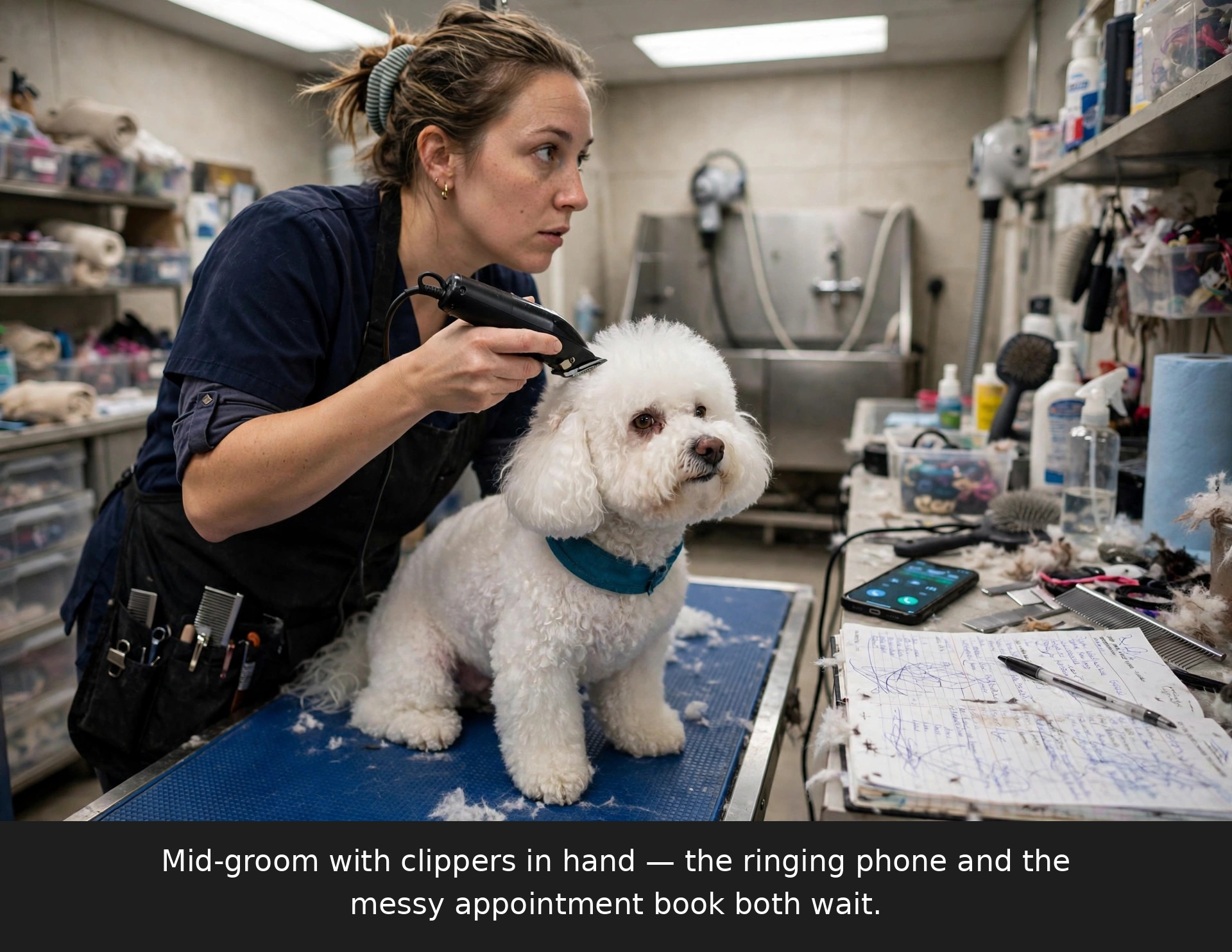
You have a nervous terrier on the table, clippers in your hand, and your phone is ringing on the counter. Again. It is a new customer asking about a full groom for their golden retriever. You cannot stop mid-cut to answer - and you cannot call back an hour later and expect them to still be waiting. They will have booked the groomer who picked up. An AI chatbot for pet grooming fixes this daily frustration. It answers every enquiry in seconds, books the appointment by breed, size and service, and fills your day - while your hands never leave the dog.
Quick answer: An AI chatbot for pet groomers answers calls and messages while the groomer is hands-on with a dog, books appointments by breed, service, and size, sends reminders, and collects vaccination details upfront. No booking is ever lost to a missed call during a two-hour groom.
The Missed-Call Problem Is the Business Problem
Grooming is hands-on work. A full groom takes one to two hours of undivided attention, and during those hours your phone is effectively dead. Meanwhile, new customers discover you on Google and Instagram - see how Instagram DM automation for salons handles the same discovery moment for beauty businesses - and they message when the thought strikes them: lunch breaks, evenings, weekends. Missed calls during grooming hours are the main way pet grooming businesses lose new customers. Pet grooming booking automation turns every one of those moments into a booked appointment instead of a lost lead. It matters more here than in most businesses: your best working hours are your worst answering hours.
What the Chatbot Needs to Book Properly
A grooming appointment needs three facts before you can quote time and price: the breed, the size, and the service type. A poodle's full groom and a Labrador's bath-and-brush are completely different jobs. The dog groomer appointment chatbot collects all three in a friendly chat, quotes your real prices for that combination, and offers your actual open slots. No more "how much for my dog?" messages that go nowhere because you do not know what dog. It also asks the question groomers wish every customer answered upfront: "When was the last groom?" - because a matted coat changes the price and the time. An AI chatbot for pet grooming never skips these questions, because they are built into its booking flow.
- Books by breed, size and service - full groom, bath and brush, nail trim, de-shedding - with your real prices.
- Checks your actual calendar and offers open slots, so double-bookings stop happening.
- Sends vaccination reminders - "Bella's rabies certificate expires next month" - which customers genuinely appreciate.
- Confirms the day before with a one-tap reschedule option, cutting no-shows dramatically.
- Refills cancellations from a waitlist automatically - an empty slot at 2pm becomes a booked slot by 2:15.
Vaccination Reminders Build Loyalty (and Protect You)
Most groomers require up-to-date vaccinations, and chasing certificates is awkward admin work nobody enjoys. The chatbot stores each pet's vaccination expiry date - with the owner's permission - and sends a friendly reminder before it lapses. Customers love this; it feels like you care about their dog, not just their money. It also protects your business: no more discovering an expired certificate when the dog is already on your table. Dental clinics run the same playbook for checkup recalls - see AI chatbots for dental clinics - because reminder-driven businesses all work the same way.
Fill Cancellations the Same Day
A cancelled 2pm slot is money evaporating. The moment a customer cancels, the chatbot messages your waitlist in order: "A full-groom slot just opened today at 2pm - want it?" The first to reply gets it. No frantic phone calls between grooms, no empty table. Over a month, recovered slots add up to real revenue - often the difference between a flat month and a growing one. This is the quiet power of automation: it does not just take bookings, it protects the bookings you already had.
Sound Like a Dog Person, Not Software
Pet owners are entrusting you with a family member. A chatbot that talks like a parking meter will not earn that trust. Train it on your real voice - the way you fuss over a nervous rescue dog, the honest advice you give ("for a doodle coat like Milo's, I'd book every six weeks, not eight"), your real policies on aggressive dogs and matted coats. When owners feel the chatbot understands dogs, they trust the business behind it. That trust is what turns a one-time bath into a customer who books every six weeks for years.
What Should the Chatbot Do About Matted Coats and Difficult Dogs?
Two bookings cause most grooming headaches: the matted coat nobody warned you about, and the dog that does not like strangers. Both are avoidable — if the right questions get asked before the appointment. This is where your chatbot earns its keep.
Teach it to ask two gentle questions during every booking. “When was Bella’s last groom?” tells you about matting risk without accusing anyone. “How is she with new people and other dogs?” tells you about temperament. Based on the answers, the chatbot adjusts: a matted coat gets your real de-matting surcharge stated upfront — no surprise at pickup — and extra time blocked in your calendar. A nervous or snappy dog gets your honest policy in kind words: “For everyone’s safety, we may not be able to finish the groom if a dog is very distressed — we’ll always call you first.”
- State extra charges before booking, not at pickup — surprises at the till destroy trust.
- Give the chatbot your real temperament policy, in your own kind words.
- Set a handoff: any mention of biting history goes straight to you for a personal call.
Owners appreciate this honesty. An owner warned about a de-matting charge books anyway — and arrives expecting it. An owner surprised by it at pickup leaves a bad review. The chatbot asks the awkward questions so you don’t have to, every single time.
The First Groom: Calming a Nervous New Owner
Picture a new customer: first puppy, first ever groom, and she is anxious. She messages at 9pm: “My puppy is five months old, is he too young? Will he be scared? What do I bring?” A slow reply — or a cold one — and she books elsewhere. Your chatbot answers in seconds, warmly, like the dog person you are.
“Five months is a perfect age to start! We do a gentle first visit — bath, dry, nails, and a little tidy, no pressure. Bring his vaccination record and his favourite treat. You’ll pick him up in about an hour, and we’ll text you when he’s ready.” Just like that, her worry turns into trust. She books the slot, and she arrives calm — which means the puppy arrives calm too.
This is the chatbot at its best: not just booking, but reassuring. First-time owners become regulars when their first experience feels safe. And every one of those 9pm questions is a booking your competitors missed while their phones sat silent.
How to Teach the Chatbot Your Real Rules
A grooming chatbot is only as good as the rules you give it. The setup takes an afternoon, and it comes down to writing down what you already know.
- Your services and prices by size — small, medium, large, giant — for every service you offer: full groom, bath and brush, de-shedding, nail trim.
- Your policies, in plain words — vaccination requirements, late pickup rules, no-show policy, de-matting surcharge, and how you handle aggressive dogs.
- Your calendar and reminders — real open slots, day-before confirmations, and your waitlist rules for refilling cancellations.
- Your voice — three or four of your actual replies to customers, so it learns how you really talk.
Then test it before it goes live. Message it as a difficult customer: a matted doodle, a puppy with no vaccination record, someone asking for a Sunday slot you do not offer. Fix every wrong answer. A chatbot trained on your real rules, in your real voice, feels like texting you — which is exactly the point. Veterinary clinics train their assistants on health rules the same careful way — see AI chatbots for veterinary clinics — because “your rules, your voice” works in every animal business.
What Your Pet-Grooming Chatbot Must Never Do
Pet owners ask emotional questions, and a chatbot must know where its job ends. These limits are not optional — write them into its instructions on day one.
- Never give health advice. “Is this lump normal?” “Why is my dog limping?” The only correct answer is: “I’m not qualified to say — please check with your vet.” Medical guesses can harm a dog and put your business at risk.
- Never promise an owner an exact groom. “Make him look exactly like this photo” gets: “We’ll do our very best — every coat is a little different, so I’ll have the groomer take a close look.”
- Never override your temperament policy. If your rule is no aggressive dogs, the chatbot does not make exceptions to be nice.
- Never diagnose skin or coat problems. Red skin, bald patches, constant scratching — those are vet questions, not grooming questions.
When it hits a limit, it hands over: “Let me have the groomer call you about this one.” Owners respect a business that knows what it does not know. A chatbot that plays vet for a day can undo years of trust in a single message.
Four Mistakes Groomers Make With Chatbots
Want this for your pet groomers?
ReplyPilot builds a custom ai chatbot setup for your pet groomers — answering customer questions instantly, taking orders and bookings, and handing off to you when a human is needed.
Ask on WhatsApp — it's freeThe technology is rarely the problem. The setup is. Here are the four mistakes that trip up grooming businesses most often.
- Quoting without the breed. A chatbot that gives prices before asking “what breed?” creates the worst moment in grooming: the price changing at pickup. Breed first, price second — always.
- No handoff for the hard questions. Bite history, severe matting, a dog with a medical condition — these need your judgment, not a script. If the chatbot cannot smoothly pass the chat to you, it will give a bad answer instead.
- Forgetting to update it. You raised your prices in January but the chatbot still quotes last year’s rates. Every price change, new service, or policy update goes into the chatbot the same day — put it on your checklist.
- Ignoring the chat logs. The logs show you what owners really ask: “do you do cats?” “can I stay and watch?” Those questions are telling you what your website and your script are missing.
None of these need technical skill to fix. They need ten minutes of attention when something changes, and a quick read of the logs now and then. Treat the chatbot like a junior team member: brief it well, keep it updated, and check its work.
How Do You Know It’s Paying Off?
Forget fancy dashboards. Four numbers tell you whether the chatbot is earning its place.
- No-show rate — the day-before confirmations with one-tap reschedule should be cutting this down.
- Recovered slots — how many cancelled appointments got refilled from the waitlist this month?
- After-hours bookings — appointments made while you were asleep or mid-groom. Every one of these is a customer you would have lost.
- Rebooking rate — are one-time customers coming back every six to eight weeks? Reminder messages should be lifting this.
Compare each number against the months before the chatbot. You do not need perfect records — your appointment book and a quick scroll through the chats are enough. If the trend is up across two or three of these, the chatbot is paying for itself. Most groomers see it in the first month: a fuller book, fewer empty slots, and a phone that stays quiet while the clippers are running.
What If a Customer Says the Cut Looks Wrong?
Grooming is personal and subjective. One owner’s “too short” is another owner’s “perfect.” Complaints will come, usually by message, usually with a photo. The first reply sets the tone for everything after.
The chatbot’s script is short and warm: “I’m so sorry you’re not happy with it — let me sort this out for you right away.” Then it offers your real fix policy: a free touch-up visit within a few days, or a call from you to talk it through. It never argues about the cut, never says “that’s what you asked for,” and never offers refunds on its own — money decisions are yours.
Then it books the fix-up slot or passes the chat to you with the photo. Here is the part owners forget: a handled complaint creates a more loyal customer than a perfect groom. Anyone can be happy when things go well. The customer you rescue — quickly, kindly, without a fight — tells their friends about you. The chatbot just makes sure the rescue starts in seconds, not hours.
How the Chatbot Brings Quiet Weeks Back to Life
Every groomer knows the quiet weeks. The diary has gaps, the phone is silent, and you wonder where all your regulars went. Most of them did not leave — they just forgot. Life gets busy, the dog’s coat grows slowly, and six weeks becomes twelve before they notice.
This is where the chatbot quietly earns its keep. It knows which customers have not booked in a while, and it sends a gentle nudge: “Hi Sarah! It’s been a while since Milo’s last groom — would you like me to find him a slot this week?” Warm, personal, no pressure. A good share of lapsed customers book on the spot, because the only thing stopping them was inertia.
- Set the nudge timing yourself — eight or ten weeks after the last appointment works for most coats.
- Keep it to one message — a single friendly reminder, never a chase.
- Skip anyone who asked not to be contacted — respect keeps the list welcome.
The beauty of this is that it costs you nothing and fills the exact gaps that hurt most. A quiet Tuesday with three rebooked regulars is a very different day from a quiet Tuesday with an empty table. The chatbot does not just protect the bookings you have — it goes and finds the ones you lost.
Want this booking grooming appointments for you?
You became a groomer because you love dogs, not because you love answering phones. An AI chatbot for pet grooming handles the booking, the reminders and the refills - so your calendar stays full and your hands stay on the dogs. If you want to see this working with your own services, prices and calendar, ReplyPilot will build you a free custom demo: request it at https://replypilot-site.vercel.app/ and watch your next appointment book itself while you are mid-groom.
How Does the Chatbot Book Three Dogs at Once?
“I need grooms for all three of my dogs” is a great message to receive — and a complicated one to handle by hand. Three breeds, three sizes, three temperaments, and a calendar that needs back-to-back slots with the right gaps. Done manually, it is ten minutes of typing. The chatbot does it as a natural conversation.
It collects each dog one at a time — name, breed, size, service — and keeps a tidy list as it goes: “Got it — Max the Labrador, full groom. Now tell me about the second one.” Then it finds consecutive slots that fit the total time, quotes the combined price from your real price list, and confirms everything in one summary before booking. The owner checks one message instead of twelve.
Multi-pet households are also your best customers — three dogs groomed every six weeks is serious revenue. Treat them like it. The chatbot can remember the whole pack after the first visit, so next time it is just: “The usual for all three on Saturday?” One reply, three bookings, a very happy owner.
Selling the Extras Without Feeling Pushy
De-shedding treatments, teeth brushing, nail trims, specialty shampoos — the extras are good money and genuinely good for the dogs. But most groomers never offer them, because mentioning them face-to-face feels like upselling. The chatbot has no such awkwardness. It just asks helpful questions.
The trick is timing and framing. During booking, after the main service is chosen: “Max is a Husky — would you like the de-shedding treatment too? It really helps with the spring coat blowout.” That is not a sales pitch. That is a groomer who knows Huskies talking to an owner who hates the tumbleweeds of fur. Framed as care, the extra sells itself.
Keep it to one relevant extra per booking, matched to the breed and season. Huskies in spring get de-shedding. Long-haired breeds get the sanitary trim. The chatbot knows your calendar, your breeds, and your services — so its suggestion always feels personal, never like a menu of add-ons read from a script.
The “How Long Will It Take?” Question
After price, this is the question every groomer hears most: “When can I pick him up?” Owners plan their day around it, and a vague “a few hours” is not an answer. The chatbot gives a real estimate from your real timing rules — a small dog’s bath and tidy is quicker than a large doodle’s full groom — and it states it as a window, not a promise.
“Bella’s full groom usually takes about two to three hours. We’ll text you the moment she’s ready — no need to wait around.” That last sentence is the magic. Owners do not actually need an exact time; they need permission to go live their life. The text-when-ready message removes the hovering, the early arrivals, and the “is he done yet?” calls.
And when the day runs long — the matted doodle took an extra hour — the chatbot tells waiting owners before they ask. “We’re running about thirty minutes behind today — Bella will be ready around 4:30.” Bad news delivered early is just information. Bad news discovered at the counter is a complaint.
“Can I Stay and Watch My Dog?”
Every groomer gets this one, and it is always a little awkward. The owner means well — they are anxious, or curious, or their last groomer hurt their dog. But a nervous owner hovering over the table makes every dog worse. Your chatbot can say no kindly, so you do not have to.
The answer is warm and firm, written in your words: “We totally understand wanting to stay! But dogs actually behave much better without their owners watching — they relax and we can work faster and safer. You’re welcome to wait in our seating area, and we’ll text you the moment they’re ready.” Empathy first, policy second, alternative offered.
This pattern works for every awkward policy question: the “can you groom my aggressive dog?” (your honest safety policy, kindly stated), the “can I bring my own shampoo?” (yes, with a note about what works), the “do you groom cats?” (only if you do). Write each answer once, warmly and firmly. The chatbot delivers it the same way every time — no awkwardness, no exceptions made under pressure, no policy bent because someone asked nicely at the counter.
Pet businesses get flooded with DM questions — Instagram DM automation for dog trainers answers training, pricing and availability questions instantly.
Frequently Asked Questions
Can an AI chatbot book grooming appointments by breed and service?
Yes. It asks for the dog's breed, size, and the service wanted — full groom, bath, nail trim — then offers your real open slots. Breed matters for pricing, so it quotes correctly from your price list.
How much does a chatbot cost for a small pet grooming salon?
Usually a modest monthly fee based on booking volume. A single no-show appointment costs you more than a month of the chatbot. Many groomers find it pays for itself within the first week.
Can the chatbot send vaccination reminders to pet owners?
Yes. You set the reminder schedule, and it messages owners when vaccinations are due before their appointment. This keeps your salon compliant and clients' pets safe. Owners love not having to remember.
Will the chatbot handle appointment cancellations for my grooming business?
Yes. When someone cancels, it immediately offers the freed slot to your waitlist. Empty slots are the biggest profit leak for groomers, and this fills them automatically. You set how the waitlist works.
Can pet owners book grooming appointments at night through the chatbot?
Absolutely. Most pet owners think about grooming after work or late evening. The chatbot books them into your real calendar while you sleep. You wake up to a full book instead of missed calls.