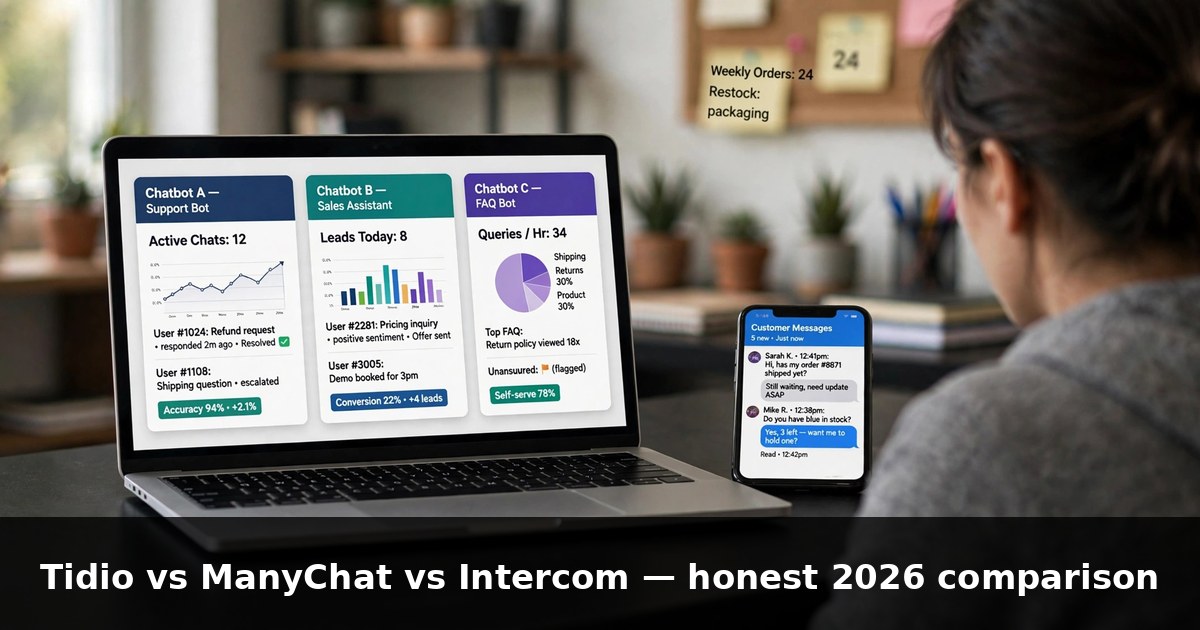
Three platforms, three philosophies — pick the wrong one and you pay for a year.
You have decided your business needs an AI chatbot. Then you search for one, and three names eat the entire first page: Tidio, ManyChat, Intercom. Each claims to be the answer. Each shows you a different price, a different feature list, and a different idea of what a "chatbot" even is.
Here is the thing most comparison articles will not tell you: these three are barely the same product. Tidio is a website-chat platform with AI bolted on. ManyChat is a social-messaging automation platform. Intercom is a full customer-service suite with a genuinely powerful AI agent. Comparing them on a feature checklist is like comparing a pickup truck, a motorbike and a bus by counting wheels.
This guide compares them the way a small business owner actually needs: what each one is for, what it really costs, how hard it is to set up, and — most importantly — which business should pick which. No affiliate fluff, no sponsored winner. Prices below were publicly listed around mid-2026; platforms change pricing often, so treat them as orientation, not gospel, and verify before you pay.
Tidio suits small businesses wanting AI chat on their website with fast setup and accessible pricing. ManyChat suits businesses whose customers live on Instagram, Facebook or WhatsApp. Intercom suits larger teams where support volume is high and per-resolution AI quality justifies per-seat pricing. Pricing changes often — verify on official sites before deciding.
The 60-Second Verdict
In a hurry? Here is the honest short version:
- Pick Tidio if your customers come through your website, you want to be live this week, and you want the lowest-friction path to AI chat. Best for: online stores, local services with a website, small teams.
- Pick ManyChat if your customers live on Instagram DMs, Facebook Messenger or WhatsApp. Best for: creators, social sellers, businesses that get DMs, not website visits.
- Pick Intercom if you run a larger operation where support quality directly affects retention and you can justify per-seat pricing. Best for: SaaS, growth-stage companies, high-volume support teams.
- Core idea: Tidio is website live chat plus its Lyro AI agent; ManyChat is social-messaging automation for Instagram, Facebook and WhatsApp; Intercom is a full customer-service platform plus its Fin AI agent.
- Starting price: Tidio has a free tier with paid plans from ~$24/mo; ManyChat is free up to 25 contacts with paid plans from ~$17/mo; Intercom offers a 14-day trial, then ~$29/seat/mo plus ~$0.99 per AI resolution.
- AI model: Tidio's Lyro trains on your docs; ManyChat pairs an AI add-on with its flow builder; Intercom's Fin is built on Claude and OpenAI models.
- Channels: Tidio covers website, email, Messenger, Instagram and WhatsApp; ManyChat covers Instagram, Messenger, TikTok, Telegram, WhatsApp, SMS and email; Intercom covers website, in-app, email, phone, WhatsApp and SMS.
- Setup effort: Tidio is low — live in a day. ManyChat is low-medium — flows take a few hours. Intercom is medium-high — knowledge base plus routing setup.
- Best for: Tidio suits SMB website chat and ecommerce; ManyChat suits social-first businesses and creators; Intercom suits support-heavy teams and SaaS.
Pricing orientation only — verify current pricing on tidio.com, manychat.com, and intercom.com before deciding. For the wider field beyond these three, see our 7 best AI chatbots for small business roundup.
Tidio: The Website-Chat Workhorse
Tidio started as live chat and grew into AI. Its Lyro AI agent answers from your help docs and website content, and the whole thing is designed so a non-technical owner can be live quickly — most small businesses get a working setup within a day.
Picture an emergency plumber. Most of his enquiries arrive between 9pm and midnight through the contact page on his website — burst pipes do not respect office hours. With Tidio, he installs one snippet of code on his site, points Lyro at his services page and price list, and by tomorrow the bot is answering "do you cover my area?" and "how fast can you get here?" at 11:40pm. The urgent jobs get passed to his phone; the tyre-kickers get polite answers and a quote form. Nothing about this setup needs a developer.
What setup actually looks like: sign up, add the chat widget to your website (most builders take about 20 minutes), connect your FAQ or help pages so Lyro has something to read, write answers to your ten most common questions, and set the handoff rules — for example, "if the customer mentions 'emergency', notify my phone immediately." Test it by pretending to be a difficult customer. Most owners finish this in an afternoon.
Strengths: genuinely fast setup, accessible pricing, strong ecommerce integrations (Shopify, Wix), and a free tier that lets you test before paying. For a small business whose customers arrive via Google and land on a website, Tidio is the path of least resistance.
Weaknesses: it is website-first. If your customers message you on Instagram and never visit your site, Tidio's best features sit idle. The AI is capable but narrower than Intercom's Fin — fine for FAQs and lead capture, less suited to complex multi-step support. And here is the cost trap to watch: pricing scales with conversations. A quiet business stays on cheap tiers; a busy store with thousands of chats a month can climb tiers faster than expected.
Who should skip it: if more than half your customer conversations happen in Instagram DMs or WhatsApp, you are buying a website tool for a social problem.
ManyChat: The Social DM Machine
ManyChat owns the social-messaging lane. If your business runs on Instagram DMs — creators, beauty businesses, local shops with strong social followings — ManyChat's visual flow builder turns comments into conversations and conversations into bookings.
Picture a boutique owner who posts a new dress on Instagram every morning. Every post gets forty comments asking "price?" and "do you deliver?" With ManyChat, anyone who comments "PRICE" gets an instant DM with the price, sizes in stock, and a link to order. The flow took her one evening to build.
What setup actually looks like: connect your Instagram, build your first flow in the visual builder — trigger (comment keyword) → DM (product details) → button (order link). Then add your FAQ auto-replies for the repetitive questions.
Strengths: best-in-class Instagram and Messenger automation, an approachable flow builder, a generous free tier for starting out, and now TikTok and WhatsApp coverage too.
Weaknesses: it is marketing automation first, support second. Complex customer-service workflows are not its strength. The AI features are an add-on, not the core.
One caution: automation rules on Instagram change periodically. Stick to providers with proper Meta Business Partner status and keep your flows human-friendly.
Intercom: The Heavyweight
Intercom's Fin is arguably the most capable AI support agent on this list — it resolves genuinely complex queries, works from your help centre, and the platform around it is built for teams, not solo owners.
Want this for your business?
ReplyPilot builds a custom ai automation setup for your business — answering customer questions instantly, taking orders and bookings, and handing off to you when a human is needed.
Ask on WhatsApp — it's freePicture a small software company with 3,000 customers. Their two-person support team was drowning in tickets. With Intercom, Fin answers from their help centre and resolves the routine 70% instantly. The humans handle the genuinely tricky cases.
What setup actually looks like: this is a project, not an afternoon. Connect your help centre, design your conversation routing, configure the inbox for your team, and test Fin against your hardest real tickets. Budget a week or two.
Strengths: best-in-class AI resolution quality, deep integrations, serious analytics, and a platform that scales from startup to enterprise without migrating.
Weaknesses: price and complexity. Per-seat pricing plus per-resolution AI fees add up fast for a small team.
The honest exception: if you are a 5-person team today but plan to be 30 people handling thousands of conversations in 18 months, starting on Intercom can make sense. Just be honest about whether that growth is a plan or a fantasy.
Which Should YOU Choose? (By Business Type)
Forget "best overall." Match the platform to where your customers already talk to you:
- Local service business with a website → Tidio. Fast, cheap, website-first.
- Business that lives on Instagram → ManyChat. DMs are your storefront.
- Online store → Tidio for website chat; add ManyChat if Instagram drives real sales.
- SaaS or high-volume support → Intercom. Quality at scale justifies the price.
- WhatsApp-first business → ManyChat, or a WhatsApp-native tool.
- Phone-heavy business → none of the three is the primary answer; look at voice AI first.
- Business spread across website + Instagram + WhatsApp → start with the platform matching your dominant channel.
What about WhatsApp-native tools? If WhatsApp is your primary channel, the big three are not the whole story. WhatsApp-native platforms are built around the WhatsApp Business API from the ground up.
One honest aside: platforms sell you tools, but someone still has to configure the AI, write the flows, connect the channels, and keep everything updated. If you would rather skip the DIY entirely, that is exactly the gap ReplyPilot fills.
You do not have to marry one platform on day one. Start with a free tier on the platform matching your main channel, run it for a month on real conversations, then decide.
The Real Cost at 3 Volume Levels
Headline prices lie by omission. Here is what each platform roughly costs at three realistic volumes.
Quiet business (~200 conversations/month): Tidio's entry tier covers this comfortably. ManyChat's free tier will feel tight fast. Intercom is overkill here.
Growing business (~2,000 conversations/month): this is where the pricing models diverge. Tidio's per-conversation meters start to bite. ManyChat stays predictable if your contact list is small. Intercom's per-resolution fees start adding up seriously.
High volume (10,000+ conversations/month): at this scale, Intercom's quality advantage can pay for itself. You are also no longer really a "small business" buyer — negotiate annual pricing everywhere.
The hidden costs nobody puts on the pricing page: your time, WhatsApp's own per-conversation charges from Meta, and seat creep on Intercom as your team grows.
5 Mistakes Buyers Make (All Three Platforms)
- Buying on feature count instead of channel fit — start from where your customers already message you.
- Ignoring per-conversation pricing — model your real volume for 12 months out.
- Skipping the free trial with REAL questions — feed the bot your ten hardest customer questions.
- No handoff plan — every platform needs a "talk to a human" escape hatch.
- Forgetting lock-in and data ownership — ask: can you export every conversation if you cancel?
How to Test-Drive All Three in 7 Days
Do not buy on reviews — not even this one. Run this 7-day test instead:
Day 1–2: Tidio. Install the widget, feed it your FAQ, message it as a customer with your five hardest questions. Score: how many did it answer correctly?
Day 3–4: ManyChat. Connect your Instagram. Build one flow: comment keyword → DM → booking link. Test it with a friend's account.
Day 5–6: Intercom trial. Connect your help centre, configure Fin, set up routing. Test the same five hard questions. Score resolution quality head-to-head.
Day 7: Decide on evidence. Which one answered best? Which felt maintainable? Which pricing scared you least at three times your current volume?
When to revisit your choice: revisit when your monthly conversations triple, when you add a channel, when support quality complaints rise, or when the bill crosses a pain threshold.
So the real question was never "which chatbot is best?" It is: where do your customers already talk to you — and which platform meets them there?
FAQs
Is there a free AI chatbot for small business?
Yes — all three offer free tiers or trials. Free tiers are genuinely useful for testing, but expect conversation or contact limits.
Which is cheaper: Tidio or ManyChat?
Entry pricing is similar, but they charge for different things — Tidio scales with conversations, ManyChat with contacts. Model your own numbers; headline prices mislead.
Can Intercom work for a very small business?
Technically yes, practically rarely. Per-seat pricing plus per-resolution AI fees make it expensive under about 10 people.
Do I need a developer to set up any of these?
Tidio and ManyChat: no — a non-technical owner can do it in an afternoon. Intercom: you can start without one, but getting real value usually needs someone comfortable with knowledge bases.
What about WhatsApp — which platform handles it best?
ManyChat has the broadest social-messaging coverage including WhatsApp. Tidio supports WhatsApp too but is website-first. Intercom supports WhatsApp within its suite.