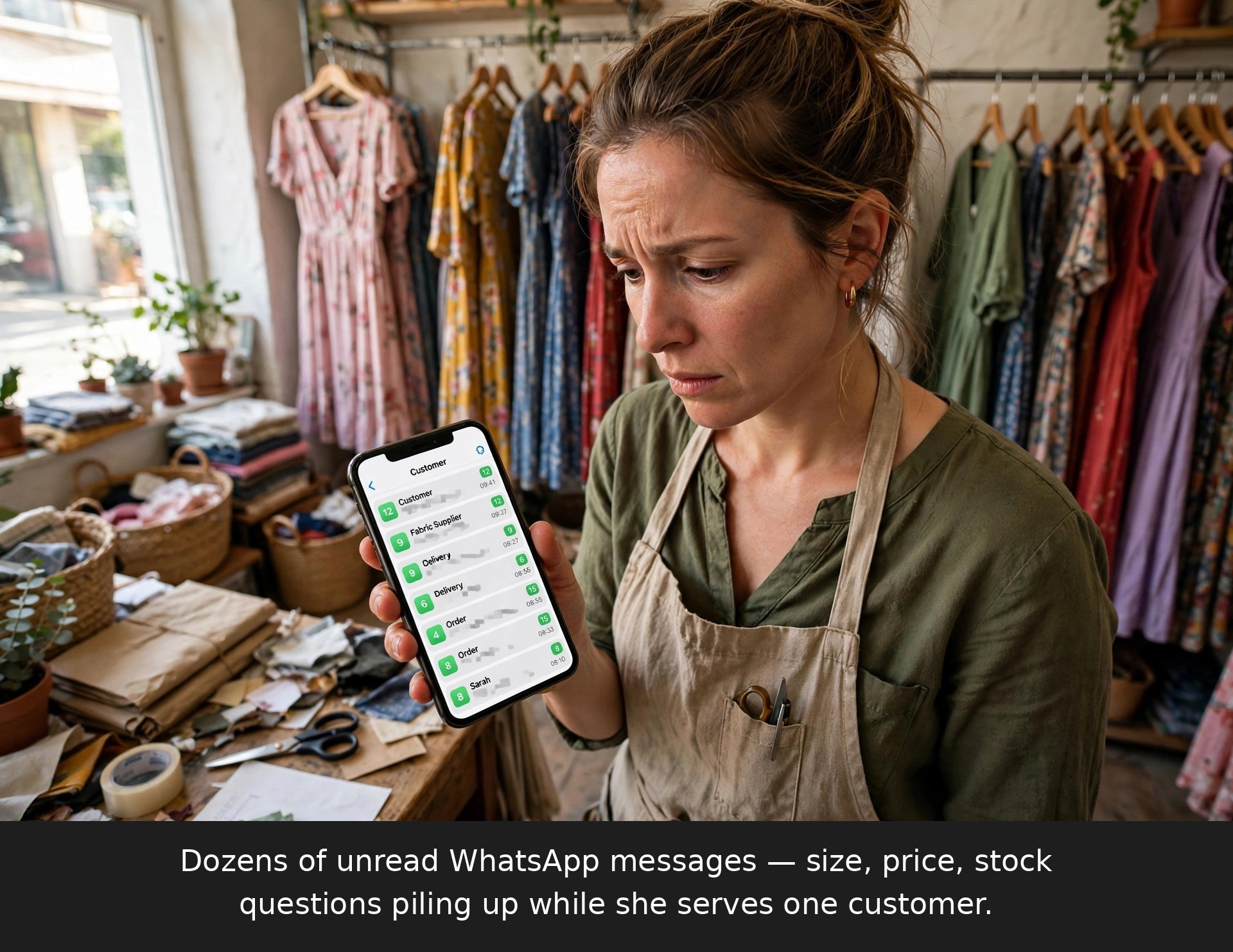
It is a busy Saturday afternoon at your boutique. A customer is holding up a kurta, asking whether you have it in medium. Your phone is buzzing on the counter - fourteen unread WhatsApp messages: "Price of the blue dress?" "Do you have size 40?" "Is the black abaya in stock?" "Home delivery available?" You cannot leave the customer in front of you, so the messages wait. By the time you reply that evening, half of those shoppers have bought from the boutique down the road. WhatsApp automation for clothing boutiques exists for exactly this moment. It answers the messages while you serve the people in your shop - instantly, in your own tone, every time.
Quick answer: WhatsApp automation answers a boutique's size, price, and stock questions instantly, sends new-drop broadcasts to opted-in shoppers, follows up on abandoned carts, and shares delivery and exchange details — all in the shop's own tone, around the clock. The owner keeps serving in-store customers while no WhatsApp message waits.
Watch it working for a boutique:
Why Size, Price and Stock Questions Eat Your Whole Day
Strip a boutique owner's WhatsApp down to its bones and it is the same ten questions, repeated every day. What size is this? How much? Is it in stock? Do you deliver to my city? What is your exchange policy? These questions are simple, but each one interrupts real work. Worse, most of them arrive after hours, when nobody is there to answer. A shopper who asks "size 38 available?" at 11pm and gets silence until noon the next day has already kept scrolling. That is the gap a boutique WhatsApp chatbot closes. WhatsApp automation for clothing boutiques works so well for one reason: the questions are repetitive, the answers are factual, and the timing is everything.
What WhatsApp Automation for Clothing Boutiques Actually Does
- Answers size, price and stock questions instantly - trained on your catalogue, so it knows which sizes exist for which piece.
- Sends new-drop announcements to customers who asked to hear from you - one message, hundreds of shoppers, in seconds.
- Follows up on abandoned carts - "Still thinking about the blue kurta? Size M just came back in stock."
- Shares delivery and exchange details - charges, time, cities served - so you never type the same paragraph again.
- Hands over tricky conversations to you with full context - haggling, custom stitching, bridal orders go straight to a human.
New Drops and Broadcasts Without Spamming People
Clothing store WhatsApp marketing lives or dies on one rule: only message people who asked for updates. The automation keeps a list of customers who said yes - after a purchase, after asking about a new collection - and your broadcast goes only to them. Send a photo of the new drop with prices, and the chatbot handles the flood of replies. WhatsApp's official Business Platform documentation lays out the messaging rules every setup must follow, including consent for marketing messages. Done properly, a single broadcast can sell out a new arrival before lunch - the same trick restaurants use for table bookings, just applied to racks of clothes, as explained in ecommerce store assistants.
Recovering the 'I'll Think About It' Shoppers
Some of your best customers almost bought. They asked about the dress, picked a size, then went quiet. An automated follow-up the next day - polite, personal, and timed - brings a surprising number of them back. The chatbot can even flag scarcity honestly: "Just so you know, size S in the black abaya is the last piece." No pressure tactics invented out of thin air - only true stock information, because you trained it on your real inventory. This is the same logic behind lead capture automation: a warm conversation at the right moment beats a cold ad every time.
Make It Sound Like Your Shop, Not a Call Centre
The fastest way to ruin a boutique's charm is a chatbot that talks like a bank. Feed it your actual replies - the way you really text customers - and the automation mirrors your voice. When it is done right, WhatsApp automation for clothing boutiques feels like texting the owner herself - not a machine. It should use your words for prices, your policy for exchanges, your warmth for greetings. Shoppers message boutiques because they want a personal shop, not a warehouse. The same personal-touch thinking applies to beauty businesses - see how Instagram DM automation for salons keeps the conversation human on a different app.
Two Mistakes That Kill a Good Setup
First: no human escape hatch. If a customer is upset about a late delivery or wants a custom-stitched order, the chatbot must hand over to you immediately, with the whole conversation attached - not argue in circles. Second: stale stock data. If the chatbot says size 40 is available and it is not, you have created a worse experience than no answer at all. Check your stock sync weekly, read a few chat transcripts, and add the questions you missed. The setup gets sharper every week you review it.
What Should the Chatbot Do When a Shopper Wants to Haggle?
It will happen: “Last price?” “Give me a discount, I'm buying two.” Haggling is normal in boutique shopping, and the chatbot needs a plan that protects your margins without insulting the customer.
The right approach is warm and firm. The chatbot states the price clearly, mentions what the price includes — the fabric, the stitching, your exchange policy — and holds the line politely. No rudeness, no caving in the first message.
If you do offer flexibility — a small discount on two pieces, a free alteration — the chatbot should know exactly what is allowed and what is not. Write the rules down: which items can flex, how much, and when. A chatbot that invents discounts is a chatbot that costs you money.
And when haggling gets heated or personal, hand over to a human. Some negotiations need a person who can read the room. The chatbot's job is to handle the easy ninety percent and recognise the ten percent that needs you.
Watch for the professional haggler — the shopper who was never going to pay full price and enjoys the game. The chatbot should recognise the pattern: three rounds of “last price” with no real interest in the piece. Your rule might be one polite final offer, then a warm close: “The price is firm, but the piece will be here when you're ready.” Dignity kept, margin kept.
A Saturday at the Boutique With the Chatbot On
11am: You are helping a bride choose fabric. Your phone buzzes — “Is the green kurta available in large?” The chatbot checks your stock list and answers in seconds. You never stop pinning.
3pm: Peak rush. Seven shoppers in the store, and WhatsApp is buzzing too. The chatbot answers price questions, shares delivery charges, and sends your exchange policy to three different people. Every one of them gets an instant reply.
8pm: Shop closed, you are finally home. The chatbot sends you a short summary: twenty-two conversations today, nine questions about the new festive collection, three abandoned carts recovered with a follow-up, one tricky bridal order flagged for your personal reply tomorrow.
Before automation, those evening messages waited until you had energy — usually the next day, usually too late. Now the shop keeps selling after the shutters come down. Same boutique, same you, twice the presence.
Monday morning, read the weekend's conversations before you do anything else. Ten minutes with coffee: which pieces got asked about most, which questions stumped the chatbot, which haggling attempts succeeded or failed. This weekly habit is the entire improvement system — the chatbot gets sharper, your stock decisions get smarter, and nothing important slips past.
The chatbot can also suggest the matching piece — gently, once. “The dupatta that goes with that kurta just came in, want a photo?” One relevant suggestion per conversation, never more. Done with taste, it raises the average order without annoying anyone. Done aggressively, it trains shoppers to ignore the chatbot. Taste is the whole difference in a boutique.
Handling Exchanges and Returns Without Losing the Customer
Exchanges are where boutiques win or lose customers for life. A shopper messages: “The size is wrong, I want to exchange.” The chatbot's first job is to stay warm — nobody writing this message is happy.
Then it follows your policy step by step: what is the exchange window, what condition the piece must be in, how the swap happens — in-store or by courier. Clear answers, no arguing, no making exceptions it is not authorised to make.
If the policy does not cover the situation — a damaged piece, a complaint about quality — the chatbot hands over to you immediately with the order details attached. Exchanges handled gracefully turn unhappy shoppers into loyal ones. Handled badly, they turn into reviews you do not want.
Want this for your clothing boutiques?
ReplyPilot builds a custom whatsapp automation setup for your clothing boutiques — answering customer questions instantly, taking orders and bookings, and handing off to you when a human is needed.
Ask on WhatsApp — it's freeFinal-sale items need special handling. The chatbot must know exactly which pieces are final sale — and say so clearly before the purchase, not after. “Just so you know, sale pieces are final sale” at checkout prevents the angry exchange conversation later. Surprises after payment destroy trust; clarity before payment builds it.
What Your Boutique Chatbot Should Never Do
Never guess about stock. If the inventory data is unclear, the chatbot should say so: “Let me check that piece for you and confirm shortly.” A wrong “yes, in stock” creates the worst possible customer experience — excitement followed by disappointment.
Never pressure. “Only one left, buy now!” might work once, but it poisons trust. Scarcity messages should only ever reflect real stock levels. Honesty sells more over time than pressure sells today.
Never message people who did not opt in. Broadcasts go only to customers who asked for updates. WhatsApp's rules require consent for marketing messages, and your customers' goodwill requires it too. One spammy broadcast can undo months of good service.
Never invent delivery dates. If the courier timeline is uncertain, the chatbot says “usually three to five days” only if that is your real average — otherwise it says it will confirm. A promised Tuesday delivery that arrives Friday creates a complaint; an honest “let me check” creates patience.
The Mistakes Boutique Owners Make in Month One
Mistake one: broadcasting too often. The new-drop feature is exciting, and the temptation is to message everyone weekly. Resist it. Save broadcasts for real news — new collections, festive drops, genuine sales. Every boutique broadcast should feel like news, not noise.
Mistake two: slow handover. When a bridal order or a complaint lands, the chatbot should flag it instantly — and you should actually check the flags. An escape hatch nobody monitors is decoration, not a system.
Mistake three: ignoring the chat logs. The first month's conversations show you exactly what shoppers ask, what confuses them, and where they drop off. Owners who read the logs weekly get a sharper chatbot every week. Owners who do not wonder why it “stopped working.”
- Broadcast only real news — new drops and genuine sales, not weekly noise.
- Check handover flags daily; an unmonitored escape hatch helps nobody.
- Read chat transcripts weekly and add the answers you missed.
Month one sets the habits. Read the logs, fix the gaps, respect the opt-in list, and check your handover flags like you check your cash register. Do that for four weeks and the system runs itself — skip it, and you will spend month two fixing what month one could have prevented.
How Do You Know Your Boutique Automation Is Working? The Numbers That Matter
Number one: after-hours conversations answered. Every message the chatbot handled at 11pm or on your day off is a conversation that used to wait — or die. Count them weekly.
Number two: recovered carts. Track how many “still thinking about it?” follow-ups turn into orders. This number is pure found revenue — sales that would not have happened without the nudge.
Number three: stock-answer accuracy. Spot-check weekly: when the chatbot said a size was in stock, was it right? This is the trust metric. One wrong answer damages more than ten right answers build.
Ignore total message counts. A hundred chats that sell nothing are noise. Measure conversations that end in orders, and accuracy that keeps customers trusting the answers.
Bonus number: handover rate. How often does the chatbot pass conversations to you? A low, steady rate means it handles the routine. A spike means something changed — a new collection it does not know, a policy question it cannot answer. Spikes are to-do lists for your boutique, not failures.
Watch your broadcast opt-out rate as well. Every broadcast will lose a few subscribers — that is normal. But if opt-outs spike after a particular message, that message was noise, not news. The opt-out rate is your audience voting honestly. Listen to it, and your list stays warm and willing instead of slowly going cold.
Feeding the Chatbot Your Real Catalogue: What Good Training Looks Like
Start with your real catalogue — every piece, every size, every price, updated. The chatbot is only as accurate as the stock data behind it. If your inventory lives in a notebook, photograph it, type it up, keep it current. This is the unglamorous work that makes everything else work.
Next, your real messages. Pull your last hundred WhatsApp conversations and note the questions that repeat: price, size, delivery, exchange policy. Write the answers in your own words — the way you actually text. The chatbot should sound like your shop's best day, every day.
Finally, your boundaries: which conversations hand over to you, what discounts are allowed, what the chatbot must never promise. Write them plainly. Good training takes an afternoon, not a month — but it is the difference between a chatbot that sells and one that just chats.
Re-train before every festive season. New collections, new prices, gift wrapping options, extended exchange windows — festive shoppers ask different questions, and the chatbot must be ready before the rush, not during it. One focused afternoon of updates before the season beats a month of apologising during it.
Want this working in your boutique?
The boutiques winning on WhatsApp are not the ones with the cleverest technology. They are the ones that simply answer - about size, about price, about stock - in seconds, every single time. A boutique's most common messages are the same ten questions about price, size and availability, repeated daily; automating those answers frees you for the customers standing in front of you. WhatsApp is the most widely used messaging app in the world, which means your shoppers are already there - you just have to be there too. If you want to see this working with your own catalogue and your own tone, ReplyPilot builds a free custom demo around your boutique: request yours at https://replypilot-site.vercel.app/ and watch your WhatsApp answer itself.
The Courier Is Late: Delivery Questions Without the Panic
Nothing tests a boutique’s reputation like a delayed parcel — and the customer always messages you, not the courier. The bot handles the whole arc: where is my order, when will it arrive, and the anxious follow-up two days later.
It starts with the tracking link and the honest timeline — your real average, not a hopeful guess. If the parcel is past that window, it says so plainly and tells the customer exactly what happens next: “It is two days past our usual delivery time. I have flagged it with the courier and I will update you tomorrow by noon.” Then it flags you, because a late parcel needs a human checking with the courier, not just a bot saying soothing words.
The rule that saves reputations: the bot never invents a delivery date. “It will arrive Tuesday” is a promise the courier did not make. “Usually three to five days — I will confirm yours specifically” is honesty, and honesty keeps the customer while the parcel catches up.
Bridal and Bulk Orders: The High-Value Branch
A bride ordering eleven outfits for her trousseau is worth fifty casual shoppers — and she messages differently: longer questions, fabric doubts, stitching details, delivery deadlines that cannot move. The bot gives this conversation its own branch.
It collects the essentials fast: the event date (which sets the real deadline), the number of pieces, sizes, and whether stitching is included. Then it does the one thing that matters most — it hands the conversation to you, personally, with everything attached. Bridal money deserves a human voice; the bot’s job is to make sure you enter that conversation organised instead of starting from “hi, what do you need?”
The same branch handles bulk orders — dance troupes, office uniforms, resellers. Same principle: collect the facts, hand over fast. High-value conversations convert on trust, and trust starts with a person.
One Suggestion Per Chat: Styling Without Annoying
The bot can raise your average order — but only with restraint. The rule is simple: one relevant suggestion per conversation, never more. “The dupatta that matches that kurta arrived this week — want a photo?” That is styling. Three follow-up suggestions is a sales pitch wearing a chatbot costume.
The suggestion must be genuinely relevant — the matching piece, the size the customer asked about, the colour from the same collection. Random upsells teach shoppers to ignore the bot entirely. And it must always be easy to decline: one “no thanks” ends it, no guilt, no second try. Restraint is what makes the one suggestion work.
Fashion customers ask about sizes, fabrics and alterations — WhatsApp automation for tailoring shops handles measurements and fitting bookings.
Frequently Asked Questions
How much does WhatsApp automation cost for a small clothing boutique?
Most boutiques pay a small monthly fee, usually less than the cost of one missed sale per week. The price depends on your message volume and extras like catalogue sync. Many providers offer a free demo so you can see the return before paying anything.
Can WhatsApp automation answer size and stock questions for my boutique?
Yes, that is its most common job. You connect it to your stock list or catalogue, and it answers "Do you have this in medium?" instantly, any time of day. If a size is out of stock, it can suggest the closest alternative instead of losing the sale.
Will my boutique customers know they are talking to automation?
They will get instant answers, which customers prefer over waiting hours for a reply. Good setups use your boutique's tone and name, so it feels like your shop. You can set it to hand tricky questions over to you personally.
Can it send new-arrival broadcasts to my boutique customers on WhatsApp?
Yes. You can send new-drop announcements, sale alerts, and festive collection updates to customers who opted in. WhatsApp requires customer permission first, which the automation collects for you. Open rates are far higher than email or Instagram posts.
Do I need the WhatsApp Business API for boutique automation?
For real automation with catalogues and broadcasts, yes — the regular WhatsApp Business app is too limited. Your boutique provider handles the API approval and setup for you. For a boutique it usually takes a few days and needs a Facebook Business account.