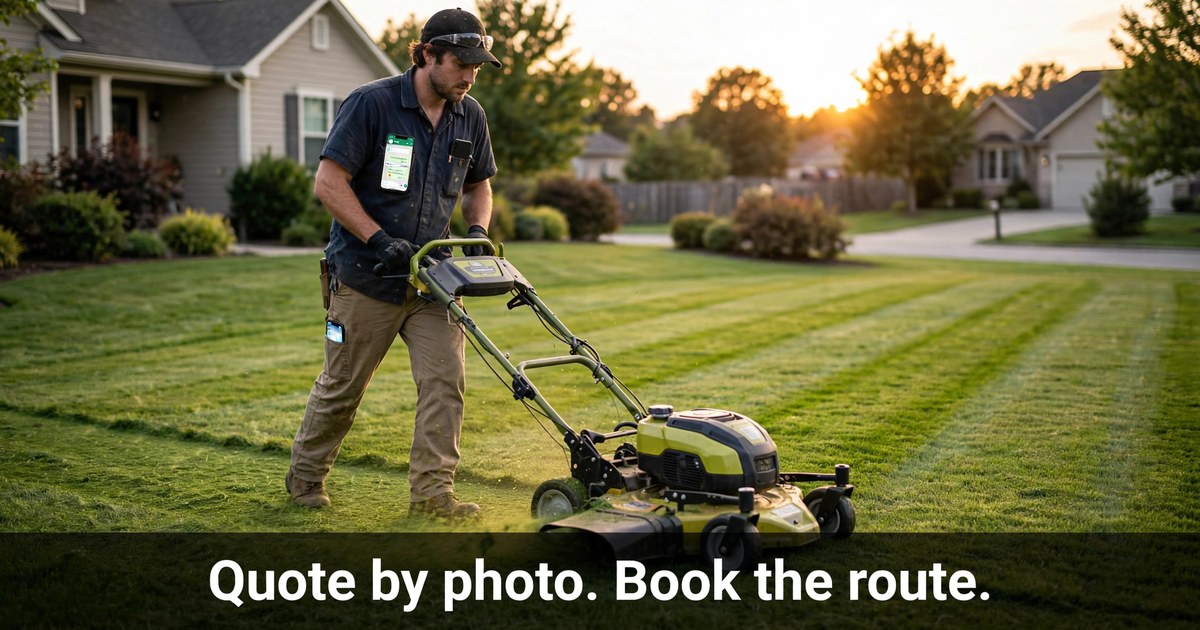
Your mower is running, the edger is screaming, and your phone buzzes for the fourth time in an hour. Another "How much for weekly mowing?" from a stranger. You'll answer at 9 PM, after dinner, when the daylight quotes have gone cold. You know how this ends. By 9 PM, that stranger has called your competitor, and your competitor answered.
Every landscaping crew lives this story. The work happens outside, with both hands busy and both ears full of engine noise. The quotes — the money — arrive as messages at the worst possible moment. Most landscapers lose work not because they're expensive or slow, but because they're silent for four hours.
WhatsApp automation flips that. An AI assistant answers your WhatsApp the second a message lands: it greets the homeowner, asks for yard photos, scopes the job, quotes an honest range, and books the on-site estimate — while your crew finishes the route. This guide shows exactly how it works for a landscaping business, what it does well, what it can't do, and how to set it up this week.
Quick answer: WhatsApp automation for landscapers is an AI assistant that answers your business WhatsApp instantly. It greets homeowners, collects yard photos for quote-by-photo scoping, gives honest price ranges, books free on-site estimates into your calendar, signs customers onto recurring mowing plans, and reschedules rain days automatically. It handles the messaging work; you handle the mowing.
Why your phone is your biggest leak
A landscaping business sells trust and timing. The homeowner wants the yard sorted before the family barbecue on Saturday. They message three crews on Tuesday morning. The first crew that answers like a professional wins — usually at a fair price, not the cheapest one.
Here's what a normal Tuesday looks like without automation:
- 9:12 AM — "Hi, do you do weekly mowing near Maple Street?" You see it at 11:40, on a water break.
- 10:05 AM — "Can I get a quote for a backyard cleanup?" You reply at lunch: "Sure, what's your address?" They've gone quiet. They'll reply tomorrow. Maybe.
- 2:30 PM — A photo of a jungle-like yard: "How much to tame this?" You meant to reply. The crew needed the trailer moved. You forgot.
Industry veterans call this the "pocket problem": the money is sitting in your pocket, buzzing, while your hands are on the mower. WhatsApp automation doesn't replace you. It stands guard over your pocket while you work.
What WhatsApp automation actually does for a landscaping crew
Picture your most reliable office hand — the one who picks up on the first ring, never forgets a follow-up, and never sounds tired at the tenth "how much?" of the day. Now imagine they never sleep and never leave the phone. That's what lives inside your business WhatsApp.
- It greets every message in under a minute. Day, night, Sunday morning. The homeowner feels heard instantly, which is half the sale.
- It runs the quote-by-photo flow. This is the landscaper's superpower. The bot asks for a few yard photos, looks at the size and state of the lawn, and scopes the job. It won't replace your eyes — but it separates the '$40 weekly mow' yards from the '$400 overgrown cleanup' yards before you ever drive there.
- It speaks in honest ranges, never locked-in numbers. It gives ranges with clear conditions ('for a quarter-acre weekly mow, most customers land between $85 and $110 per visit'), then books a free on-site estimate for the exact number. Homeowners respect a range more than a guess.
- It books estimates straight into your calendar. No 'I'll call you to schedule.' The bot offers your real open slots and locks one in, then sends the confirmation and a reminder the day before.
- It sells recurring mowing plans. One-time cleanups are nice. Weekly routes pay the bills. The bot follows up after a cleanup: 'Want this yard kept like this for $95 a visit, every Thursday?' That's route density built while you sleep.
- It handles rain-day rescheduling. The single biggest messaging headache in landscaping. When a storm kills Tuesday's route, the bot messages every affected customer, offers new slots, and rebuilds the day — in minutes, not in a three-hour phone marathon.
What it does NOT do
Honesty first: it can't walk the property line, smell the drainage problem, or spot the buried stump that will eat your mower blade. It can't safely quote tree removal, retaining walls, or drainage work — anything where a wrong number is dangerous or expensive gets handed to you with the customer's details ready. And it can't replace the final on-site estimate. It makes the estimate worth doing by filtering out the tire-kickers first.
The quote-by-photo flow: your new first impression
Here's the flow that changes everything, step by step, the way it actually runs on a customer's phone:
Step 1 — The greeting (instant). "Hi! Thanks for messaging GreenEdge Landscaping. Are you looking for regular mowing, a one-time cleanup, or something else?" The customer picks one.
Step 2 — The photo request. "Great — can you send 2 or 3 photos of the yard? One wide shot of the front, one of the back. That lets me scope the job and give you a real range right now." Nine out of ten homeowners do this happily. They've been waiting for a crew to ask.
Step 3 — The honest range. The assistant reads the photos: lot size, grass height, obvious problem spots. It responds like a human estimator: "Thanks! From the photos, that's roughly a quarter acre, and the back is pretty overgrown. A first cleanup plus weekly mowing would run $85–$110 per visit. Most quarter-acre lawns land near $95."
Step 4 — The booking. "Want me to book a free 15-minute on-site estimate? I've got Saturday 8–10 AM or Monday 4–6 PM open. I'll lock it in right now." The customer picks. Done. Confirmation, address capture, reminder — all handled.
Step 5 — The follow-up that builds routes. After the cleanup visit, the bot checks in: "How did the yard look after our visit? Want me to keep it like this every Thursday for $95?" One tap, and a one-time job becomes a weekly route.
The whole exchange takes about three minutes of the customer's time and zero minutes of yours. Before this existed, the same job took you two phone calls, one missed call, and a Sunday evening of admin.
Ready to stop losing quotes to your pocket? ReplyPilot's WhatsApp AI handles your quote-by-photo flow, books estimates, and reschedules rain days — while your crew keeps mowing. Get a free custom demo for your landscaping business: https://replypilot-site.vercel.app
Recurring mowing plans that sell themselves
Landscaping has the best business model in the trades and the worst follow-up in the trades. Weekly mowing is subscription revenue — the same money, every week, all season. But most crews treat every job like a one-off because following up with forty customers takes an evening nobody has.
Automation fixes the follow-up:
Want this for your landscapers?
ReplyPilot builds a custom whatsapp automation setup for your landscapers — answering customer questions instantly, taking orders and bookings, and handing off to you when a human is needed.
Ask on WhatsApp — it's free- After every cleanup: the 'keep it like this?' message, sent 24 hours after the visit with a photo of the finished yard.
- Plan options, not pressure: 'Weekly $95, every-two-weeks $120, monthly $160 — which fits your yard?' Customers choose instead of haggling.
- Pause, don't cancel: when a customer hesitates, the bot offers a pause ('Shall I pause July and restart in August?') instead of losing them. Paused customers come back. Cancelled ones don't.
- Payment nudges: polite invoice reminders on WhatsApp get paid faster than emailed ones, because the customer is already in the chat where they booked.
One crew owner put it this way: the bot doesn't just win new customers, it stops the quiet leak of old ones drifting away. Route density — more lawns, closer together — is what turns a crew from surviving to thriving, and route density is built one follow-up message at a time.
Rain days: the reschedule headache, solved
Ask any landscaper what they dread, and it isn't the heat. It's the 6 AM weather check. Rain kills Tuesday. Now twelve customers need new slots, the phone won't stop, and you're rebuilding the whole week by hand while the crew stands around.
This is where WhatsApp automation earns its keep in one morning:
- 1. You mark the day rained out — one tap in the morning.
- 2. The bot messages every affected customer at once: 'Hi, Tuesday's visit is rained out — safety first. I've got Wednesday afternoon or Thursday morning open. Which works?'
- 3. Customers pick; the bot rebuilds the route in order, filling slots back-to-front so drive time stays tight.
- 4. Anyone who doesn't answer by noon gets a second nudge; anyone still silent gets flagged for your personal call. You call two people instead of twelve.
The customers who've lived through a rain day with a bot remember it. They tell neighbors. "My lawn guy rescheduled the whole street before 8 AM." That's marketing you can't buy.
Seasonal upsells without being pushy
Landscaping is seasonal, and seasons are money sitting on the table. The customers already trust you — the bot just reminds them at the right moment:
- Spring: 'Aeration and overseeding season is here — want your lawn on the list before the slots fill? Most quarter-acre lawns run $180–$240.'
- Late summer: mulch refresh and hedge trimming offers, with before-and-after photos from your own past jobs.
- Fall: leaf cleanup packages, quoted by the same photo flow ('send a photo of the yard with the leaves down').
- Winter (where it applies): gutter cleaning, holiday lighting, or simply the 'see you in March' plan renewal.
The key word is timed. A human forgets to send the aeration campaign in March because March is chaos. The bot sends it on March 1st, every year, to exactly the customers whose lawns qualify. If you want to see how another outdoor trade runs the same playbook, read how house painters quote mid-job on WhatsApp: https://replypilot-site.vercel.app/blog/whatsapp-automation-house-painters — the seasonal logic is identical.
Mistakes that kill your results
Automation done badly is worse than no automation. These are the failures we see, and the root cause of each:
- The robot voice. If the bot opens with 'Greetings valued customer! How may I assist you today?' the homeowner feels the machine and disengages. Root cause: generic templates written by someone who's never stood on a lawn. Fix: write the bot's lines the way your best crew lead talks — short, plain, warm.
- Quoting exact numbers from photos. '$97.50 for your cleanup' — then you arrive and it's $240 because of the slope and the fence line. Root cause: the bot was set to sound confident instead of honest. Fix: ranges with conditions, always ending in the free on-site estimate. The range builds trust; the estimate closes the sale.
- No human escape hatch. A customer with a fallen tree on their fence gets trapped in a bot loop asking for photos. Root cause: no escalation rule. Fix: keywords like 'emergency,' 'fallen,' 'urgent,' or any message the bot can't parse twice routes straight to your phone with the full conversation attached.
- Forgetting the after-job message. Crews automate the booking and skip the follow-up. Root cause: treating the sale as the finish line. Fix: the post-visit check-in and the plan upsell are where the profit lives — automate them first, not last.
- Setting it and forgetting it. Prices change. Your service area changes. The bot quoting last year's rates is a slow-motion disaster. Root cause: no owner review. Fix: a ten-minute monthly check of your prices, slots, and service list. Put it in your calendar like an oil change.
DIY vs hiring an office hand vs automation
Three ways to solve the pocket problem. Here's the honest math:
DIY (you answer everything yourself). Cost: $0, plus your evenings. Works until you have more than about fifteen active customers, then the 9 PM message sessions start costing you family time and next-day energy. Every crew starts here. Almost none can stay here past year two.
Hiring a part-time office hand. Cost: roughly $400–$800 a month for someone answering messages a few hours a day. They reply well during office hours and go home at 5 PM — exactly when homeowners message. You still lose the evening quotes, and sick days happen.
WhatsApp automation. Cost: typically a modest monthly subscription, far below a part-timer. It answers in under a minute, 24/7, runs the photo-quote flow, books estimates, reschedules rain days, and never has a sick day. What it can't do: the on-site estimate, the judgment calls, the relationship. That's still yours — it's just no longer buried under forty unread messages.
The crews that grow fastest usually land on automation plus the owner: the bot handles every message, the owner handles every lawn. If you're still deciding whether the underlying tech fits your business, our WhatsApp Business API setup guide (https://replypilot-site.vercel.app/blog/whatsapp-business-api-setup-guide) walks through what the plumbing actually looks like behind the scenes — and the official WhatsApp Business Platform documentation (https://business.whatsapp.com/products/platform) covers the API itself.
How to set this up this week
You don't need a developer, and you don't need to change how you work. Here's the realistic path:
Day 1–2: Map your top five conversations. Write down the messages you answer most: "How much for weekly mowing?", "Do you do cleanups?", "Are you insured?", "When can you come?", "It rained — are you still coming?" These five cover 80% of your inbox. Your bot gets trained on these first.
Day 3: Set your ranges. For each service and each common lot size, write the honest range and the conditions. Quarter-acre weekly mow: $85–$110. Half-acre: $120–$160. Overgrown first cleanup: add 50–100%. These numbers are yours — the bot quotes what you tell it to quote.
Day 4: Connect your calendar. The bot needs your real availability to book estimates. Connect whatever calendar you use; if you use a paper diary, this is the week it goes digital. For the full picture of turning chats into booked jobs, see our lead capture automation guide: https://replypilot-site.vercel.app/blog/lead-capture-automation
Day 5: Write it like you talk. Go through the bot's messages and rewrite anything that sounds like a corporation. "Hey, thanks for the photos — that's a solid quarter acre" beats "Thank you for your submission."
Day 6–7: Soft launch. Put the WhatsApp number on your truck, your flyers, and your Google Business Profile. Tell your next five quote requests to message the WhatsApp. Watch the first conversations land while you're on the mower. Adjust the wording once, then let it run.
One season from now, the difference is simple: every message answered, every rain day rebuilt by 8 AM, every cleanup followed up, every estimate booked. Your crew still mows. But nothing in your pocket buzzes unanswered anymore.
Frequently Asked Questions
Can a WhatsApp bot really quote a landscaping job from photos?
It can scope the job and quote an honest range — which is what the first message is for. From 2–3 photos it reads approximate lot size, grass height, and obvious problem areas, then gives a range with conditions ("$85–$110 per visit for a quarter-acre weekly mow") and books a free on-site estimate for the exact number. It replaces the back-and-forth, not your eyes. Anything complex — slopes, drainage, retaining walls, tree work — gets handed to you with the customer's details and photos ready.
Will customers think they're talking to a robot and hang up?
Only if it sounds like one. The bots that work are written in the crew's own voice — short sentences, plain words, the occasional "got it" — and they say upfront they're the business's assistant, not a person. Homeowners care about speed and clarity, not about who typed the message. A reply in 40 seconds that asks for yard photos feels more professional than a reply in 4 hours from a human.
How do you handle rain-day rescheduling automatically?
You mark the day rained out once, and the bot messages every affected customer with your real open slots, lets them pick, and rebuilds the route in order. Customers who don't respond get a second nudge; anyone still silent after that gets flagged for your personal call. What used to be a three-hour phone marathon becomes about ten minutes of your morning.
Does this work with my existing booking or CRM software?
In most cases, yes. The bot connects to common calendars and CRMs through standard integrations or the WhatsApp Business API, so bookings land where your jobs already live. If you run on a paper diary or a spreadsheet, the setup week is a good moment to move the schedule digital — the bot needs one source of truth for your availability.
What happens when someone needs a quote for a huge or complex job?
The bot is trained to recognize its limits. Tree removal, retaining walls, drainage systems, grading — anything where a wrong number is dangerous or expensive — triggers an instant handoff: the customer gets a message saying a specialist will call them, and you get the full conversation, the photos, and the address on your phone. Complex jobs get human attention faster, not slower.