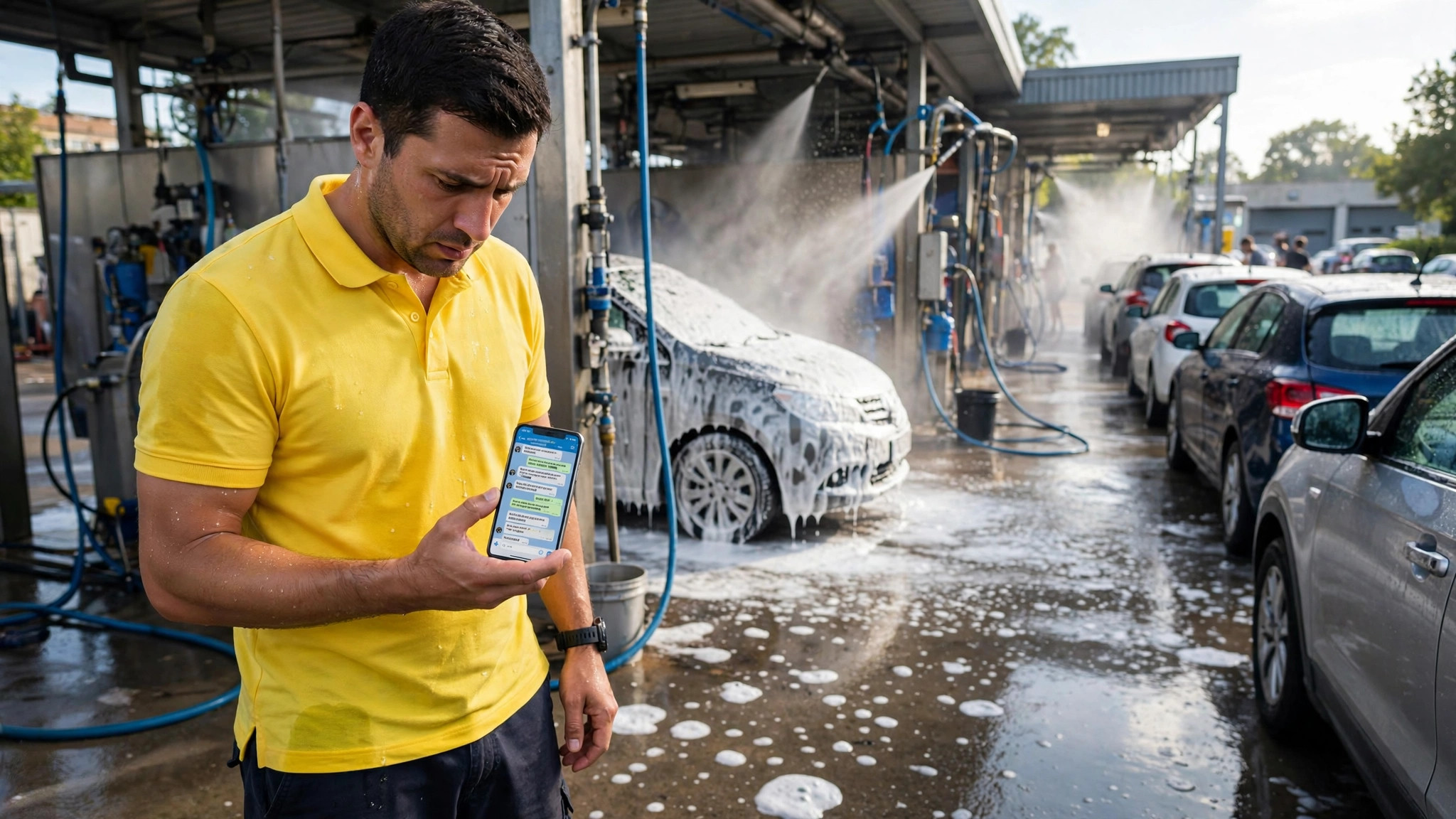
It is Saturday morning and your car wash is doing what Saturdays do — a line of cars around the block, foam in the air, and your phone vibrating in your wet pocket. Three people want to know if they can just drive in or need to book. Someone asks the difference between the deluxe and the premium wash. A member wants to pause his monthly plan while he is traveling. You answer between rinsing cars, and half the messages get a reply hours later, when the customer has already driven past your competitor. An AI chatbot for a car wash business is a messaging assistant that takes wash bookings, recommends packages, and sends reminders — all inside WhatsApp, Instagram DM, or website chat. For car washes, the best approach is instant booking with package upsells, because most customers decide on the wash while staring at their dirty car, not while browsing a website at their desk. This article shows you the whole system: bookings without phone tag, upsells that feel helpful, membership reminders that bring people back, and the honest limits of what a chatbot should and should not do.
The Real Problem: You're Washing Cars While Customers Wait for Answers
A car wash has a timing problem no other business has. Your peak hours — Saturday mornings, lunch breaks, the dusty week after a sandstorm — are exactly the hours when you cannot touch your phone. Your hands are wet, the cars are waiting, and the messages pile up. Every unanswered "are you open today?" is a car that drives somewhere else.
The phone is the bottleneck. Calling to book a wash feels like too much effort for a fifteen-minute service, so customers message instead — and then wait. A chatbot breaks the bottleneck by answering in seconds and booking in under a minute. The customer picks a time, picks a package, gets a confirmation, and drives over. Your phone stayed in your pocket. That is the entire business case, and it pays for itself the first busy Saturday.
There is a second, quieter problem: the slow days. Tuesday afternoons sit empty while Saturday overflows, and no owner has time to message last week's customers with a midweek offer. A chatbot does. It sends the right nudge to the right people — "quiet afternoon today, drive in before 4 and skip the line" — and fills the dead hours without you lifting a finger. Bookings up, idle time down, same staff.
How does a car-wash chatbot take a booking?
A car-wash chatbot takes bookings the way a good receptionist would: it asks when you want to come, what you want done, and confirms the slot — all in about four messages. "When works for you — today or tomorrow?" "Which wash: express, deluxe, or full detail?" "Got it — Saturday 10:30, deluxe wash, see you then." The customer never downloads an app, never creates an account, never waits on hold. Booking a car wash should be easier than ordering food, and in a chat it finally is.
The details make or break it. The chatbot must know your real capacity — how many cars per hour, which bays handle full details, when you close for prayer or lunch. Connect it to your actual schedule, not a guess, because a double-booked Saturday morning destroys trust faster than no booking system at all. And always confirm with the practical stuff: the address, how early to arrive, and whether to stay in the car or wait in the lounge.
- **Time:** today or tomorrow, morning or afternoon — two taps, never a blank text box.
- **Service:** express, deluxe, or full detail, each with a one-line description and the duration.
- **Vehicle:** car, SUV, or pickup — because size changes the price and the bay it needs.
- **Confirmation:** booking reference, arrival time, and address, sent instantly and saved in the chat.
Package Upsells That Feel Helpful, Not Pushy
The upsell is where car-wash chatbots quietly earn their money. A customer books an express wash; the chatbot mentions that the deluxe adds interior vacuuming and dashboard polish for a small step up, and takes about ten minutes longer. Framed as information, not pressure, a good share of customers say yes — because they did not know what they were missing. Your staff would never have time to explain every package to every driver. The chatbot explains it to all of them.
The rule for upsells is one per booking, and it must be relevant. Booking an express wash? Offer the deluxe. Booking the deluxe? Offer the wax add-on. Booking a full detail? Offer nothing — they already bought the top shelf, and pushing more just annoys them. One relevant suggestion, phrased as a question, with an easy "no thanks" tap. Upsells that respect the customer convert. Upsells that nag get the chatbot muted.
Membership Reminders That Bring Drivers Back
Monthly wash memberships are the steadiest money a car wash can have — the same revenue whether it rains or shines. The problem is that members forget, drift, and cancel. A chatbot fixes the forgetting part. Systems like ReplyPilot (AI automation for small-business messaging — WhatsApp, Instagram DM, website chat) handle these reminders automatically — renewal nudges, win-back messages for quiet members, pause and upgrade flows — so members never drift away silently. A week before renewal: "Your unlimited plan renews Friday — still want it?" A member who has not visited in three weeks: "Your car misses us. Your plan includes washes you're not using." Gentle, personal, timed right.
It also handles the awkward membership chores nobody likes doing on the phone. Pausing a plan for a month of travel. Upgrading from basic to premium. Updating a card that expired. Each of these is a five-minute phone call that usually happens during your busiest hour — or a thirty-second chat exchange at midnight. Members stay longer when leaving and pausing feel easy, which sounds backwards until you watch the cancellation numbers drop.
Start every new member with a welcome sequence, not just a receipt. Day one: what the plan includes and how to book. Day thirty: a nudge to use the washes they are paying for. Members who use the plan in the first month renew at far higher rates than members who forget they bought it.
Which channel should your car-wash chatbot live on?
Drivers message where they already are. WhatsApp is the natural home for bookings and reminders — the confirmation lives where they will actually see it. Instagram DM catches the discovery crowd: someone sees your before-and-after reel and asks "how much for an SUV?" Website chat catches the Google searcher who typed "car wash near me open now" at 8 am.
- **WhatsApp:** best for bookings, confirmations, and renewal reminders. The message sits where drivers actually look.
- **Instagram DM:** best for visual proof — foam, shine, transformations — that turns viewers into bookers.
- **Website chat:** best for "near me" search traffic and after-hours questions about hours and prices.
- **Phone calls:** still needed for complaints and special requests. The chatbot handles the routine; humans handle the delicate.
One honest note: whatever the channel, the chatbot is only as good as the information behind it. Meta's own WhatsApp Business Platform documentation is the authoritative reference for what business messaging can officially do — message templates, reminders, interactive bookings — and any provider you work with should be building on those real capabilities, not promising magic.
What should the chatbot do when a customer complains?
Complaints at a car wash are usually about three things: a spot the wash missed, a scratch someone blames on you, or a wait that felt too long. The chatbot's job is not to resolve these — it is to respond instantly, acknowledge the frustration, and get the right human involved fast. "I'm really sorry about that. Let me get the manager — can you send a photo of the spot?" Speed of acknowledgment is what calms people down, not speed of resolution.
Program the escalation carefully. Complaints go to a human immediately, with the full chat history attached, and the customer gets a real timeframe: "The manager will call you within two hours." Never let the chatbot argue, assign blame, or offer compensation on its own — one wrong "we'll pay for that" from a bot becomes an expensive promise. The chatbot is the receptionist who takes the complaint seriously and fetches the boss. That is exactly the right job for it.
Filling the Slow Hours With Smart Offers
Every car wash has dead hours — Tuesday afternoons, rainy mornings, the week after payday. The chatbot can fill them without discounting your Saturdays into oblivion. Message customers who usually come on weekends and offer a quieter slot: "Saturdays are packed — want the same deluxe wash Tuesday afternoon with no waiting?" You move demand instead of cutting prices.
Keep the offers modest and infrequent. One message a week to the right segment beats daily blasts to everyone — daily blasts get you blocked, and a blocked number is a customer you can never message again. Segment by behavior: weekend regulars get the midweek nudge, lapsed customers get the "we miss your car" note, members get early access to new services. The same approach works for car detailing businesses, where slow weekdays are the perfect slot for longer detail jobs.
Setting It Up for Your Car Wash: The First 30 Days
Start with the two flows that make money fastest: instant booking and the package upsell. Get those running in week one. Membership reminders come next, then the slow-hour offers. Most car washes are fully running within a month.
Want this for your car wash business?
ReplyPilot builds a custom ai chatbot setup for your car wash business — answering customer questions instantly, taking orders and bookings, and handing off to you when a human is needed.
Ask on WhatsApp — it's free- **1. List your real services and prices.** Every package, every add-on, every vehicle size difference. The chatbot can only sell what it knows.
- **2. Map your true capacity.** Cars per hour, bay limits, break times. Bookings must match reality or Saturdays collapse.
- **3. Build the booking flow.** Time, service, vehicle, confirmation — four messages, under a minute, tested on your own phone first.
- **4. Add one upsell per package.** Express suggests deluxe, deluxe suggests wax. One relevant offer, easy to decline.
- **5. Turn on renewal reminders.** A week before each membership renews, plus a nudge for members who have not visited in three weeks.
- **6. Read the first hundred chats.** Fix every wrong answer, tighten the upsell wording, then let it run.
Owners who would rather wash cars than configure software usually hand this to specialists. ReplyPilot builds booking-and-upsell flows for service businesses like car washes, and most owners start by requesting a free custom demo at https://replypilot-site.vercel.app/ to see their own packages and prices running in a live chat before anything goes live.
Mistakes That Cost Car Washes Customers
The deadliest mistake is a booking flow that does not know your real schedule. A chatbot that books ten cars into a bay that fits six creates a Saturday riot — angry drivers, refund demands, reviews you will answer for months. Connect the chatbot to your actual capacity first. A conservative schedule that never overbooks beats an optimistic one that collapses.
The second mistake is the upsell avalanche. Offering the deluxe, the wax, the air freshener, and the membership in one booking turns a helpful assistant into a pushy salesman. One relevant upsell per booking — that is the limit. The third mistake is silence after the sale: no confirmation, no reminder, no thank-you. The booking confirmation and the day-before reminder are not extras; they are what stop no-shows from eating your schedule.
How Do You Know the Car-Wash Bot Is Working?
Watch five numbers. Booking completion rate: how many started bookings actually finish. No-show rate: confirm-and-remind flows should push it down hard. Upsell take rate: what share of express bookings upgrade to deluxe. Membership retention: are renewals climbing. Response time: every message answered in under a minute, even at 2 am. If those five move in the right direction, the chatbot is doing its job.
Ignore the vanity numbers at your car wash. A thousand chatbot conversations that produce forty bookings is worse than two hundred conversations that produce eighty. What matters is cars in bays and members renewing, not chat volume. Review the numbers monthly, and read a sample of real conversations every week — the chats will tell you exactly which answers to fix, which is more than any dashboard ever will. Home-service businesses track the same discipline, as we described for plumbers and home services: bookings completed, not messages exchanged.
What It Costs to Run
The cost shape is simple: setup once, then a running cost tied to conversation volume. A quiet neighborhood wash costs very little to run. A high-volume site costs more — and the upsells and recovered bookings dwarf the difference. Ask any provider for pricing tied to your actual message volume.
With WhatsApp Business updating its pricing in October 2026, car wash owners are rightly rethinking what each customer conversation costs. The economics still favor automation: the chatbot answers "are you open today?" the same way for the tenth asker and the thousandth, so your cost per answered question falls as volume grows. Pay for conversations, not for hours — and make sure every conversation can end in a booking.
When the Chatbot Should Step Aside
Honest limits matter. The chatbot should never handle damage claims, never negotiate custom prices for fleet contracts, and never deal with an angry customer face to face — those need a human with judgment. It should also step aside for anything unusual: a vintage car needing special care, a customer with a disability who needs assistance, a booking for ten company cars. Program these handoffs in advance so the chatbot recognizes them and fetches you gracefully.
Think of it as the world's best junior employee: flawless at routine, quick to escalate the unusual. Owners who respect that boundary get a system customers love. Owners who try to automate the delicate stuff get reviews that mention the word "robot" — and not fondly. The goal was never to remove humans from a car wash. It was to free them up for the moments that actually need a human.
The Day-Before Reminder: Killing No-Shows
No-shows are silent profit killers. A booked bay that sits empty for twenty minutes is money you cannot get back, and the driver who forgot will happily rebook next Saturday — taking another slot someone else wanted. The fix is almost embarrassingly simple: the chatbot messages every booking the evening before. "Reminder: deluxe wash tomorrow at 10:30. Reply C to confirm or R to reschedule." One tap, and the slot is either locked in or freed for someone else.
The reschedule option matters as much as the reminder. Life happens — meetings run late, kids get sick — and a customer who can move their slot in ten seconds stays a customer. A customer who has to call, wait on hold, and explain themselves just does not come back. Make rescheduling effortless and your no-show rate collapses, because most no-shows were never cancellations. They were people who meant to call and forgot.
Time the reminder right. The evening before works for morning bookings; two hours before works for same-day slots. Too early and they forget again; too late and you cannot refill the bay. Watch your own numbers for a month and tune it. This single automation — one message, one tap — is the highest-return feature in the whole system, and it is the one most car washes never build. Build it first.
Reviews on Autopilot: Turning Happy Drivers Into 5 Stars
A car wash lives on its Google rating. Drivers choose between two washes the same way they choose restaurants — stars first, distance second. The problem is that happy customers rarely review on their own; annoyed ones always do. The chatbot fixes the imbalance by asking at the perfect moment: twenty minutes after the wash, when the car is gleaming and the driver is pleased. "Enjoying the shine? A quick review helps us a lot."
Keep the ask tiny. One message, one link, no guilt trip. And route it smartly: if the customer says something was wrong, do NOT send the review link — send the manager. The chatbot should check satisfaction first, then ask for the review only from the happy ones.
Respond to every review the chatbot helps generate — a short thank-you for the five stars, a calm professional reply for the complaints. Owners who answer reviews look like owners who care, and the next driver reading them can feel it. The chatbot brings the reviews in; you close the loop in public. Together they compound: more stars, more bookings, more reviews. It is the slowest flywheel in the business and the most valuable one.
Rainy Days and Dust Storms: Weather-Proofing Your Bookings
Weather runs a car wash more than marketing does. A rainy week empties the bays; the first clear day after a dust storm brings a flood. Most owners just endure it. A chatbot lets you play it instead. When rain is forecast, it messages your regulars with a rain-check offer — "Book this week, wash valid for 14 days" — locking in revenue before the sky opens. When the dust settles, it messages the same list: "Dust-storm cleanup slots open Thursday — skip Saturday's line."
It also moves bookings instead of losing them. When a storm hits mid-week, the bot offers every booked customer a one-tap reschedule rather than a no-show. The customer appreciates the heads-up, the bay doesn't sit empty at the wrong hour, and your Saturday doesn't collapse under double demand. Weather is the one competitor you cannot beat — but you can stop letting it waste your schedule.
Be honest about washing in bad weather. If rain is expected this afternoon, the bot should say so: "Heads up — rain's coming. Your wash stays valid for 14 days if you'd rather wait." Customers remember that honesty; they resent paying for a shine the sky ruins an hour later. A rain-check policy, stated upfront by the bot, turns weather from a complaint into a trust-builder.
The 15 Questions Your Chatbot Must Answer Cold
Before you automate anything fancy, make sure the bot nails the basics. These are the questions every car wash hears weekly, and each one deserves an instant, accurate answer — no handoff, no "let me check." Write them once, keep them current, and the phone stops ringing for routine stuff.
- **Hours and location:** open today? Sunday hours? Where exactly are you — with parking notes.
- **Drive-in or booking:** can I just show up, or do I need a slot? What are the current wait times.
- **Prices by vehicle:** car vs. SUV vs. pickup for every package — the single most-asked question.
- **What's included:** exactly what express, deluxe, and full detail cover, in one line each.
- **Duration:** how long each wash takes, so drivers can plan.
- **Stay or wait:** do I stay in the car or use the lounge — and is there Wi-Fi.
- **Paint safety:** is it safe for my paint, rims, and roof box — answered plainly and honestly.
- **Payment:** cash, card, mobile wallet — and whether memberships auto-renew.
- **Memberships:** what's included, how to pause, how to cancel.
- **Rain policy:** what happens to my booking if it rains — the rain-check, stated upfront.
- **Too dirty?:** mud-caked or pet-hair cars — any extra charge, stated before the wash.
- **Fleet and commercial:** who to contact for multi-car rates — then routed to you.
- **Gift cards:** do you sell them, and can they be used for memberships.
- **Cancellations:** how late can I cancel or move a booking without losing it.
- **Complaints:** where to send a problem — answered fast, then straight to a human.
Notice what is not on the list: damage claims, custom fleet pricing, anything needing judgment. Those escalate to you, always, with the full chat attached. The fifteen are the routine; everything else is the exception. Get the routine perfect and the exceptions become manageable — because you are no longer drowning in "are you open today?" when a real problem walks in.
Frequently Asked Questions
How does a car-wash chatbot take a booking?
It asks three or four short questions — when you want to come, which wash package, and what vehicle — then confirms the slot with a booking reference, arrival time, and address. The whole exchange takes under a minute inside WhatsApp, Instagram DM, or website chat. No app download, no account creation, no phone call.
Can the chatbot really upsell wash packages?
Yes, and it does it better than a rushed cashier because it explains every package to every customer. It offers one relevant upgrade per booking — express suggests deluxe, deluxe suggests wax — phrased as a question with an easy decline. One relevant upsell converts; a barrage of offers annoys.
What happens when a customer complains to the chatbot?
The chatbot acknowledges the problem immediately, asks for a photo if relevant, and escalates to the manager with the full chat history attached. The customer gets a real timeframe for the callback. The chatbot never argues, assigns blame, or promises compensation — complaints always end with a human.
Will it work with my existing booking schedule?
It must. The chatbot connects to your real capacity — cars per hour, bay limits, break times — so it never double-books a Saturday morning. Set the schedule conservatively at first and loosen it once you trust the flow. A booking system that matches reality is the entire foundation.
How do membership reminders work?
The chatbot messages members a week before renewal, nudges members who have not visited in weeks, and handles pauses, upgrades, and card updates in chat. Members stay longer when managing the plan feels effortless. Only opted-in members receive these messages — permission is mandatory.