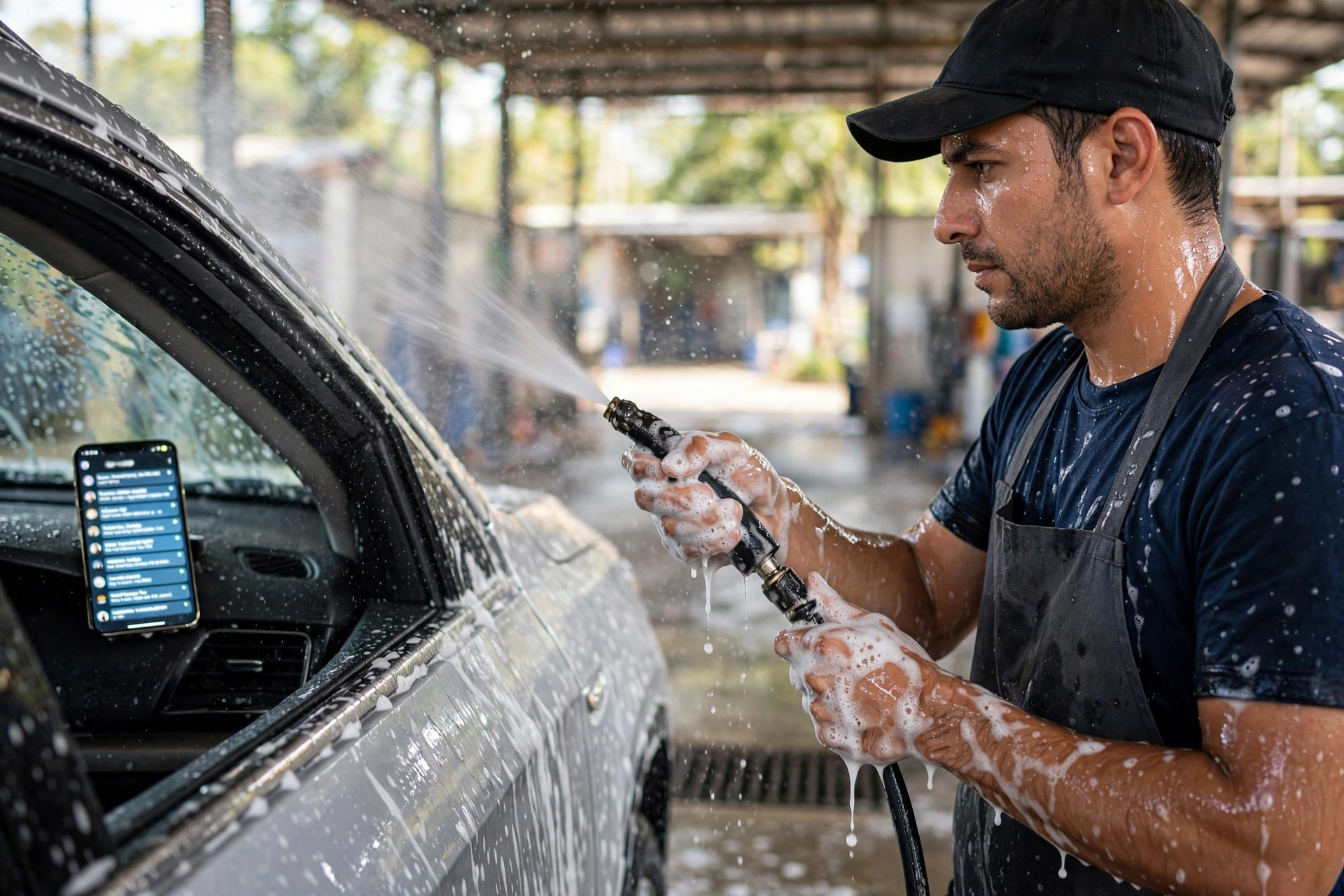
It is 11 am on a Saturday, your busiest day. You are halfway through washing an SUV — hands covered in foam, hose in one hand, sponge in the other. Your phone is on the dashboard of a customer's car, buzzing non-stop. "Is there a free slot at 2 pm?" "How much for full wash + interior?" "My car is ready? I am waiting outside." You cannot touch the phone with soapy hands, so the messages pile up. The man asking about the 2 pm slot waits ten minutes, gets no reply, and drives to the car wash two streets away. Meanwhile, the customer waiting outside calls you, annoyed, because nobody told him his car is done. This is the daily reality of a car wash business — and it is exactly what WhatsApp automation for car wash services fixes. While you wash, the system books, answers, updates and reminds. Your hands stay on the car. The business runs itself.
Why a Car Wash Loses Customers Differently
A car wash does not sell a product. It sells a time slot on a wash bay, and a time slot that goes empty is money that never comes back. You cannot store Saturday's empty 3 pm slot and sell it on Monday. Every missed booking message is a bay sitting idle while a customer drives somewhere else. And car wash customers are impatient by nature — they are choosing between you and the place down the road while sitting in traffic, and whoever answers first wins.
The second problem is the waiting game. Nobody enjoys waiting at a car wash. Customers hover around asking, "How much longer?" and "Is mine next?" These questions interrupt your work constantly. A car wash WhatsApp booking chatbot ends both problems at once: it takes the booking without you touching the phone, and it tells each customer exactly where their car is in the queue, so they stop asking.
What WhatsApp Automation for Car Wash Services Actually Does
A good system for a car wash is less like a chatbot and more like a front-desk manager who never leaves the counter. Here is what it handles while you work the bays:
- Books wash slots automatically — the customer picks a service (exterior, full wash, interior detailing) and a time, and gets an instant confirmation with a booking reference.
- Answers price questions instantly: every package, every add-on (wax, underbody, engine wash), and the difference between them.
- Sends queue updates — "Your car is next in line" and "Your car wash has started" — so customers stop crowding the counter to ask.
- Notifies the customer the moment their car is ready, with a payment link attached, so pickup is quick and the bay frees up faster.
- Reminds customers of upcoming bookings the evening before, which cuts down the no-shows that leave your bays empty.
- Follows up with customers who have not visited in weeks: "It has been a month since your last wash — book a slot this weekend?"
- Collects ratings after each wash and routes unhappy customers straight to you before they leave a bad public review.
- Runs a simple loyalty count — every 10th wash free, tracked automatically — so regulars have a reason to keep coming back to you.
The Booking Flow That Fills Your Bays
Think about how bookings happen today: a customer calls or messages, you check your mental schedule, you write their name on a paper or in your head, and half the time the details are wrong. Now picture the automated version. A customer messages your WhatsApp number at 9 pm on a Friday: "I want a full wash tomorrow." The system replies instantly with your packages and tomorrow's free slots. He picks "Full wash, 11 am." He gets a confirmation: "Booked — full wash, Saturday 11 am. Please arrive 10 minutes early. Your booking reference is CW-184." Saturday morning, he gets a reminder. At 11 am, he arrives, his car goes on the bay, and the queue moves. When it is done, he gets a message: "Your car is ready! Pay here or at the counter." The whole booking happened without a single phone call and without you looking at a diary.
The beauty of this is what it does to your schedule. Instead of a messy first-come-first-served crowd at 11 am and an empty bay at 3 pm, bookings spread across the day. You see tomorrow's schedule tonight. You know how many cars are coming, which packages they chose, and you can plan your staff around it. A car wash runs on rhythm, and a booking system gives you that rhythm.
Queue Updates: The Feature Customers Love Most
Ask any car wash customer what annoys them and you will hear the same thing: not knowing how long the wait is. A customer drops their car and goes to sit in the waiting area, or walks to a nearby shop. Then the guessing starts. "Should I go back? Is it done? Will they call me?" An automated queue update removes all of it. When their car moves up — "You are next in line" — when the wash starts — "We have started washing your car" — and when it finishes — "Your car is ready for pickup." Simple messages, sent at the right moment, turn a boring wait into a calm one.
This also helps you operationally. When the customer knows their car is ready instantly, they come to collect it faster, and your bay turns over quicker. Slow turnover is a hidden cost most car wash owners never measure — every car that sits washed but uncollected is blocking the next paying customer. Instant "ready" notifications tighten the whole cycle.
Rainy Days, Dust Storms and Slow Tuesdays
Every car wash has dead days. A rainy week means nobody wants a wash. A random Tuesday afternoon means empty bays. This is where WhatsApp automation for car wash services earns money that did not exist before. Because the system has your customer list and knows who has not visited in a while, you can send a well-timed offer to exactly the right people: "Slow week? 20% off full washes this Tuesday and Wednesday — reply TUESDAY to book." You are not shouting into the void. You are talking to people who already trust you with their cars, at the moment your bays need filling.
Weather is the other trigger. After a dust storm or a rainy spell, cars are filthy — and that is your best sales day of the month if you act fast. A quick message to your customer list the morning after — "Dust storm last night? Get your car looking new again today, slots available" — can fill a whole day. Manual messaging could never do this at scale; you would be typing for hours. The automation sends it to hundreds of opted-in customers in minutes. One important rule from the platform itself: the regular WhatsApp Business App caps broadcast lists at 256 contacts, while the official WhatsApp Business API supports much larger tiered broadcasts (source) — so a growing customer list needs the API route.
Monthly Packages: Turn One-Time Washers Into Regulars
The most profitable customers for any car wash are not the one-time visitors. They are the ones on a monthly rhythm — the office commuter who washes every two weeks, the ride-hailing driver who washes twice a week, the family with two cars. WhatsApp automation makes selling monthly packages almost effortless. The system explains the package, takes the signup, tracks how many washes have been used, and reminds the customer when the month is ending: "You have used 3 of your 4 washes this month — book your last one before Sunday."
- Weekly driver plans for taxis and ride-hailing drivers, who wash more than anyone and value speed above everything.
- Monthly family plans covering two cars, which lock in a household for a full year.
- Corporate plans for companies with fleets — offices, delivery services, rental companies — booked and billed in one place.
- Seasonal deep-clean packages before festivals and holidays, when everyone wants their car shining.
- Interior-detailing add-ons offered automatically to customers who always book exterior-only washes.
Packages change the relationship. Instead of hoping the customer remembers you, you have their commitment. And because the system tracks usage and renewals, you never lose a renewal to forgetfulness — yours or theirs.
The Comeback Message: Winning Back Quiet Customers
Here is a question worth real money: how many customers washed their car with you once and never came back? For most car washes, it is a large number. They did not leave angry — they just drifted. They tried the place near their office, or they got busy, or they simply forgot. These customers are pure gold because winning them back is far easier than finding new ones. They already know your location, your quality and your prices.
Car wash appointment automation handles this with a simple, timed nudge. If a customer has not booked in 30 days, the system sends a personal-feeling message: "Hi Ahmed, it has been a while! Your car misses us. Book a full wash this week and we will add a free interior vacuum." Not a mass blast — a quiet, personal reminder. Space these out, keep the tone warm, and always make it easy to book with one reply. Even a small fraction of these customers returning each month adds steady revenue that costs you nothing to acquire.
Handling Complaints Before They Become Reviews
A missed spot on the windshield. A streak on the bonnet. A scratch the customer swears was not there before. In a car wash, small complaints are normal — what matters is how fast you catch them. An automated message after every wash — "How was your wash today? Reply with a number from 1 to 5" — does two jobs at once. Happy customers get a gentle nudge to leave a public review, which brings new business. Unhappy customers get routed to you immediately, with their booking details attached, while they are still at your shop and the problem can still be fixed.
The timing here is everything. A customer who rates you 2 out of 5 and gets a personal call from you within ten minutes usually leaves satisfied. The same customer, ignored, writes a one-star review that sits on the internet forever. The automation does not solve the complaint — you do. It just makes sure you hear about it in time.
What About Mobile Car Wash Services?
If you run a mobile car wash — going to customers' homes and offices — WhatsApp automation fits even better, because your whole business already runs on messages. Customers send their location pin, pick a package and a time, and your team gets the job details with the address attached. The system can send the customer a message when your team is on the way — "Our team will reach you in 20 minutes" — which is the number one thing mobile customers ask about. It can also collect payment through a link right after the wash, so your team does not handle cash on every job. And because mobile customers are scattered across the city, the system can group nearby bookings by area, helping you plan routes that waste less fuel and time.
Mistakes Car Wash Owners Make With Automation
A few honest warnings from watching these systems in the real world:
- Overbooking the bays — if the system allows bookings every 15 minutes but a full wash takes 40, you will have angry queues; set slot times from your real wash durations.
- No human escape hatch — a customer with a scratched bumper needs a person, not a menu; always offer "talk to the owner" clearly.
- Stale prices — update the system the same day you change any package price, or you will be honouring old prices all week.
- Spamming the list — one or two useful messages a month is welcome; daily "deals" get your number blocked fast.
- Ignoring the feedback replies — if you ask customers to rate the wash, you must actually read the low scores and act on them.
- Forgetting walk-ins — the system manages bookings, but walk-in customers still need the queue updates and ready notifications too.
Want this for your car wash?
ReplyPilot builds a custom whatsapp automation setup for your car wash — answering customer questions instantly, taking orders and bookings, and handing off to you when a human is needed.
Ask on WhatsApp — it's freeHow to Set Up WhatsApp for Your Car Wash, Step by Step
You do not need technical skills — whether you build it yourself or have ReplyPilot build it for you. You need clarity about how your wash runs. Here is the practical order:
- 1. Time your real wash durations — how long does an exterior wash, a full wash and an interior detail actually take on a normal day? Your booking slots must match reality.
- 2. Write down every package and price in one clean list, including add-ons and what each package includes — this becomes the system's menu.
- 3. Decide your booking rules — how far ahead can people book, what is your cancellation policy, do you take a deposit for detailing jobs?
- 4. List the 15 questions customers ask most — prices, timings, "do you wash SUVs?", location, payment methods — with your exact answers.
- 5. Set up the queue stages you want announced — at minimum: booking confirmed, car received, wash started, car ready.
- 6. Run it for two weeks and read the chats every evening — fix anything confusing, then add the extras: loyalty, comeback messages, package renewals.
If you also offer detailing, our guide to AI chatbots for car detailing goes deeper on quoting and scheduling detail jobs. And if you want to see how appointment reminders cut no-shows in another business, AI chatbots for gyms and fitness studios covers the same reminder psychology for class bookings.
What It Costs Your Car Wash — and What It Saves
Count it plainly. The costs are the setup, the monthly WhatsApp Business API conversation fees, and a little time each month keeping prices and slots updated. The savings come from three places: bookings that no longer slip away unanswered, bays that stay fuller because of reminders and comeback messages, and faster turnover from instant "car ready" notifications. For most car washes, filling just two or three extra slots a week — slots that were previously lost to unanswered messages — covers the cost. The deeper win is the customer experience: a person who books in ten seconds, gets queue updates without asking, pays with a tap and gets a loyalty reward will not be shopping around for another car wash. In June 2026, Meta introduced Business Agent, an AI layer for WhatsApp and Messenger that answers business-specific questions and books appointments, with over a million businesses already using it at launch — conversational booking is becoming the normal way customers expect to deal with service businesses.
The Questions That Must Be Answered Perfectly
Every car wash gets the same questions, day after day. The quality of your automation is decided by how well it answers these ten — because if it fumbles them, customers will not trust it with their booking:
- "How much for a full wash?" — answered with the full package list, not just one number, so the customer can compare.
- "Do you wash SUVs / 7-seaters?" — answered with the vehicle-size pricing, since bigger cars cost more and customers know it.
- "How long does it take?" — answered with your real durations per package, not a guess.
- "Are you open right now?" — answered from your actual hours, including Friday prayer breaks and public holidays.
- "Do I need an appointment or can I just come?" — answered with your policy, plus an offer to book a slot to skip the queue.
- "Where exactly are you?" — answered with a location pin, not a text description nobody can follow.
- "Can you pick up my car?" — answered honestly about whether you offer pickup, the areas covered, and any extra charge.
- "What payment methods do you take?" — cash, cards, mobile wallets, whatever you actually accept.
- "Do you do interior detailing?" — answered with the detailing menu, since this is your highest-margin service.
- "My car has a stain / scratch — can you fix it?" — answered carefully, with honest limits and an offer to look at it in person.
Write these answers once, in your own words, and the system gives them perfectly a thousand times. That consistency is something no human team can match — your staff answers the same question slightly differently every time, depending on mood and memory. The automation never has a bad day.
One more thing worth saying plainly: automation does not make your car wash feel cold or corporate. Done right, it makes you feel more attentive than before — because every customer gets an instant reply, a clear queue position and a thank-you after every wash. That is not less human. For a busy customer choosing between two car washes, it is the most human thing of all: being there, instantly, every time they reach out.
Your Next Step
Think about yesterday. How many booking messages arrived while your hands were wet? How many of those people are washing their car somewhere else today? WhatsApp automation for car wash services does not change what you do — you still wash cars, and you still do it well. It changes what happens while you do it: every message answered, every slot bookable, every customer updated, every quiet customer gently invited back. Your bays fill up while your hands stay on the hose.
ReplyPilot builds custom WhatsApp automation for service businesses — trained on your packages, your real wash times and your tone, with queue updates, payment links and loyalty built in. If you want to see your own car wash taking bookings by itself, get a free custom demo and watch it work.
A Saturday With the System Running: What Actually Changes
Friday night, 9 pm. You open tomorrow's schedule on your phone: fourteen cars booked, spread from 9 am to 5 pm, every package chosen in advance. You already know it is a two-washer day. No guessing, no hoping — you plan the staff the night before, the way a real business should.
Saturday, 10 am. The rush arrives, but it does not hit you all at once. Booked customers walk in at their slots. The queue updates go out by themselves — “your car is next,” “your car is ready” — so nobody crowds the counter asking questions. Your hands stay on the hose. The phone stays in your pocket.
1 pm. The system nudges the 2:30 booking to confirm, and they tap yes. The 3 pm slot that would have gone empty gets offered to the waitlist customer from this morning. The schedule you saw last night is still holding, because every booking was a real commitment with a reminder attached — not a vague “I will come by.”
6 pm. The bays are empty and the day is done. Two quiet customers rebooked themselves through the comeback message without you lifting a finger. Every message got answered, every slot got filled, and you never once stopped washing to type. That is the whole change: the business ran its front desk while you ran the bays.
How Do You Get Your Staff to Actually Tap the Buttons?
The system needs exactly one thing from your team: tap “started” when a car enters the bay, tap “done” when it leaves. Two taps. If they skip it, the queue updates die, customers go back to hovering at the counter, and you are back where you started. Staff adoption is not a small detail — it is the whole thing.
Make it easier than the old way, or they will keep the old way. One big button, no logins, no forms, on a tablet mounted where the work happens — not in the office, not in your pocket. If tapping “done” takes longer than shouting across the bay, they will shout. Design for wet hands and hurry.
Explain the why exactly once, in their terms: “When you tap done, the customer comes to collect faster, and we fit more cars into the day.” Staff adopt tools that make their day easier. Nobody adopts a tool that only makes the owner's reports prettier.
And watch the taps for the first two weeks — not as policing, as habit-building. Notice who taps every time and say so out loud. The washer whose cars turn over fastest gets the credit. Habits stick when they are tied to pride, not punishment. After two weeks, the taps are just part of the job.
Fleet Washing: The Monthly Contract Most Car Washes Miss
Think about who washes most often: taxi drivers, ride-hailing drivers, delivery vans, company cars. They wash weekly, pay regularly, and hate chaos more than anyone. A fleet manager with ten cars is your dream customer — steady, predictable, and completely uninterested in phone-tag.
Automation makes the fleet pitch easy because it solves the manager's actual headache. A dedicated booking flow for their vehicles. Recurring weekly slots that never need rebooking. One monthly bill instead of ten cash payments. A simple record of every wash for their accounts. You are not selling washes — you are selling one less thing to manage.
Start with the drivers you already have. Your three most frequent regulars probably drive for someone. Offer the fleet plan to their manager: a fixed weekly slot, a simple monthly invoice, priority booking. Once one fleet runs smoothly for a month, walk into the next taxi stand with proof instead of promises.
One honest note: fleets negotiate harder on price, and that is fine. They fill your slowest hours — weekday mornings — and they pay like clockwork. Volume and certainty beat a slightly higher per-wash price every time. A bay that is always booked at a fair price earns more than a bay waiting for a premium customer who never comes.
One more practical tip: give each fleet its own simple name in the system — “City Cabs,” “Green Delivery” — so every booking, wash, and invoice lines up under it. When the manager asks for a monthly summary, you send one clean record instead of digging through old chats.
What Happens When a Customer Says You Scratched Their Car?
This is the scariest message a car wash can receive, and it will arrive through chat — possibly with photos, possibly with anger. How the next hour goes decides whether you keep the customer or gain a one-star review. Speed is everything.
The chatbot's job is immediate and narrow: acknowledge within seconds, ask for photos, and put the case in front of you with the booking details attached — which bay, which washer, what time. You look at the car yourself, today, not next week. The customer sees a business that took them seriously within minutes.
Records calm arguments. If the scratch was already there, your intake notes prove it. If it happened on your bay, admit it fast and fix it — a quick, honest repair keeps a customer for years, while a week of arguing loses them and tells their friends. Customers forgive mistakes far more easily than they forgive being ignored.
Decide your damage policy before you ever need it, and write it down: what you cover, how you assess, who decides. Teach the chatbot to collect facts and escalate — never to admit fault or promise payment on its own. The judgment is yours. The chatbot just makes sure you hear about it in minutes, while there is still time to make it right.
Frequently Asked Questions
How does a car wash WhatsApp booking chatbot actually work?
You add your packages and free time slots once. When a customer messages, the chatbot shows the packages and open slots, takes the booking, and sends a confirmation with a reference number. You just watch the schedule fill up while you wash.
Can WhatsApp automation tell customers when their car is ready?
Yes, and customers love this feature most. Your staff taps one button when the wash starts and finishes, and the customer gets an instant message. They stop crowding your counter asking whether their car is done.
What if it rains for a week and my car wash goes quiet?
The system keeps your customer list, so you can send a well-timed offer to exactly the right people — past customers who have not visited in a while. One message after a dust storm or rainy spell can fill a whole day of empty bays.
Do I need the WhatsApp Business API for car wash automation?
For real automation with bookings and broadcasts, yes — the regular WhatsApp Business app is too limited. Your car-wash provider handles the API approval and setup for you. For a car wash it usually takes a few days and needs a Facebook Business account.
Can the chatbot sell monthly wash packages for my car wash?
Yes. It explains the package, takes the signup, tracks how many washes the customer has used, and reminds them before the month ends. Weekly plans for drivers and fleet plans for companies work the same way.