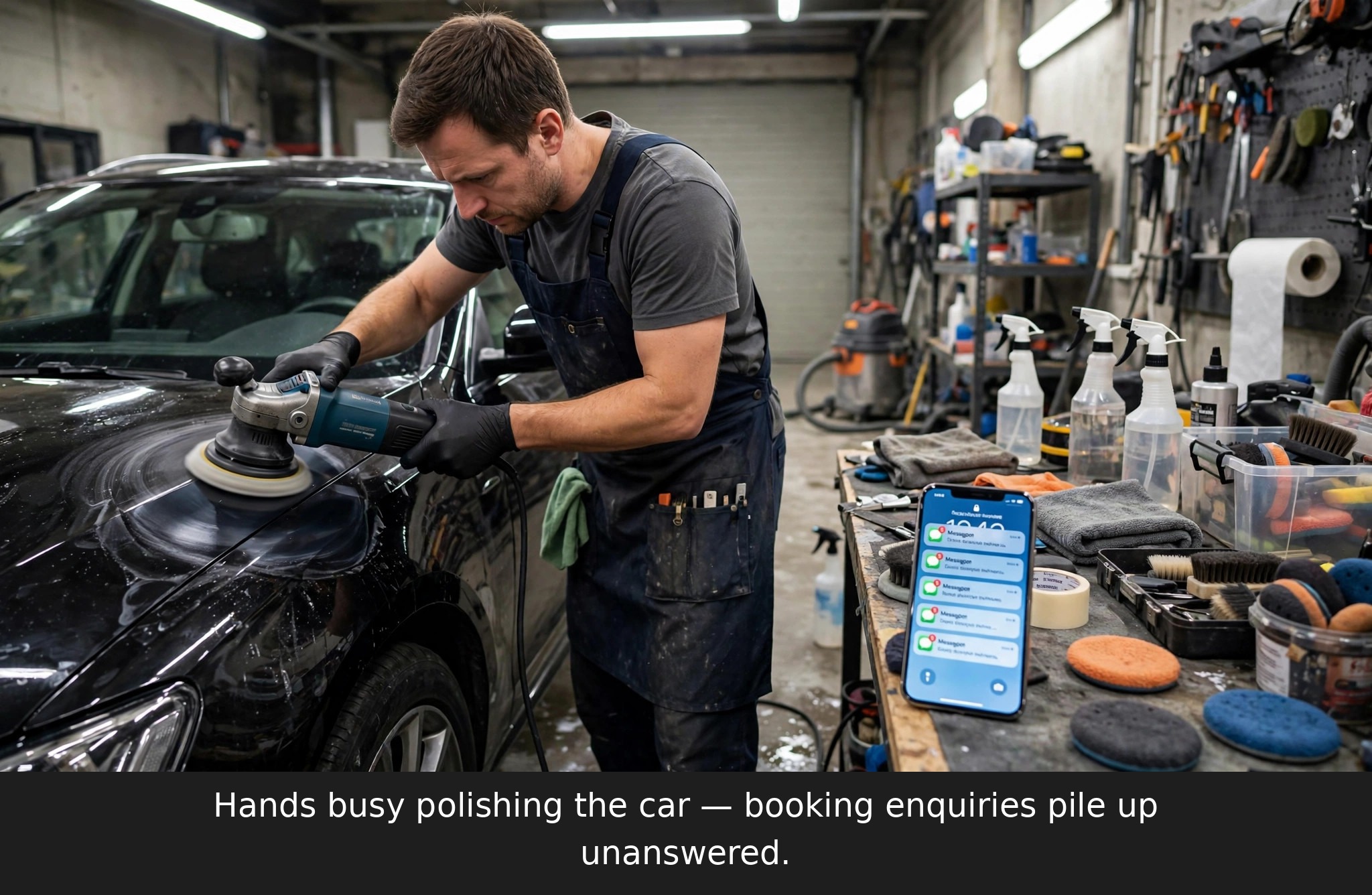
Your hands are covered in compound, you're halfway through a full detail on an SUV, and your phone buzzes on the workbench: 'How much for a full detail on my sedan?' You can't answer — and by the time you wipe your hands and check, the customer has messaged the next detailer. An AI chatbot for car detailing answers that message in seconds. It asks about the vehicle size and condition, gives a clear price range, offers your open slots, and books the job — all while you keep polishing.
Your Phone Rings When Your Hands Are Busiest
Most car detailing enquiries arrive during working hours — the exact hours you are on a job and cannot pick up the phone. This is the cruel math of the trade: the better you are at detailing, the busier your hands are, and the more enquiries you miss. Customers shopping for a detailer usually message two or three businesses and book with whoever answers first with a clear price. A vague 'call me back later' loses to an instant, specific quote almost every time. The enquiries aren't the problem — the timing is.
What an AI Chatbot for Car Detailing Actually Does
- Answers instantly at any hour — pricing, services, availability, and how long each job takes.
- Quotes by vehicle size and condition: sedan vs SUV vs truck, light clean vs pet hair and stains, interior vs exterior vs full detail.
- Books appointments into your schedule with confirmations, so jobs stop living in scattered text messages.
- Sends prep instructions automatically — 'please remove valuables and child seats before we arrive' — so you never waste time on arrival.
- Follows up with customers who asked for a quote but didn't book, with one polite nudge a few days later.
Quote by Vehicle Size and Condition — Without the Back-and-Forth
Detailing quotes die in back-and-forth. 'How much?' 'Depends — what car?' 'Honda Civic.' 'What condition?' 'Pretty dirty, dog hair.' Four messages just to start. A chatbot runs this conversation in one smooth flow: it asks the vehicle type, the service wanted, and the condition, then gives your real price range immediately. You set the pricing logic once — small car, medium, large; maintenance wash, full detail, paint correction — and it quotes consistently every time, even at midnight. Consistent quotes also protect you: no more underquoting on the phone because you were rushed between jobs.
Book the Job Into Your Real Schedule
A quote without a booking is just a conversation. The chatbot offers your actual open slots — Tuesday 10am or Thursday 2pm — and locks one in when the customer picks it. Both sides get a confirmation, and the customer gets a reminder the day before, which cuts the no-shows that leave a hole in your day. If you run mobile detailing, it also collects the address and confirms your service area before booking, so you never drive forty minutes to a job outside your zone. Home-service businesses run the same playbook — see how AI chatbots for plumbers and home services handle bookings and dispatch.
Send Prep Instructions Automatically
Every detailer has lost time to a preventable surprise: valuables scattered across the back seat, a child seat bolted in, a dog in the car. A short prep message sent automatically after booking — 'please remove valuables and personal items before your appointment' — saves you fifteen awkward minutes on every job. It also sets you up as a professional: customers arrive prepared, the job starts on time, and your day stays on schedule. Small, automatic, and worth real money across a month of appointments.
Mobile Detailers: Win on Speed and Clarity
If you go to the customer, your chatbot is your dispatcher. It confirms the address is inside your service area, gives an arrival window, and sends a 'we're on our way' style update on the day. Customers choosing between two mobile detailers pick the one that feels organized — instant answers, clear windows, no confusion. Car dealerships win the same way on WhatsApp, as shown in WhatsApp automation for car dealerships: speed and clarity beat a slightly lower price.
What Should the Chatbot Say When Someone Asks for a Discount?
Every detailer knows this message. “What’s your best price?” It usually arrives right after the quote, from a customer who likes your work but wants to pay less. This is the moment many businesses lose money — either by dropping the price too fast, or by sounding rude and losing the job. Your chatbot should have a clear, calm answer ready, written by you in advance.
The best answer holds your price and explains it in plain words. Something like: “Our full detail for a sedan is four hours of work — wash, clay, polish, interior deep clean and wax. That is why the price is what it is.” It can also point to the cheaper option: “If the full detail is more than you need, our maintenance wash keeps the car looking great for less.” Notice what it does not do: it never invents a discount you did not approve, and it never argues.
- Give it your real discount policy — for example, a lower rate for monthly maintenance plans or fleet vehicles — and nothing else.
- Let it offer the smaller service instead of cutting the price of the big one.
- Set a handoff rule: if a customer pushes twice, the chatbot passes the chat to you with the full history attached.
One more thing worth doing. Read these conversations once a month. If the same people keep asking for discounts on the same service, your price might genuinely be above what your area pays — or your quote might not be explaining the work well enough. Either way, the chats tell you the truth.
What the Chatbot Should Never Promise
A chatbot is confident by nature. It will say yes to things it cannot see, and that is where trouble starts. Your job is to teach it the limits — the honest boundaries that keep you out of arguments. Think of this section as the chatbot’s rulebook for saying “I can’t promise that.”
Stains, scratches and paint are the danger zone. “Can you get this stain out?” is a question the chatbot cannot answer honestly, because it cannot see the stain. Teach it to say: “Some stains come out fully, some only improve. We always do our best, and I’ll ask the detailer to take a close look when you arrive.” Same with scratches: it must never promise that a scratch will disappear. Paint correction results depend on how deep the damage is — only your eyes can judge that.
- Never guarantee a result — use “we’ll do our best” instead of “it will look brand new”.
- Never diagnose damage from a customer’s description — a “small scratch” in a message can be a deep gouge in real life.
- Never quote unusual jobs sight unseen — heavy soiling, mould, or flood damage need photos or an in-person look first.
When in doubt, the chatbot hands over. “Let me have the detailer confirm this one for you” is a perfect sentence. Customers respect honesty far more than a confident promise that falls apart on the day.
How to Set It Up Without Stopping Your Work
Setting up a chatbot sounds like a big project. It is not. Most detailers finish it over a weekend, in the gaps between jobs. You do it in four small steps, and you never have to close the shop for it.
Step one: write down your real prices. Vehicle sizes, service levels, add-ons — exactly as you quote them today. Step two: write your common answers. How long does a full detail take? Do you come to the customer? What should they remove from the car? You already know these answers; you type them every week.
Connect your calendar, then test it like a customer
Step three: connect your calendar so the chatbot offers real slots, not guesses. Step four: test it. Ask a friend to message it and try to confuse it — wrong vehicle type, strange questions, discount requests. Fix what sounds wrong. That is the whole setup. From then on, you only touch it when your prices or hours change — five minutes, a few times a year.
A Normal Tuesday With the Chatbot Running
Here is what changes on an ordinary workday. You are driving to your first job at 7:40 in the morning. At 7:42, a customer messages: “How much for an SUV full detail?” The chatbot answers with your price, explains what is included, and offers Thursday or Friday. By the time you park, the customer has picked Thursday. You did nothing.
Want this for your car detailing?
ReplyPilot builds a custom ai chatbot setup for your car detailing — answering customer questions instantly, taking orders and bookings, and handing off to you when a human is needed.
Ask on WhatsApp — it's freeAt 11:30 you are halfway through polishing a bonnet when another message arrives. The chatbot handles it — quotes, books, sends your prep instructions. At 2pm, yesterday’s quote that went quiet gets one polite nudge: “Still interested in the full detail? We have Friday open.” The customer books. In the evening you check your phone twice: once to see the new bookings, once to reply to the one message the chatbot handed over — a fleet enquiry with five vans.
Nothing about your work changed. You polished the same cars, took the same care. The difference is that the business kept selling while your hands were busy. That is the whole point: the chatbot does not replace your craft. It just makes sure your craft gets booked.
Three Mistakes Detailers Make With Their First Chatbot
Most chatbots fail for boring, fixable reasons. Here are the three we see most often with detailing businesses — and how to avoid each one.
- Letting it sound like a call centre. If your chatbot says “Dear valued customer,” you have already lost. Write its messages the way you actually text — short, warm, direct.
- No handoff rule. A customer asks about a ten-year-old classic car with original paint, and the chatbot loops through its script three times. Every chatbot needs an escape: unusual question, unhappy customer, or second discount ask — straight to you, with the full chat attached.
- Never reading the chat logs. Your logs are free market research. If ten people ask “do you do headlight restoration?” and it is not in your script, you have found a service to add — or at least an answer to write.
The good news: all three mistakes are fixed in an afternoon. Rewrite the tone, add the handoff rule, and put a monthly reminder on your phone to read the logs. A chatbot is not a machine you switch on and forget. It is a new employee — and new employees need a little training.
How Do You Know It’s Actually Working?
Do not judge the chatbot by how clever it sounds. Judge it by four simple numbers, compared against the month before you switched it on.
- Quotes given after hours — messages answered at 9pm, 11pm, 6am that used to sit unread.
- Bookings per week — are more quote conversations turning into calendar slots?
- No-show rate — the automatic reminders should be shrinking this.
- Your own phone time — fewer “just checking my messages” breaks during jobs.
You do not need fancy software for this. Count the bookings in your calendar, note the no-shows, and glance at how many chats happened while you were working. If the numbers move in the right direction over a month or two, the chatbot is earning its keep. If they do not, read the logs — the answer is usually there. A chatbot that books one extra full detail a week has already paid for itself many times over.
What Happens When a Customer Is Unhappy After the Detail?
Sooner or later, a complaint arrives by message. “There’s still a mark on the seat.” “The wheels don’t look clean.” How your business answers in the first ten minutes decides whether this becomes a bad review or a loyal customer. The chatbot’s job here is simple: stay calm, stay kind, and never argue.
Teach it three sentences and nothing more. One: “I’m really sorry to hear that.” Two: “Let me get this in front of the detailer right away — can you send a quick photo of the spot?” Three: “He’ll call you back today to sort it out.” That is it. The chatbot must never debate whether the mark was already there, never offer a refund on its own, and never blame the customer.
Then it hands the chat to you immediately, with the photo attached. You call back, you listen, and most of the time you fix it — a quick touch-up visit costs you an hour and earns you a customer for life. The chatbot bought you the two things that matter most in a complaint: a fast first reply, and time to respond properly instead of reacting while annoyed.
What Should the Chatbot Do When You’re on Holiday?
Detailers need days off too. But a week away used to mean a week of missed enquiries — or an anxious week of answering messages from a sun lounger. The chatbot gives you a third option: it holds the fort while you rest.
Teach it your holiday dates and one honest script: “We’re closed this week and back on Monday — but I can book you in for next week right now if you like.” It keeps quoting, keeps booking into your reopening week, and tells every customer exactly when to expect you. Nobody feels ignored, and you come home to a full diary instead of a pile of cold messages.
- Set your closed dates in advance — the chatbot switches its script automatically.
- Let it book ahead, not just for this week — a holiday is the perfect time to fill next week’s slots.
- Give it your return date, not vague words — “back Monday” beats “back soon”.
One rule: truly urgent messages still reach you. Set the chatbot to flag anything marked urgent — a fleet customer, a complaint — and send you one short summary a day. You stay reachable for the things that matter, and properly offline for everything else.
Want this kind of setup in your detailing shop?
You got into detailing because you love making cars look new — not because you love answering 'how much?' texts between jobs. An AI chatbot for car detailing handles the quoting, booking and follow-ups while your hands stay on the polisher. If you want to see it quoting with your prices and booking into your schedule, request a free custom demo at https://replypilot-site.vercel.app/ and ReplyPilot will build you a working preview for your detailing business.
Rain Days and Reschedules: When the Weather Moves Your Jobs
Detailing lives outdoors more than most trades admit — driveways, car parks, open forecourts. One rainy morning can move three jobs, and doing that rescheduling by phone takes longer than the jobs themselves. This is where the bot quietly earns its keep.
The night before a weather warning, the bot messages every booked customer: the forecast looks bad for tomorrow, here are your options — move to Thursday at the same time, or pick any slot this week. It moves each booking in your calendar as they reply. The customers it cannot reach get a morning-of message instead, with one clear offer to move the booking.
Two rules keep this from turning into chaos. First, the bot never cancels outright — it always offers two concrete alternatives, because an open-ended “let’s reschedule sometime” dies quietly. Second, it messages in order of job size: the full-day corrections get first pick of the new slots. By 9am you have a reorganised week and zero phone calls. The rain still cost you a day’s polish — but it did not cost you the bookings.
Fleet Work and Repeat Customers: The Quiet Revenue
Most detailers chase one-off full details. The steady money is in the customers who come back — the sales rep whose car needs a monthly wash, the taxi firm with four cars, the small dealership with a forecourt to keep clean. These people do not need convincing; they need remembering.
The bot keeps a simple rhythm for them. After each fleet job it books the next one on its own — “the vans are due again on the 14th, same time as last month?” — and sends the confirmation without you touching anything. For repeat retail customers, it times a gentle nudge: six weeks after a full detail, “your car is probably due a freshen-up — we have Tuesday or Thursday this week.”
One rule matters here: the bot must know your fleet terms cold — the agreed rate, the payment terms, who authorises the work. A fleet manager who gets quoted the retail price twice will not call back. Load the fleet list once, with every agreed detail, and the bot treats them like the regulars they are.
The Morning-Of Message That Saves Your Day
A detailer’s day breaks or holds in the first hour. The customer who forgot the appointment, the car that is not there, the gate that is locked — every one of these costs you the job’s profit in wasted travel. One automatic message the morning of the booking prevents most of it.
It goes out two hours before the slot: the arrival window, the address it confirms back to the customer, the prep reminder (valuables out, keys ready), and one question — “ready for us at 10?” The customer taps yes, and the job is real. No reply after thirty minutes and the bot tries once more; still nothing, and it flags you, so you decide whether to drive.
This message kills the no-show before you leave the house, surfaces address mistakes while there is still time to fix them, and repeats the prep list when the customer can still act on it. This is what separates the detailer who runs on time from the one who loses an hour a day to confusion.
Car care customers message at all hours — WhatsApp automation for car washes books washes and answers pricing questions instantly.
Frequently Asked Questions
Can an AI chatbot quote car detailing prices by vehicle size?
Yes. It asks for the vehicle type — hatchback, sedan, SUV — plus the service level and condition, then quotes from your price list. Accurate quotes upfront mean fewer haggling conversations later.
How much does a chatbot cost for a car detailing business?
Usually a modest monthly subscription. One booked full-detail job typically covers the cost. Mobile detailers especially benefit since they are always on the road and cannot answer phones.
Can the detailing chatbot book appointments while I am working on a car?
That is exactly the point. With compound on your hands, you cannot type. The chatbot checks your calendar, books the customer in, and sends prep instructions. You keep polishing; bookings pile up on their own.
Will the chatbot send prep instructions to detailing customers?
Yes. After booking, it automatically tells the customer to remove personal items, where to park, and how long the job takes. Prepared customers mean faster jobs and fewer delays in your day.
Can the car detailing chatbot handle add-on services like ceramic coating?
Yes. When a customer books a basic detail, it can mention your premium add-ons — ceramic coating, engine bay cleaning, headlight restoration. This raises your average job value without you having to upsell in person.