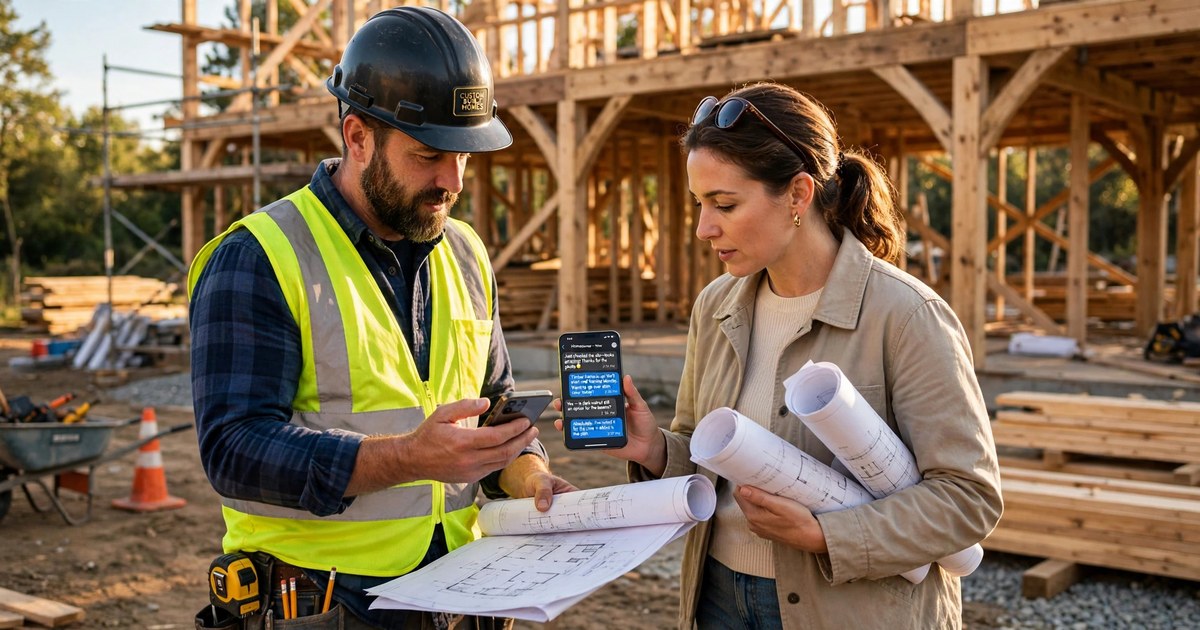
Mike runs a small custom home building company with six people on his crew and a simple website. On a good week, three families fill in his contact form. On a bad week, nobody does, even though his site gets visits every day. He found out why when he checked his phone one Monday morning. A couple had messaged on Saturday night about a lot they owned outside town. They wanted to know if Mike built on owner lots, what his starting price range was, and how long a build like theirs might take. By Monday, they had already booked a visit with another builder. Mike had not ignored them on purpose. He was on site, his hands were full, and the message sat unread in an inbox nobody watched on weekends.
That story is common in homebuilding. People shop for a builder the way they shop for anything else now. They browse late at night, after the kids are in bed, or on a lunch break at work. They want a straight answer before they give up their phone number. If the answer is slow, they move on. If the answer is vague, they move on too. An ai chatbot for homebuilding guidance and builder matching is built for that moment. It talks to the visitor right away, asks the right first questions, and sorts a real lead from a casual browser, so a builder like Mike spends his call time on people who are ready to build.
For a home builder, an AI chatbot means every website visitor gets a fast, helpful reply day or night, even when your crew is on site. It asks about lot, budget, and timeline, books model-home visits, and hands warm leads to you with notes, so you call back people who are ready to talk, not every cold click.
What home buyers actually ask before they ever call
Most first messages from home buyers sound simple, but they carry a lot of weight. A buyer might ask if you build in their town, if you work on land they already own, or if you have lots of your own to sell. They might ask for a price range for a four-bedroom home, or what is included in that price. They might ask how long the whole job takes, from first drawing to keys in hand. None of these questions can be answered with one number, and a good chatbot should not pretend otherwise.
The job of the chatbot at this stage is to guide, not to close. It can explain that price depends on the plan, the finishes, and the lot, and then ask a few short questions that narrow things down. Does the buyer own a lot already, or are they still looking? What town or school area matters to them? Are they hoping to start this year, or are they planning for next year? Each answer helps the builder see the shape of the job before the first call.
This early chat also saves the buyer from a dead end. Many builder websites only offer a form that says someone will reply within two business days. Two days is a long time when three other builders answer in two minutes. A chatbot that replies at once, asks one clear question at a time, and explains what happens next keeps the buyer on your site instead of sending them back to search results to try the next name on the list. Readers who want to see how this kind of first-contact chat works for trade businesses can look at the best AI chatbot for contractors page for a close comparison.
Builders lose jobs for a reason that has little to do with skill. Building work happens away from a desk. When the framer needs a decision, when concrete is coming, or when a walkthrough runs long, the phone stays in a truck. Website messages pile up. A family that messaged at noon may get a reply at seven in the evening, after they have already talked to a builder who answered at noon.
Speed matters more than polish here. Buyers do not expect a chatbot to sign a contract. They expect it to be awake, polite, and useful. It should say hello, ask what they are building, and give a clear next step. That next step might be a model-home visit, a short call, or a plan review. The point is that the buyer leaves the chat knowing something real: a time, a date, or a named person who will call them back.
Lot and land questions the chatbot can sort out first
Land causes more confusion than almost any other part of a custom build. A buyer may own a lot, may be about to buy one, or may want the builder to find one. Each path changes the conversation completely. A chatbot can sort this out in two or three questions, before a sales call is ever booked.
First, it can ask if the buyer owns land already. If the answer is yes, it can ask where the lot is, how big it is, and whether services like water, sewer, and power are already at the lot line. If the answer is no, it can ask which towns they like and whether they want help finding lots the builder already works with. It should never guess about soil, slopes, or zoning. It can simply note the details and flag anything that needs the builder's own eyes on the site.
Third, the chatbot can book the right next step for each case. A buyer with a lot might need a site visit. A buyer without one might need a lot list or a short call about areas. A buyer who is still unsure might want to visit a model home first and talk about lots in person. Matching the next step to the buyer's real situation is what builder matching means in practice. It is not a fancy label. It is the difference between a booked visit and a wasted call.
Budget, allowances and upgrades without guessing games
Money questions make many builders nervous, and for good reason. No honest builder can quote a finished home from one chat message. But silence on price is worse than a careful range. Buyers need some sense of whether they are in the right place before they share personal details or book a visit.
A chatbot can handle this by asking about budget range in bands, not exact figures. It can offer ranges the builder sets, such as a starting range for a plan type, and explain what that range usually covers. It can also explain the idea of allowances in simple terms. An allowance is a sum set aside in the contract for an item the buyer will pick later, like kitchen counters or light fixtures. If the buyer picks something above the allowance, the difference is an upgrade cost. If they pick below it, they may get a credit. Many first-time custom buyers have never heard this word, and they feel foolish asking about it on a call. A chatbot lets them ask without embarrassment.
Upgrade confusion is where many builds lose trust. A buyer may fall in love with a model home, then learn that the stone front, the taller ceilings, or the upgraded kitchen in that model were not in the base price. A chatbot can walk through this calmly. It can list what the model shows, what is standard, and what is an upgrade, using the builder's own list. It should never invent prices. Every number it gives should be a number the builder has set and can stand behind. When a buyer asks for something outside that list, the chatbot should say so plainly and offer a call to talk it through.
This kind of honest budget chat does two useful things. It filters out buyers whose budget is far below the builder's range, kindly and early, before anyone wastes a Saturday on a visit. And it warms up the buyers who are in range, because they arrive at the first call already understanding allowances, upgrades, and what their money can buy. For roofing and other trade businesses, the same first-contact pattern shows up in the AI chatbot for roofing companies guide, where price-range questions also decide whether a visit is worth booking.
Many builders also ask whether the same chat helper can keep working after the sale, on a channel buyers already use every day. That question is answered in full on the best WhatsApp automation tools guide, which explains how WhatsApp follow-ups fit alongside website chat for a small business. The point for a builder is simple: the website chat starts the job, and the follow-up channel keeps the buyer close while selections and stages move along.
Plan sets, selections and the choices that stall a build
After lot and budget, the next wall buyers hit is choice overload. A custom home means hundreds of choices: plan layout, kitchen shape, flooring, paint, doors, taps, lighting, and more. Buyers love choice in theory. In practice, too many open choices at once can stall a build for weeks.
A chatbot helps by breaking selections into small, timed steps. Early on, it can ask which plan the buyer likes, or whether they want a one-storey or two-storey layout. It can explain what a plan set includes: floor plans, elevations, and the drawings the trades need to price and build the work. Later, once a buyer is under contract, the same chat helper can answer selection questions: when are kitchen choices due, what happens if a chosen tile is out of stock, and who confirms a change before it is ordered.
See it answer your customers' questions
ReplyPilot builds a website chatbot trained on your services, your prices and your booking rules — it answers in seconds, books the job, and passes tricky conversations to you with the full history attached.
Ask on WhatsApp — it's freeReal detail matters here. A generic chat helper that talks about homes in general will sound smooth and say nothing. A builder-specific helper that knows your three most popular plans, your standard finish list, and your selections order sounds like your company. Buyers notice the difference. They trust the second one, because it answers their exact question instead of giving a smooth paragraph that could fit any builder in any state.
How the wider market is already moving
The wider market gives a useful sense of where buyer expectations are heading. Semrush data via PowerSEOTool, recorded in the bank on 2026-11-04, puts this keyword at 1,000 searches a month, with a keyword difficulty of 11 percent and a cost per click of zero, and the manual check found a thin first page. That combination matters for a builder using an ai chatbot for homebuilding guidance and builder matching. It means real people are searching in these words, the page they land on is thin, and a genuinely helpful builder page has room to stand out.
The manual search on 2026-11-05 found a mixed first page, and each result tells a different part of the story. One result was the Modernize HomeBuddy AI launch, a May 2026 beta product for homeowner guidance. Another was HomeHelp.ai, a contractor matching service. A third was Ridgebeam, a tool aimed at custom builders. A fourth was a Devpost hackathon project from an owner-builder angle. None of these pages, as observed, was a single builder's own chat helper answering lot, budget, and timeline questions in that builder's voice. That gap is the opening. A builder does not need to out-build a national platform. A builder needs one page, and one chat helper, that answers local buyers better than a thin national result does.
Scheduling the trades in the right order
Homebuilding is a chain. The framer comes before the electrician and plumber rough in their work. Inspections come at set stages. Drywall cannot go up until rough-ins pass. Paint comes late. Flooring comes later still. When one trade slips, the next one shifts too, and buyers feel every delay even when the reason is simple.
A chatbot cannot run a job site, and it should never claim to. What it can do is answer the scheduling questions buyers and even trade partners ask most often. A buyer might ask what stage their home is at, or what happens next. The chatbot can give the builder's current stage in plain words, using updates the builder has entered, and explain what the next stage involves. A trade partner might ask about access times or the next walkthrough date. The chatbot can pass that message to the builder with the job name attached, instead of letting it sit in a general inbox.
Change orders and mid-build updates that keep trust
Nothing tests a builder-client relationship like a change order. A buyer wants to move a wall, add a window, or change a finish after work has started. Sometimes the change is easy. Sometimes it means rework, extra material, or a new inspection. The worst way to handle it is silence, followed by a surprise cost on the next invoice.
A chatbot can make change orders less painful by being clear from the first message. It can explain that a change order is a written change to the agreed work, with its own price and time effect, and that no change is made until the buyer approves it. It can collect the details: which room, what change, and why the buyer wants it. It can then pass a tidy note to the builder, who prices it and replies with real numbers. The chatbot never prices the change itself. That line matters, because a guessed price on a change order is how trust breaks.
Mid-build updates work the same way. Buyers do not need daily reports. They need regular, honest updates in plain words: framing is done, rough-ins start next week, the kitchen selections are due by a certain date. A chatbot can share the latest update the builder has entered, and it can tell the buyer who to contact if they have a question about that stage. It should never invent a finish date. If the builder has not set a date, the chatbot should say the builder will confirm it, and offer to pass the question along.
Permit-stage waiting and honest answers that never promise a date
Permit waiting is the quietest, hardest part of a build for many buyers. Paperwork goes in, and then nothing visible happens for weeks. The buyer drives past an empty lot and wonders if anything is happening at all. A chatbot cannot speed up a city office, and it must never pretend it can.
What it can do is explain the stage in honest terms. It can say that the plans are under review, list what was submitted, and explain that review times vary by office and by project. It can answer the questions buyers ask most: what happens if the office asks for a change, who answers that request, and how the buyer will hear about it. Every one of those answers should end with the same promise: the builder will share news as soon as the office gives it, and no date will be guessed in the meantime.
This honesty is also a sales strength before a contract is signed. A buyer shopping for a builder should hear, early, that permit timing is outside any builder's full control. A builder who says this plainly sounds more trustworthy than one who hints at a fast approval to win the job. A chatbot that carries that honest message, in the builder's own words, sets the right expectation before money changes hands.
Setting it up so it sounds like your company
A chatbot only works for a builder if it sounds like that builder. Buyers can tell when answers are generic. They can also tell when answers use the builder's real plan names, real towns, and real process words. Setup, then, is mostly writing down what your company already says on calls, in the order you say it.
Start with the first five questions you ask every caller. For most custom builders, they are: where is the lot, what town do you want to live in, what size home are you thinking about, what budget range are you working with, and when do you hope to start. Put those questions, in your words, into the chatbot first. Next, add your short answers for the questions you hear every week: what is included in a base price, how allowances work, what the selections order is, and how change orders are handled. Keep each answer short enough to read on a phone.
Then set the limits. List the questions the chatbot must pass to you at once: anything about a specific lot problem, a price outside your set ranges, a permit ruling, or a change order cost. List the next steps it may offer on its own: a model-home visit, a short call, a lot list, or a plan review. When those two lists are clear, the chatbot stops being a risk and starts being a reliable first team member.
ReplyPilot builds AI chat agents for local businesses that answer customer messages on WhatsApp, Instagram and the web. For a builder, that means the same first-chat help can live on your website and keep working on the channels your buyers already check. The product fits here as a ready-made next step, not as a replacement for your judgment. You still price the job, walk the lot, and sign the contract. The chat helper just makes sure the first conversation happens fast, and that the notes from it reach you in usable shape.
Pricing is plain, so a builder can judge it without a sales call first. Setup is 249 dollars, split as a 125 dollar deposit and 124 dollars at go-live, and the Care Plan is 99 dollars a month. Those are the real figures, stated here so a builder can compare the cost against one lost job. One missed Saturday enquiry can cost far more than a month of the plan, and one well-handled first chat can pay for the setup many times over. There is no promise of a set number of leads, because no honest tool can promise that. The promise is simpler: faster first replies, better notes, and fewer good buyers slipping away while you are on site.
When you are ready to see it on your own site, book a ReplyPilot demo and walk through your first five questions with the team.
Frequently asked questions
Can an AI chatbot quote the price of my custom home?
No, it should not quote a finished price from a chat message. It can share price ranges you have set, explain what those ranges cover, and explain allowances and upgrades in plain words. The real quote still comes from you, after you know the lot, the plan, and the finishes.
Will a chatbot replace calls and model-home visits?
No, it makes those steps better. It handles the first questions, collects lot, budget, and timeline details, and books the visit or call. You still meet the buyer, walk the lot, and talk through the plan in person, but you start that meeting with useful notes instead of a blank form.
What if a buyer asks about a permit date?
The chatbot should never promise a permit date. It can explain the review stage, what was submitted, and that timing varies by office and project. It should pass the question to you and tell the buyer you will share news as soon as the office gives it.
Can the chatbot help buyers who are already mid-build?
Yes, if you feed it your real stage updates. It can share the current stage, explain what happens next, note selection deadlines, and collect change-order details for you to price. It must never invent a finish date or price a change itself.
Does a small builder need this, or is it only for large companies?
A small builder may need it most. Large companies often have office staff to answer messages. A small crew is on site all day, so messages wait longest. A chat helper covers those hours and hands you a short, tidy lead note, so you spend call time on buyers who are ready.