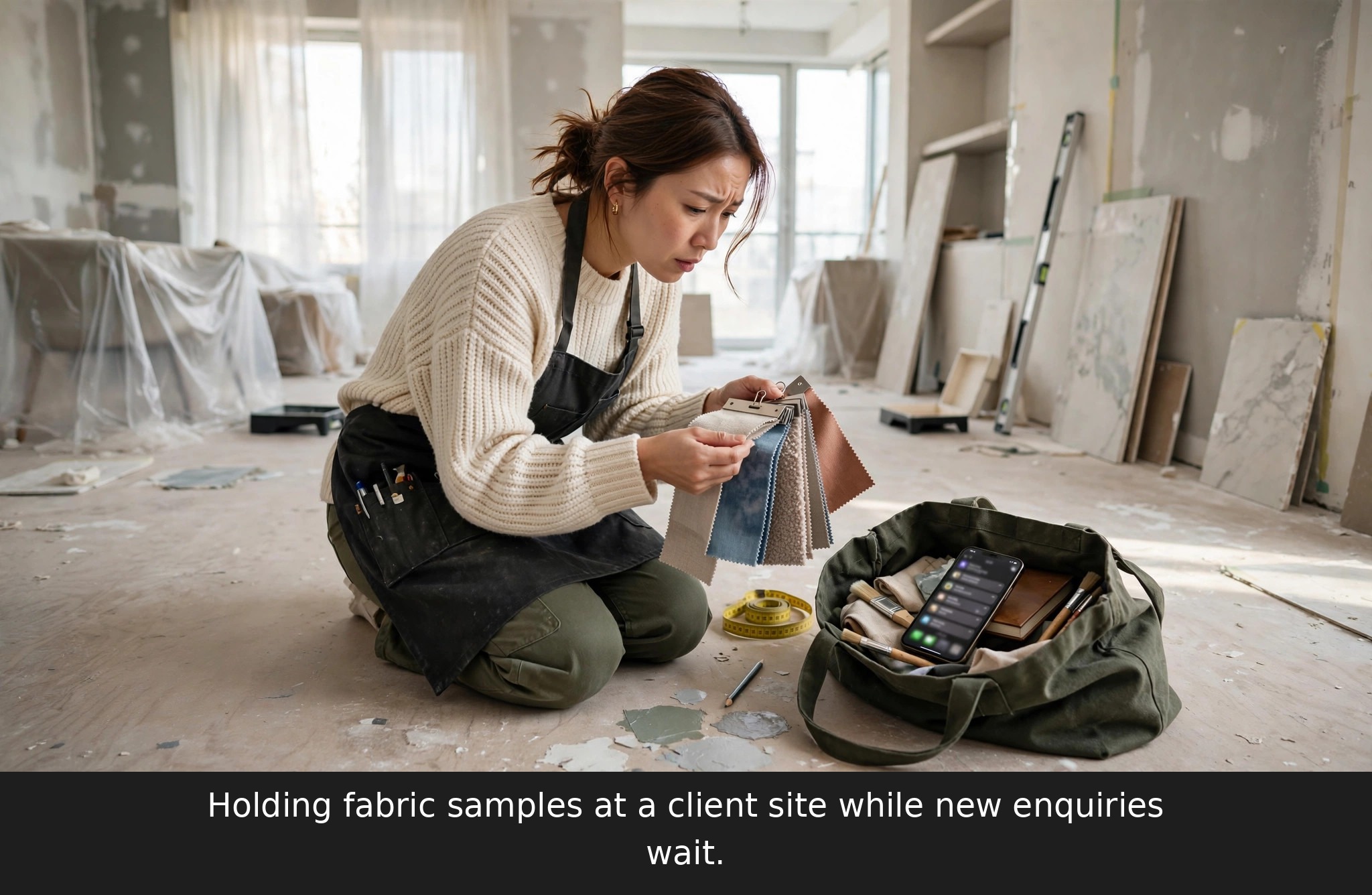
You're kneeling on a client's living room floor, fabric samples spread out, measuring tape in hand. Your phone buzzes in your bag: a new enquiry. 'Hi, do you take on small flats? What's your fee?' You can't stop mid-appointment to chat — and by evening, that potential client has messaged two other designers. An AI chatbot for interior designers answers her right away. It asks about the project, shares relevant portfolio work, and books a discovery call into your calendar — while you stay focused on the client in front of you.
Site Visits and Enquiries Never Happen at the Same Time
Interior designers spend most of their working day on site — measuring rooms, meeting contractors, checking paintwork — not sitting at a desk answering messages. Meanwhile, new clients browse portfolios in the evening and message when inspiration strikes. The result is a permanent mismatch: enquiries arrive when you are least able to answer them, and the clients who get a fast, warm reply from a competitor rarely come back. This isn't about working longer hours. It's about having someone — or something — answer while you can't.
What an AI Chatbot for Interior Designers Actually Does
- Greets every new enquiry instantly and asks the qualifying questions: how many rooms, what city, rough budget range, and ideal timeline.
- Answers portfolio questions in your words — 'have you done small apartments?' gets a real answer with links to your relevant projects.
- Explains how you work: your process, your fee structure, what a discovery call covers, and what happens after.
- Books discovery calls into your calendar with confirmations and reminders, so consultations stop living in DM threads.
- Collects project details before the call — photos of the space, style preferences, must-haves — so you arrive prepared.
Qualify Clients Before the First Call
Not every enquiry deserves an hour of your time. Some clients want a full home renovation and your minimum project size is one room; others have a budget far below your starting fee; some need work done next week when you're booked for two months. A chatbot asks about room count, budget range, timeline and city early — politely, conversationally — and routes each enquiry correctly. Strong fits get nudged toward your calendar. Poor fits get an honest, kind answer instead of a wasted consultation. Asking about budget and timeline early saves both sides an awkward call, and it positions you as a professional with a real process. Real estate agents qualify buyers the same way before viewings — see AI chatbots for real estate agents.
Answer Portfolio Questions in Your Own Words
'Do you do modern styles?' 'Have you worked with small budgets?' 'Can I see a kitchen you designed?' These questions decide whether a client books a call — and they arrive when you're on site. Train the chatbot on your real portfolio: which projects to show for which question, how you describe your style, what you're honest about not doing. A client who sees two relevant projects before the first call arrives warmer, more trusting, and more ready to hire. Photographers handle portfolio enquiries the same way — read how in AI chatbots for photographers. The principle is identical: show the right work at the right moment, automatically.
Book Discovery Calls Without the Scheduling Dance
'Are you free Thursday?' 'Thursday's full — how about next week?' Every round of scheduling ping-pong is a chance for the client to cool off. Connect your calendar and the chatbot offers your real availability inside the conversation, books the slot, and sends a reminder beforehand. Ask for two things before the call: photos of the space and a rough idea of their style. You walk into every discovery call already picturing their rooms instead of starting from zero — and clients notice the difference. Prepared designers win projects; unprepared ones just chat.
Sound Like a Designer, Not a Call Centre
Interior design is personal — clients invite you into their homes. A stiff, robotic chatbot kills that intimacy instantly. Write its messages the way you actually talk to new clients: warm, curious, a little stylish. Let it ask about their dream for the space, not just their budget. And give it honest boundaries: what you don't do, your minimum project size, the cities you serve. Clients respect clarity far more than vague promises. Check the chat transcripts monthly — the questions clients keep asking are the questions your website should answer better.
What Should the Chatbot Say When the Budget Is Too Small?
This is the conversation designers dread: a lovely enquiry, a project you would enjoy — and a budget at half your minimum. Handled badly, it feels rude. Handled well, it protects your time and leaves the door open. Your chatbot should handle it with the same grace you would.
Teach it your real minimum, and a kind script around it: “Thank you for thinking of us! Our full-service projects start at our minimum, which covers design, sourcing and site management. If that’s beyond reach right now, our one-off consultation gives you a complete plan you can carry out yourself.” No shame, no lecture — just clarity and an alternative.
- Always offer the next step down — a consultation, an e-design package, or a paid advice call — instead of a flat no.
- Never let the chatbot hint it can “work something out” or “see what we can do.” Vague hope wastes everyone’s time.
- Keep the door open: “If your plans change down the road, we’d love to hear from you.” Today’s small budget is sometimes next year’s renovation.
The hidden benefit: every polite decline trains your market. People learn what you cost before they message, and your future enquiries arrive better qualified. A chatbot that says no kindly is doing your positioning work for you.
A Week of Enquiries With the Chatbot Running
Monday evening, 8pm. You are at a site visit, paint samples in hand. A new enquiry lands: a couple renovating a three-bedroom flat. The chatbot greets them, asks about rooms, city, budget range and timeline, shares two relevant portfolio projects, and books a discovery call for Thursday. You find out over breakfast on Tuesday — with their photos already attached.
Wednesday brings the opposite: an enquiry for a single rented room, budget far below your minimum, needed next week. The chatbot thanks them kindly, explains your minimum project size, and points them to your consultation option. No awkward call, no hour lost. Friday night, 11pm: “Do you do kitchens in a modern style?” The chatbot shares your two best kitchen projects instantly. By Monday morning, that client has booked too.
Notice what did not happen all week: you never stopped a site visit to type, never played scheduling ping-pong, never sat through a call with someone who could never afford you. The chatbot did the filtering, the answering and the booking. You just showed up to prepared, qualified conversations.
The Questions You Must Teach It Before Launch
A designer chatbot that only knows your phone number is useless. Before it meets a single client, it needs your real answers to the questions every enquiry asks.
- How you work — your process from first call to finished room, in plain steps.
- Your fee structure — how you charge, what it includes, and your minimum project size.
- Timelines — how long a typical project takes, and how far ahead you are booked.
- Your boundaries — the cities you serve, the project types you do not take, and what a discovery call covers.
- Your style, in your words — how you describe what you do, with the portfolio pieces to prove it.
Write these the way you speak, not the way a brochure reads. Feed it real replies you have sent to real clients. Then test it hard: ask about a project type you dislike, a city you do not serve, a budget below your minimum. Every wrong or vague answer is a fix to make before launch. An hour of testing now saves months of awkward chats later.
What Your Design Chatbot Must Never Promise
Design projects run on other people’s work — contractors, suppliers, shipping — and a chatbot must never promise what those people will do. These limits keep you out of trouble.
Want this for your interior designers?
ReplyPilot builds a custom ai chatbot setup for your interior designers — answering customer questions instantly, taking orders and bookings, and handing off to you when a human is needed.
Ask on WhatsApp — it's free- Never promise timelines. “The renovation will take six weeks” is a promise your contractor might break. The chatbot says: “A project like this usually takes around this long, but we’ll confirm a schedule after the site visit.”
- Never quote material costs as fixed. Prices move; the chatbot gives ranges and says final numbers come with the proposal.
- Never promise a client an exact look. “It will look just like this photo” becomes “We’ll aim for this feel — every space and light is different.”
- Never commit you to a start date. It offers discovery calls, not project start dates — your calendar decides those.
The pattern is simple: ranges, not promises; next steps, not guarantees. Clients actually trust this more. A designer whose chatbot says “we’ll confirm after seeing the space” sounds careful and professional. One that promises the moon in a chat sounds like trouble later.
How to Handle the “Just Tell Me the Price” Client
Every designer meets this client: “I don’t want a call, just tell me what a living room costs.” They are not rude — they are busy, or they have been burned before. Your chatbot should meet them where they are, without inventing numbers.
The honest answer explains why the number depends: “A living room can mean new cushions or new everything — the range is wide. Our full-service projects start at our minimum. If you share a few photos, I can tell you in one call whether we’re the right fit, and it takes twenty minutes.” It respects their time, gives them a real starting point, and nudges toward the call — where design actually gets sold.
Some will still refuse the call. Let them go politely: “No problem — here’s our consultation option if you’d like a fixed-fee plan to start with.” Never let the chatbot throw out a made-up figure just to keep the chat alive. A wrong number quoted in a chat becomes the number the client holds you to. Silence is cheaper than an invented price.
Five Mistakes Designers Make With Their First Chatbot
Design chatbots usually fail on taste, not technology. Five mistakes come up again and again.
- Free design advice in the chat. “What colour should my sofa be?” is a consultation, not a chat question. The chatbot should answer briefly, then book the call: “That’s exactly what our discovery call is for — shall I find you a slot?”
- Generic style descriptions. “We create beautiful, functional spaces” could be anyone. Train it on how you really talk about your work — specific, opinionated, yours.
- Endless chatting with no booking nudge. A chatbot that answers twelve questions and never suggests a call is a very polite time-waster. Every few messages, it should offer the next step.
- Stale availability. You blocked out two weeks for a big project but the chatbot still offers those days. Sync it with your real calendar and check it weekly.
- No handoff for the unusual. Listed-building rules, structural questions, contractor disputes — the chatbot must pass these to you, not improvise.
Read your chat logs monthly with these five in mind. The logs will show you exactly which mistake you are making — usually within the first ten conversations.
How Do You Know Your Design-Studio Bot Is Working?
A design chatbot is not there to chat. It is there to fill your calendar with the right people. Measure that.
- Qualified calls booked — how many discovery calls came through the chatbot this month, and how many were genuine fits?
- Show-up rate — confirmation reminders should be cutting no-shows.
- Call preparation — are clients arriving with photos and a clear brief, because the chatbot asked?
- Time saved — how many poor-fit enquiries were handled without taking an hour of your week?
Track these for two months and compare against your old way of handling enquiries — the DM threads and the missed calls. Most designers notice the difference in the first month: fewer wasted calls, better-prepared clients, and enquiries answered at 11pm that used to vanish. One extra converted project pays for the whole year.
What Should the Chatbot Do After the Project Ends?
Most designers go quiet after handover. The project is done, the photos are taken, and the client disappears — until, years later, they message out of the blue about their next home. That gap is wasted opportunity. A finished project is the start of your best marketing, and the chatbot can run it.
A week after handover, it sends a warm check-in: “How are you settling into the new living room? If you’re happy with how it turned out, a short review would mean the world to us.” Happy clients write the reviews that win your next projects — but only if someone asks. The chatbot can also ask one more thing: permission to photograph the finished space for your portfolio, if you haven’t already.
- Ask for the review while the excitement is fresh — a week after handover, not six months later.
- Request referrals gently: “If you know anyone dreaming about their own space, we’d love an introduction.”
- Note the client’s next plans — “we’ll do the bedrooms next year” is a future project to follow up on.
Then, once or twice a year, a light touch: a festive message, or a note when you publish a project like theirs. Not selling — staying remembered. Interior design runs on trust and timing. The chatbot keeps you in the client’s mind, so when the next project comes, you are the only designer they call.
Want this working in your design studio?
Your best work happens on site, with samples in your hands — not in your inbox at 11pm. An AI chatbot for interior designers handles the qualifying, the portfolio answers and the booking while you're with the client in front of you. If you want to see it answering with your portfolio, your process and your voice, request a free custom demo at https://replypilot-site.vercel.app/ and ReplyPilot will build you a working preview for your design studio.
How Should the Chatbot Handle “Can You Work With What I Already Have?”
A large share of enquiries are not “design my whole home” — they are “I like my sofa, can you work around it?” These refresh clients are often your easiest, happiest projects, but only if expectations are set early. Teach the chatbot to welcome the question and ask for photos of the pieces they want to keep. It should explain, in your voice, what working with existing pieces looks like: you design around them, you are honest about which pieces fight the look they want, and some rooms have a limit on how far kept furniture can go. The bot can also name your lighter refresh-style service if you offer one — a smaller package with a smaller fee — which turns a “maybe too small” enquiry into a booked consultation instead of a polite decline. Clients who feel heard about the sofa they love become clients who trust you with the rest of the room.
Why the bot should ask for photos before the call
“Can you work with what I have?” is unanswerable without seeing what they have. The chatbot should request a few phone photos of the room and the key pieces as a natural part of the chat — not as homework, but as “send me two or three photos and I can give you a much better answer on our call.” Clients comply happily because it clearly helps them. You walk into the discovery call already knowing whether the beloved sofa is a treasure or a problem, and the client feels taken seriously from the very first message.
What About the Client Who Wants a Pinterest Room Copied Exactly?
Every designer knows this message: a Pinterest board and “I want exactly this.” Said bluntly, “no” sounds arrogant; said weakly, it becomes a promise you cannot keep. The chatbot should handle it with warm honesty: it loves the taste shown in the images, and explains that exact copies disappoint — different light, different room shape, different budget — while a room inspired by the same feeling usually turns out better. The key line is reassurance, not refusal: “We can absolutely create that calm, warm feeling in your space — let us show you how it translates to your rooms.” Then it books the call, where your portfolio does the convincing. Handled this way, the Pinterest client stops being a risk and becomes one of your most decisive clients, because she already knows what she loves.
Should the Chatbot Mention Your Consultation Fee Upfront?
If you charge for the first consultation — and many established designers do — the chatbot should say so early, plainly, and without apology. Hiding the fee until the call wastes everyone’s time and creates the exact awkwardness you want to avoid. A good script sounds like this: “Our initial consultation is a paid session — it includes a full walkthrough of your space and a written plan of recommendations, and the fee comes off your project if you go ahead with us.” Notice what that does: it frames the fee as value, not a barrier, and the credit-toward-project line removes the sting. Clients who pay for the first call arrive serious, prepared, and respectful of your time. The ones who vanish at the mention of a fee were never going to hire you — the chatbot just saved you an hour finding that out.
The Couple Who Disagrees: A Conversation the Bot Must Not Take Sides In
Sooner or later the chatbot meets them: one partner wants minimal and calm, the other wants bold and cosy, and both are messaging. This is a moment where a clumsy bot does real damage — agreeing with whoever typed last, or suggesting a compromise that pleases nobody. Teach it the only correct move: warm neutrality. It acknowledges both tastes genuinely, notes that blending two styles is one of the most common parts of the job, and books a joint call where you — the professional — navigate it live. Something like: “That mix is more common than you would think, and it usually leads to the most interesting rooms. This is exactly what our first call is for — shall we find a time you are both free?” The bot never adjudicates taste. It just makes sure both partners feel heard, and that the call happens with both of them in it.
Designers and furniture sellers answer the same customer questions daily — WhatsApp automation for furniture stores puts those answers on autopilot.
Frequently Asked Questions
Can an AI chatbot qualify interior design clients by budget?
Yes. It asks about room count, project scope, timeline, and budget range before you ever get on a call. Clients below your minimum get helpful resources; serious ones get booked into your consultation calendar.
How much does a chatbot cost for an interior design studio?
Pricing is usually a monthly fee based on conversation volume. A single qualified consultation that converts covers months of cost. For high-ticket services like design, the maths is very favourable.
Can the chatbot show my interior design portfolio to enquiries?
Yes. When someone asks "Do you do modern kitchens?", it shares relevant portfolio photos and project details. This happens instantly, even at midnight. Your best work sells itself while you sleep.
Will a chatbot feel too cold for a luxury design brand?
Not if it is trained in your voice. Luxury is about responsiveness and attention — a fast, elegant reply feels more premium than silence until Monday. You control the tone, wording, and when it hands over to you.
Can the interior design chatbot schedule site visits?
Yes. After qualifying the enquiry, it offers your real consultation slots and books the visit. It sends a confirmation with what the client should prepare — measurements, inspiration photos, budget. You arrive to a prepared client.