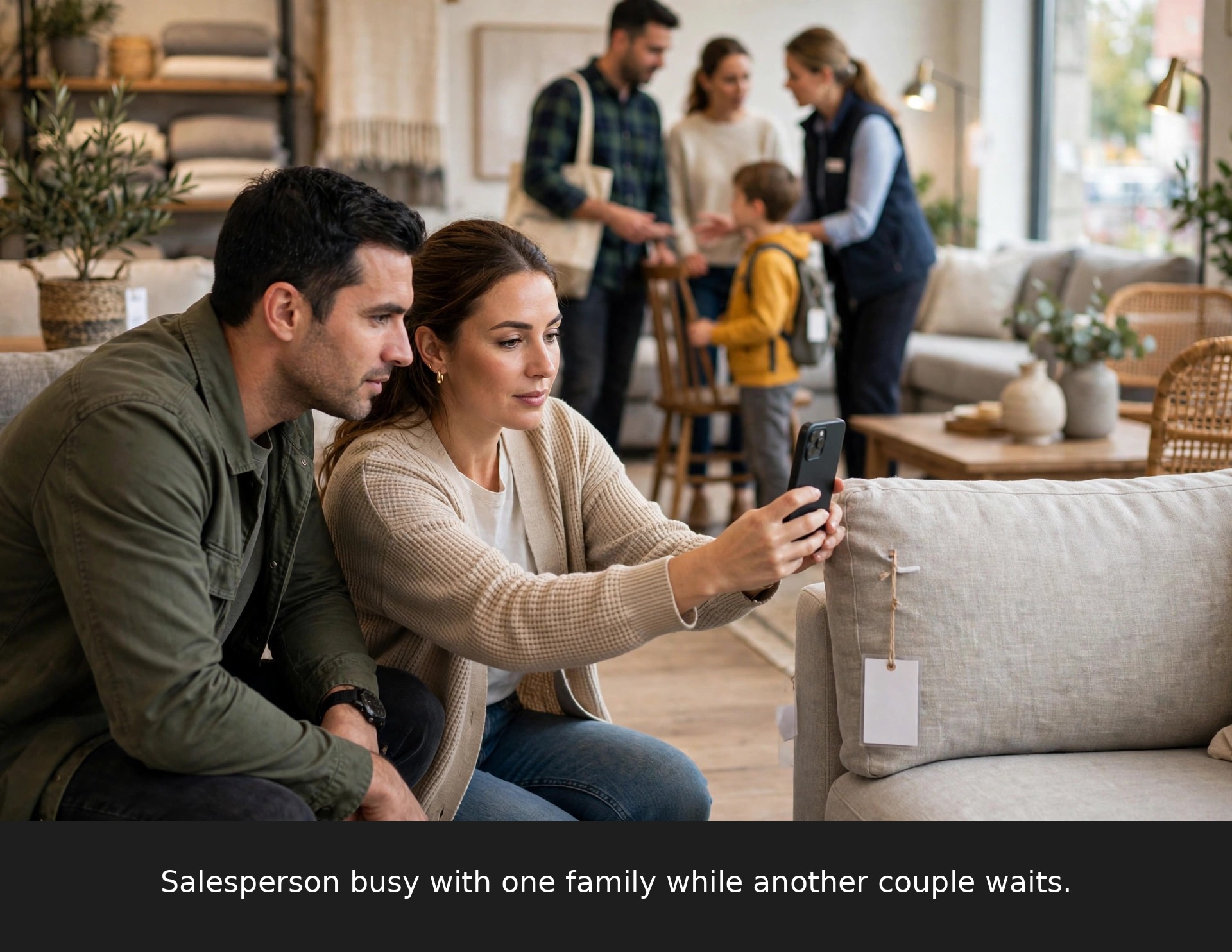
Saturday afternoon. A couple walks through your showroom, and she stops at the grey sectional. She sits on it. She looks at him. He nods. She takes a photo of the price tag. 'We'll think about it,' she says with a smile, and they leave. That evening, at 9pm, she messages your WhatsApp: 'Hi, is the grey sectional still available? What's the delivery time to our area?' Your phone is in your pocket. You're having dinner. You'll reply tomorrow morning. By then, she's visited your competitor's website, found a similar sectional, and ordered it with free next-day delivery. Online-first stores win those moments - ecommerce store assistants shows how chatbots recover shoppers who buy without visiting a showroom. The sale - $1,800, gone. Not because your sofa was worse. Because your reply was 14 hours late. This is the brutal reality of furniture retail in 2026: customers decide in the showroom but buy on WhatsApp, and whoever answers fastest wins. WhatsApp automation for furniture stores lives in that gap. It answers the 9pm message in seconds with your real stock, your real delivery schedule, and a path to purchase - while you're having dinner.
Why Furniture Sales Die After the Showroom Visit
Furniture is not an impulse buy. Nobody walks in and buys a $2000 dining set in ten minutes. The typical journey looks like this: visit the showroom, fall in love with something, take photos, go home, measure the room, discuss with family, compare with two other stores, message questions, and eventually - maybe - buy. That 'eventually' is where sales go to die. Industry data suggests that furniture stores convert only a small fraction of showroom visitors, and the drop-off happens almost entirely in the follow-up phase. The customer was interested. Then life happened. Then they forgot. Then they bought from whoever was easiest.
The questions that come over WhatsApp after a visit are always the same: 'Is it still in stock?' 'What are the exact dimensions?' 'How much is delivery to my area?' 'Can I pay in installments?' 'Do you have it in blue?' Each of these is a buying signal - the customer is doing final checks before purchasing. But each one is also a moment of friction. If the answer takes hours, the momentum fades. If it takes a day, they've moved on. The store that answers in 30 seconds keeps the excitement alive. The store that answers tomorrow gets 'thanks, we already ordered elsewhere.'
Let's quantify it. Say your store gets 200 showroom visitors a month. If 40 message you afterward with questions, and you convert half of the ones you answer quickly but only a tenth of the ones you answer slowly, the difference is enormous. At an average sale of $800, converting even 5 extra browsers a month is $4,000 monthly, $48,000 annually. That's not new traffic. That's not new advertising. That's just answering the messages you already receive, faster than you currently do.
Instant Answers From Your Real Inventory
The foundation of furniture WhatsApp automation is simple: it knows what you have, what it costs, and when you can deliver it. When the couple messages about the grey sectional at 9pm, the assistant checks your actual inventory: 'Yes! The grey sectional is in stock - $1,799. Dimensions are 280cm x 180cm. We deliver to your area every Tuesday and Friday - want me to book you in for this Friday?' That's not a generic reply. That's a salesperson working at 9pm, with perfect product knowledge, closing the sale.
It handles the full range of product questions. Dimensions, materials, colors, warranty terms, assembly - all from your real catalog. 'Is the oak dining table solid wood or veneer?' 'Solid oak top, $1,200, seats 6. We have 3 in stock.' 'Do you have the blue armchair?' 'The blue sold out, but we have it in green and beige - want photos?' Every answer is accurate because it's pulled from your data, not generated from guesswork. And when something isn't in stock, it's honest about it - then offers alternatives instead of just saying no.
Delivery questions are where it really shines, because delivery is where furniture purchases get complicated. The assistant knows your delivery zones, your schedule, your charges: 'Delivery to your area is $50, free on orders over $1500. We deliver Tuesdays and Fridays - this Friday has 2 slots left.' It can book the delivery, confirm the address, and send a reminder the day before. The customer goes from 'we'll think about it' to 'see you Friday' without ever needing to call or visit again.
- Live stock checks - honest yes/no with current prices
- Full dimensions and materials - from your real catalog
- Delivery zones, schedules and charges - booked in-chat
- Color and variant alternatives - with photos when items sell out
- Warranty and return policy - clear before they ask
Installment Plans: Removing the Price Barrier
Furniture is expensive, and price is the number one reason browsers don't become buyers. But often it's not the total price - it's the lump sum. A $1,800 sectional feels impossible as one payment but manageable as $150 a month. Most furniture stores offer installment plans, but they explain them badly or too late - usually only when the customer asks, which many won't because they're embarrassed. The automation brings installments into the conversation proactively and naturally.
When the assistant senses price hesitation - 'that's a bit more than we budgeted' - it responds helpfully: 'Totally understand! Just so you know, we do 12-month plans - that sectional would be $150/month with zero deposit. Want me to set that up?' This isn't pushy. It's genuinely helpful information that the customer probably didn't know. Stores that surface installment options early in the WhatsApp conversation see meaningful conversion lifts, because they're solving the real objection instead of letting it silently kill the sale.
The assistant can also handle the installment application flow: collecting the basic details, explaining the terms clearly, and flagging the application for your finance team. 'To set up the plan, I'll need your ID and proof of address - you can send photos right here. Approval usually takes 2 hours.' The customer does it all from their sofa. By the time your team reviews it, everything's collected and organized. The sale that would have died on 'it's too expensive' becomes a signed installment plan.
The Follow-Up System (Recovering the Maybe Pile)
Every furniture store has a 'maybe pile' - browsers who showed interest, asked questions, then went quiet. In most stores, that pile just sits there. Nobody follows up because the sales team is busy with today's visitors, and yesterday's maybes feel like ancient history. But that pile is pure gold. These are people who already visited, already liked something, already gave you their WhatsApp. They're warmer than any cold lead you'll ever buy.
The automation works the maybe pile systematically. Two days after a showroom visit where the customer messaged but didn't buy: 'Hi! Still thinking about the grey sectional? It's still in stock, and we have a Friday delivery slot open. Want me to hold it for you?' A week later, if relevant: 'Quick heads up - we're running 10% off sectionals this weekend. That brings yours to $1,619.' These messages aren't spam - they're timed, relevant, and personal. They reference the actual product the customer looked at. And they work because they arrive when the customer is still in decision mode, not three months later.
It also handles the measurement problem. So many furniture sales die on 'we need to measure the room first.' The assistant follows up: 'Did you get a chance to measure? The sectional needs 280cm of wall space. If it fits, I can book your Friday delivery right now.' It can even send a simple measuring guide. This kind of practical help is what turns 'we need to think about it' into 'it fits, let's do it.' You're not selling harder - you're removing the obstacles between interest and purchase.
New Arrivals and Restocks (Your Built-In Audience)
When new stock arrives, most stores post it on Instagram and hope the right people see it. The algorithm shows it to a fraction of followers, at whatever time it chooses. Meanwhile, you have a WhatsApp list of people who asked about similar items - and you're not telling them. The automation fixes this with targeted restock alerts. Someone asked about the blue armchair when it was sold out? The moment it's back: 'Good news - the blue armchair is back in stock! Want me to reserve one? They sold out in 2 weeks last time.'
New collections get the same treatment, segmented by interest. Customers who browsed dining sets hear about the new dining collection. Sofa browsers hear about sofas. This isn't broadcast spam - it's personal relevance at scale. 'You asked about oak tables last month - our new oak collection just landed, and I thought of you.' That message feels like service, not marketing. And it drives foot traffic and WhatsApp orders from people who already trust your store.
After the Sale: Delivery, Assembly, and Reviews
Want this for your furniture stores?
ReplyPilot builds a custom whatsapp automation setup for your furniture stores — answering customer questions instantly, taking orders and bookings, and handing off to you when a human is needed.
Ask on WhatsApp — it's freeThe sale isn't the end of the conversation - it's the middle. After purchase, the assistant manages the delivery experience: confirmation with date and time window, reminder the day before, driver contact on the day, and assembly instructions after delivery. 'Your sectional arrives tomorrow between 10am-1pm. The driver will call 30 minutes before. Assembly takes about 20 minutes - here's a quick video guide.' This is the kind of communication that turns a nervous big purchase into a confident one.
A week after delivery, the check-in: 'How's the sectional settling in? Everything good with the delivery?' If there are issues, they're caught and flagged for you immediately - before they become bad reviews. If everything's great, the assistant asks for a review and a photo. 'Would you mind leaving us a quick review? It really helps our small business.' Furniture reviews with customer photos are incredibly powerful social proof, and this is how you collect them systematically instead of hoping customers remember.
It also opens the door to the next sale. 'Glad you love the sectional! Just so you know, the matching ottoman is 15% off this month...' Furniture purchases come in clusters - someone who buys a sofa often needs a coffee table, then lamps, then rugs. The automation nurtures these natural next purchases over months, turning a single sale into a furnished room. Your average order value grows without any additional advertising.
Handling Price Shoppers (Without Racing to the Bottom)
Every furniture store dreads the price shopper: 'I saw the same sofa online for $200 less.' The instinct is to discount or get defensive. Both are wrong. The automation handles this gracefully by shifting the conversation from price to value - automatically, without your salesperson having to think on their feet at 9pm.
When the price objection comes, the assistant responds with facts, not panic: 'I understand - price matters! A couple of things worth knowing: our price includes free delivery and assembly (that's usually $120 elsewhere), a 5-year frame warranty (most online sellers do 1 year), and you can see and touch it before buying. Plus, if you find the exact same model cheaper within 7 days, we'll match it.' This isn't a script your staff has to memorize. It's your best response, delivered perfectly every time.
It also knows when the price gap is real and when it's not. If the competitor's 'same sofa' is actually a smaller size or cheaper material, the assistant can note the difference gently: 'Just checking - is that the 3-seater or the 2-seater? Ours is the full 3-seater in solid frame. Happy to send you a side-by-side comparison.' Educated customers buy on value. The automation educates at scale.
Showroom Appointments: Bringing Serious Buyers In
Not every customer wants to buy over WhatsApp. Many want to see, touch, and sit on the furniture first - especially for big purchases. The automation doesn't fight this; it facilitates it. When the conversation reaches the point where the customer wants to experience the product, the assistant books a showroom appointment: 'Want to see it in person? I can book you a slot Saturday at 2pm - our sofa specialist will have the sectional and two alternatives ready for you to compare. No waiting, no wandering.'
This transforms walk-in traffic into appointment traffic. Appointment customers convert at dramatically higher rates than walk-ins - they're pre-qualified, they've already discussed options, and a salesperson is prepared for them. The assistant sends a reminder before the appointment, shares the store location and parking info, and follows up afterward if they didn't buy: 'How was your visit? Still deciding between the grey and beige? I can hold either one until Friday.' The showroom visit becomes one step in a guided journey instead of a random event.
For the sales team, this is transformative. Instead of waiting for walk-ins and hoping they're serious, they get a daily schedule of appointments with full context: '2pm - the Ahmeds, interested in grey sectional ($1,799), measured their wall at 300cm, asked about installments, visited last Saturday.' The salesperson walks in prepared, confident, and relevant. Close rates climb because every conversation starts three steps ahead.
Trade and Bulk Orders (The B2B Opportunity)
Beyond individual customers, furniture stores often serve interior designers, Airbnb hosts, offices, and restaurants - buyers who purchase in bulk and reorder regularly. These B2B relationships are incredibly valuable: a single Airbnb host furnishing 10 units might spend $30,000. But B2B enquiries are complex - bulk pricing, custom orders, delivery scheduling across multiple locations - and they often get lost in the same WhatsApp inbox as retail questions. Designers themselves are adopting the same tools - AI chatbots for interior designers shows how they handle client enquiries automatically.
The automation identifies B2B signals - 'I need 20 chairs,' 'furnishing a restaurant,' 'we manage vacation rentals' - and switches to a trade flow. It collects the essentials: business name, quantity needed, timeline, delivery locations, and whether they need design help. Then it does something smart: instead of trying to quote complex bulk orders automatically, it prepares a full brief and books a call with your trade specialist. 'I've noted everything - 20 dining chairs, needed by next month, delivered to two locations. Our trade manager will call you tomorrow at 10am with bulk pricing. I've sent you our trade catalog in the meantime.'
For repeat B2B customers, it goes further. The Airbnb host who orders the same bed frames every quarter gets a streamlined reorder flow: 'Time for your usual restock? 10 bed frames at trade price $180 each - same as last time. Confirm and I'll schedule delivery.' B2B buyers value speed and reliability above all. The store that makes reordering effortless keeps the contract. The one that makes them chase quotes loses it to whoever responds first.
What You Need to Get Started
The setup is practical, not technical. You provide your product catalog (even a spreadsheet with names, prices, dimensions, and stock works), your delivery zones and schedule, your installment terms, and your return policy. The assistant is trained on your real data and your real voice - professional but warm, the way your best salesperson talks. Testing takes a week: you watch the conversations, correct anything, and then it goes live in your WhatsApp Business account.
- Product catalog with prices, dimensions, materials - spreadsheet is fine
- Current stock levels - updated daily or connected to your system
- Delivery zones, schedule, and charges
- Installment plan terms and application process
- Return, warranty, and assembly policies
Start with the after-hours questions - it's the simplest automation with the most immediate impact. Then add follow-ups for the maybe pile. Then restock alerts. Each layer compounds. Within two months, the messages that used to wait until morning are answered in seconds, the browsers who used to disappear are followed up automatically, and your sales team spends their time with serious buyers instead of answering 'what are your hours?' for the hundredth time.
Want this working in your furniture store?
The furniture stores winning with this aren't the biggest ones. They're the ones who realized that the 9pm WhatsApp message is the most important moment in the entire sales process - more important than the showroom visit, more important than the advertising that brought the customer in. Because that message is the customer saying 'I'm ready, convince me.' And now, someone always answers. If you want to see exactly what this looks like with your own catalog, your own prices, and your own delivery schedule, ReplyPilot will build you a free custom demo: request it at https://replypilot-site.vercel.app/ and stop losing showroom visitors to slow replies.
Frequently Asked Questions
Can WhatsApp automation answer stock questions for my furniture store?
Yes. "Is the grey sectional in stock?" gets an instant answer from your inventory. Furniture shoppers visit multiple stores — the fastest accurate answer keeps them coming to yours.
How much does WhatsApp automation cost for a furniture store?
Typically a monthly fee for a furniture store, based on volume. A single saved sale — furniture tickets are large — covers months of cost. Stores with big showrooms benefit most because shoppers research before visiting.
Can it follow up with showroom visitors who did not buy?
Yes. When a shopper shares their number in-store, the automation follows up a few days later — "Still thinking about the sectional? It's still available." Furniture decisions take days; follow-up wins them.
Will the automation share delivery timeframes with customers?
Yes. It answers "How long for delivery?" from your real schedule and can book the delivery slot. Delivery anxiety kills furniture sales; instant clear answers remove it.
Can the furniture store chatbot send fabric and colour options on WhatsApp?
Yes. When someone asks about options, it sends photos of fabrics, colours, and finishes. Shoppers decide faster with visuals in hand. Your sales team stops emailing swatches one by one.