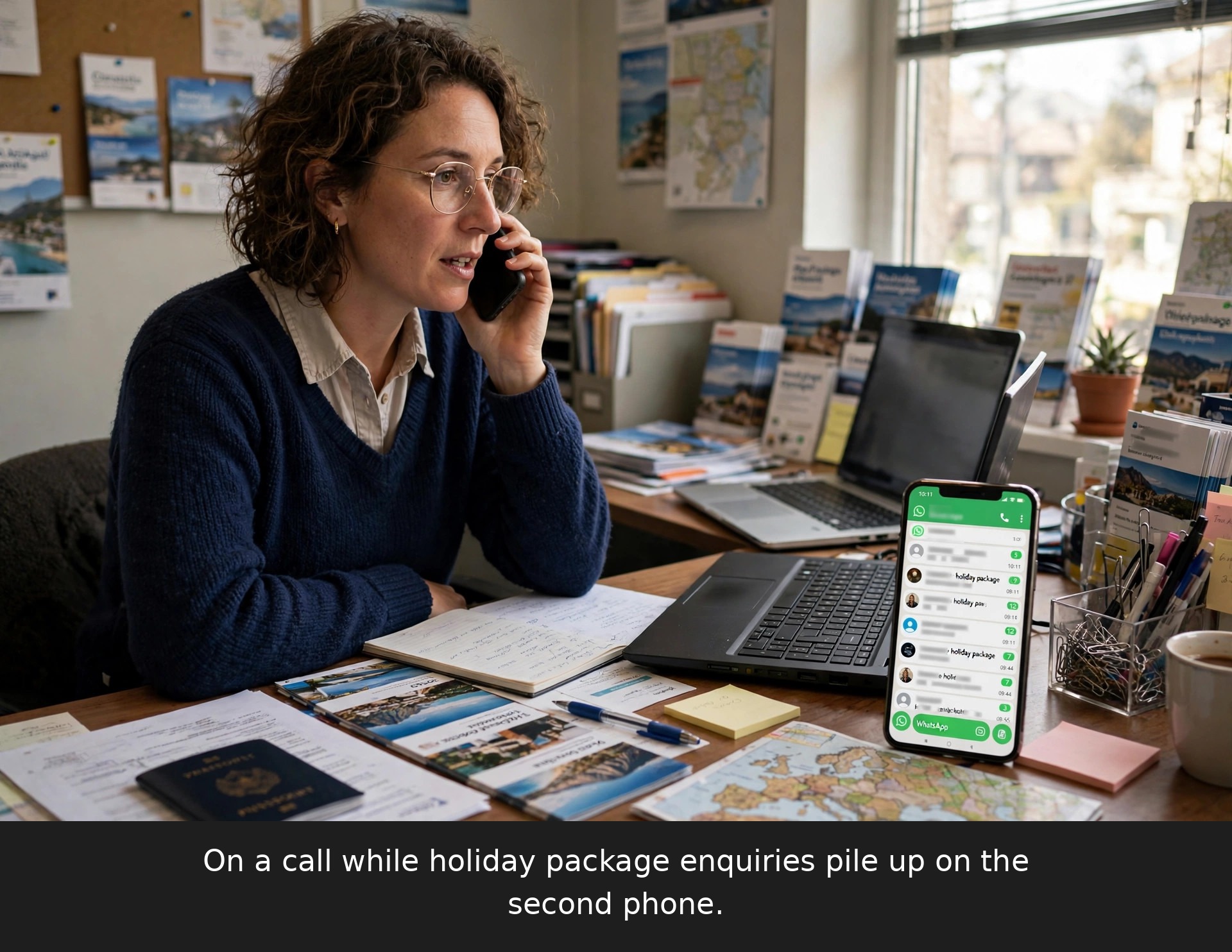
It's 1am. A couple is on their sofa, scrolling through Bali photos, and the idea hits them: let's finally do the honeymoon we kept postponing. She's excited. He's already checking his leave calendar. She messages your travel agency: 'Honeymoon package to Bali, 7 days, around $2000?' Then she messages two other agencies with the same question. Whoever answers first - with real options, not 'we'll get back to you tomorrow' - wins a $2000 booking. Your phone is on silent. You'll see the message at 9am. By then, she's already paid a deposit to the agency whose chatbot replied in 40 seconds with three package options. This is how travel bookings actually work in 2026: the decision happens at midnight, on a phone, in a moment of excitement. An AI chatbot for travel agencies lives in that moment. It answers the 1am message with your real packages, collects the details you need to quote properly, and hands you a warm lead by morning - instead of a cold 'hi' you reply to eight hours too late.
Why Travel Agencies Lose Bookings While They Sleep
Travel is an emotional purchase, and emotional purchases happen at emotional moments - late at night, on weekends, during lunch breaks when someone's daydreaming about escaping. Industry data consistently shows that a huge share of travel enquiries arrive outside business hours. Your agency is closed. The dreamer is wide awake. And in that gap, bookings die. Not because your packages are worse, but because excitement has a half-life. The couple buzzing about Bali at 1am is less excited at 9am after a night's sleep and a morning of emails. Every hour of delay cools the lead.
Do the rough maths on your own week. Count how many enquiries arrive when your shop is closed — evenings, weekends, holidays. Those are the ones most likely to go cold by morning, because a traveler who is excited at midnight will happily message the next agency that answers. Every one of those leads cost you money to win, and silence hands them to whoever replies first.
Then there's the qualification problem. Even when you do reply in the morning, the conversation takes days. 'What's your budget?' 'When do you want to travel?' 'How many people?' 'Hotel or villa?' Each question is a message, each message waits hours for a reply, and with every exchange the lead cools a little more. By day three, when you finally have enough details to send a proper quote, the couple has already booked with someone who moved faster. Speed isn't just nice in travel - it's the entire game.
What the Chatbot Actually Does (It's Not Just Auto-Reply)
An AI chatbot for travel agencies is a conversational assistant that lives in your WhatsApp or Instagram DMs and handles the enquiry the way your best salesperson would - if your best salesperson never slept. When the 1am Bali message arrives, it doesn't send 'thanks, we'll reply soon.' It starts the conversation: 'Bali honeymoon - amazing choice! To find you the perfect package, quick questions: which month are you thinking, and is the $2000 budget for both of you?' It's warm, it's natural, and it's moving the sale forward while the excitement is hot.
As the conversation flows, it collects everything you need: destination, dates, travelers, budget, hotel preferences, must-haves ('we want a private pool', 'vegetarian food options important'). It pulls matching packages from your real inventory - not generic suggestions, but your actual packages with your actual prices. 'Based on what you told me, here are 3 options: the 6-night Ubud + Seminyak package at $1850, the luxury villa option at $2300, and the budget-friendly 5-night at $1600. Want details on any of these?' The couple is browsing real options at 1:15am. By 1:30am, they've picked a favorite and the chatbot has booked them a call with you for tomorrow: 'Great choice! I've reserved a 20-min call with our Bali specialist tomorrow at 11am to finalize everything. Does that work?'
You wake up to a qualified lead: names, dates, budget, preferred package, and a scheduled call. Instead of starting from 'hi,' you start from 'so you're interested in the Ubud package - let me walk you through the hotels.' The chatbot did the 80% that's repetitive. You do the 20% that's human - the reassurance, the expertise, the closing. That's the correct division of labor, and it's how small agencies compete with big platforms.
Handling the Questions That Eat Your Afternoons
Every travel agent knows the repeat questions. 'Do I need a visa for Thailand?' 'What's included in the package?' 'Can I pay in installments?' 'What's your cancellation policy?' 'Is the flight included?' These are important questions - they deserve accurate answers - but they don't need you personally to answer them for the fiftieth time. The chatbot is trained on your real packages, your real policies, your real visa guidance. It answers consistently, every time, at any hour. Car rental companies answer the same kind of repeat questions - AI chatbots for car rental services shows how another travel business automates them.
Visa questions deserve special attention because they're high-anxiety and high-value. A family planning a Europe trip is nervous about Schengen visas. The chatbot can walk them through your actual process: required documents, processing times, your success rate, what you handle versus what they handle. 'For Schengen, you'll need bank statements, employment letter, and travel insurance - we prepare the full file for you, and our approval rate is 98%.' That answer, delivered instantly at 10pm, builds enormous trust. The family stops shopping around because they feel taken care of.
Payment questions are equally critical. Travel is expensive, and installment options often make the difference between booking and hesitating. The chatbot explains your real payment plans clearly: 'You can reserve with 30% now ($600) and pay the rest 30 days before travel. Want me to set that up?' It can send payment links, confirm deposits, and send receipts - all in the chat, all automatically. The friction between 'I want to go' and 'I've paid the deposit' shrinks to almost nothing.
- Visa requirements and document checklists - from your real process
- Package inclusions and exclusions - no surprises, no confusion
- Payment plans and installment options - with direct payment links
- Cancellation and refund policies - clear before they ask
- Travel insurance options - quoted from your actual providers
The Follow-Up Engine (Where Most Agencies Fail)
Here's an uncomfortable truth: most travel enquiries don't book on first contact. The couple likes the Bali package but wants to 'think about it.' The family needs to check school holidays. The group of friends can't agree on dates yet. In a perfect world, you'd follow up with every one of them at exactly the right moment. In the real world, you're busy with the clients who are ready now, and the 'think about it' leads quietly die. Industry estimates suggest travel agencies lose 60-70% of enquiries to poor follow-up - not to competitors, just to inertia.
The chatbot runs follow-up automatically, and it does it well because it's patient and perfectly timed. Three days after the Bali conversation: 'Hi! Just checking - still dreaming about Bali? The October slots for that Ubud package are filling up. Want me to hold your dates while you decide?' Two weeks later: 'Quick heads up - flight prices to Bali typically rise after this month. Locking in now could save you $200-300.' These aren't pushy. They're helpful. And they work because they arrive when the lead is warm, not when you happen to remember.
It also handles the long game. Someone enquired about Europe in January for a summer trip? The chatbot checks in monthly with relevant updates: new packages, price drops, deadline reminders for visas. 'Schengen appointments are booking 6 weeks out now - if you're still thinking July, we should start the visa file soon.' By the time they're ready, you're the only agency still in the conversation. Everyone else gave up after the first 'we'll think about it.'
Group Bookings and Complex Trips (The High-Value Work)
Not every trip is a simple package. Destination weddings, corporate retreats, multi-family vacations, honeymoon-plus-family combos - these are high-value, complex, and exactly where your human expertise shines. The chatbot's job here isn't to handle the whole thing. It's to qualify and prepare. When someone messages about a 40-person destination wedding, the chatbot collects the essentials - date range, destination preferences, budget per person, must-haves - and then does something smart: it books a proper consultation call and sends you a full brief beforehand.
You walk into that call knowing everything: 'So you're planning 40 guests in Goa next February, around $800 per person, and the couple wants a beach venue - I've pulled three resorts that fit. Let's talk through them.' Compare that to the usual first call, where you spend 30 minutes just extracting basic information. The chatbot makes your expert time more valuable by ensuring it's spent on expertise, not data collection. For high-ticket trips, this preparation is the difference between a good agency and a great one.
Want this for your travel agencies?
ReplyPilot builds a custom ai chatbot setup for your travel agencies — answering customer questions instantly, taking orders and bookings, and handing off to you when a human is needed.
Ask on WhatsApp — it's freePost-Booking: The Part Everyone Forgets
The sale isn't the end - it's the beginning of the experience. And it's where most agencies go silent, which is a massive missed opportunity. The chatbot handles post-booking communication beautifully: payment reminders ('Balance of $1400 due in 10 days - here's your link'), document checklists ('Don't forget: passports need 6 months validity'), pre-trip excitement builders ('5 days to Bali! Here's your hotel's check-in info and our 24/7 support number'), and post-trip follow-ups. Guesthouses handle the same stay-related questions - WhatsApp automation for guesthouses shows how small stays automate check-ins and guest messages.
That post-trip message is gold. 'Welcome back! How was Bali?' If they loved it - and they usually do - the chatbot asks for a review and a photo. Those reviews become your social proof. It also plants the seed: 'Glad you loved it! Lots of our Bali couples come back for Thailand next year - want me to send you some ideas when you're ready?' Repeat customers and referrals are the cheapest growth in travel, and they come from staying in touch after the trip, not just before it.
During the trip, the chatbot serves as first-line support. 'Our flight is delayed - what do we do?' It has your emergency protocols, your local partner contacts, and clear escalation rules. For anything serious, it connects them to you immediately. For the routine stuff - 'what time is checkout?', 'where's the meeting point for the tour?' - it answers from the trip details. Travelers feel supported. You handle only the real emergencies instead of every minor question.
Seasonal Campaigns That Run Themselves
Travel has seasons, and smart agencies market to them. But seasonal campaigns usually mean someone has to manually message hundreds of past enquirers - which never happens because everyone's busy. The automation runs these campaigns while you focus on current bookings. Summer approaching? Every past Europe enquirer gets: 'Summer in Santorini - our June packages just dropped, and early booking saves 15%. Remember you were looking at Greece? Want the new brochure?' Winter? 'Ski season is here - Swiss Alps packages from $1200, and we still have December slots.'
Honeymoon season, school holidays, long weekends - each gets a targeted wave to the right segment. The messages feel personal because they reference the actual conversation: 'You asked about Maldives last March - our new overwater villa packages are stunning, and there's a monsoon-season discount if you're flexible on dates.' This is the marketing that big agencies pay teams to do. You get it automatically, from data you already have, sent at exactly the right moment.
It also handles urgency honestly. 'Only 3 seats left on the December 20th Bali departure' - when it's true, because it's pulled from your real inventory. False urgency destroys trust; real urgency drives action. The automation only creates urgency from facts, which is why it works long-term. Customers learn that when your messages say 'filling fast,' they mean it.
Keeping the Human Magic (Why This Isn't Replacing You)
Let's address the fear directly: a chatbot can't replace a travel agent. It can't share the excitement of describing a Santorini sunset. It can't read a couple's hesitation and suggest the perfect alternative. It can't handle a crisis with genuine empathy. And it's not trying to. What it does is handle everything around those human moments - the midnight questions, the repetitive details, the follow-ups, the paperwork - so that your human moments are more frequent and more valuable.
Think of it as the world's best junior assistant. It does the research, prepares the briefs, chases the paperwork, and never forgets a follow-up. You do the consulting, the reassuring, the celebrating. Clients still feel your expertise and your care - they just also get instant responses at midnight. The agencies thriving with this aren't less personal. They're more personal, because the humans finally have time to be human.
The tone matters enormously in travel. Travel is dreams and excitement, and the chatbot needs to feel that way. It's trained on your voice - enthusiastic but not pushy, knowledgeable but not lecturing. When someone describes their dream trip, it responds like someone who gets it: 'A private pool villa in Ubud for your honeymoon - that's going to be incredible. Let me find you the best options.' That warmth, combined with instant accurate answers, is what makes people choose your agency and stay with it.
Last-Minute Bookings: Capturing the Spontaneous Traveler
Not all travel is planned months ahead. There's a growing segment of spontaneous travelers - the long weekend someone decides on Wednesday, the cancelled plans that free up a week, the 'let's just go' moments. These travelers are the most time-sensitive customers in the industry. They're deciding today, traveling this week, and they'll book with whoever makes it easiest. Traditional agencies are terrible at serving them because the enquiry-to-quote cycle takes days. The chatbot serves them in minutes.
When someone messages 'Anything available for this long weekend? 2 people, beach, under $1000?' the assistant checks real-time availability across your suitable packages: 'Yes! Three options for this weekend: 3 nights in Sharm El Sheikh at $850 (flight + hotel), 2 nights Maldives guesthouse at $950, or 4 nights in Bali on a flash deal at $990. All have availability right now. Want me to hold one while you decide?' The hold is key - it creates commitment without pressure. 'I've held the Sharm option for 4 hours - no charge. Just say the word and it's yours.'
It also handles the logistics that make last-minute travel stressful: 'Your flight is tomorrow at 6am - here's your e-ticket, hotel voucher, and transfer details. Our emergency number is...' The traveler feels taken care of despite the rush. And after the trip, the follow-up is even more effective because the experience was so smooth: 'That was fast! How was Sharm? Next time you get the urge, you know where to find us.' Spontaneous travelers become repeat spontaneous travelers - and they're the highest-margin segment because they don't price-shop.
The Honest Business Case
Let's talk numbers. If the chatbot saves even 3 bookings a month that would have gone cold - at $225 average commission, that's $675 a month, $8,100 a year. Add the follow-up recoveries, the after-hours conversions, the group booking qualifications that turn into $2000+ commissions. For a small agency, the annual impact easily reaches five figures. The cost? A fraction of one employee's salary, for coverage that no employee can provide - 24 hours a day, instant response, perfect memory, infinite patience.
Setup takes about two weeks. You provide your packages with prices, your visa processes, your payment plans, your cancellation policies, and examples of how you talk to clients. The chatbot is trained, tested with real enquiry scenarios, and launched in your WhatsApp or Instagram. You monitor the first couple of weeks, fine-tune the tone, and then it runs. Most agencies report the same revelation: the Monday morning inbox is full of qualified leads instead of cold 'hi' messages. The week starts with momentum instead of catch-up.
Want this working in your travel agency?
The travel agencies winning with this aren't the biggest ones. They're the ones who realized that the 1am dreamer is their best customer - the one who's most excited, most ready, and most likely to book with whoever answers first. The moment it clicks is usually the first time you wake up to a booked consultation from a conversation you never had, for a trip you never quoted, from a lead who would have gone cold by morning. If you want to see exactly what this looks like with your own packages, your own destinations, and your own voice, ReplyPilot will build you a free custom demo: request it at https://replypilot-site.vercel.app/ and catch your next midnight dreamer before someone else does.
Frequently Asked Questions
Can an AI chatbot quote holiday packages at 1am?
Yes. A couple plans their honeymoon at midnight; the chatbot asks destination, dates, budget, and hotel preferences, then quotes from your real packages. They wake up excited instead of still shopping.
How much does a chatbot cost for a travel agency?
Usually a monthly fee for a travel agency, based on conversation volume. A single booked package covers it many times over. Agencies selling honeymoons and family holidays — high-value trips — see the fastest return.
Will the chatbot know my actual available packages?
Yes — it works from your real inventory and supplier prices, not guesses. When a package sells out, it stops offering it. Customers get accurate quotes instead of "let me check and call you back."
Can the travel chatbot collect passport and traveller details?
Yes. After a booking, it collects names, passport numbers, and special requests step by step. This admin work normally eats hours; the chatbot does it while you plan itineraries.
Can it handle visa requirement questions for travellers?
Yes, for standard cases — it answers common visa questions from your knowledge base and flags complex cases to you. Travellers ask visa questions constantly; automating the routine ones saves enormous time.