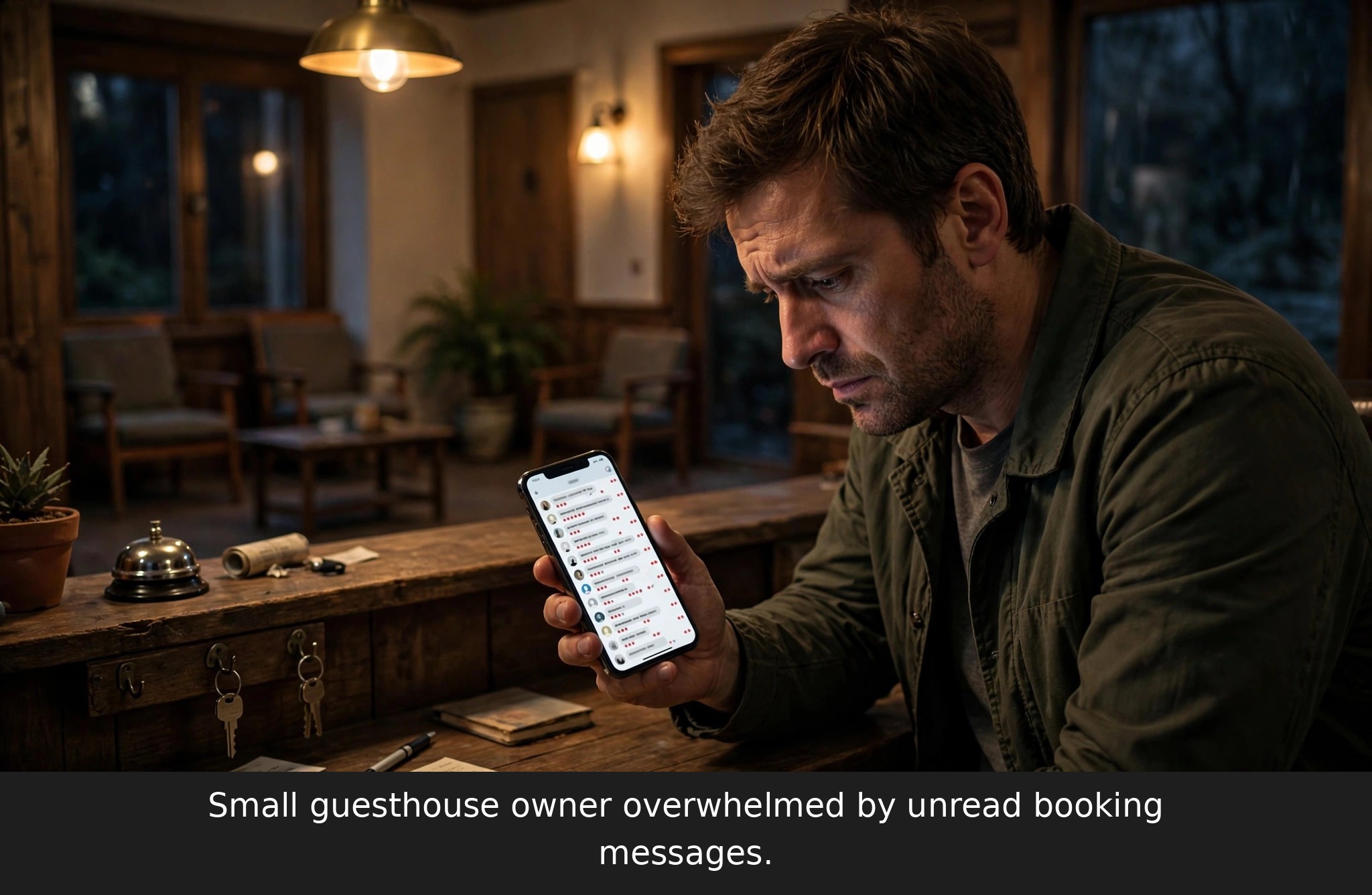
It's 10pm. A traveller is planning a weekend trip, finds your small guesthouse online, and sends you a WhatsApp message: 'Room available this Friday? Price?' You are asleep, or busy with guests, and the message sits unread until morning. By then, the traveller has booked through a big platform instead — and you've paid that platform a hefty commission for a guest who wanted to book with you directly. WhatsApp automation for guesthouses fixes this quietly: it answers in seconds, checks your availability, quotes your price, and confirms the booking — at any hour, in your voice.
The Platform Trap Small Guesthouses Live In
Big booking platforms bring you guests, but they take a cut of every single stay — and they own the guest relationship, not you. The guest remembers the platform's name, not yours. Every direct booking you win back is money that stays in your pocket and a guest you can welcome back next season by name. The problem is that direct bookings arrive as WhatsApp messages at all hours, and a small guesthouse owner cannot be on the phone all day and all night. Automation breaks the trap: you stay reachable around the clock without hiring anyone. Restaurants face the same fight for direct bookings — see how WhatsApp automation for restaurants handles it.
What WhatsApp Automation for Guesthouses Actually Does
- Answers 'is a room free on these dates?' instantly, with your real availability and prices.
- Explains your rooms, amenities, check-in and check-out times, parking, and house rules in plain words.
- Confirms direct bookings and collects guest details — names, phone numbers, arrival times.
- Sends check-in details automatically before arrival: your address, directions, gate codes, and your phone number.
- Asks happy guests for a review after checkout, which slowly builds the reputation that brings more direct bookings.
How Much Does WhatsApp Automation Cost?
This is one of the most asked questions, so let's answer it honestly. The cost depends on your setup — how many of your guest conversations you automate and how it connects to your booking records. There are two parts to understand. First, WhatsApp itself charges businesses per conversation (one conversation covers a full 24-hour window of back-and-forth with a guest), not per message. Second, you need a WhatsApp Business setup with pre-approved message templates for anything you send outside an active conversation — more on that below. The main investment is the setup itself: someone building the agent, teaching it your rooms, prices and policies, and connecting it to your availability. For a small guesthouse it is typically far less than one season of platform commissions on the bookings it wins back.
What Is the 24-Hour Rule on WhatsApp?
Here is a true fact every guesthouse owner should know. WhatsApp allows a business to reply freely — normal, conversational messages — for 24 hours after the guest's last message. This 24-hour window is called a customer service window, and almost all guest conversations happen inside it. Once the window closes, you can only message the guest using pre-approved template messages (for things like booking confirmations or check-in reminders). A good automation setup respects this rule automatically: it chats freely while the guest is active and switches to templates for reminders and follow-ups. WhatsApp's official Business Platform documentation explains these messaging rules in full, and any setup you build should follow them.
Check-In Details and Reviews on Autopilot
Two small automations punch far above their weight. The first: a day before arrival, the guest automatically receives everything they need — your exact location pin, how to reach you late at night, the Wi-Fi password, and check-in time. Fewer 'we can't find you' calls at midnight. The second: a day after checkout, a short thank-you message with a gentle request for a review. Reviews are the fuel of direct bookings — travellers trust a guesthouse with forty warm reviews far more than a listing with four. Car dealerships use the same post-visit follow-up rhythm, as covered in WhatsApp automation for car dealerships. Small touches, repeated every time, compound into reputation.
Keep Your Voice — Guests Chose YOU, Not a Platform
Guests pick a small guesthouse for its character: the host who knows the best local restaurant, the homemade breakfast, the personal welcome. Your automation should sound like that host, not like a hotel chain's call centre. Write the messages the way you talk — warm, brief, helpful — and teach the agent your real details: which room has the best view, where guests park, what time breakfast is actually served. If a guest asks something unusual, the agent hands over to you with the full conversation attached. You stay the host; the automation just makes sure no guest ever waits until morning for an answer.
A 10pm Booking, Start to Finish
Tuesday, 10:04pm. A traveller finds your guesthouse online and messages: “Do you have a room this Friday? Two people, one night. Price?” You are asleep. Six months ago, this message waited until morning — and by morning, the traveller had booked on a big platform. Tonight, the chatbot answers in seconds.
10:04: “Yes, we have our garden room free this Friday — it’s our quietest room, with breakfast included.” 10:06: the price, the check-in time, the parking details. 10:09: the traveller says yes. The chatbot collects both names, the arrival time, and sends the booking confirmation. 10:10: done. A direct booking, no commission, guest details in your book.
Wednesday morning, you wake up to a confirmed booking and a full conversation you can read in thirty seconds. The traveller chose you because you answered first with a clear price — the same reason travellers choose anyone. The only difference is that you were asleep while it happened.
What Should Happen When You Are Fully Booked?
Every guesthouse fills up sometimes — festival weekend, wedding season, a holiday. What your chatbot says in that moment matters, because a traveller told “no” rudely books elsewhere and never comes back. Told “no” well, they book next month.
The honest script has three parts. One: say it plainly — “We’re fully booked that weekend, I’m afraid.” Two: offer the nearest alternative you control — “We do have rooms the weekend after, and the Thursday before.” Three: take their details for cancellations — “Shall I message you if a room opens up?” Never fake availability, never quote a price for a room that does not exist, and never leave them hanging.
Some owners go one step further: recommending a trusted neighbouring guesthouse when full. It feels like giving business away, but travellers remember the honesty — and they come back to you next time, often bringing friends. A chatbot that handles “no” gracefully turns a lost booking into a future one.
How to Handle the Difficult Guest Before They Arrive
Not every enquiry is simple. A group of eight wants a party. Someone asks to bring three dogs. A guest demands check-in at 6am. These conversations need your judgment — but the chatbot can do the groundwork so you decide with facts, not guesses.
Teach it your house rules in plain, kind language: quiet hours, maximum occupancy, pet policy, check-in window. When a request pushes against a rule, the chatbot states the rule without apology — “I’m afraid we don’t allow parties, as we’re a quiet guesthouse” — and collects the details: how many guests, what dates, what they need. Then it hands the full picture to you.
- Rules stated kindly but firmly — the chatbot never negotiates your policies to be nice.
- Facts collected before opinions — you decide with the full story in front of you.
- Special needs flagged early — elderly guests, allergies, accessibility needs go straight to you.
The goal is not to reject people. It is to make sure the guests who book are guests who will be happy — and who will not make your other guests unhappy. A difficult conversation handled before arrival is a peaceful stay. One discovered at midnight is a nightmare.
What Your Guesthouse Chatbot Must Never Promise
A guesthouse chatbot talks to travellers who are imagining their trip. It is tempting to let it paint a rosy picture — but every promise it makes, you have to keep. Set the limits clearly.
Want this for your guesthouses?
ReplyPilot builds a custom whatsapp automation setup for your guesthouses — answering customer questions instantly, taking orders and bookings, and handing off to you when a human is needed.
Ask on WhatsApp — it's free- Never promise a specific room. “The one with the sea view” gets: “I’ll note your preference — rooms are assigned on arrival, and we’ll do our best.” View promises broken at check-in start stays badly.
- Never promise experiences. Weather, sunsets, “the beach is a five-minute walk” — the chatbot states facts from your listing, not dreams.
- Never promise refunds beyond your policy. Cancellation questions get your real policy, word for word — the chatbot does not improvise generosity.
- Never give travel, visa or medical advice. “Do I need a visa?” and “is the water safe?” get: “Please check the official sources — I can share the links.”
Under-promising is a guesthouse superpower. A guest who expected a simple clean room and found a lovely one leaves a glowing review. A guest promised the moon and given a room leaves a bitter one. Teach the chatbot to describe honestly — and let the stay do the impressing.
Common Mistakes Guesthouses Make With Automation
Guesthouse automation usually breaks on operations, not technology. Four mistakes do most of the damage.
- A stale calendar. You took a phone booking but forgot to block the dates — now the chatbot has promised the same room twice. Every booking, from every channel, goes into one calendar the same day.
- Letting it haggle. “Can you do it cheaper?” The chatbot must hold your price with a warm explanation, not invent discounts. Your rates are your rates — train that sentence.
- Messaging outside the 24-hour window carelessly. Once the window closes, only pre-approved templates go out. A chatbot that sends free-text follow-ups on day three can get your number flagged.
- No handoff for special requests. Allergies, wheelchair access, a baby cot — these need a human answer, not a confident guess. The chatbot collects the question and passes it to you.
Notice the pattern: every mistake is about keeping the system honest and current. One calendar, fixed prices, proper templates, and a handoff rule. Review these monthly and the automation stays trustworthy — which is the whole currency of a small guesthouse.
How Do You Know Your Guesthouse Bot Is Working?
A guesthouse chatbot has one job: more direct bookings, less commission, happier guests. Five numbers tell you if it is delivering.
- Direct versus platform split — what share of bookings now comes through WhatsApp instead of the big platforms?
- After-hours bookings — reservations confirmed while you were asleep or busy. Each one is a booking the platforms did not get.
- Response time — from minutes or hours down to seconds. Travellers message several places; the fastest clear answer usually wins.
- Review growth — the post-checkout review request should be steadily adding reviews.
- Repeat guests — are past guests messaging you directly next season instead of searching platforms?
Check these monthly — it takes ten minutes with your booking book and the chat history. You are looking for a trend, not perfection: the direct share creeping up, the 10pm bookings appearing, the reviews accumulating. When a single peak-season month of direct bookings covers the year’s cost several times over, the question answers itself.
How the Chatbot Earns You Repeat Guests
The cheapest booking you will ever get is the guest who has already stayed with you. They know the breakfast, they trust the beds, they do not need convincing — they just need a reason to come back, and a nudge at the right time. The chatbot keeps that relationship warm without you lifting a finger.
It starts the day after checkout with a genuine thank-you — not a template blast, but a personal-feeling message that remembers their stay. Then it stays quietly in touch: a note before the season they visited last year, “The garden room you loved is free that same weekend — shall I hold it for you?” Guests who book direct the second time skip the platform entirely, and the commission stays in your pocket.
- Remember preferences — the quiet room, the extra pillow, the early breakfast — and mention them when they rebook.
- Time the nudge to their rhythm — last year’s dates, school holidays, the festival they came for.
- Reward direct booking warmly — a small gesture on arrival beats a discount code.
Repeat guests are also your best marketers. They bring friends, they leave the longest reviews, they forgive the small things. A guesthouse with a loyal base of returning visitors worries far less about platforms and seasons. The chatbot does not create loyalty — your hospitality does that. It just makes sure loyalty turns into the next booking.
What Should the Chatbot Tell Guests About the Area?
Here is something no booking platform can copy: you know your town. The restaurant the tourists miss, the beach that is empty at sunset, the shortcut to the station, which taxi driver to trust. Guests choose small guesthouses for exactly this — a host who knows the place. Your chatbot should share that knowledge.
Teach it your local favourites: three restaurants for different budgets, the sights worth the walk, how to get around, what to do on a rainy day. When a guest asks “where should we eat tonight?” the chatbot answers like you would — with opinions, not a search result. “The place on the corner is good, but walk ten minutes to the harbour — the fish there is worth it.”
- Keep the list short and honest — five places you truly recommend beat fifty you have never tried.
- Update it seasonally — the beach bar that closes in winter should not be recommended in January.
- Include the practical stuff — nearest pharmacy, cash machine, how the local buses work.
This does two jobs at once. Guests have a better trip, which shows up in your reviews — “the host’s recommendations made our stay” is a sentence that books your next ten guests. And it deepens the one advantage platforms cannot match: you are a person who lives here, not a listing. The chatbot just makes sure every guest gets your local knowledge, even the ones who arrive at midnight.
Want this working in your guesthouse?
Every direct booking you confirm on WhatsApp is a commission you didn't pay and a guest relationship you own. WhatsApp automation for guesthouses makes sure those bookings never slip away at 10pm again. If you want to see it answering with your rooms, your prices and your voice, request a free custom demo at https://replypilot-site.vercel.app/ and ReplyPilot will build you a working preview for your guesthouse.
How Should the Chatbot Handle “Can We Check In Early?”
Early check-in is the most common special request in hospitality, and the answer is almost always “it depends on housekeeping.” A good bot does not guess — it checks. If the room is free the night before, it confirms the early check-in warmly. If not, it is honest and offers what it can: “The room will not be ready before 2pm, I am afraid — but you are welcome to drop your bags from 11am and I will message you the moment it is ready.” Late checkout gets the same treatment: offered when the calendar allows, declined kindly when it does not. The key is that the bot knows your real policy — what time housekeeping finishes, whether late checkout carries a fee — instead of inventing one. Guests accept “no” gracefully when it comes with a reason and an alternative.
Taking Deposits Without the Awkwardness
Asking for money is uncomfortable face to face, which is why many small guesthouses skip deposits and then suffer the no-shows. The chatbot has no such discomfort — it states the policy plainly and kindly, the same way every time. Teach it your real terms: how much, when it is due, and exactly what happens on cancellation — full refund before a certain date, partial after. The script stays warm: “To confirm your booking we take a small deposit, which is fully refundable up to a week before your stay — here is the secure link.” Guests rarely argue with a clear, fair policy delivered matter-of-factly. And the deposit does quiet work beyond protection: a guest who has paid something shows up, full stop. Your no-show rate drops the week you switch it on.
What About Special Requests — Cots, Cakes, Anniversaries?
Some of your best reviews will come from occasions: the anniversary weekend, the birthday surprise, the family arriving with a baby. These requests need a human touch, but the chatbot can do the detective work. Teach it to ask the questions you would ask: which room, what date, what would make it special — a cake, flowers, a cot in the corner, a quiet table recommendation. It collects every detail and hands the full brief to you, so the surprise is actually ready when they arrive. One rule matters here: the bot never promises what it cannot guarantee. “I will pass this to the host personally and confirm back to you” beats a confident “of course!” that you cannot deliver. Guests remember the guesthouse that got the little things right far longer than they remember the room itself.
The Long-Stay Guest: A Different Conversation
Every town has them: the remote worker staying a month, the family between houses, the contractor on a long job. Long-stay enquiries need a different flow from weekend bookings — weekly rates instead of nightly, questions about laundry and kitchen access, house rules that matter more over thirty days than over two. Teach the chatbot your long-stay terms: the weekly price, what is included, how cleaning works during the stay, and any house rules about guests or noise. It should also ask what brings them, because a remote worker and a relocating family need different reassurance. Long stays are wonderful business — steady income, less turnover work — and they almost always start with a long WhatsApp conversation. Let the bot handle the first twenty questions so you only step in for the handshake.
Travel bookings spike at odd hours — an AI chatbot for travel agencies answers itinerary questions and captures leads while you sleep.
Frequently Asked Questions
Can WhatsApp automation answer room availability questions for my guesthouse?
Yes. Connect it to your booking calendar and it answers "Room available this Friday?" in seconds, with the price. Travellers message several places at once — the fastest answer usually wins the booking.
How does WhatsApp automation help guesthouses get direct bookings?
Every direct booking saves you the 15–20% commission that booking platforms take. The chatbot answers questions, shares photos, and confirms the booking right in WhatsApp. Guests prefer messaging over filling in forms.
Can it send check-in instructions to guesthouse guests automatically?
Yes. On booking day it sends directions, check-in time, Wi-Fi password, and house rules. This cuts the "how do I find you?" messages at midnight. Guests arrive relaxed instead of confused.
How much does WhatsApp automation cost for a small guesthouse?
Typically a modest monthly fee for a guesthouse. A single direct booking saved from platform commission often covers the whole month. Small guesthouses with 5–15 rooms see the fastest payback.
Can the guesthouse chatbot handle enquiries in other languages?
Yes, most support multiple languages, which matters for international travellers. You choose the languages your guests use. A German backpacker gets answers in German without you hiring translators.