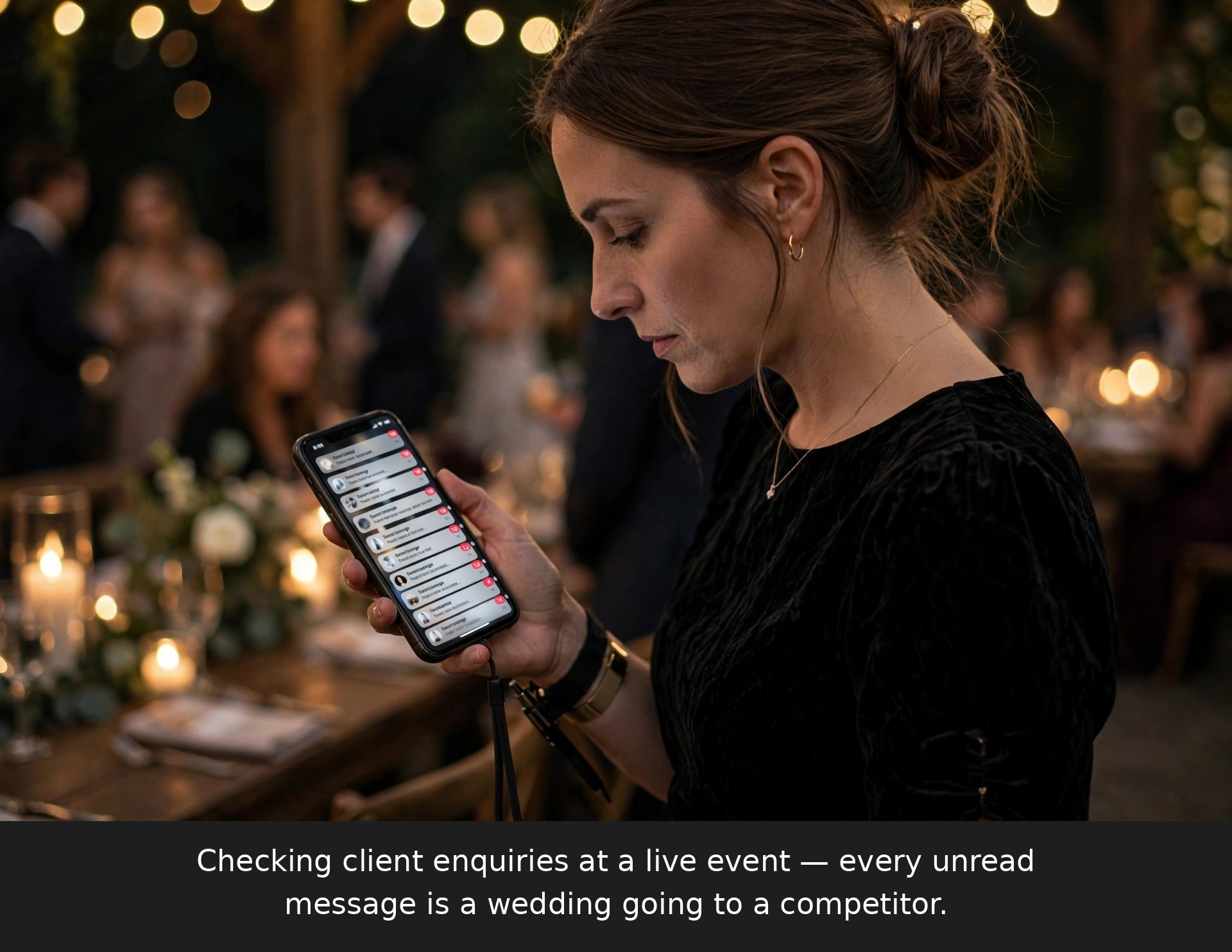
It is 11pm on a Saturday. You are at a wedding venue making sure the first dance starts on time, the caterer is on schedule, and nobody's grandmother is lost. Meanwhile, an engaged couple is sitting on their sofa, phones in hand, sending the same enquiry to six wedding planners. Yours arrives with the rest - and sits unanswered until Monday morning. By then, the couple has already had two video calls with planners who replied on Saturday night. An AI chatbot for wedding planners closes this gap completely. It answers the moment they ask, qualifies them properly, and books a consultation into your calendar - while you are busy making someone else's wedding perfect.
Quick answer: An AI chatbot for wedding planners captures enquiries at 11pm, when couples actually plan, and qualifies them by asking about the date, venue, guest count, and budget. Serious couples get booked into a consultation; time-wasters get filtered out. The planner wakes up to a diary of qualified leads instead of a pile of missed calls.
The 11pm Enquiry Problem
Couples plan weddings at night and on weekends. That is when they are free, excited, and comparing vendors. But nights and weekends are exactly when you are working events - the one time you physically cannot reply. This is not poor service; it is the nature of the job. The result, though, is brutal: the planner who responds first usually wins the couple. Wedding planner lead automation does not replace your judgement or your taste. It simply makes sure the first response happens in seconds, not on Monday, so your talent gets a chance to be seen.
What the Chatbot Asks (So You Don't Waste Consultations)
A serious wedding enquiry needs three facts before you can quote: the date, the venue, and the budget range. Without them, a consultation is just a chat. The event enquiry chatbot collects all three in a natural conversation, along with guest count and the services they want - full planning, partial planning, or day-of coordination. Couples whose date you are already booked for get an honest answer immediately. Couples with a budget far below your minimum get a polite, kind response instead of a wasted hour of your time. The couples who reach your calendar are the ones who can actually hire you. This is where an AI chatbot for wedding planners earns its keep: it asks the three qualifying questions the same careful way, every time, at any hour. Photographers face the identical triage problem - see how an AI chatbot for photographers filters their enquiries the same way.
- Greets every enquiry instantly - even at 2am on a Sunday - and answers questions about your services, packages and pricing style.
- Collects the wedding date, venue, guest count and budget range in one smooth conversation.
- Explains your planning packages in your own words - full, partial, or day-of coordination.
- Books consultations into your real calendar with automatic reminders, so no-shows drop.
- Captures details from couples who are early in planning, so you can follow up with your portfolio and pricing guide.
Answer the Price Question Without Killing the Romance
Every planner dreads the pricing conversation, and every couple wants it upfront. The chatbot handles this in the way you train it to: sharing your starting prices, explaining what full planning includes versus day-of coordination, and clarifying what costs extra - travel, additional planners, rehearsal dinner coverage. You set the numbers; it never invents them. Couples who know your starting price before the consultation arrive ready to talk seriously instead of spending the first twenty minutes circling the topic. Transparency filters in the right clients and filters out the wrong ones.
Sound Like a Planner, Not a Booking Form
Weddings are emotional. A chatbot that sounds like an airline booking system will scare couples off. Train it on your real messages - the warm way you congratulate newly engaged couples, the questions you actually ask on a first call, the stories you tell about past weddings (anonymised, always). When the tone is right, couples forget they are chatting with software, and by the time you meet them, they already feel like they know you. That emotional head start is worth more than any ad spend. Couples should never feel the difference between a thoughtful automated reply and you - that is the standard every AI chatbot for wedding planners should be held to.
Read Your Chat Logs Like a Business Coach
A month of chat transcripts is a free business consultant. If twelve couples ask whether you plan destination weddings, that is a service page you need. If everyone asks about your minimum budget, your pricing page is not clear enough. If couples keep mentioning a venue you have never worked at, that is a partnership to pursue. Review the logs monthly - the same discipline behind good lead capture automation - and every insight makes both your website and your chatbot stronger.
What Should the Chatbot Do When a Couple Is Talking to Three Planners at Once?
Assume every couple is comparing you with at least two other planners. They usually are. The chatbot's job is not to badmouth anyone. Its job is to make your enquiry feel different: faster, warmer, and easier than the rest.
Speed is the first win. While other planners reply on Monday, your chatbot has already answered, asked the right questions, and offered a call slot. The couple starts to feel that working with you will be easy. That feeling matters more than most planners realise.
The second win is memory. When the couple mentions their venue or their date, the chatbot remembers it later in the chat. A small thing — “So for your June wedding at Rosewood Hall...” — but it makes the conversation feel personal. Train it to use the couple's names and details naturally, the way you would.
Never let it criticise other planners or promise things you cannot deliver. If a couple asks “why should we pick you?”, it should answer with your real strengths — your experience, your style, your reviews — in your words. Confidence, not comparison, is what wins.
When a couple mentions a competitor's lower price, the chatbot should not panic or discount. It should calmly restate what your planning includes that cheaper options skip — the rehearsals you attend, the vendor relationships you bring, the day-of team — and invite them to the consultation where the difference becomes obvious. Price shoppers who only care about cheapest were never going to book you. The ones who care about the day will hear the difference.
And when a couple goes quiet after a good first chat, the chatbot follows up once — politely, forty-eight hours later. “Just checking in — did you have any other questions about the packages?” One gentle nudge recovers conversations that died from busyness, not disinterest. More than one nudge becomes pestering, so the rule is simple: follow up once, warmly, then let them come to you.
A Saturday With the Chatbot On: Hour by Hour
10am: You are at the venue, checking the flowers. A couple messages from their kitchen table: “Do you do day-of coordination?” The chatbot answers instantly with your day-of package summary and asks their date.
2pm: You are calming a nervous father of the bride. Another enquiry lands: a couple with a December date you are already booked for. The chatbot tells them kindly and honestly, and offers your waitlist. No awkward silence, no false hope.
9pm: The first dance is over and you finally check your phone. Three conversations happened while you worked. Two couples are booked into your calendar for next week. One left early — the chatbot noted their budget was below your minimum and sent them your planning guide instead.
Monday morning: Instead of starting the week with a pile of cold messages, you start with two warm consultations. That is the whole change. You did not work Saturday night. The chatbot did.
Sunday morning brings the quiet follow-up. The chatbot sends each booked couple a short prep message: what to bring to the consultation, your portfolio link, and one warm line about their venue. By the time they meet you, they feel looked after already. Consultations that start warm end in bookings far more often than cold ones.
The Mistakes Wedding Planners Make With Their First Chatbot
Mistake one: feeding it a price list and nothing else. A chatbot trained only on prices sounds like a vending machine. Give it your stories, your advice, your voice — the things couples actually fall in love with.
Want this for your wedding planners?
ReplyPilot builds a custom ai chatbot setup for your wedding planners — answering customer questions instantly, taking orders and bookings, and handing off to you when a human is needed.
Ask on WhatsApp — it's freeMistake two: letting it book anyone into your calendar. Without budget and date questions asked first, your diary fills with couples you cannot serve. Qualification first, calendar second. Always.
Mistake three: never testing the handover. Send yourself a test message that sounds upset and check what the chatbot does. If it argues or loops instead of handing over to you gracefully, fix it before a real couple finds out.
- Train it on your voice, not just your prices.
- Ask the qualifying questions before offering a calendar slot.
- Test the handover with an upset-customer message before going live.
- Update packages and prices the same day they change on your website.
Mistake four: copying another planner's chatbot. Borrowed answers sound borrowed. Couples choose planners for taste and personality — the two things a copied script cannot fake. Your real messages, your real stories, your real way of calming a nervous couple: that is the training data no competitor can copy.
What Your Wedding Chatbot Should Never Do
Be honest about limits. A chatbot is brilliant at first contact, qualification, and booking. It is not a wedding planner. It should never promise a specific vendor, quote a custom price, or advise on contracts. Those are your calls.
It should never argue. If a couple is upset or rude, the chatbot stays warm and offers a human: “I want to make sure you get the right answer — can I have my planner call you?” One graceful handover beats ten clever replies.
And it should never pretend to be you after the handover point. Once a real conversation starts, the chatbot steps back. Couples trust you because the machine knew when to stop being a machine.
It should never share details about other couples' weddings — not dates, not venues, not budgets, not even as examples. Privacy is sacred in this business. If it needs an example, it uses anonymised stories you approved: “a vineyard wedding last spring”, never names, never places.
How Do You Know Your Wedding Bot Is Working? Three Numbers That Matter
Number one for weddings: response time. Before the chatbot, your average first reply might have been hours. Now it should be seconds, at any hour. Check this monthly — it is the foundation everything else sits on.
Number two: qualified consultations booked. Not chats started — consultations with couples who passed your date, venue, and budget questions. If chats are up but bookings are flat, your qualifying questions need work.
Number three: no-show rate for consultations. Automatic reminders should bring this down. If couples still miss calls, the reminder timing or wording needs a tweak.
Ignore vanity numbers like total messages. A hundred chats that book nothing are worth less than ten chats that book three consultations. Measure what pays.
Bonus number: which package gets asked about most. If everyone asks about day-of coordination but your site pushes full planning, your marketing and your market are misaligned. This one insight can reshape your packages page — and it comes free with the chat logs.
Also watch your consultation show-up confirmations. The reminder goes out, the couple taps “confirmed” — or they don't. A falling confirmation rate is an early warning that your reminder timing is off or your booking gap is too long. Couples who book three weeks out forget; couples who book within ten days show up. The data will tell you your sweet spot.
Handling the Tricky Conversations: Families, Budgets, and Last-Minute Panic
Wedding planning involves whole families, and the chatbot will meet them all. A mother asking about guest list politics. A couple whose budget just got cut. Train the chatbot for the emotional moments, not just the easy ones.
For budget worries, it should stay kind and practical: explain what your packages cover, what can flex, and what simply costs what it costs. No judgement, no pressure. Couples remember how you made them feel about money.
For last-minute panic — a vendor cancelled, the date moved — the chatbot's job is to stay calm, collect the facts, and get your eyes on it fast. “That sounds stressful. Let me get the details so my planner can call you within the hour.” Speed plus a human handover is the right answer.
If a conversation turns emotional or complicated, the rule is simple: hand over early. A chatbot that tries to counsel a crying bride does more harm than good. Warmth, facts, handover — in that order.
Divided families need neutrality. When divorced parents or competing in-laws message with conflicting wishes, the chatbot must never take sides. It collects each request factually, notes who asked, and hands the whole picture to you. You are the diplomat; the chatbot is just the messenger.
Then there is the couple who wants everything on half the budget. The chatbot should not laugh them off or lecture them. It reframes honestly: “With that budget, most couples choose our partial planning and handle décor themselves — here is what that looks like.” Respect the budget, offer the real alternative, and some of them will stretch it once they see the value.
Training the Chatbot on Your Real Enquiries: A Simple Setup Plan
Week one: gather your raw material. Your packages and prices, your twenty most-asked questions, and — most valuable of all — your last fifty real enquiry messages with your replies. Real words beat written-from-scratch scripts every time.
Week two: write the rules. Your minimum budget. Dates you are already booked. Services you do not offer. The chatbot needs to know your “no” as clearly as your “yes”.
Week three: go live quietly. Let it answer new enquiries while you watch every conversation. Fix anything that sounds wrong the same day. By week four, you will trust it with the nights and weekends — which was the whole point.
Week four: stress-test it. Ask a friend to play the difficult couple — the haggler, the vague texter, the one who changes the date three times. Watch where the chatbot stumbles and fix those spots. A chatbot that survives your toughest friend will survive real couples.
Want this working for your wedding-planning business?
You became a wedding planner to create unforgettable days, not to answer the same enquiry questions at midnight. An AI chatbot for wedding planners handles the instant response, the qualification, and the booking - so every consultation on your calendar is with a couple who is ready. If you want to see this on your own website, in your voice, with your packages and your calendar, ReplyPilot will build you a free custom demo: request it at https://replypilot-site.vercel.app/ and let your next 11pm enquiry answer itself.
Event flowers mean urgent timing questions — WhatsApp automation for flower shops confirms orders and delivery slots instantly.
Frequently Asked Questions
How can an AI chatbot help my wedding planning business get more clients?
It answers enquiries instantly — even at midnight when couples are browsing — and asks your qualifying questions: date, venue, guest count, budget. Serious couples get booked into your calendar; casual browsers get polite answers without eating your time.
Can the chatbot qualify wedding couples by budget before I talk to them?
Yes. You set your minimum package price, and the chatbot asks about budget range early in the chat. Couples below your range get helpful guidance instead of a dead end. You only spend sales calls on couples who can actually book you.
Will a chatbot sound too impersonal for a wedding business?
It does not have to. You train it in your voice — warm, excited, personal — the way you would text a friend about their wedding. Couples care about speed first; a fast warm reply beats a slow perfect one every time.
Can the wedding chatbot handle enquiries in different languages?
Most modern chatbots handle multiple languages, which matters when families are involved in planning. You choose which languages to support. Mixed-language families get smooth answers instead of confusion.
How long does it take to set up a chatbot for a wedding planner?
A basic version can be live within a week — you provide your packages, prices, FAQs, and calendar link. More advanced setups with portfolio galleries take a little longer. You approve every answer before it goes live.