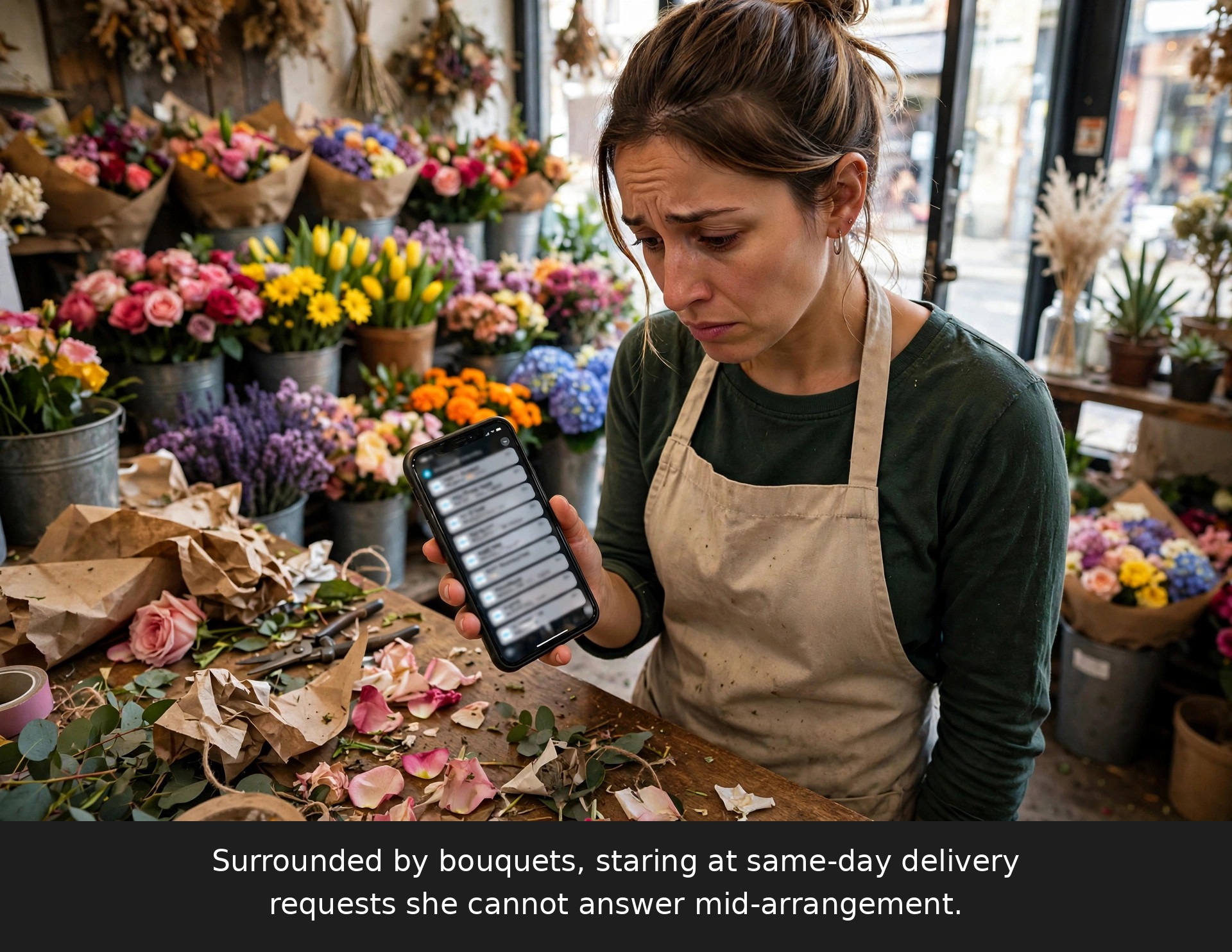
It is 9:15 in the morning. Your shop smells of roses, the delivery van is idling outside, and your phone has 23 unread WhatsApp messages. "Need red roses delivered TODAY before 5pm." "Birthday bouquet for my wife, budget 3000." "What's your address for the anniversary flowers??" You are wrist-deep in arranging a funeral wreath and cannot touch your phone. By the time you reply at noon, two of those customers have ordered from the online flower site. WhatsApp automation for flower shops exists for this exact morning rush. It reads every message the second it arrives, takes the order details, confirms the address, and queues the delivery - while your hands stay in the flowers.
Quick answer: WhatsApp automation for flower shops captures delivery orders the second they arrive, confirms the delivery date, address, and message card, sends occasion reminders before birthdays and anniversaries, and handles the morning flood of same-day requests. In a deadline business, the shop that answers first wins the order.
Flower Delivery Is a Deadline Business
Here is the hard truth about florist WhatsApp orders: flowers are almost never bought casually. They are for today. An anniversary, a birthday, an apology, a funeral - every order has a deadline measured in hours, not days. A customer who messages at 9am and hears nothing by 11am does not wait; they find someone who answers. Most flower shops lose their best same-day orders to missed messages during the busiest morning hours. An always-on chat agent turns that around: the order is captured at 9:01, the address is confirmed at 9:02, and your van is loaded by 9:30. That is the gap WhatsApp automation for flower shops was made for: seconds, not hours, between the message and the confirmed order.
What Flower Delivery Automation Actually Captures
- The occasion and the deadline - "anniversary, today before 6pm" - so urgent orders jump the queue.
- The full delivery address, confirmed back to the customer - wrong addresses are the costliest mistake in this business.
- Bouquet choice and budget - it shows your real options with prices, instead of a vague "we have many designs".
- A card message - it asks what to write on the card, so you never deliver a beautiful bouquet with a blank one.
- Payment confirmation - sends your payment link and marks the order ready only when it is paid.
Occasion Reminders: The Message Customers Actually Want
Nobody likes spam. But a message that says "Hi Ahmed! Your anniversary is next week - want us to prepare the same red rose bouquet as last year?" is not spam; it is a rescue. The automation remembers each customer's occasions - with their permission - and sends a gentle reminder a few days before. This is the most natural marketing a flower shop can do, because the customer genuinely needs the reminder. It is the same principle as restaurant reminders, just pointed at emotions instead of tables - see WhatsApp automation for restaurants for the sibling pattern.
Handle the Morning Flood Without Hiring Extra Hands
Valentine's week, Mother's Day, Eid - your order volume can triple overnight, and hiring temporary staff who know your products is nearly impossible. The automation does not get overwhelmed. It answers every message in seconds, in order, with your real prices and your real delivery slots. You set the rules: cutoff times for same-day delivery, delivery zones, which days the van does not run. WhatsApp's official Business Platform documentation covers the messaging rules for high-volume periods like these, including the consent requirements for customer updates. When the flood comes, you arrange flowers while the chat takes orders. During those peak weeks, WhatsApp automation for flower shops is the difference between capturing the flood and drowning in it.
Keep It Human: Flowers Are Feelings, Not SKUs
A customer ordering funeral flowers is grieving. A customer ordering anniversary roses is nervous. The chatbot must read the room - trained on your actual tone, your real empathy, your honest advice ("for a hospital visit, I'd suggest the smaller arrangement - big bouquets aren't allowed in the wards"). That kind of genuine guidance is what makes people loyal to a neighbourhood florist over a website. The same human-first thinking powers good ecommerce store assistants - but flowers deserve it even more, because nobody buys flowers without feeling something.
One Rule That Protects You
Never let the chatbot promise a delivery time you cannot keep. The cutoff for same-day delivery must be a hard rule in its instructions - "orders after 2pm go tomorrow" - and it must never invent stock. A customer told honestly that the peonies are finished will pick roses; a customer promised peonies that never arrive will never come back. Check the delivery log daily during peak weeks, and adjust your cutoffs based on what the chats tell you.
A Valentine’s Morning, Hour by Hour
Valentine’s Day, 8:00am. Your shop opens to a phone already buzzing — forty unread messages, and the van leaves at ten. Without automation, you spend the first hour typing instead of arranging, and every minute of typing is a bouquet that does not get made. With automation, the morning runs like this.
8:05: the first wave of orders is captured — occasion, bouquet choice, address, card message, payment link sent. 8:40: payment confirmations roll in and the orders queue up in the order they must be arranged. 9:30: the van is loaded with the first route, addresses already confirmed back to each customer. Midday: your same-day cutoff hits, and the chatbot starts telling new messages, politely, that their flowers will arrive tomorrow — no promises you cannot keep.
Evening: the “where is my order?” messages arrive, and the chatbot answers each one with the real delivery window — because you updated it once, and it told everyone. You spent the day doing what only you can do: arranging flowers. The chatbot did what it does best: capturing every order the second it arrived.
What Happens When the Exact Flowers Are Gone?
Mid-morning on a busy day, the peonies run out. Three customers have already asked for them. This is the moment that decides whether automation helps or hurts — because a chatbot that keeps promising peonies is worse than no chatbot at all.
The rule is simple: the chatbot only offers what you actually have. When something sells out, you mark it unavailable once, and from that second the chatbot pivots: “The peonies have just sold out — but the garden roses in blush are beautiful today, and I can show you a photo. Would you like those instead?” It shows a real photo, states the real price, and waits for a yes.
- Never substitute silently — the customer approves every change before you arrange a thing.
- Update availability the moment something sells out, not at the end of the day.
- Offer one clear alternative, not a list of ten — decisions are hard when someone is in a hurry.
Customers accept substitutions gracefully when they are asked. What they never forgive is opening the box to find flowers they did not choose. The chatbot’s honesty here is not just good service — it is the difference between a repeat customer and a lost one.
How to Handle a Funeral Order With Care
Some orders need more than speed. A funeral order arrives from someone grieving, often in a hurry, often unsure what to send. The chatbot must slow down here — gentle words, simple choices, zero sales pressure.
Teach it a separate tone for these orders: short sentences, no upselling, no cheerful exclamation marks. It asks only what it needs: the name for the card — spelled carefully, confirmed twice — the service time and venue, and whether the family has requested a particular style. It confirms the delivery time against the service, not against your convenience.
And it knows when to step aside. Anything unusual — a request in another language for the card, a delivery to a home instead of the service, a customer who seems distressed in their messages — goes straight to you, with the full conversation attached. Some moments need a human voice. The chatbot’s job is to recognise those moments and get out of the way.
What Should the Chatbot Do About a Late or Wrong Delivery?
Even good shops have bad days. The van gets stuck in traffic. The wrong bouquet goes out. What happens in the next ten minutes matters more than the mistake itself — and the chatbot is usually the first to hear about it.
“Where are my flowers?” The chatbot never guesses. It checks the real delivery status and gives an honest answer: “Your bouquet is on the van — the driver is running about thirty minutes behind because of traffic. The new arrival window is 4:30 to 5:00.” If it does not know, it says so: “Let me check with the shop right now and come straight back to you.” Then it tells you immediately.
- Never invent a status — a guessed “on its way” that turns out wrong destroys trust twice.
- Apologise once, sincerely, and give a real new time — not “soon”.
- For a wrong bouquet: arrange the replacement first, apologise second. Fix the flowers, then fix the feelings.
Here is what owners learn: a late delivery handled honestly often keeps the customer. A late delivery met with silence or excuses loses them. The chatbot makes sure every complaint gets an instant, honest first reply — and makes sure you hear about it while there is still time to fix it.
Want this for your flower shops?
ReplyPilot builds a custom whatsapp automation setup for your flower shops — answering customer questions instantly, taking orders and bookings, and handing off to you when a human is needed.
Ask on WhatsApp — it's freeCommon Mistakes Flower Shops Make With Automation
Flower shop automation fails in predictable ways. Four mistakes cause most of the damage.
- Reminders without permission. Occasion reminders are gold — but only for customers who asked for them. One “reminder” to someone who never consented feels like spam, and spam complaints can get your business number restricted.
- A chatbot with yesterday’s prices. You raised bouquet prices for Valentine’s week but forgot to update the chatbot. Now it is quoting the old price to forty customers. Update prices and availability the moment they change.
- No human tone for emotional orders. A grieving customer gets the same chirpy replies as a birthday order. Train a separate, gentle tone for funeral and sympathy orders — it matters enormously.
- Never reading the order log. The log shows patterns: which bouquets get asked about most, what time the flood starts, which questions confuse people. Read it weekly during peak season and adjust.
All four are operational habits, not technical problems. Permission, updates, tone, and a weekly glance at the log — that is the whole maintenance routine. A flower shop that does these four things will find its automation quietly getting better every season.
How Do You Know the Automation Is Paying Off?
Do not measure it by how modern it feels. Measure it by orders and mistakes.
- Orders captured during busy hours — how many same-day orders were confirmed while your hands were in the flowers?
- Failed deliveries — wrong addresses and missed windows should be dropping, because addresses get confirmed in the chat.
- Repeat orders from reminders — are occasion reminders turning into real reorders?
- Peak-week revenue versus last year — the same Valentine’s week, with the same staff, should capture more orders.
Keep it simple: compare one busy week with automation against the same week last year. More orders captured, fewer delivery failures, calmer mornings — that is the payoff. Most florists see it in the first peak season. The automation does not need to be perfect. It just needs to catch the orders that used to slip away at 9am.
How to Teach the Chatbot Your Delivery Zones
Every flower shop has a map in its head: the streets you serve daily, the far suburb you only reach on Fridays, the village you do not serve at all. Customers do not know this map — so they ask, one by one, “do you deliver to my area?” Teach the chatbot the map once, and it answers forever.
Write down your zones in plain words: which areas get same-day delivery, which get next-day, what the delivery charge is for each, and where you simply do not go. The chatbot checks every address against this list before confirming an order. “We deliver to your area on Tuesdays and Fridays — shall I book yours for Friday?” is a far better answer than a vague promise.
- List every zone with its cutoff time — the chatbot must never offer same-day where the van cannot reach.
- State delivery charges upfront — surprise fees at payment are the fastest way to lose an order.
- Update the zones when they change — a new driver or a new van can redraw your map.
The hidden win: fewer failed deliveries. Most failed flower deliveries are not wrong addresses — they are addresses outside the real delivery area that someone accepted anyway. A chatbot that knows your map says no early, kindly, before flowers are arranged and fuel is burned.
Should the Chatbot Sell Flower Subscriptions?
One-off orders are wonderful, but they make every month a fresh hunt. Subscriptions — a fresh bouquet for the office every Monday, or for the home on the first of the month — turn one sale into twelve. And the chatbot is a natural subscription seller, because it never forgets to ask.
The moment fits naturally after a happy delivery. A few days later: “Glad the birthday bouquet went down well! Many of our customers get fresh flowers every two weeks — shall I set that up for you?” No pressure, just an offer at the exact moment the customer is happiest with your flowers. Offices, salons, restaurants and receptions are the best targets — places where fresh flowers are part of the look.
- Offer it after a good experience — never in the middle of a first order.
- Keep the choices simple — weekly or fortnightly, two sizes, pause anytime.
- Let the chatbot handle the admin — pauses, skips, address changes, payment reminders.
Subscriptions also smooth out your quiet weeks. Valentine’s and Mother’s Day will always spike, but a base of regular deliveries keeps the van moving — and the cash coming — in between. It is the steadiest income a flower shop can build, and the chatbot sells it while you arrange.
Want this working in your flower shop?
Flower shops do not lose customers to better flowers. They lose them to faster answers. WhatsApp automation for flower shops makes sure the 9am message becomes a 9:30 delivery, not a noon apology. If you want to see this working with your own bouquets, prices and delivery zones, ReplyPilot will build you a free custom demo: request it at https://replypilot-site.vercel.app/ and watch your next same-day order book itself.
Can the Chatbot Help Customers Who Do Not Know What to Write on the Card?
Walk into any flower shop and you will hear it: “I need flowers for my wife’s birthday... I have no idea what to write on the card.” This is one of the most common messages a florist gets, and one of the most human. People know how they feel; they just cannot find the words. A chatbot trained on your real card-message examples becomes the perfect helper here.
It starts with the occasion — birthday, anniversary, apology, new baby, get well — and offers two or three short options in your shop’s voice. Real ones, written by you, not poetry from the internet. The customer picks one, tweaks a word or two, and the message goes on the card exactly as approved. No more blank stares, no more “just write Happy Birthday.”
Why this matters more than it sounds
The card message is the emotional heart of a flower delivery. Get it right and the customer remembers your shop as the place that helped them say it. It is also the question that eats the most back-and-forth time — “how about this?” “too formal?” “shorter?” — the exact kind of patient conversation a chatbot does well while you arrange.
- Keep a small library of card messages by occasion — birthday, anniversary, sympathy, new baby, thank you
- Always show the final message back for approval before it goes on the card
- For sympathy messages, keep the tone gentle and never offer cheerful options
How Does It Handle Wedding and Event Orders?
Weddings are a flower shop’s biggest single orders — and its longest conversations. A bride might message twelve times over two months: questions about seasonal flowers, centerpiece styles, buttonholes, delivery timing on the day. Answering all of that by hand is wonderful service and terrible time management.
The chatbot handles the rhythm of it. Early on, it collects the basics: the date, the venue, the rough budget, the colors. It shares photos of your real past work in those colors. It books the consultation with you — the one conversation that truly needs a human eye. After the booking is confirmed, it takes care of the follow-ups: the deposit reminder, the final flower count two weeks before, the delivery schedule for the morning of the wedding.
The rule here is simple: the chatbot organizes, you create. It never quotes a final wedding price on its own — too many variables — but it can share your starting prices honestly so nobody wastes a consultation. And every message it sends keeps the couple feeling looked after during the long wait between booking and the big day.
Should You Send a Photo of the Bouquet Before Delivery?
Here is a small habit that prevents big problems: before the van leaves, the chatbot sends the customer a quick photo of their actual bouquet. “Here’s what we’re sending — does it look right?” It takes ten seconds and it changes everything.
First, it catches mistakes while they are still fixable — the wrong color ribbon, a flower the customer did not expect. Second, it builds trust that no description can match; the customer sees their money turned into something beautiful. Third, it quietly kills the “this isn’t what I ordered” complaint, because the customer approved the exact arrangement.
Not every order needs it — a standard dozen red roses, maybe not. But for custom bouquets, wedding flowers, and anything above your usual price, make it automatic. Customers love it, and the photos become your best marketing material with permission.
How Do You Turn a Happy Delivery Into a Review?
The best moment to ask for a review is not a week later — it is an hour after the flowers arrive, when the customer is happiest. The chatbot knows the delivery time, so it can message at exactly the right moment: “Your flowers were just delivered — hope they brought a smile! If you have a minute, a quick review would mean the world to us.”
Keep the ask small and specific. A link, one tap, done. And here is the part most shops miss: the chatbot should also ask how the flowers looked. “Were they fresh and lovely?” That question does two jobs — it shows you care, and it surfaces problems while you can still fix them. A customer who mentions a wilted stem gets an instant apology and a replacement offer, not a one-star review a week later.
Never ask for a review after a complaint, a late delivery, or a funeral order. The chatbot should know the difference. Reviews come from joy, not from obligation — and asking at the wrong moment can undo the goodwill you just earned.
Frequently Asked Questions
Can WhatsApp automation handle same-day flower delivery orders?
Yes, this is its strongest job. A customer messages "red roses, deliver today before 5pm," and the automation confirms the arrangement, collects the address, and takes payment details. You just arrange and deliver.
How much does WhatsApp automation cost for a flower shop?
It is typically a small monthly fee tied to how many conversations you handle. One saved same-day order usually covers the cost. Most providers let you start with a free trial around Valentine's or Mother's Day season.
Can it send occasion reminders to my flower shop customers?
Yes. It remembers anniversaries, birthdays, and past orders, then nudges customers a few days before. "Your anniversary is Friday — want the usual bouquet?" This creates repeat orders you would otherwise miss.
What happens when a customer wants a custom bouquet on WhatsApp?
The automation asks about occasion, budget, colours, and delivery date, then sends you a clean order summary. For truly unusual requests it hands the chat to you. You spend time arranging flowers, not typing questions.
Can WhatsApp automation confirm delivery addresses to avoid failed deliveries?
Yes. Before dispatch, it sends the customer a confirmation message with the address and a delivery window. The customer confirms or corrects it. Failed deliveries — which cost you flowers, fuel, and time — drop sharply.