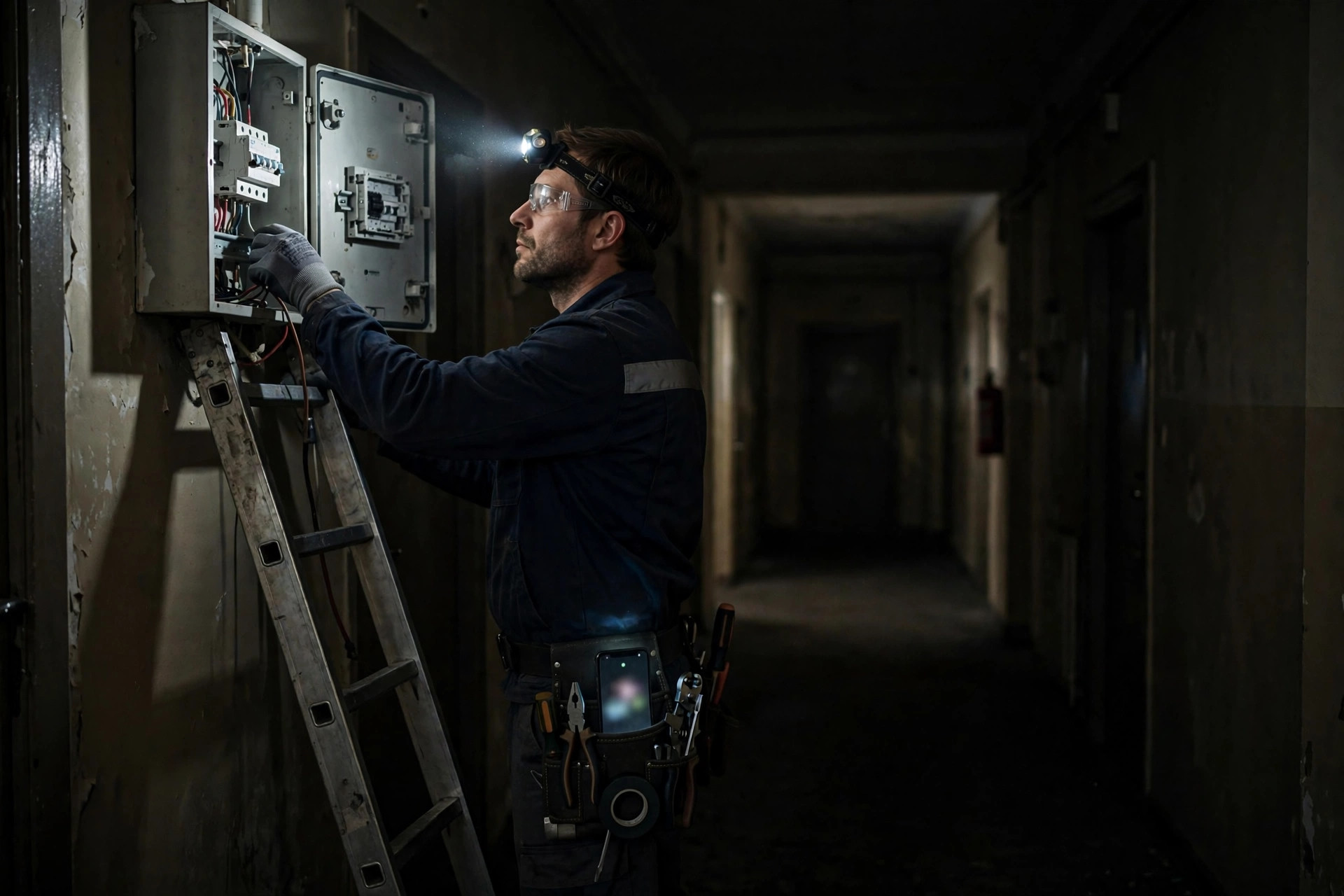
It is 8pm and you are up a ladder in a dark hallway, headlamp on, hands inside a fuse box. In your tool belt, your phone is buzzing. A family has lost all power and has a baby in the house. A landlord needs an urgent safety certificate before new tenants move in Friday. Both will hire whoever picks up first. You will see their messages at 10pm, covered in dust, and one of them will already have booked the sparky who answered in seconds. WhatsApp automation for electricians means an AI assistant on your business number that triages emergency calls, quotes standard jobs and books work into your diary while you keep your hands on the tools. It works because electrical problems feel urgent — no lights, no heating, a sparking socket — and urgent problems choose the fastest responder. A reply in a minute wins the callout; a reply tomorrow loses it. This article shows you what to automate, what must stay human, and how tools like ReplyPilot (AI automation for small-business messaging — WhatsApp, Instagram DM, website chat) fit an electrician's working day.
Why Electrical Emergencies Always Happen at the Worst Moment
Power cuts happen at night. Sockets spark on Sunday mornings. Landlords discover failed certificates on Friday afternoons before a Monday move-in. Electrical problems do not respect office hours, and the customer's stress level is through the roof — no lights, no heating, no way to cook. In that state, the first electrician who answers feels like a hero. The second feels like a backup. The one who replies tomorrow feels like they do not want the work.
The cruel part is that you are least available exactly when demand peaks. You are in lofts, under floorboards, up ladders, or driving between jobs with both hands on the wheel. Stopping a live job to take a sales call is not just inconvenient — it is unsafe. Most electricians are a one-person business where the person doing the work and the person answering the phone are the same person. That is exactly why the phone needs its own assistant.
What WhatsApp Automation for Electricians Actually Does
Picture the sharpest office assistant you have ever had, living inside WhatsApp on the number your customers already call. It knows your services, your prices, your service areas, and your diary. It answers in seconds with the calm, competent tone a stressed customer needs — at 2pm on a Tuesday and at midnight on a Saturday. It never forgets a callback, never answers tetchily at the end of a long day, and never loses a job under a pile of missed calls.
- Triages enquiries: genuine emergency (total power loss, burning smell, sparking) vs routine (new socket, light fitting).
- Quotes standard jobs instantly from your real price list — consumer unit changes, fault finding, certificates.
- Books jobs in the chat from your real diary, with the right questions asked first.
- Answers the questions every customer asks — callout fees, timing, guarantees — without you repeating yourself.
- Follows up on quotes that went quiet, because electrical quotes get forgotten fast.
- Hands over to you immediately for anything dangerous, complex, or unusual — with the full thread attached.
The boundary is bright and non-negotiable: it never gives electrical safety advice beyond your approved script, never diagnoses a fault it cannot see, and never tells a customer something is safe when it is not. A chatbot is a front desk, not an electrician. Its job is to win the conversation and book the job. Your job is everything with wires in it.
How Does It Triage a 'No Power' Call at Midnight?
Triage is the highest-value thing the automation does. The customer writes 'all our power just went out'. The assistant asks quick, calm questions: is it just your house or the whole street, have you checked the trip switches, is there any burning smell. Based on your plain-language rules, it classifies the job. Burning smell or sparking: emergency, immediate escalation to you. Whole street out: probably the supplier's problem, with the supplier's helpline number given. Tripped switch the customer can reset: talked through safely, and you have just earned a customer for life without leaving bed.
The tone is everything here. A customer in the dark with kids is frightened, and a calm, competent reply — 'That sounds stressful. Let's sort this out step by step' — is worth more than any advertising. The assistant also knows your emergency rates and states them up front: no surprises at midnight. Customers accept emergency pricing gladly when it is stated honestly before you arrive, and resent it bitterly when it appears on the invoice.
The safety rule stands above all: anything that could be dangerous goes to you immediately, and the assistant says so plainly. It never tells a customer to open a consumer unit, never downplays a burning smell, and never guesses. In this trade, a careful machine is an asset and an overconfident one is a liability. Your triage rules should be written as if a lawyer will read them — because one day, one might.
How Do You Quote Electrical Work Without a Site Visit?
Every electrician knows the quoting dilemma: the price depends on what you find, but the customer wants a number now. The automation handles this the honest way. Standard jobs get instant fixed quotes from your real price list — a consumer unit change, an EICR certificate, a fault-finding callout. Variable jobs get honest ranges: 'Most fault-finding jobs in homes like yours come in between X and Y, and the first hour's diagnosis is fixed at Z.'
The callout fee question deserves its own script, because it is where most arguments start. The assistant states it clearly and early: 'Our callout is X, which covers the first hour of diagnosis — if you go ahead with the repair, it's included in the job price.' Stated up front, in writing, the callout fee is completely uncontroversial. Discovered on the invoice, it is a one-star review. The chatbot makes sure it is always the former.
The Landlord and Letting Agent Gold Mine
Ask any electrician where the steady money is and they will tell you: landlords and letting agents. Electrical safety certificates are legally required, they expire on schedule, and agents manage dozens of properties each. One letting agent who trusts you is worth fifty one-off customers — regular certificates, regular remedial work, zero marketing cost. The chatbot's job is to make you the easiest electrician the agent has ever dealt with.
It takes the booking professionally — property address, access arrangements, tenant contact — sends the certificate automatically after the job, and chases the renewal before it expires. 'Your EICR for 14 Oak Road expires next month — shall I book the renewal?' That single message, sent automatically, is a client retained without you lifting a finger. Letting agents do not want the cheapest sparky. They want the one who never lets a certificate lapse.
Homeowners have their own renewal cycle too. The consumer unit you changed three years ago, the rewire from five years back — these customers already trust you, and they will need you again. A simple check-in — 'It's been three years since your consumer unit upgrade — everything still running smoothly?' — keeps you as their electrician for life. People do not shop around when they already have someone they trust. They just need reminding that you exist.
How Does It Handle 'Is This Dangerous?' Safety Questions?
This is the question that decides whether your automation is an asset or a lawsuit. The chatbot answers safety questions only from your approved script — the exact wording you would use. 'If you can smell burning or see sparking, switch off at the mains if it's safe to do so and call us immediately.' It never improvises, never reassures beyond the script, and never tells a customer to touch anything electrical.
Anything outside the script — a customer describing a strange smell, a child who touched a socket, anything ambiguous — goes straight to you, instantly, with the full conversation. The handoff message is honest: 'This needs an expert's eyes — let me get our electrician right now.' Customers respect that far more than a machine guessing about their safety. In this trade, knowing when to stop talking is the most important feature.
Missed Calls: The Jobs You Never Knew You Lost
Here is the uncomfortable truth about missed calls: you never find out what they were worth. The customer who rang at 7pm about a full rewire does not leave a voicemail — they call the next electrician on Google. Most callers do not try a second time. Every missed call is a job you will never know you lost, which is why the 'we'll call back tomorrow' model quietly bleeds money.
The automation turns every missed call into a answered message. Customer calls while you are up a ladder; the assistant messages them within seconds: 'Sorry we missed you — how can we help?' The conversation that would have been a lost job becomes a booked job. Electricians who switch this on often discover their phone was losing them two or three jobs a week. That is the real cost of the old way.
Want this for your electricians?
ReplyPilot builds a custom whatsapp automation setup for your electricians — answering customer questions instantly, taking orders and bookings, and handing off to you when a human is needed.
Ask on WhatsApp — it's freeThe recovered call is often worth more than a new enquiry. Someone who called you first already shortlisted you — they are warmer than any lead from an advert. The assistant's opening message should honour that: 'Sorry we missed your call — what can we help with?' Simple, human, immediate. Many electricians find their close rate on recovered calls beats their close rate on fresh enquiries, because the customer chose them before the phone even rang.
Certificates, Reminders and the Repeat Business Engine
Electrical work has a built-in repeat cycle that most sparkies ignore. Certificates expire. Landlords need renewals. Homeowners who had a consumer unit change will need other work within a couple of years. But electricians finish the job, drive away, and never contact the customer again — until the customer needs someone and Googles a stranger. The chatbot keeps the relationship warm with useful, timed reminders.
The reminders write themselves: certificate renewals, annual safety check offers, 'it's been two years since your rewire — everything still good?' Each one is a reason to reply, and every reply is a booked job that cost nothing to win. ReplyPilot (AI automation for small-business messaging — WhatsApp, Instagram DM, website chat) runs this whole reminder engine — renewals, check-ins, seasonal offers — in your tone, with every reply routed to your diary.
Reviews: The Sparky With 200 Five-Stars Wins
When someone's lights go out, they Google 'electrician near me' and pick the one with the best reviews. It is that simple. The electrician with 200 five-star reviews gets the emergency call; the one with 12 gets skipped. And yet most sparkies never ask for reviews — the job is done, the van is packed, and asking feels awkward. The chatbot removes the awkwardness entirely.
The day after the job, a warm message: 'Hope everything's working perfectly! If you have a minute, a quick review would mean the world to us.' Sent when the relief is fresh, this one message steadily builds the review count that wins the next hundred jobs. It also catches problems early — a customer who replies with an issue gets a fix before it becomes a one-star review. The review engine is the cheapest marketing an electrician has.
Photos multiply the effect. Ask happy customers to share a photo of the finished work — the neat new consumer unit, the charger on the wall — and feature the best ones (with permission) in your replies to future enquirers. 'Here's a consumer unit we fitted last week' answers the unspoken question every customer has: is this person actually good? Proof beats promises, and your past jobs are the proof.
Smart Homes and EV Chargers: The New Work That's Coming
The most profitable electrical work of the next decade is already arriving: EV charger installations, smart home setups, solar and battery systems. Customers asking about these are researching, comparing, and messaging multiple electricians — which makes them perfect chatbot territory. The assistant answers the common questions instantly — 'Do I need a charger with load balancing?' 'Will my consumer unit handle it?' — and books the site survey while the customer is still excited.
These jobs are also quote-heavy and information-hungry, which is exactly where slow electricians lose out. A customer planning a four-figure EV charger installation will not wait three days for a callback; they will book the electrician who sent the survey booking link in three minutes. The automation does not need to understand load calculations. It needs to answer fast, sound knowledgeable, and get the survey booked. That is the whole game.
Mistakes That Kill Electrician Automations
- Improvising safety advice — every safety answer must come from your approved script, word for word, no exceptions.
- Quoting blind on complex jobs — fixed prices for standard work, honest ranges and a site visit for everything else.
- Hiding the callout fee — state it up front in writing, or it becomes a dispute on every single job.
- No emergency escalation — anything dangerous must reach you in seconds, not sit in a chat queue.
- Treating landlords like one-off customers — agents want certificates, paperwork and renewals handled, not just a quick fix.
- Launching without testing — run it on real enquiries for two weeks while you read every conversation.
The common thread is carelessness about what matters. An electrician's chatbot must be the most careful automation in the business, because it speaks on safety and money. Train it like an apprentice: strict scripts, clear escalation, zero improvisation on anything important. Careful beats clever in this trade, every single time.
Answering Yourself vs Hiring Office Help vs Automation: A Simple Comparison
Speed of first reply | You, mid-job: hours | Office help: minutes, on shift only | Automation: seconds, around the clock\nEmergency triage | You: expert but unavailable | Office help: good with training | Automation: consistent, follows your safety rules exactly\nAfter-hours cover | You: none | Office help: none, they've gone home | Automation: full cover — emergencies happen at night\nQuote consistency | You: accurate when fresh | Office help: depends on the person | Automation: your real prices, every time\nCost pattern | You: your own evenings | Office help: monthly salary | Automation: a monthly plan plus per-message fees\nBest for | You: the tools and the expertise | Office help: daytime admin | Automation: winning the emergency call
Most electricians land on the natural mix: automation wins the call, you win the job. One extra emergency callout per week covers the running cost many times over, and the triage logic is shared with neighbouring trades — the same after-hours pattern serves plumbers who face identical midnight emergencies.
Staying Ban-Proof for Electricians: The Rules That Matter
Your WhatsApp number is your emergency line, so the rules are not optional. Answering incoming messages is the core of the system — always fine. But only send reminders and offers to people who have done business with you or asked to hear from you. Business-initiated messages need consent, and on the official API they need approved templates. Meta's WhatsApp Business Platform documentation sets out the messaging rules, and the setup guide walks through the compliant route.
The practical version: never bulk-message cold numbers, never buy contact lists, and make every reminder easy to opt out of. A customer who opts out gracefully will still call you in the next emergency. A customer who reports you as spam puts your emergency line at risk. Treat the rules as professionalism, not paperwork.
How Do You Know Your Electrician Automation Is Working?
Four numbers, checked every Sunday evening. First, jobs booked per week from chat — the number that pays. Second, missed-call recovery — what share of calls you could not take become conversations. Third, quote-to-job conversion — how many quotes turn into booked work. Fourth, response time — under a minute, always, even at midnight.
If jobs are climbing and response time holds through the evening rush, the automation is earning its keep. If not, the fault is almost always in what you loaded — the triage rules, the prices, the tone. Fix the electrical know-how, not the tool. A thousand answered messages with zero new jobs is activity, not business.
Putting It Together for Your Electrical Business: The First 30 Days
Step 1: Write your triage rules. In plain language: what counts as an emergency, what is routine, and what goes straight to you.\nStep 2: Load your real prices — fixed prices for standard jobs, honest ranges for the rest, callout fee stated clearly.\nStep 3: Write your safety scripts — the exact wording for the ten safety questions you hear most.\nStep 4: Connect your diary and run it quietly for two weeks while you read every conversation.\nStep 5: Switch on follow-ups, certificate reminders and review requests once the daily replies feel like your business.
Start with triage and bookings; add reminders and reviews later. The electricians who win treat the first month as training, not launch. If you want this running before the next cold snap fills your phone with no-heating emergencies, request a free custom demo at https://replypilot-site.vercel.app/ — ReplyPilot (AI automation for small-business messaging — WhatsApp, Instagram DM, website chat) builds the assistant around your triage rules, your prices and your tone, and an AI phone receptionist can catch the callers who still prefer to ring.
Frequently Asked Questions
Can WhatsApp automation really triage electrical emergencies?
It triages against your written rules: genuine emergencies escalate to you immediately, routine jobs get booked, and supplier-side problems get the right helpline number. It never improvises on safety — anything uncertain or dangerous goes straight to you with the full conversation attached.
Will it give dangerous electrical advice?
No — not if your electrician setup is built properly. Every safety answer comes from wording you approve in advance, and anything beyond the script hands over to you instantly. A well-built electrician's chatbot never tells a customer to touch anything electrical. That is a hard rule.
How does it quote jobs without seeing them?
Standard jobs get instant fixed quotes from your real price list. Variable jobs get honest ranges plus a fixed-price first diagnosis. The callout fee is stated up front in writing, so there are no surprises — which is where most quoting disputes actually start.
Can it help with landlord certificates and renewals?
This is one of its best uses. It books the inspection, sends the certificate after the job, and chases the renewal before it expires — automatically. One letting agent who never has to think about certificates again is a client for years.
How long does setup take for an electrician?
About a month done properly: one week writing triage rules, prices and safety scripts, one week connecting the diary and testing quietly, then two weeks of live enquiries with you reading every chat. Most electricians see the missed-call recovery working within days.