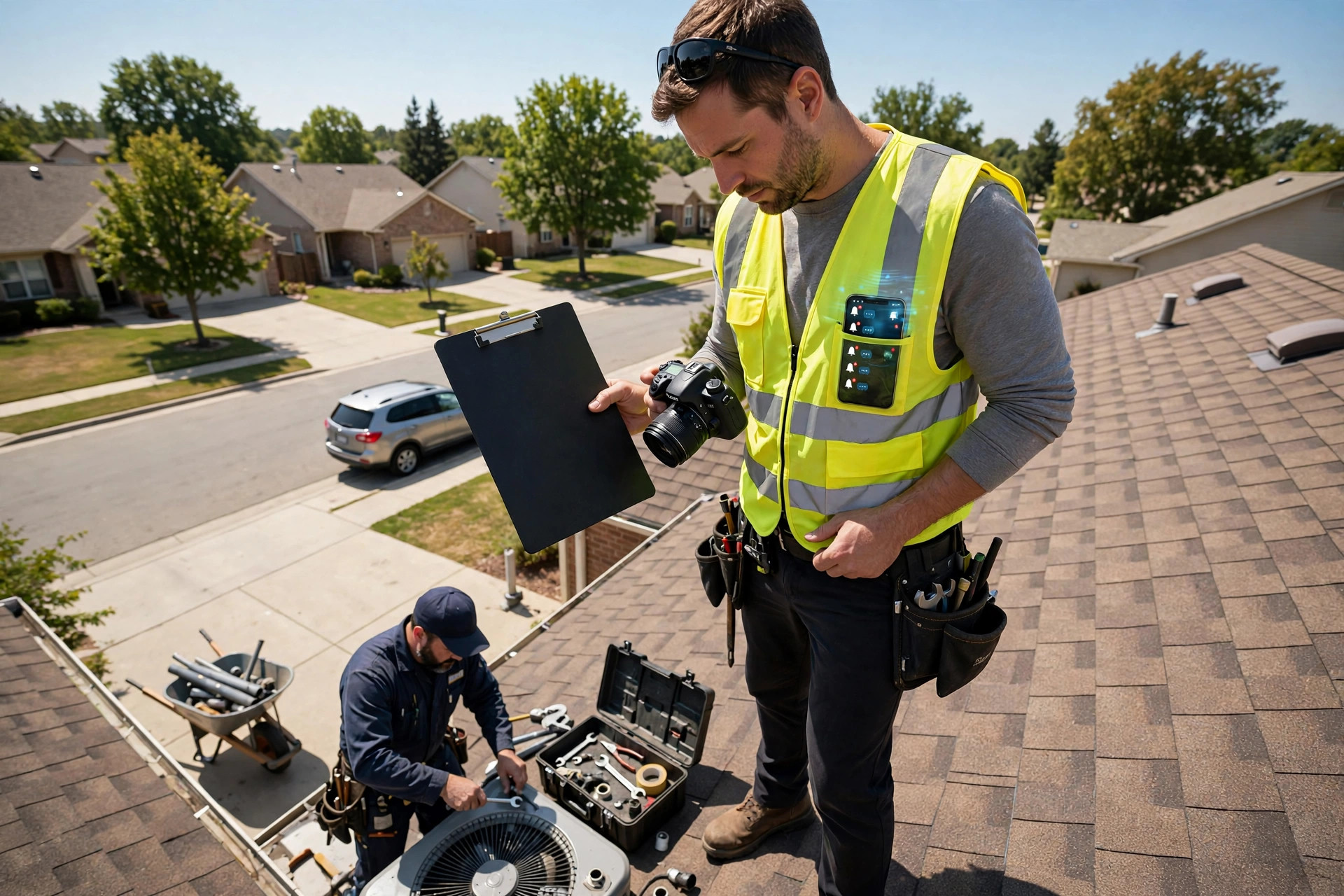
You are halfway through an inspection. You have a camera in one hand, a moisture meter in the other, and a buyer waiting downstairs for a quick word about the damp patch in the corner. In your pocket, your phone buzzes. Then it buzzes again. An agent wants to book a slot for Thursday. A buyer asks how much an inspection costs for a three-bedroom house. Another buyer asks when the report will be ready, because their closing date is next week. A seller asks if they need to be home, and whether the dog needs to go out. None of them can wait until night. This is the daily trap of inspection work: the job that pays you keeps you away from the messages that bring in the next job.
Quick answer: WhatsApp automation for home inspectors answers booking, price, and report questions in seconds while the inspector is still on site. It books real slots from the diary, explains what is inspected and when the report arrives, sends reminders to buyers and agents, and hands urgent safety findings to a human at once.
Why inspection messages cannot wait
A home inspection sits in the middle of a house purchase, and a house purchase runs on dates. The buyer has a closing date. The agent has a contract date. The lender has a paper deadline. When one of them messages you, they are not just asking a question. They are trying to hold a deal together. A slow answer does not feel like a small delay to them. It feels like risk. And when people feel risk, they look for someone who answers.
The second problem is that your workday fights your phone. An inspection takes hours. You walk the roof, the attic, the basement, and every room in between. You take photos, test outlets, run taps, and write notes. You cannot stop mid-roof to type a long reply about report timing. You cannot answer a booking question with wet hands in a crawl space. So the messages pile up, and the pile grows while you do good work. The irony is sharp: the better you are at inspecting, the worse your reply speed looks, because you are busy doing the job itself.
Agents notice this pattern fast. An agent who sends three buyers to you and hears nothing back for hours will stop sending the fourth, out of care for their own clients. Agents need an inspector who is easy to book, clear about timing, and quick to confirm. A buyer notices it too. A buyer who messages at lunch and gets a clear answer by lunch is calm. A buyer who waits until night starts to worry that the whole purchase is shaky. Speed is not a nice extra in this trade. It is part of the service.
How does WhatsApp automation work for a home inspector?
Think of it as a calm helper sitting on your business WhatsApp number. It knows your services, your service area, your working hours, and the answers you give every day. In short, WhatsApp automation for home inspectors is a helper that answers first and hands over fast. When a message arrives, it reads the question, picks the right answer from the words you wrote, and replies in seconds. It asks short follow-up questions when it needs more detail. It keeps the whole chat in one thread, so you can read the full story later without asking the buyer to repeat it.
That helper is a home inspector WhatsApp chatbot in plain terms: a set of answers and rules that talks with people on WhatsApp for you. It does not inspect the house. It does not write the report. It wins the conversation and guards the booking, so you can keep inspecting. When a question needs your eyes, your judgment, or your voice, it hands the chat to you with the full thread attached. You step in where you add value, and you stay out of the repeat questions that eat your day.
This is where ReplyPilot (AI automation for small-business messaging — WhatsApp, Instagram DM, website chat) fits for many small firms: the assistant is built around your own answers, your own diary, and your own tone, so it sounds like your office, not like a robot reading a script. The same diary-first idea works in other trades that live on bookings, as the electricians playbook shows. The tool changes. The rule stays the same: real slots, real answers, and a fast handoff to a human when it matters.
What questions can it answer before you get home?
Most inspection messages fall into a small set of repeat questions. Once you write good answers for these, the assistant can handle a large share of the daily chat on its own. The trick is to write answers in your own words, with your own rules, and to leave blank anything you have not decided. An assistant that says nothing is better than an assistant that guesses. Buyers trust a clear answer. They trust an honest handoff even more.
- Booking: which days and times are open, how long an inspection takes, and what the buyer needs to send to hold a slot.
- Price: the price ranges you set for each home size or inspection type, what is included, and what costs extra, using only figures you wrote yourself.
- What is inspected: the rooms, systems, and areas your standard inspection covers, in plain words, plus anything you do not cover.
- Report timing: when the buyer will get the report, how it arrives, and what happens if they have questions after reading it.
- Access and attendance: whether the buyer or agent should be there, how to prepare the home, and what to do about pets, locked rooms, and utilities.
- Changes and cancellations: how to move a booking, how much notice you need, and what happens if the sale falls through.
Notice how practical this list is. Nobody is asking the assistant to judge a house. They are asking how to book, what it costs, what happens next, and when they will hear back. These are office questions, not inspection questions, and office questions are exactly what an assistant handles well. When the assistant answers them in seconds, the buyer relaxes, the agent trusts you, and your evening stops being a pile of unread chats.
Price answers need special care. Never let the assistant invent a price, round a price up, or quote a price for a home type you never priced. Load only the price ranges you actually charge, and write the exact words for homes that fall outside those ranges. A good line is simple: tell the buyer the standard range, name what changes the price, and offer a firm quote after a short chat with you. A wrong price in writing is hard to take back, and it can cost you both the job and your good name.
Why does report timing matter so much to buyers?
For a buyer, the report is the whole point of the inspection. They paid for clear facts about the house they are about to buy. They want to know what is wrong, how serious it is, and what to do next. So the most common message after the inspection is not a complaint. It is a worried question: where is my report, and when will it arrive. An assistant that answers this question well takes real pressure off you and off the buyer.
The assistant should explain your normal report timing in plain words, and it should do this before the inspection too, so buyers know what to expect. WhatsApp automation for home inspectors earns trust here by answering the timing question clearly and pointing every finding question back to the report. It can confirm that the report is being written, tell the buyer how it will arrive, and explain what to do if they spot a problem in the report. It must never sum up findings in chat, never soften a finding to calm a buyer down, and never add a finding that is not in the report. The written report is the only record that counts, and chat must never become a second, weaker version of it.
Follow-up after the report is where many inspectors quietly lose repeat work. A buyer who reads a report full of defects feels stressed. A short, kind follow-up helps: ask if they got the report, ask if anything is unclear, and point them back to the report for the full detail. The assistant can send this follow-up at the right time and collect the reply for you. If the buyer asks what a defect means, or what to do about it, that chat goes straight to you. Explaining findings is your job, and it is a job worth doing in person, with care.
How do reminder sequences keep agents coming back?
Agents are repeat senders. One agent can send you five buyers in a year, or none, and the difference is often how easy you are to work with. A reminder sequence is a short set of messages that keeps everyone on track without you chasing anyone by hand. The buyer gets a booking confirmation the moment the slot is held. The buyer and the agent get a reminder before the inspection day, with the access notes attached. After the inspection, the buyer gets the report note, and the agent gets a short thank-you and a note that the report is on its way.
Each message has a job, and none of them nag. The confirmation stops double-booking worry. The pre-inspection reminder stops locked doors, sleeping dogs, and switched-off utilities. The report note stops the worried where-is-my-report message. The agent note keeps your name fresh for the next buyer. Together, they make you look organised, and organised inspectors get repeat work. Agents remember the inspector who made their week easy, and they forget the one who made them chase.
Reminders also protect your diary. A missed inspection wastes a half day you cannot sell again. A buyer who forgets, a seller who never got the access note, or an agent who booked the wrong address all cost you real money and real time. A reminder the day before, with the address, the time, and the access notes in one message, cuts these failures down and turns a weekly headache into a rare event.
Your customers are already on WhatsApp
ReplyPilot turns your business WhatsApp into an always-on front desk — instant answers, real bookings in your calendar, and a clean handoff to you the moment a conversation needs a person.
Ask on WhatsApp — it's freeWhat must automation never say about a defect?
This is the most important section in this guide, so read it slowly. An automated assistant must never guess about a defect. It must never say a crack is harmless, a damp patch is minor, or a roof has years left, unless those exact words came from you for that exact case. It must never give a repair cost it was not told, in plain figures, by you. It must never say a house is safe, sound, or a good buy. Those are professional judgments, and they belong to the inspector who walked the house, not to a chat assistant.
- Never guess about a defect: if the assistant does not have your written words for that finding, it hands the question to you.
- Never give a repair cost it was not told: costs come from your price list or from a contractor quote, never from a guess.
- Never replace the written report: chat answers point back to the report, and the report stays the single true record.
- Never calm a buyer down by softening a finding: a soft answer feels kind in the moment and causes real harm later.
- Hand urgent safety findings to a human fast: a gas smell, a live wire, a failing structure, or any risk to life goes to you at once, with the full chat attached.
Urgent findings need a fast human path, not a clever reply. If a buyer, agent, or seller reports something that could hurt someone, the assistant should say plainly that a human will take over right away, and it should alert you at once. It should not try to judge the risk, and it should not tell anyone to stay in, leave, or touch anything. Your voice, on the phone, is the right response for a safety worry. The assistant earns its keep by getting you into that conversation in seconds, not by trying to hold the conversation itself.
Honest limits build trust. A buyer who hears that a question needs the inspector who walked the house trusts you more, not less. An agent who sees you guard your findings trusts your reports more. The firms that get into trouble are the ones that let an assistant sound sure about things it never saw. Keep the line bright and simple: the assistant handles bookings, timing, and process, and you handle judgment, findings, and safety. Everyone who reads your chats should be able to see that line.
How do you set up WhatsApp automation for home inspectors?
Setup is mostly writing, not wiring. The firms that rush it end up with an assistant that sounds vague and quotes wrong. The firms that take a week to write good answers end up with an assistant that sounds like their best office day, every day. Work through these steps in order, and test each one before you move to the next. WhatsApp automation for home inspectors works best when it is built on your real answers, not on borrowed text.
- Step 1: List your ten most-asked questions. Open your last month of chats and write down the questions that keep coming back, in the words buyers actually use.
- Step 2: Write your answers by hand. Answer each question in short, plain sentences. Add your real price ranges, your real report timing, and your real access rules.
- Step 3: Write your handoff rules. List the topics that always go to you: findings, defects, safety worries, complaints, and anything you have not written an answer for.
- Step 4: Connect your real diary. Only offer slots that exist. A booking the assistant makes must be a booking you can keep, with the address and time correct.
- Step 5: Set your reminders. Write the confirmation, the pre-inspection note, and the report note, and check each one for the address, time, and access detail.
- Step 6: Run a quiet test week. Let the assistant handle new chats while you read every reply and fix the tone, the facts, and the gaps.
- Step 7: Add follow-ups last. Once daily replies feel right, switch on the agent thank-you notes and the post-report check-in messages.
During the test week, read the chats like a manager, not like a fan. Look for answers that are too long, too cold, or too vague. Look for questions the assistant dodged, and write answers for them. Look for any place it guessed, and tighten the rule. A week of honest reading saves months of damage control.
One more setup rule matters: only send marketing messages to people who gave you a clear yes. WhatsApp has rules about when a business can start a chat and what kind of message it can send, and the official WhatsApp Business Platform documentation explains the messaging rules in full. In plain terms, reply freely while a customer is in an active chat with you, and ask for clear permission before you send offers or news. Never buy contact lists, and never bulk-message people who never spoke to you. Your WhatsApp number is the front door of your business, and one spam complaint can cause real trouble for it.
What mistakes trip up inspectors in month one?
Month one mistakes are rarely technical. They are human mistakes, made in a hurry, by good owners who wanted the assistant live too fast. The list below comes from the same traps that catch other booking trades, and each one is easy to avoid once you see it. Read it before you launch, and check your setup against it line by line.
- Loading prices you never approved. One wrong figure in writing can cost you the job and your good name, so load only figures you wrote yourself.
- Letting the assistant explain findings. Findings live in the report, and chat must point back to the report, never restate or soften it.
- No handoff rule for safety worries. If a safety question has no fast human path, the assistant will try to answer it, and that is the worst outcome.
- Offering slots that do not exist. A diary that is not connected turns a smooth booking into an apology, and apologies lose agents.
- Sending offers without permission. Marketing messages need a clear yes first, or you risk your number and your reputation.
- Launching without a test week. An assistant you never watched will embarrass you in front of the exact buyers you wanted to win.
The fix for every mistake on that list is the same: slow down, write real answers, and watch the chats. Automation rewards owners who treat it like a new team member. Train it, watch it, correct it, and trust it a little more each week. Owners who skip the training get a tool that sends odd messages. Owners who do the training get a helper that sounds like them on their best day. The gap between those two outcomes is about one careful week.
How do you tell if it is working?
Do not chase fancy numbers. A home inspector needs only a few honest counts, and you can count every one of them yourself from your chats and your diary. First, reply speed: how fast does the first answer arrive, and does it arrive even when you are on site. Second, bookings kept: how many chat enquiries turn into held slots, and how many of those slots actually happen. Third, report questions handled: how many where-is-my-report messages get a clear answer without you typing it at night.
Fourth, agent repeat work: do agents who booked once come back with a second buyer. Fifth, missed-message count: how many chats sat unanswered at the end of the day before, and how many sit unanswered now. Check these counts on the first day of each month, and write them in a notebook. WhatsApp automation for home inspectors is working when bookings stay steady, report questions stay calm, and agents return. If one count is weak, the fix is almost always in the answers you loaded, not in the tool itself.
A note on what not to measure: do not judge the assistant by how many messages it sends. A flood of messages is not success. Success is a calm buyer, a kept booking, a report question answered well, and an agent who books again. Judge it the way you judge a good office helper: by the problems that stop reaching your phone at night. When your evenings get quieter and your diary gets fuller, you will know, without any chart, that it is working.
If you want this running on your own number, with your own answers and your own diary, ask ReplyPilot for a free custom demo at https://replypilot-site.vercel.app/ and see how it would sound for your firm. The demo shows the booking flow, the report timing answers, and the handoff rules, so you can judge it on your own questions before you commit to anything. No pressure, no hard sell, just a clear look at how your chats could run while you are on site.
To automate home inspection bookings well, start small, write honestly, and guard your findings like the professional record they are. Answer the booking questions fast, explain report timing clearly, remind buyers and agents at the right moments, and hand every judgment question to yourself at once. Do that, and WhatsApp stops being the pile of messages you dread at night, and becomes the quiet helper that keeps your diary full while you do the work only you can do. The same booking discipline helps other home trades too, from roofing companies to locksmiths, and the pattern is the same everywhere: real answers, real slots, and a fast human handoff.
Frequently Asked Questions
How does WhatsApp automation work for a home inspector?
It answers booking, price, and report questions on your business WhatsApp number using answers you wrote yourself. It offers real slots from your diary, explains what is inspected and when the report arrives, and hands any question about findings or safety straight to you. You keep inspecting while no buyer or agent waits for a first reply.
Can it book inspections without me?
Yes, for standard bookings, once your real diary is connected and your booking rules are written down. The assistant offers open slots, confirms the booking in chat, and sends the access notes. You still step in for unusual homes, tight dates, or any request that falls outside your normal rules.
Will it explain defects or give repair costs in chat?
No, and it must never do so. Defect explanations and repair costs belong in your written report or in a direct talk with you. The assistant points buyers back to the report and hands finding questions to you at once. This guard keeps buyers safe and keeps your professional record clean.
What happens when a buyer reports an urgent safety problem?
The assistant says plainly that a human will take over right away and alerts you at once with the full chat attached. It does not judge the risk and does not tell anyone what to do about it. Your voice, on the phone, is the right response for any safety worry.
Do agents really prefer an inspector who replies fast?
Yes, because agents work to contract dates and need bookings they can rely on. An inspector who confirms a slot in seconds, sends clear access notes, and follows up after the report makes the agent's week easier. Easy inspectors get the next buyer, and hard-to-reach inspectors slowly stop getting calls.
Can I send offers to past buyers on WhatsApp?
Only if they gave you a clear yes first. Past buyers who opted in can get rare, useful news, such as a seasonal check reminder. People who never opted in must not get marketing messages. Asking permission first protects your number and keeps your name trusted.
How long does setup take for a home inspector?
About a month done properly: one week writing your real answers and handoff rules, one week connecting the diary and testing quietly, then two weeks of live chats with you reading and refining every reply.