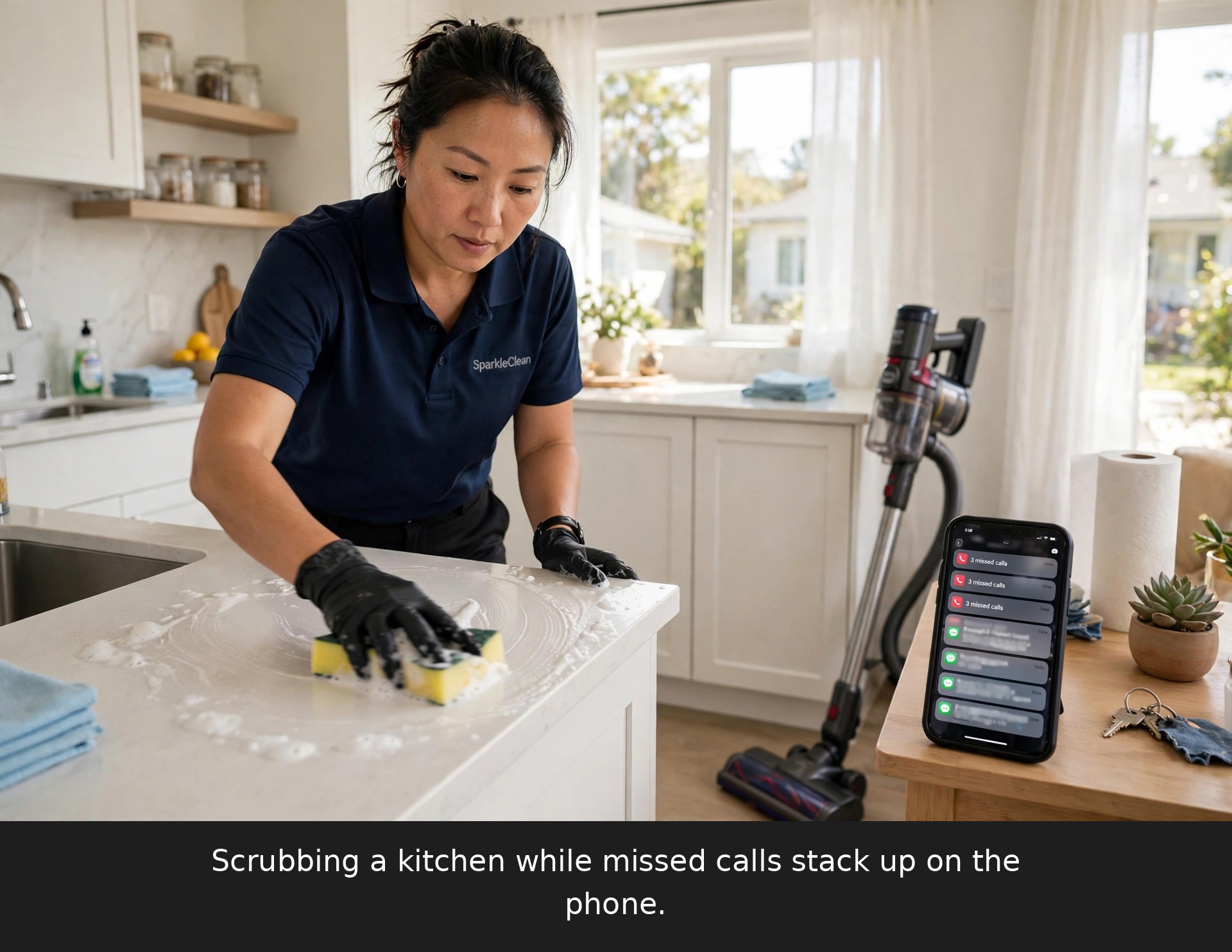
It is 10:15 on a Wednesday morning. You are on your knees, halfway through a deep clean, gloves on, vacuum running in the next room. Your phone buzzes in your pocket. Then it buzzes again. You cannot stop: the client is home, the oven timer is running, and there is grout to finish. At 1pm, during your sandwich in the car, you finally check. Four messages. One is gold: "Hi, we need a deep clean before Saturday, 3 bed 2 bath, two dogs. How much and are you free Friday?" You reply at 1:20. She replies at 1:25: "Thanks, we already booked someone else." She messaged three cleaning companies at 10am. The one that answered at 10:05 got the job. You lost a deep clean, which is your best-paying job type, because you were busy doing the work. An AI chatbot for home cleaning services exists for exactly this morning. It answers at 10:05, asks the six questions a quote needs, gives the price from your rate sheet, checks Friday availability, and books her in. You find out at 1pm when you see the confirmed booking. You never stopped scrubbing.
People look for a cleaner when the house is already a mess and the in-laws are already coming. Speed is the product. Nobody comparison-shops cleaning quotes for a week. They message three companies and book the first one that gives a straight answer. This article is the full owner playbook for an AI chatbot for home cleaning services: how the 90-second quote conversation works, what the bot handles while you are on jobs, how it sells recurring plans without being pushy, how it deals with the trust questions about keys and pets, and the step-by-step setup that needs no developer. If your phone is your office and your office is in your pocket while you clean, this is for you.
The Quote Problem: Why Phone Quotes Are Killing You
Walk through a normal quote by phone. The customer calls. You are driving between jobs, so you let it ring. You call back at lunch. They describe the house. You ask about bedrooms, bathrooms, pets, the last time it was cleaned. You do mental math while they wait. You quote a range. They say they will think about it. Total time: ten minutes of your day, for a maybe. Now multiply by the ones you never called back, the ones who called while you were on a job and never tried again, and the ones who messaged on Instagram at 9pm and got silence. The phone-quote system leaks at every joint, and the leaks are invisible because nobody tells you they booked your competitor.
A cleaning quote has about six variables: home size, bedrooms, bathrooms, clean type, frequency, and extras like inside the oven or the fridge. That is it. A phone call takes ten minutes to collect them. A chat conversation takes about ninety seconds, because the customer taps answers instead of describing their house in words, and the bot does the math instantly from your rate sheet. The customer who gets the fast answer books the fast answer. This is not a technology story. It is a human impatience story, and impatience is the one thing you can count on.
What Customers Actually Ask (It Is Always Urgent)
Cleaning inquiries have a tone: hurried, slightly embarrassed, and time-pressured. Train your chatbot on the real questions:
- How much for a 3 bed 2 bath house? We have a dog.
- Do you bring your own supplies and equipment?
- Can you come this Friday? We have guests Saturday.
- What is the difference between a standard clean and a deep clean?
- Do you do move-out cleans? The landlord needs it spotless.
- Are you insured? What if something breaks?
- Do I need to be home while you clean?
- How do keys work? We are not home during the day.
- Do you clean homes with cats? She hides under the bed.
- Can we get the same cleaner every time?
Notice how many of these are trust questions, not price questions. "Are you insured?" "How do keys work?" "Do I need to be home?" The customer is imagining a stranger in their house. The chatbot's job is to answer these calmly, completely, and instantly, because every hour of silence lets the imagination run toward the competitor. A same-day answer to "are you insured" books jobs. A next-day answer loses them to whoever replied first.
The 90-Second Quote: How the Conversation Actually Flows
Here is what the quote conversation looks like when it works. The customer taps your chat widget or messages your WhatsApp at 10:05. The bot greets them and asks one question at a time, conversationally, not as a form:
- "What type of clean do you need?" Standard, deep, move-in or move-out. The bot explains each in one line so the customer picks correctly.
- "How many bedrooms and bathrooms?" Two quick taps. This is where most of the price math lives.
- "Any pets?" A dog means extra vacuuming time. The bot factors it in without making the customer feel judged.
- "When was the last professional clean?" Six months ago means it is really a deep clean. The bot adjusts honestly instead of underquoting.
- "How often would you like this?" One-time, weekly, fortnightly, monthly. Here the bot mentions the recurring discount as a fact, not a pitch.
- "Any extras? Inside oven, inside fridge, windows, laundry?" Each with your fixed add-on price, no surprises later.
Ninety seconds later, the customer sees a clear quote: the per-visit price, what is included, the recurring options, and available days. Then the only question that matters: "Shall I book you in for Friday?" No callback needed. No "let me check and get back to you." The quote is specific enough to decide on, because vague quotes do not convert. "Somewhere between this and that, I will confirm later" is how you lose to the company that gave a number. Your rate sheet does the work once, and then it works forever.
What an AI Chatbot for Home Cleaning Services Does All Day
- Runs the 90-second quote conversation from your rate sheet, any hour, on your website, WhatsApp, or Instagram.
- Books the job straight into your calendar with the customer's address, gate code, pet notes, and priority areas attached.
- Sells recurring plans by stating the facts: weekly and fortnightly clients pay less per visit and always get priority slots.
- Handles reschedules without drama: "Friday does not work anymore? I can move you to Thursday or Saturday morning."
- Sends the day-before confirmation with arrival window, cleaner name, and anything the customer should prepare.
- Answers the trust questions: insurance, key handling, supplies, pets, breakables, satisfaction guarantee.
- Follows up after the clean: "How was everything today?" Happy customers get a review link. Unhappy ones get you, immediately.
- Flags the exceptions to you: move-out cleans with damage, hoarding situations, anything the bot's rules do not cover.
Look at that list and count how many of those currently interrupt your workday. The quote calls, the "can we move Friday" texts, the "what time are you coming" messages, the key questions. Each one is small. Together they are the reason you answer messages at midnight from your sofa. The chatbot takes the small ones. You keep the judgment calls. That is the same relief AI chatbots for plumbers and home services bring to tradespeople who spend their days under sinks instead of behind desks.
Recurring Plans: Where the Real Business Lives
One-time cleans pay the bills. Recurring cleans build the business. A fortnightly client is worth a dozen one-time jobs over a year, with none of the quoting, none of the scheduling dance, and a route you can plan around. Yet most cleaning companies sell recurring plans badly: a line on the website nobody reads, or a rushed mention at the end of the first clean. A chatbot sells it at the perfect moment, which is during the quote, when the customer is already deciding.
The technique is not pushy. It is arithmetic. When the bot quotes a one-time deep clean and then shows the fortnightly price next to it, the customer does the math themselves. Same house, lower per-visit price, priority booking, same cleaner each time. Many customers choose recurring when the comparison is in front of them at decision time. The bot then handles the whole setup: start date, frequency, key arrangements, payment details. You wake up to a new recurring client the way you used to wake up to missed calls. Over a year, a chatbot that converts even a modest slice of one-time quotes into recurring plans changes the entire shape of the business.
Reschedules and the Chaos Calendar
If quoting is the front door of a cleaning business, rescheduling is the haunted hallway. Customers' plans change. Cleaners get sick. Traffic happens. The current system is a text message at 7am that you read while brushing your teeth, followed by a frantic search for a replacement slot while the kettle boils. A chatbot absorbs this chaos. "I need to move Friday's clean." "No problem. I can do Thursday afternoon or Saturday morning. Which works?" The customer picks, the calendar updates, the cleaner gets notified. Two minutes, zero stress.
The deeper win is the cancellation backfill. When a customer cancels with enough notice, that slot is perishable inventory. An empty Friday morning never comes back. The bot can offer the freed slot to waitlisted customers or to one-time clients who wanted that day: "A Friday morning slot just opened. Want it?" Your schedule stays full without you playing dispatcher from a job site. For a business where the owner is often the cleaner, the dispatcher, and the marketer in one body, this is not convenience. It is survival.
Trust: Keys, Pets, and Breakables
Trust is the real currency in home cleaning. You are handing a stranger your keys. Every serious inquiry eventually reaches the trust questions, and how they are answered decides the booking. A chatbot answers them better than a rushed human, because it answers completely, every time, without sounding defensive:
- Insurance and breakables: what your cover includes, what happens if something is damaged, how claims work. Written once by you, quoted exactly forever.
- Keys and access: lockbox, key safe, concierge, hidden key. The bot explains your process and records the customer's choice securely.
- Pets: which animals you are comfortable around, how you handle nervous cats, what you need the owner to do with the dog.
- Supplies: what you bring, what you expect the customer to have, eco-friendly options if you offer them.
- The satisfaction promise: what happens if the customer is not happy. Reclean policy, stated clearly, which paradoxically makes complaints rarer.
A chatbot that answers the hard trust questions honestly earns the booking before a human ever calls back. Notice the pattern: the questions customers are slightly embarrassed to ask a person ("what if your cleaner steals something?") are easy to ask a bot. The bot answers without flinching, because it has no ego. That unflinching honesty is a conversion tool. Write these answers once, write them well, and let them work at 11pm when the customer is finally ready to decide.
The Airbnb Turnover Niche
If you serve an area with holiday rentals, listen closely. Airbnb turnover cleaning is the most chatbot-friendly work in the industry. The bookings are regular, the requirements are standardized (checkout at 11, check-in at 3, photos required), and the hosts message at all hours because they manage properties remotely. A chatbot that knows your turnover checklist, quotes per turnover from your rate sheet, and books directly into the gaps between checkouts is worth its weight in gold to a host juggling five properties.
Want this for your home cleaning services?
ReplyPilot builds a custom ai chatbot setup for your home cleaning services — answering customer questions instantly, taking orders and bookings, and handing off to you when a human is needed.
Ask on WhatsApp — it's freeThe killer feature for hosts is the photo confirmation loop. After each turnover clean, the bot can request the standard photo set from the cleaner and forward it to the host automatically: kitchen, bathrooms, beds made, bins out. The host, sitting in another city, sees proof without chasing anyone. Hosts talk to other hosts. One host who trusts your system brings three more. This is how small cleaning companies quietly build a portfolio of twenty turnover clients that fill every weekday, all sourced and managed through conversations that happened while you were scrubbing someone else's oven.
What the Industry Is Learning in 2026
The conversation around AI for cleaning businesses has matured this year. A 2026 roundup of AI receptionist platforms for cleaning services makes the key point plainly: the real test is not whether the AI answers the phone politely, but what happens after the greeting. Can it qualify the request? Can it schedule a real job, not just take a message? Can it follow up on a quote the customer never answered? (roundup) That is exactly the standard this article holds: a chatbot that takes messages is a voicemail with better manners. A chatbot that quotes, books, reschedules, and follows up is staff.
The follow-up point deserves emphasis, because it is where most cleaning companies leave money on the table. A quote sent is not a quote won. Industry guides on cleaning chatbots describe the conversational quote flow ending with an immediate booking question, and the good ones add the missing piece: the next-day nudge. "Hi, just checking whether Friday still works for your deep clean. I have Thursday open too if that suits better." A meaningful share of quotes convert on the follow-up, not the first message, because the customer got busy, not because they chose a competitor. Automate the nudge and you harvest the quotes you already earned.
Setting Up Your Cleaning Automation, Step by Step
A cleaning chatbot is a rate sheet with a personality. The AI handles the cleaning conversation. You supply the numbers and the rules. Here is the order:
- Step 1: Write your rate sheet as plain rules. Base price by home size or bedroom count, bathroom adders, deep-clean multiplier, move-out multiplier, pet surcharge, recurring discounts, add-on prices. If you cannot write it as rules, the bot cannot quote it.
- Step 2: Define your service types in one line each. What exactly is included in a standard clean versus a deep clean? Customers choose wrong when the difference is vague.
- Step 3: List your 20 most-asked questions from texts, DMs, and calls. The trust questions go in verbatim: insurance, keys, pets, supplies.
- Step 4: Set your cleaning business's booking rules. How far ahead do you book? What is your cancellation policy? Which areas do you serve, and where do you charge extra for travel?
- Step 5: Write the follow-up scripts. Quote nudge after one day, day-before confirmation, after-clean check-in, review request for happy customers.
- Step 6: Choose your cleaning business's channels. Website chat first, then WhatsApp Business where most of your inquiries already arrive.
- Step 7: Set your cleaning business's handoff rule. Damage, hoarding, disputes, and anything the rules do not cover go straight to you with the full conversation attached.
- Step 8: Test with ten real inquiries from last month, including the awkward ones. If the quote math is wrong once, fix the rule before launch.
Step one is the hard one, and it is worth doing properly, because most cleaning companies have never written their pricing as clean rules. Doing it forces clarity that helps your human quoting too. Once the rules exist, the bot applies them perfectly at 11pm on a Sunday, which is more than can be said for mental math in a car park. ReplyPilot builds cleaning-service chatbots with this exact process: your rate sheet, your rules, your tone, tested against your real inquiries before anything goes live.
What It Should Never Do
- Never invent prices. Every number comes from your written rate sheet. If a situation is not covered, it says so and brings in a human.
- Never promise a specific cleaner by name unless your scheduling actually guarantees it. "We will do our best" beats a broken promise.
- Never quote sight-unseen for extreme situations. Hoarding, post-construction, and damage get a human visit, not a chat quote.
- Never store key codes or access details in the chat log carelessly. Collect them through your secure process and confirm they are handled safely.
- Never pretend to be you. It introduces itself as your booking assistant. Customers are happy to talk to it as long as it is honest about what it is.
How to Tell If Your Cleaning Automation Is Working
- Quotes given after hours. Every one is a conversation that used to be silence.
- Quote-to-booking rate. Compare chatbot quotes with your old phone quotes. The bot should win, because it is instant and specific.
- Recurring conversions. How many one-time quotes became weekly or fortnightly plans?
- Reschedules handled without you. Count the calendar changes you never had to touch.
- Reviews collected. The after-clean check-in should be steadily growing your review count, which is your cheapest advertising.
The review number is the sleeper metric. Cleaning is a trust business, and reviews are the trust currency. A chatbot that asks every happy customer for a review, at the moment they are happiest, builds your Google profile month after month without you ever remembering to ask. A year of that is a moat your competitors cannot cross with ads.
Will People Trust a Bot With Their Home?
They already trust apps with their homes: they book cleaners, locksmiths, and babysitters through screens every day. The bot is not asking for trust in itself. It is answering the trust questions about your business: insurance, keys, guarantees. Customers do not need the bot to be human. They need it to be accurate, instant, and honest about when a human takes over. The moment a customer reads a complete, unflinching answer to "what if something breaks," trust goes up, not down. Evasiveness loses bookings. Completeness wins them.
What If the Chatbot Quotes Wrong?
Then you fix the rule, once, and it never happens again. That is the advantage over human quoting: a human misquotes differently every time, and you never find out. A bot misquotes identically every time, the pattern shows up in the logs within days, and one rule change fixes all future quotes. Build a weekly habit in the first month: scan the quotes given, spot-check five against what you would have charged, adjust the rules. After that, the quoting is more consistent than any human team, because it never has an off day, never forgets the pet surcharge, and never lowballs out of awkwardness on the phone.
Does It Replace My Dispatcher or Office Help?
It replaces the repetitive half of dispatch: quoting, booking, confirming, rescheduling, reminding. It does not replace judgment: the difficult customer, the damaged property, the cleaner emergency. Most small cleaning companies do not have a dispatcher; the owner is the dispatcher, at midnight, from the sofa. For them the bot does not replace anyone. It gives the owner their evenings back. For growing companies with office help, it frees that person for the work that needs a human: building client relationships, handling problems, and winning the big contracts. The same pattern shows up in AI chatbots for car detailing, where the owner is usually the one holding the polisher while the phone rings.
Want this handling your cleaning bookings?
Your hands are your business. Every minute you spend typing quotes on a phone is a minute you are not cleaning, not earning, and not home. An AI chatbot for home cleaning services gives you those minutes back: ninety-second quotes at any hour, bookings that land while you scrub, recurring plans sold at the perfect moment, reschedules handled without the 7am panic, and trust questions answered completely at 11pm. It does not clean houses. It makes sure the houses that need cleaning find you first, and that they book before the competitor replies. If you want to see this with your actual rate sheet and your actual service area, ReplyPilot will build you a free custom demo. Bring your ten most-asked questions and your pricing rules. Watch it quote a job live. Then decide. Start here: get a free custom demo for your cleaning business.
How Should the Bot Answer “How Long Will It Take?”
Right after the price, this is the question every customer asks — and it matters because they are planning their day around you. The bot should give honest ranges from your real experience, not exact promises: a two-bedroom regular clean usually takes around two hours, a deep clean of the same home closer to four. It should name what changes the time — pets, clutter, how long since the last proper clean — so the customer understands the range is real, not vague. And it must never promise “we will be done by noon” when the job starts at ten. An honest range that you beat feels like a gift; an exact time you miss feels like a lie. Customers plan around the honest version happily.
What Should the Bot Do When a Customer Complains?
A missed spot, a streaky mirror, a bin forgotten — it happens in every cleaning business, and how the complaint is handled decides whether you keep the customer. The chatbot is actually ideal for the first response, because it is instant, calm, and never defensive. Teach it the script: apologise simply, ask for a photo of the problem, and offer the concrete fix — a free re-clean of the area within 48 hours. “I am really sorry about that — could you send me a quick photo? We will come back and redo the bathroom properly, free, within two days.” Most complaints end there, happily. The bot should also know when to escalate: damage claims, repeated complaints, or an angry customer get handed to you immediately with the full transcript. One rule: the bot never argues about whether the spot was missed. The photo decides, the re-clean happens, the customer stays.
Who Provides the Cleaning Products?
This question comes up in nearly every quote conversation, and inconsistent answers cause real problems — a cleaner arrives expecting products to be there, and they are not. Decide your policy once and let the bot state it every time. Most companies bring their own professional products and equipment and say so proudly: “We bring everything — products, vacuum, mop. You do not need to provide a thing.” If you charge extra for inside the oven or the fridge, the bot names it during the quote, not at the door. And if a customer prefers you use their products — allergies, preferences — the bot notes it on the booking so the cleaner knows before arriving. A two-line policy, repeated identically in every conversation, ends the confusion permanently.
Move-In and Move-Out Cleans Need Their Own Flow
End-of-tenancy and move-in cleans are a different animal from regular home cleaning: the home is empty, the landlord has a checklist, and the deposit depends on the result. Your bot should run a dedicated flow for these. It asks the questions that change the quote — empty or furnished, how many bedrooms and bathrooms, oven and fridge included, windows inside — and explains what “landlord standard” means in your area. The smart addition is the photo confirmation: after the clean, the bot requests the standard photo set from the cleaner and sends it to the customer automatically. For tenants fighting for a deposit and landlords managing turnovers, that photo set is worth more than the clean itself. Price these jobs as the specialist work they are, and let the bot sell the certainty, not just the scrubbing.
Recurring home services thrive on reminders and easy rebooking — WhatsApp automation for laundry services automates the whole cycle.
Frequently Asked Questions
Can an AI chatbot quote a home cleaning price in 90 seconds?
Yes. It asks bedrooms, bathrooms, and clean type — regular or deep — then quotes from your price list. Customers get an instant price instead of waiting hours. Speed wins cleaning jobs.
How much does a chatbot cost for a cleaning business?
Usually a modest monthly fee for a cleaning business. A single booked deep clean covers it. Cleaning businesses live on quote speed — the first quote usually wins.
Can the cleaning chatbot book jobs while I am scrubbing a floor?
That is the whole point. Gloves on, vacuum running — you cannot type. The chatbot takes the booking, collects the address and access details, and confirms. You finish the job to find the next one scheduled.
Will the chatbot ask about pets and access instructions?
Yes. It collects the details cleaners need — pets, parking, gate codes, alarm codes — before the visit. Prepared cleaners work faster and customers feel the professionalism.
Can the home cleaning chatbot handle recurring bookings?
Yes. After a one-off clean, it offers weekly or fortnightly slots. Recurring clients are a cleaning business's gold — the chatbot converts one-offs into regulars automatically.