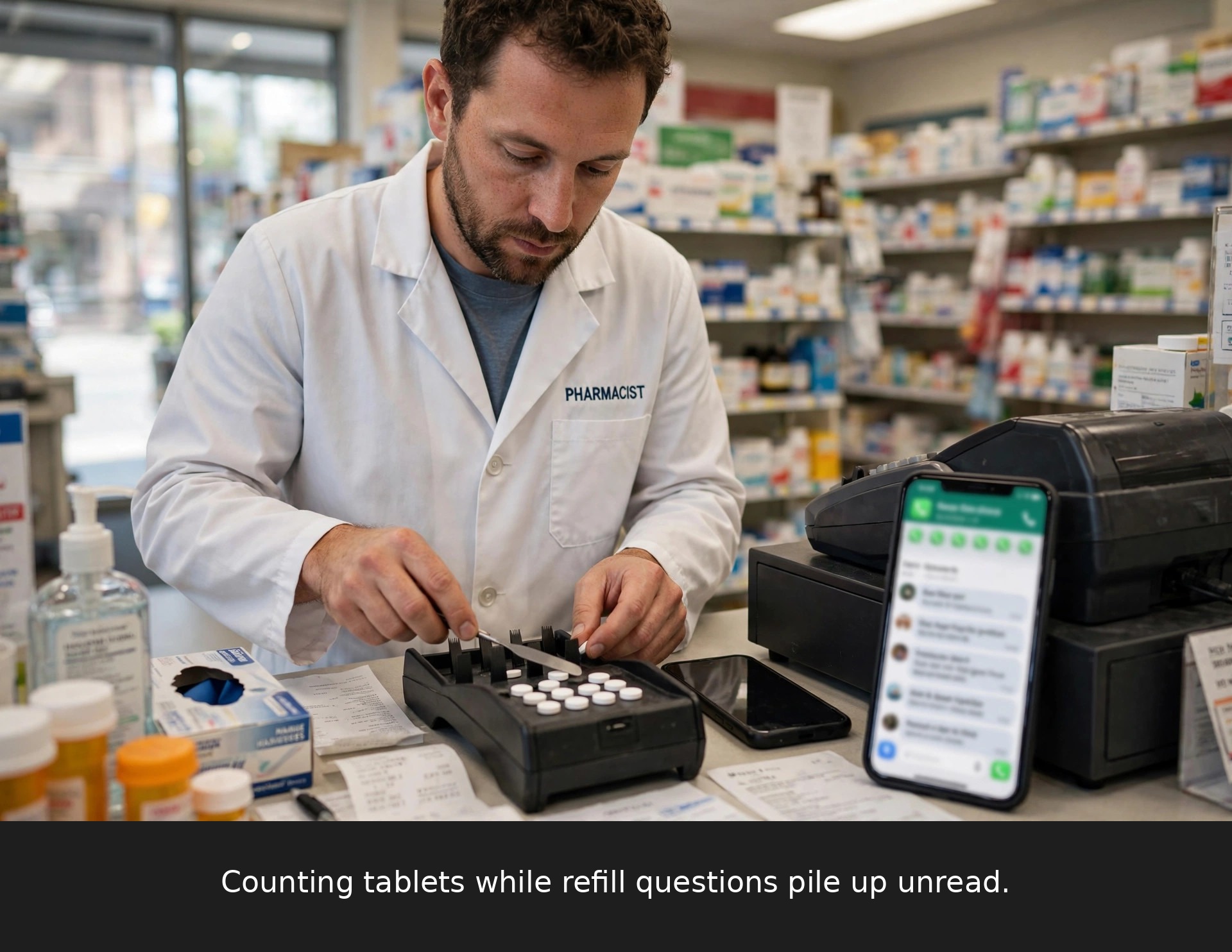
It's 6pm and your pharmacy is at its busiest. The counter has four people waiting. You're counting tablets for a prescription, and the phone rings. You let it go - you have to, your hands are full. Then a WhatsApp message buzzes: 'Is my blood pressure medicine ready?' Then another: 'Do you have children's fever syrup in stock?' Then the phone rings again. Every interruption slows down the actual dispensing, the work that genuinely needs a pharmacist's brain. Meanwhile the people at the counter wait longer, and the people on WhatsApp wait even longer. This is the daily reality of running a community pharmacy: you're a healthcare professional spending half your day answering the same logistical questions that a messaging assistant could handle in seconds. WhatsApp automation for pharmacies takes the repetitive work off your counter so you can focus on the work that actually needs you.
The Refill Problem (And Why It's Costing You)
Most pharmacy revenue comes from repeat prescriptions. Blood pressure tablets, diabetes medication, thyroid pills - the same patients, the same medicines, every 30 or 90 days, month after month. This should be the easiest, most predictable part of your business. Instead, it's a constant scramble. Patients forget to request refills. They call when they've already run out. They show up at the counter frustrated because they need it today and it's not ready. You rush to prepare it while the queue grows. Nobody's happy, and it was all preventable.
Here's what actually happens with refills: a patient takes their last tablet on Sunday night, realizes Monday morning, and calls you in a panic. Or worse - they skip doses for two days because they kept forgetting to call, which is genuinely bad for their health. Studies on medication adherence consistently show that a huge percentage of patients miss doses simply because the refill process has friction. Every step - remembering, calling, waiting, picking up - is a chance to drop off. An automated WhatsApp flow removes almost all of that friction.
The system works like this: when a patient starts a repeat prescription, the automation notes the cycle. A few days before they run out, they get a WhatsApp message: 'Hi Ahmed, your blood pressure tablets run out in 3 days. Shall I prepare your refill?' They tap yes. It's prepared. They get a message when it's ready: 'Your refill is ready for pickup - or reply DELIVER and we'll send it today.' The patient never runs out. You never get a panic call. The revenue from that prescription - which was always yours - actually arrives instead of leaking to the pharmacy down the street that happened to answer the phone faster.
The health angle matters too, and it's worth saying plainly. Missed doses for blood pressure, diabetes, and heart medication cause real harm - hospital visits that didn't need to happen. A pharmacy that helps patients stay on their medication isn't just making money; it's doing its actual job better. When you tell patients about the refill reminders, frame it that way. 'We'll make sure you never run out' is a healthcare promise, not a marketing line. Patients feel cared for. And cared-for patients don't switch pharmacies.
The Questions You Answer Fifty Times a Day
Let's list them, because every pharmacist reading this will recognize every single one. 'What are your timings?' 'Are you open on Sunday?' 'Do you have this medicine in stock?' 'How much is it?' 'Do you deliver to my area?' 'Can I pay by card?' These are not clinical questions. They don't need a pharmacist. But they currently consume hours of pharmacist time every week, because there's been no alternative - until now. Dental clinics deal with the same flood of logistical questions - AI chatbots for dental clinics shows how another healthcare practice handles them.
A WhatsApp assistant trained on your real information answers all of these instantly. Your hours, your location, your delivery areas, your payment options - it's all loaded in. When someone asks 'do you have Augmentin 625mg?', it checks your actual stock and answers honestly: 'Yes, we have it - $8.50 for 20 tablets. Want me to reserve a pack?' If it's out of stock, it says so and offers to message when it's back, or suggests the nearest alternative. No guessing. No 'let me check and call you back.' Just answers, in seconds, at any hour.
The after-hours value is enormous. Pharmacies get messages at all hours - a parent at midnight wondering if you have children's fever medicine, someone at 6am asking if you're open yet. Before automation, these messages sat unread until morning, and by then the person had gone elsewhere or the moment had passed. Now they get answered immediately. 'Yes, we're open 8am-10pm daily, and we have that in stock - want me to keep one aside for morning pickup?' That parent remembers which pharmacy helped at midnight. That's not a transaction. That's loyalty being built while you sleep.
- Opening hours and holiday schedules - answered instantly, always current
- Stock checks from your real inventory - honest yes/no with prices
- Delivery areas and charges - no more 'let me ask' delays
- Payment methods accepted - card, cash, transfer, insurance
- Prescription upload instructions - how to send a photo of the prescription
Dose Reminders: The Feature Patients Actually Thank You For
Beyond refills, there's an even more personal automation: dose reminders. Patients on complex regimens - elderly patients taking six different tablets, for instance - often struggle to remember what to take when. A WhatsApp automation can send gentle reminders: 'Good morning - time for your blood pressure tablet and vitamin D.' It's simple. It's not medical advice. It's just a nudge, and patients consistently say it's one of the most appreciated things a pharmacy can do.
This works especially well for new prescriptions. When someone starts a new medication, the first two weeks determine whether they'll stick with it. Automated check-ins - 'How are you finding the new tablets? Any questions for the pharmacist?' - catch problems early. If the patient reports a side effect, the message is flagged for you immediately. You're not replacing the consultation; you're extending it beyond the counter. The patient feels looked after. You catch issues before they become reasons to stop the medication.
For pharmacies, this is also a powerful differentiator. Most pharmacies compete on price or location. Very few compete on care. A pharmacy that reminds you to take your tablets, warns you before you run out, and checks in when you start something new - that's a pharmacy patients recommend to their families. Word of mouth in healthcare is everything, and it's built on exactly these small moments of feeling looked after.
Prescription Uploads Without the Chaos
Patients sending prescription photos over WhatsApp is already happening in most pharmacies - messily. Photos arrive at all hours, in random order, with no context. 'Whose is this?' 'What do they need?' 'Did anyone reply to this one?' The automation brings order to this chaos. When a prescription photo arrives, the assistant acknowledges it immediately: 'Got it - I'll have the pharmacist review this. What's your name and when do you need it by?' It collects the essential details, logs the request, and flags it for you in an organized queue.
You review the prescriptions in batches - say, every two hours - instead of being interrupted by each one. You confirm what's in stock, note any issues, and the assistant messages the patient: 'Your prescription is ready - total $24. Pick up anytime before 10pm, or reply DELIVER.' The patient gets a smooth experience. You get your focus back. The prescription that used to cause three interruptions now causes zero.
This also creates a record. Every prescription request, every confirmation, every pickup - logged automatically. No more 'but I sent it on Tuesday!' disputes. No more lost photos. If there's ever a question about what was requested and when, the history is right there. For a healthcare business, that kind of traceability isn't just convenient - it's proper practice.
What the Automation Will Never Do (Safety First)
Let's be clear about boundaries, because this is healthcare. The WhatsApp assistant handles logistics: hours, stock, prices, refills, reminders, prescription intake. It does NOT give medical advice. It does not recommend medicines. It does not interpret symptoms. It does not adjust dosages. These lines are programmed in firmly, and the assistant is designed to recognize when a message crosses into clinical territory. Physiotherapy clinics draw the same line - AI chatbots for physiotherapy clinics shows how they automate bookings while keeping clinical work human.
Want this for your pharmacies?
ReplyPilot builds a custom whatsapp automation setup for your pharmacies — answering customer questions instantly, taking orders and bookings, and handing off to you when a human is needed.
Ask on WhatsApp — it's freeWhen someone messages 'my child has a fever, what should I give?', the assistant doesn't answer the medical question. It says: 'I can't advise on that - but our pharmacist is available. They're in the shop now / they'll be in at 9am. For urgent concerns, please call...' and it flags the message for you immediately. This isn't a limitation - it's the correct design. The automation handles everything around the clinical work so you have more time for the clinical work itself.
You also stay in control. Every automated conversation is visible to you. You can step into any chat at any time. Flagged messages - side effects, complaints, anything unusual - come to you instantly. The weekly review takes 15 minutes: scan the flagged items, check that the tone feels right, adjust anything. You're the pharmacist. The assistant is your most reliable staff member - one that never sleeps, never forgets, and never gives medical opinions.
The Business Case (Real Numbers)
Let's do the math honestly. A pharmacy losing just 5% of repeat prescriptions to competitors or forgetfulness - on a base of, say, 500 repeat patients averaging $30 a month - is losing $750 a month, $9,000 a year. That's not dramatic; that's conservative. Refill automation alone typically recovers most of that. Add the new patients who choose you because you answered at midnight when nobody else did. Add the prescription uploads that now convert instead of getting lost. The revenue impact is real and measurable.
On the cost side, consider what you're currently spending on the problem. If you or your staff spend even one hour a day on repetitive phone and WhatsApp queries, that's 30 hours a month of skilled time doing unskilled work. The automation costs a fraction of one staff member's salary and handles the volume of three. It's not about replacing people - it's about letting your people do the work only they can do, while the routine work handles itself.
Setup is straightforward. You provide your medicine list with prices, your hours, your delivery areas, and your refill protocols. The assistant is trained on your real inventory and your real voice. Testing takes a week - you watch the conversations, correct anything, and then it runs. Most pharmacies notice the difference within days, in one specific way: the phone stops ringing for things that aren't urgent. The counter moves faster. And the WhatsApp that used to be a source of stress becomes a source of orders.
Chronic Patients: Your Most Valuable (and Most Neglected) Group
Think about your top 50 patients - the ones with diabetes, hypertension, thyroid conditions who come every single month. Together they might represent 30-40% of your revenue. They're also the most likely to drift. Not because they're unhappy, but because managing a chronic condition is exhausting and the pharmacy is one more thing to remember. Every month, a few of them delay their refill by a week. Some switch to a pharmacy that's closer to their new office. Some just... stop coming, and you never find out why.
Automation changes this relationship fundamentally. Instead of the patient having to remember you, you remember them. The WhatsApp flow for chronic patients is warmer and more personal: it uses their name, references their specific medication, and checks in like a caring human would. 'Hi Fatima, hope you're doing well - your thyroid tablets run out Thursday. Want me to have them ready Wednesday?' This isn't a corporate notification. It's the digital equivalent of what the best neighborhood pharmacists have always done - knowing their regulars. Now it scales to every regular, automatically.
You can also layer in simple care programs. New diabetes diagnosis? A 4-week WhatsApp sequence: week 1, how to take the medication; week 2, diet tips your pharmacist approves; week 3, reminder about the follow-up blood test; week 4, refill reminder. Every message is pre-approved by you, educational (not advisory), and ends with 'questions? Our pharmacist is here.' Patients in these programs show measurably better adherence - and they tell their doctors, who tell other patients, who come to your pharmacy. It's a growth loop built on genuine care.
Seasonal Surges Without the Stress
Every pharmacy knows the seasonal waves. Flu season brings a flood of 'do you have Tamiflu?' and 'what's good for this cough?' Allergy season means antihistamine questions on repeat. Winter means vitamin D. Summer means sunscreen and rehydration salts. During these surges, your phone becomes unusable - it's just constant interruptions while you're trying to serve the people physically in front of you.
The automation absorbs these waves. Before flu season, you load in the relevant information: which antivirals you stock, current prices, what requires a prescription versus what's over the counter. When the surge hits, the assistant handles the repetitive questions while you handle the counter. 'Yes, we have it in stock - $12. Want me to reserve one? We're open till 10pm.' The patient gets served. You stay focused. And because the assistant tracks what's being asked, you get a useful signal: if 40 people asked about a specific medicine this week, you know to order more before you run out.
This demand sensing is an underrated benefit. The automation quietly logs every stock question, creating a real-time picture of what your community needs. That data helps you order smarter, avoid stockouts on high-demand items, and spot trends before they become emergencies. It's market research generated automatically from conversations you were already having - you just weren't capturing them before.
Getting Started for Your Pharmacy This Week
You don't need new systems or technical skills. The automation lives in WhatsApp - the app your patients already use. Here's what you provide: your stock list (even a spreadsheet works), your hours, your delivery zones and charges, and your refill rules (how many days before running out should we remind?). That's the core. Everything else - the tone, the message templates, the escalation rules - is built around how your pharmacy already works.
- Your medicine list with current prices - spreadsheet is fine
- Opening hours including weekends and holidays
- Delivery areas, charges, and minimum order if any
- Refill reminder timing - 3 days before? 5 days?
- Your prescription review process - how often you check new uploads
Start with refills - it's the highest-impact, lowest-risk automation. Once that's running smoothly and patients are responding well, add stock questions, then prescription intake, then dose reminders. Each layer builds on the last. Within a month, the repetitive work that used to eat your days is handled, and you're spending your time on the things that made you become a pharmacist in the first place.
Want this working in your pharmacy?
The pharmacies thriving with this aren't tech companies. They're neighborhood pharmacies that got tired of watching patients slip away over missed messages and forgotten refills. The moment it clicks is usually the first Monday after going live - you open your phone to find a queue of confirmed refills, answered stock questions, and prescription uploads all neatly organized, instead of the usual chaos. Your patients got served while you were closed. If you want to see exactly what this looks like with your own medicines, your own prices, and your own refill protocols, ReplyPilot will build you a free custom demo: request it at https://replypilot-site.vercel.app/ and watch your pharmacy run itself this week.
Frequently Asked Questions
Can WhatsApp automation handle prescription refills for my pharmacy?
Yes. Customers message "Refill my blood pressure tablets," and the automation confirms the prescription, checks stock, and tells them when to collect. Refill customers are your most loyal — make it effortless for them.
How much does WhatsApp automation cost for a pharmacy?
Typically a monthly fee based on message volume. Pharmacies handle huge message volumes, so the per-message value is high. A single retained refill customer covers the cost.
Can it send medicine dose reminders to pharmacy customers?
Yes. Customers opt in, and the automation reminds them to take their doses. This improves health outcomes and builds fierce loyalty. Elderly customers especially appreciate it.
Will the automation answer "Do you have this medicine in stock?"
Yes — it checks your inventory and answers instantly. Customers stop calling for stock checks, and your counter staff focuses on the people standing in front of them.
Can the pharmacy chatbot take orders for home delivery?
Yes. It collects the order, confirms the address, and queues it for your delivery run. Home delivery customers order more often because it is easy. The automation makes easy even easier.