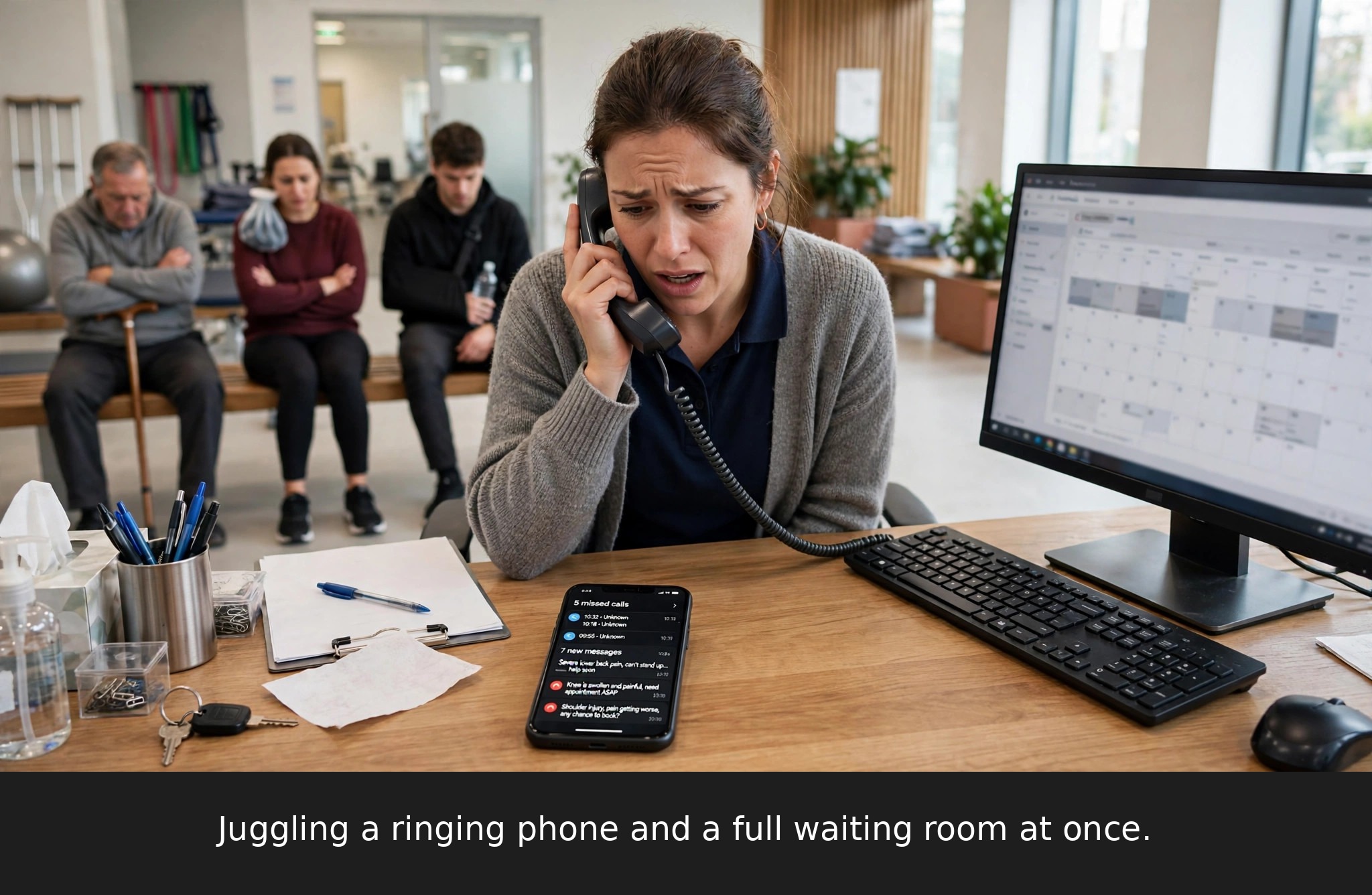
It is 11:04 on a Sunday night. Daniel, 46, bent to lift his sleeping daughter off the sofa and felt something go in his lower back. He is now lying on the living room floor, phone in hand, googling "physio near me open tomorrow." Your clinic is the top result. He taps your website. There is a contact form. He starts filling it in, then stops. It is Sunday night. Nobody will read it until morning, and by morning he will have called the second result, which answered. He closes the tab. In the morning, your receptionist finds no trace he ever existed. No call, no form, no booking. Just one more empty Monday slot and a competitor with a new patient. An AI chatbot for physiotherapy clinics exists for exactly this night. Daniel taps the chat instead of the form. "Sorry you are dealing with this. We treat lower back pain every day. I can book you with our spinal specialist tomorrow at 9:40 or 2:15. Which suits you?" Daniel picks 9:40. He also learns what to do tonight: gentle movement, heat, and the warning signs that mean go to urgent care instead. He sleeps better. You wake up to a booked new patient. Nobody worked the night shift.
People search for a physio when they are already in pain. Pain does not wait for office hours, and it does not wait for a callback. That single fact shapes everything about how a physiotherapy clinic should think about its chatbot. This is not a gadget for answering opening hours. It is a net for catching people at their most motivated moment: the night they decide they cannot live with the pain anymore. This article is the full owner playbook. What the chatbot should handle, the bright medical line it must never cross, how it deals with referrals and insurance, why home-exercise follow-ups are its secret weapon, and the step-by-step setup. A physio chatbot's job is not to treat. It is to make sure the person in pain reaches the person who can.
Pain Does Not Keep Office Hours
Think about when your patients actually decide to book. It is rarely a calm Tuesday afternoon. It is the evening the back seizes, the morning the knee gives way on the stairs, the weekend the shoulder finally stops them sleeping. A 2026 guide to physio clinic automation puts it plainly: most physiotherapy clinics receive a significant share of their enquiries outside opening hours, because evenings and weekends are when patients have time to think about their pain and search for help. And here is the part that should worry every clinic owner: patients who reach voicemail typically call the next clinic on their list rather than waiting for a callback the following morning. (guide) Your voicemail is not a waiting room. It is a redirect to your competitor.
The economics make it worse. A physio clinic sells time, and time is perishable. An empty Monday morning slot never comes back. Every in-pain searcher who bounces off your silent website is a slot that stays empty and a patient who now belongs to someone else. The chatbot flips this completely. It does not just answer. It books. The person searching at 11pm with a sore back gets a booked appointment before they finish their tea. By morning, your diary has patients in it that your old website would never have captured. That is the whole business case in one paragraph, and it has nothing to do with technology being clever.
What In-Pain Patients Actually Ask
A physio clinic's inbox is a mix of fear, logistics, and money questions. The fear comes first because pain is scary. Train your physio chatbot on the real list:
- I have had lower back pain for three days. Do you treat this?
- Do I need a doctor's referral before I can book?
- How much is a session, and how many will I need?
- Do you accept my health insurance? What do I need to bring?
- I hurt my knee playing football. Should I come in or wait?
- Do you do sports massage, or is it only rehabilitation?
- How long is each session?
- Can I book an evening appointment? I work full time.
- My mother is 78 and has trouble walking. Do you treat older patients?
- I had surgery six weeks ago. When can physio start?
Read that list like a patient and notice the emotional temperature. "Should I come in or wait?" is someone hoping they do not need treatment but fearing they do. "How many sessions will I need?" is someone doing worried math about money. "Do you treat older patients?" is a daughter asking for her mother. A chatbot that answers these quickly, warmly, and honestly does something a price list cannot: it lowers the fear enough for the person to book. The booking is the treatment pathway starting. Every hour of delay is an hour the patient spends getting stiffer, more anxious, and closer to your competitor's diary.
The Medical Line: Bright, Wide, and Non-Negotiable
This is the most important section of this article, so let us be blunt. An AI chatbot for physiotherapy clinics must never diagnose, never prescribe exercises as treatment, and never tell a patient their symptoms are nothing to worry about. Its job with a symptom is three steps: acknowledge the pain, share only your clinic's published general information, and route. Red-flag symptoms, things like chest pain, sudden weakness, numbness, or pain after serious trauma, go straight to emergency guidance with no detour. Everything else gets a booked appointment with the right therapist and simple, safe general comfort measures for tonight.
This boundary is how the serious healthcare chatbot builders design their products. One healthcare chatbot platform states its principle directly: when it comes to healthcare, accuracy is crucial, so if the bot does not know the answer or the patient needs specific medical advice, it guides the patient to the staff instead of guessing. It handles administrative data, patient routing, and operational questions, and it never invents a medical answer. (source) Your physio chatbot follows the same rule. It is a brilliant receptionist and intake assistant. It is not a clinician, it never claims to be one, and every symptom conversation ends with a human appointment, not a chatbot conclusion.
Write your routing rules with your senior physios, not your marketer. Which presentations get an urgent slot? Which get the standard first assessment? What are your red flags? Ten minutes of clinical input here is worth more than any feature. Then test the bot adversarially before launch: "my back pain is shooting down my leg and my foot feels numb, can it wait a week?" The answer must route urgently and safely, every single time. A cautious bot that over-refers to humans is a good bot. A confident bot that under-refers is a liability.
What an AI Chatbot for Physiotherapy Clinics Actually Does All Day
On a normal day, most of the work is gloriously unmedical. Here is the physio clinic's real job description:
- Answers the midnight pain inquiries: acknowledges, shares your published general information, books the right therapist, gives safe tonight-guidance and red-flag warnings.
- Explains your treatments in plain words: what manual therapy is, what sports rehab involves, what a first assessment looks like. No jargon.
- Introduces your therapists: specializations, experience, who is best for backs, sports injuries, post-surgical rehab, older patients.
- Handles the referral question: whether you need one, what to do if you have one, how self-pay works if you do not.
- Answers insurance questions from your written sheet: which insurers you work with, what patients bring, how billing works.
- Books, reschedules, and confirms appointments with one-tap options, including evening slots for working patients.
- Runs pre-visit intake: condition history, pain location and duration, previous treatment, goals. The therapist starts informed.
- Sends home-exercise reminders between sessions with links to the patient's prescribed exercises.
- Follows up after appointments, requests reviews from happy patients, and nudges lapsed patients to rebook.
Count how many of those currently eat your receptionist's morning. The insurance questions alone can absorb a shocking share of front-desk time, and every answer is the same factual paragraph your team has typed a thousand times. The chatbot types it in two seconds at any hour. Your receptionist goes back to welcoming the nervous patient at the desk, which is the human moment that actually matters. The pattern is familiar from AI chatbots for dental clinics: the admin load is identical, only the clinical specialty changes.
Pre-Visit Intake: The Therapist's Secret Weapon
Here is the feature physios love most once they see it. A first assessment is usually 45 to 60 minutes, and the first 15 are history-taking: where does it hurt, since when, what makes it worse, what have you tried, what is your goal? A chatbot collects all of this conversationally before the patient arrives. "Where is the pain? How long has it been going on? What makes it better or worse? Have you had physio before?" The answers land in the therapist's notes before the patient walks in.
The effect on the appointment is dramatic. Instead of spending the first third of the session on paperwork questions, the therapist starts with insight: "So the pain started after the football match three weeks ago, it is worse in the morning, and your goal is to run again by spring. Let us look at that knee." The patient feels heard before being touched. The therapist gets more treatment time inside the same slot. And the clinic can honestly say its assessments are more thorough, because the history is complete instead of rushed. Intake is not admin. It is the beginning of the treatment.
"Do I Need a Referral?" and the Insurance Maze
Two questions stop more bookings than any other, and both have fixed answers. "Do I need a doctor's referral?" In most private practice settings, no, but the patient does not know that, and the uncertainty alone stops them booking. The chatbot answers it in one line, then moves straight to booking: "No referral needed. You can book directly. Would tomorrow at 10 work?" The second is insurance. Patients want to know if you accept their insurer, what paperwork to bring, whether they pay you or the insurer pays you, and what happens if the insurer caps the sessions.
These answers never change week to week, which makes them perfect chatbot territory. Write your insurance sheet once: the insurers you work with, the self-pay process, what to bring, how excess payments work. The bot quotes it exactly, every time, at midnight. No receptionist needs to check and call back, which is the current experience: "let me check with our billing person and get back to you." That callback often never happens, or happens after the patient has booked elsewhere. Fixed answers, instant delivery, booking in the same conversation. That is the whole trick.
Home Exercises: Where Treatments Quietly Fail
Every physio knows the dirty secret of the profession: the treatment plan works, but the patient does not do the exercises. The shoulder mobility routine gets done twice, then forgotten. The back exercises last a week. Then progress stalls, the patient concludes physio "didn't work," and they never rebook. The clinic loses the outcome and the revenue. The patient keeps the pain. Everyone loses to forgetfulness.
A chatbot is the perfect adherence companion because it is persistent without being a nag. Each morning, the patient gets a short message: "Morning! Two minutes for your shoulder routine today. Here is the video from your therapist." That is it. No lecture. The link opens the exact exercises their therapist prescribed, not generic YouTube videos. Patients who do their exercises recover faster. Faster recovery means better outcomes, better reviews, and more referrals. The 2026 physio automation guide describes exactly this workflow: exercise programme reminders between sessions, with the observation that better adherence drives faster recovery, better outcomes, and stronger word of mouth. The mechanism is simple. The compounding effect is enormous.
Want this for your physiotherapy clinics?
ReplyPilot builds a custom ai chatbot setup for your physiotherapy clinics — answering customer questions instantly, taking orders and bookings, and handing off to you when a human is needed.
Ask on WhatsApp — it's freeReviews and Reactivation: The Quiet Growth Engine
Two follow-up workflows separate growing clinics from stagnant ones, and both are chatbot-native. First, reviews. Asking for reviews in person feels awkward for clinicians and gets forgotten in busy days. The automated version is better: a couple of hours after the appointment, the patient gets a message thanking them and asking how the session went. Happy patients get a direct link to the review page. The friction of finding your profile disappears. Because the request arrives while the experience is fresh, the reviews are specific and useful to future patients reading them. This is the standard playbook described in current physio automation guides, and it works because timing is everything in reviews.
Second, reactivation. Patients drop off treatment constantly, and usually not because they are unhappy. They felt better enough to stop, or they forgot to rebook, or life got busy. A chatbot notices the gap: no follow-up booked within a few weeks of the last session. It sends a warm, useful check-in: "How is the knee getting on? If it is not quite where you want it, we could do a progress review next week." That message recovers patients who were never lost, just distracted. For a clinic, each reactivated patient is a course of treatment that would otherwise have evaporated. It is the highest-return message your clinic will ever send.
Setting Up Your Physio Automation, Step by Step
A physio clinic chatbot is a clinical writing project with a safety review, not a software project. Your physios supply the knowledge and the red-flag rules. The AI supplies the patience a physio clinic needs. Here is the order:
- Step 1: Sit with your senior physios and write the routing rules. Which symptoms get urgent slots? Which get standard assessments? What are the red flags that go straight to emergency guidance? Write them as plain if-this-then-that rules.
- Step 2: Write your treatment guide in plain words. Every service you offer, what a first assessment involves, session length, what patients should wear and bring.
- Step 3: Write your therapist introductions. Specializations, experience, who is best for which conditions. Patients choose people, not clinics.
- Step 4: Write the referral and insurance sheet. Do you need a referral? Which insurers? Self-pay process? What to bring? Fixed answers, written once.
- Step 5: Build the intake questionnaire. Pain location, duration, triggers, previous treatment, goals, red-flag screening questions. Keep it conversational, not a medical form.
- Step 6: Set your booking rules. Assessment versus follow-up slot lengths, buffer times, evening availability, cancellation policy.
- Step 7: Write the follow-up scripts. Home-exercise reminders, post-appointment check-in, review request, reactivation message. Warm and short.
- Step 8: Choose your channels. Website chat first, then WhatsApp where your patients already message you.
- Step 9: Run the scary test. Feed it the hardest symptom questions, including red-flag traps. Every answer must route safely. Fix anything soft before launch.
- Step 10: Go live quietly and review the symptom conversations weekly with a clinician for the first two months. Each log improves the routing.
Step nine is the gate. Nothing goes live until the scary test passes, and the scary test is graded by a clinician, not a marketer. ReplyPilot builds physio clinic chatbots with this exact process: your physios write the routing rules, we build the assistant around them, and the safety test is the one step we never skip. Your clinical reputation took years to build. The chatbot must protect it from day one.
What It Should Never Do
- Never diagnose. "That sounds like sciatica" is forbidden. "Back pain with leg symptoms needs a proper assessment. I can book you with our spinal specialist tomorrow" is the correct shape.
- Never prescribe exercises as treatment. It can share links to exercises the therapist already prescribed, but it never invents a rehab plan.
- Never reassure away symptoms. "I am sure it is nothing" is the most dangerous sentence a bot can say. Uncertainty always routes to a human.
- Never invent prices, session counts, or insurance answers. Unknown facts get "let me have the team confirm" instead of a guess.
- Never pretend to be a physio. It introduces itself as the clinic's assistant and says clearly that assessments happen with qualified therapists.
- Never store sensitive health details carelessly. Intake answers go to your secure clinical system, not into a chat log that anyone can browse.
The last point deserves emphasis because it is easy to overlook. A chatbot that collects health histories is handling sensitive data. Make sure intake answers flow into your proper clinical records system with proper access controls, and that chat logs are treated with the same seriousness as any patient record. Ask your own advisor about your local data rules. The principle is simple: the convenience of conversational intake must never weaken the privacy of clinical information.
How to Tell If Your Physio Automation Is Working
- After-hours bookings. Count the appointments that came from conversations when the clinic was closed. Each one is a patient your old website lost.
- Intake completion rate. How many first visits arrived with their history already collected? Higher means shorter assessments and happier therapists.
- Rebooking rate after first assessment. Are more new patients booking their follow-up course instead of disappearing?
- Home-exercise engagement. Are patients opening the exercise links? Clinics that track this see the adherence story in the data.
- Reactivation returns. How many lapsed patients came back after a check-in message?
- Review growth. The post-appointment review request should be steadily building your profile month after month.
Watch these monthly and the picture becomes clear. The after-hours booking number usually moves first, within weeks, because the demand was always there, just unanswered. The reactivation and review numbers compound quietly over quarters. Together they describe a clinic that never sleeps on its patient relationships, even when the treatment rooms are dark. The same measurement discipline applies to AI chatbots for gyms and fitness studios, where the after-hours inquiry pattern is strikingly similar.
Can It Really Assess My Injury Over Chat?
No, and any chatbot that claims to is one to avoid. Assessment needs hands, eyes, and clinical judgment. What the chatbot can do is everything around the assessment: understand what you are describing well enough to book you with the right specialist, collect your history so the appointment starts informed, tell you what to do tonight, and warn you clearly if your symptoms sound like something that needs urgent care rather than a routine booking. Think of it as the world's most thorough receptionist, not a remote physio. The assessment still happens in the clinic, with a qualified therapist, and it is better because the chatbot did the groundwork.
Will Patients Trust a Bot With Their Health Problem?
Patients trust what helps them, and what helps them at 11pm is an instant, honest, useful response. The trust-killer is not the bot. It is the voicemail, the unanswered form, the "we will call you back" that never comes. A chatbot that says "I am the clinic's assistant, I can book you with the right therapist and help with practical questions, and anything clinical goes to our physios" is more trustworthy than a silent website. Healthcare chatbot platforms report that patients value round-the-clock access to information precisely because health worries do not keep office hours. Meet the worry where it lives, route it to the professional, and trust follows.
What About Patient Data Privacy?
This is the right question, and the answer is design, not hope. A properly built physio chatbot collects health information only through your secure intake flow, stores it in your clinical system with proper access controls, and treats chat logs with the seriousness of patient records. It should comply with your local data protection rules, whether that is GDPR, HIPAA, or your country's equivalent, and your vendor should be able to explain exactly where data lives and who can see it. If a chatbot provider cannot answer those questions clearly, do not use them. Patient trust includes data trust, and in healthcare, that trust is everything. Discuss the specifics with your own advisor before launch.
Want this working in your physio clinic?
Your patients find you at their worst moment: the night the back goes, the morning the knee gives way. What happens in the next sixty seconds decides whether they become your patient or someone else's. An AI chatbot for physiotherapy clinics makes those sixty seconds count: instant answers, the right therapist booked, intake done before they arrive, insurance questions settled, home exercises nudged, and lapsed patients welcomed back. It never diagnoses. It never prescribes. It just makes sure no person in pain ever meets your voicemail again. If you want to see this built around your clinic's actual routing rules and your actual therapists, ReplyPilot will build you a free custom demo. Bring your ten hardest patient questions, including the scary ones. Watch it handle physio enquiries live. Then decide. Start here: get a free custom demo for your physio clinic.
What Should the Chatbot Say When Patients Ask “How Many Sessions Will I Need?”
This is the question every patient asks and no honest clinic can answer before seeing them. The chatbot must resist the temptation to guess — a wrong number becomes a promise the patient holds you to, or a scare that sends them elsewhere. The safe, honest script has three parts: acknowledge the question, explain why the assessment decides, and book the assessment. “That is the first thing everyone asks! It really depends on what we find in your first assessment — that is where your therapist maps out a plan with you, including roughly how many sessions it should take. Shall I book you in?” No numbers, no timelines, no “most people need six.” Patients respect the honesty, and the assessment converts better when the patient arrives curious rather than anchored to a number the bot invented.
Which Therapist Should the Patient See?
Most clinics have therapists with different strengths — one loves sports injuries, another specialises in backs, a third handles post-surgery rehab. Patients do not know this, so they book whoever is free and sometimes land with the wrong person. The chatbot can match them properly with two or three plain-word questions: where does it hurt, how did it start, what is your goal — getting back to sport, or just sleeping through the night. Then it books them with the right therapist and says why: “I have booked you with Sarah — backs and postural pain are her special area.” That single sentence builds confidence before the patient walks in. Write short, human bios for each therapist and let the bot use them; “special interests” listed in plain words beat a wall of qualifications every time.
How Does the Bot Handle Cancellations and Late Arrivals?
Cancellation policies are where clinics lose goodwill: stated too harshly, patients feel punished; never stated, the diary bleeds. The chatbot states your real policy once, kindly, at booking time — how much notice you need, what the fee is, and the simple rebooking link. Then the reminders do the heavy lifting: a message the day before with the time, the address, and parking, plus a morning-of nudge. When a patient does need to cancel, the bot makes rebooking instant instead of awkward — no guilt trip, just “No problem — here are the next available slots.” Late arrivals get a practical answer too: “If you are running more than 15 minutes late, let me know and I will check what we can still fit in.” Firm policy, warm delivery, zero receptionist stress.
Calming First-Visit Nerves
A surprising number of patients nearly cancel their first physio appointment because they do not know what will happen. Will it hurt? What do they wear? Do they need to undress? The chatbot answers all of this before the nerves win. After booking, it sends a short “what to expect” message: the first session is mostly talking and gentle assessment, wear comfortable clothes you can move in, bring any scans or referral letters, allow a full hour, here is where to park. Practical, warm, specific to your clinic. Patients who know what is coming show up calmer, give better histories, and — the metric that matters — actually arrive instead of quietly cancelling. Ten lines of reassurance, sent automatically, protect some of your most valuable appointments.
Frequently Asked Questions
Can an AI chatbot book patients who are in pain at midnight?
Yes. Someone's back goes at 11pm; they find your clinic and the chatbot books them for tomorrow morning. In-pain patients book the first clinic that responds — speed is everything.
How much does a chatbot cost for a physio clinic?
Typically a monthly fee for a physio clinic, based on volume. A single new patient course covers it many times over. Physio patients often need multiple sessions, so each captured patient is high-value.
Will the chatbot ask about referrals and insurance?
Yes. It asks whether they have a GP referral and which insurer covers them, collecting the details your admin needs. Patients arrive with paperwork ready instead of a 20-minute admin delay.
Can the physio chatbot handle "Do you treat back pain?" questions?
Yes. It answers from your treatment list — back pain, sports injuries, post-surgery rehab — and books an assessment. Sufferers want reassurance fast; the chatbot gives it.
Is it safe for a physio chatbot to talk to injured patients?
It provides general information and books assessments — never diagnoses. Anything red-flag — numbness, severe trauma — gets escalated to you immediately. It is a booking assistant, not a clinician.