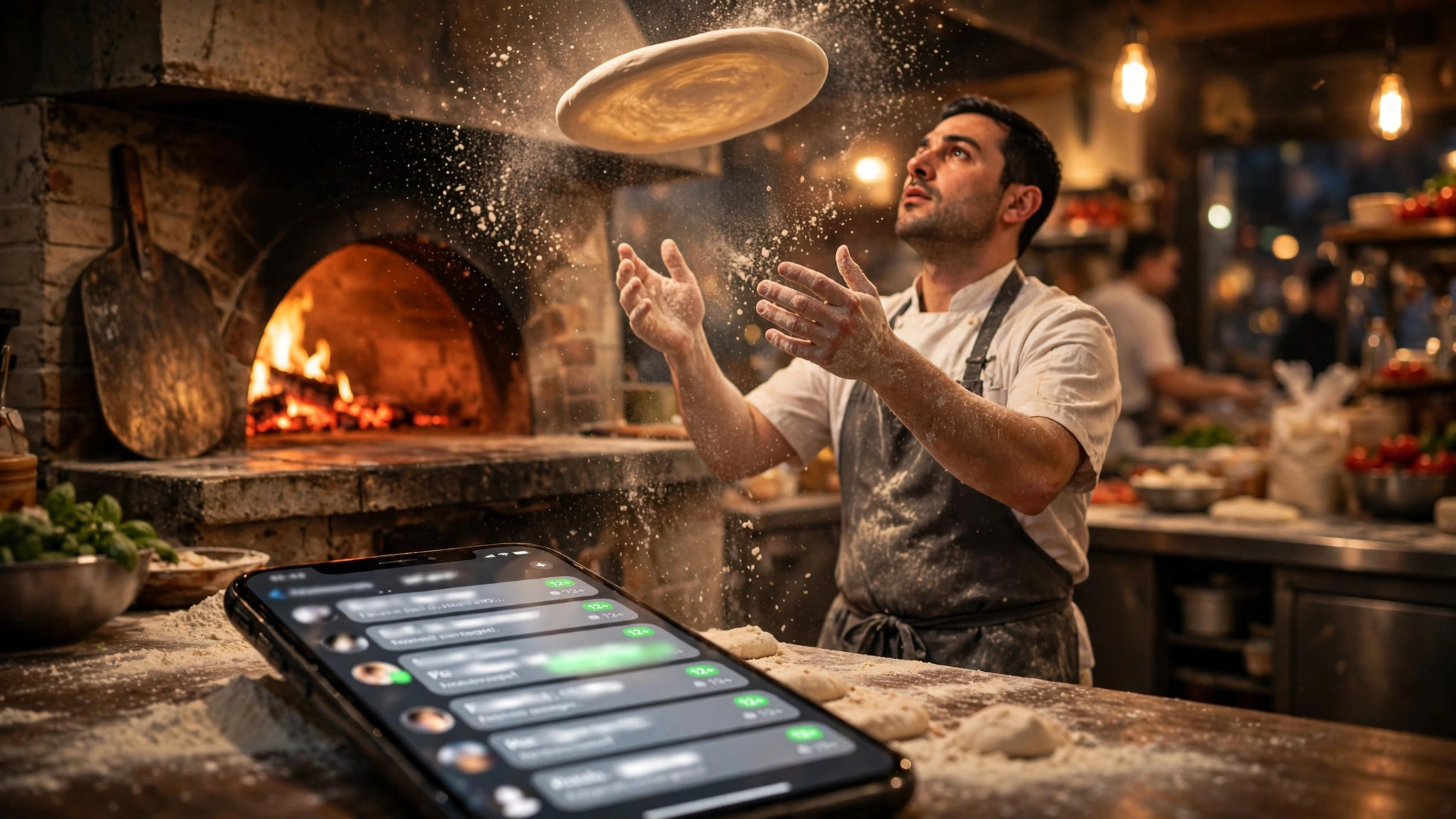
It is Friday night, 8:40 pm. Your oven is running at full heat, three pizzas are already baking, and you have dough on both hands. Your phone is on the counter behind you, screen lit up, buzzing again and again. You catch a glimpse: "2 large pepperoni, extra cheese." "Are you delivering to Block C tonight?" "Can I add garlic bread to my order?" You cannot stop. The margherita in the oven will burn if you step away for thirty seconds. So the messages wait. By the time you wipe your hands and reply, twenty minutes have passed — and one of those customers has already ordered from the place down the street. That is the exact moment WhatsApp automation for pizza restaurants is built for. It answers every message while your hands are busy, takes the order, confirms the address, and keeps the kitchen moving.
Watch it working for a pizza restaurant:
The Friday-Night Rush Is Where Pizza Orders Die
Let us be honest about how a pizza shop actually loses money. It is not because the pizza is bad. It is because of the clock. Between 7 pm and 10 pm, orders arrive faster than any human can type. A single person can answer one phone call or one chat at a time, while the automated system can talk to fifty customers at once without breaking a sweat. Every message that sits unanswered for ten minutes is an order at risk. Hungry people are impatient people. They do not think, "This poor owner is busy." They think, "No reply? Let me try somewhere else."
There is a second, quieter loss too. The regular who messages at 4 pm asking what time you open. The family that wants to place a big order for tomorrow's birthday but gives up when nobody answers that night. The office group that needs twelve pizzas for a lunch meeting and sends one message to three different pizza shops — whoever replies first gets the order. A pizza shop WhatsApp chatbot does not sleep, does not take lunch breaks, and never leaves a message unread for an hour. That alone changes the maths of your week.
What WhatsApp Automation for Pizza Restaurants Actually Does
Forget the idea of a robot that sounds like a robot. A well-built WhatsApp automation for pizza restaurants talks the way your best employee would — quick, friendly, and focused on getting the order right. Here is what it handles, day and night:
- Takes full orders in chat — size, crust, toppings, drinks and sides — then repeats the order back with the total so the customer confirms before anything goes to the kitchen.
- Answers the questions you hear every day: opening hours, delivery areas, delivery charges, minimum order, and "how long will it take tonight?"
- Sends the menu instantly as an easy list or catalogue, so customers stop asking "what do you have?" and start choosing.
- Handles group orders by collecting items from one chat instead of twenty separate phone calls, and keeps one running total everyone can see.
- Sends live order updates — "Your pizza is in the oven" and "Your order is on the way" — so customers stop calling to ask where their food is.
- Remembers repeat customers, so a regular can order their usual Friday pizza with a single reply instead of typing the whole order again.
- Collects delivery addresses once and saves them, so returning customers never repeat their address.
- Passes tricky situations to you — a complaint, an unusual request, a very large catering order — with the full chat history attached, so you step in informed.
How an Automated Pizza Order Actually Flows
Picture the same Friday night, but this time the automation is on. A customer opens WhatsApp and messages your number: "Hi, I want to order." Within a second she gets a friendly reply with the menu. She types, "large chicken tikka, thin crust, one garlic bread." The system reads it, checks it against your menu, and replies: "Got it — 1 large chicken tikka pizza (thin crust) and 1 garlic bread. Your total is shown below. Delivering to your saved address in DHA Phase 4? Reply YES to confirm." She replies YES. The order lands on your kitchen screen with a name, a phone number, the full item list, and the address. She gets an instant confirmation with the estimated time. Nobody picked up a phone. Nobody typed an address into a notepad. Your hands never left the dough.
Notice what did not happen: nobody downloaded an app, nobody created an account, nobody waited on hold. The customer stayed inside the one app she already opens fifty times a day. In one published vendor walkthrough, a chatbot completed a full pizza order — menu to confirmation — in about 25 seconds. Whether your order takes 25 seconds or two minutes, the point is the same: the friction between "I want pizza" and "order confirmed" nearly disappears.
Group Orders Without the Twenty-Message Mess
If you run a pizza shop near offices or hostels, you know the group-order nightmare. One person messages: "2 pepperoni." Another calls: "Make that 3, one without mushrooms." A third sends a voice note listing six items while standing in a noisy street. Your staff pieces it together like a puzzle, and mistakes are almost guaranteed. Automated pizza ordering on WhatsApp fixes this by making one chat the single source of truth. The organizer adds items, the system keeps the running list and total visible, and everyone can see what has been ordered so far. When the organizer confirms, the kitchen gets one clean order — not a collage of voice notes and crossed wires.
This is also where a pizza shop WhatsApp chatbot quietly earns its keep with offices. The company that orders twelve pizzas every second Friday becomes a scheduled, repeatable habit instead of a scramble. The system can even remind the office manager: "Hi Sana, it is almost Friday — same 12 pizzas for the team lunch this week?" One reply and lunch is sorted. That is not a trick. It is remembering what your customers do and making it easy to do it again.
The Regulars Are Your Real Business
Every pizza shop has them: the families who order every Friday, the bachelors who order every Sunday night, the aunty who always asks for extra oregano. Regulars are the steadiest money a small restaurant has, and they are also the easiest to lose — one unanswered message on a busy night and their habit breaks. WhatsApp automation for pizza restaurants protects these relationships in two ways. First, it never misses their message, no matter how busy the kitchen is. Second, it remembers them.
- Saved favourites: "Your usual — 1 medium fajita + 1 litre drink? Reply YES and it is on its way."
- Saved addresses: no retyping the house number and street every single time.
- Order history: the system knows what they ordered last month, so reordering takes seconds.
- Birthday and event nudges: a gentle reminder before the date they ordered a party deal last year.
- Feedback after delivery: a quick "How was your pizza tonight?" that catches problems before they become bad reviews.
None of this feels robotic when it is done well, because it is exactly what a good counter employee does — remember the regulars. The automation just does it for hundreds of people at once, perfectly, every time.
Direct Orders and the Commission Question
Many pizza shops take a large share of their orders through food-delivery apps. Those apps bring customers, and that is genuinely valuable. But every order that comes through an app carries a commission — money that leaves your pocket on every single sale. WhatsApp automation gives you a direct channel that costs you no commission per order. When a customer orders through your WhatsApp number, the full value of the sale stays with you.
The smart move is not to fight the apps. It is to slowly move your own regulars to your own channel. A simple line on every pizza box works: "Order direct on WhatsApp next time — faster, and we will throw in a free dip." A pizza shop WhatsApp chatbot makes the direct experience so smooth — instant replies, saved addresses, one-tap reorders — that customers have a reason to come back to it. Over months, that shift adds up to real money kept. Restaurants that already run direct WhatsApp ordering, like the well-known example of Pizza Hut Malaysia's EasyOrder on WhatsApp, show that big brands treat chat-based ordering as a serious sales channel, not a side project.
Delivery Zones, Drivers and Honest Timing
The most common argument in any pizza shop is about delivery time. "You said 40 minutes, it has been an hour." The customer is angry, the driver is stuck in traffic, and you are caught in the middle. Automation cannot fix traffic, but it can fix the honesty problem. A proper system:
- Checks the delivery address against your delivery zones before confirming — no more "sorry, we don't deliver there" after the customer has waited.
- Gives a realistic time estimate based on how busy the kitchen actually is, not a fixed "30 minutes" that lies on Friday nights.
- Notifies the driver with the order details automatically, so dispatch takes seconds instead of a phone call.
- Sends the customer a live status — order received, in the oven, out for delivery — so they watch progress instead of calling you.
- Asks for the exact location pin for tricky addresses, which cuts down the driver's "where is your house?" calls dramatically.
When customers can see their order moving, their patience doubles. The anger almost always comes from silence, not from waiting.
Special Requests Are Not the Enemy
Pizza customers love special requests: "half cheese, half no cheese," "extra crispy base," "cut into 8 slices," "no capsicum on one half." Old-fashioned button-menu bots choked on these. Modern AI-based systems read natural language, so "one half mushroom one half plain, and please make the base crispy" becomes a clean kitchen note. The key is training the system on your actual menu and your actual policies — which toppings cost extra, which crusts exist, what "extra crispy" means in your oven. This is where a generic chatbot fails and a system built for your shop wins. ReplyPilot builds these systems around your real menu and your real kitchen rules, not a template.
What Happens After Midnight
Here is a question most pizza owners never ask: what happens to the messages that arrive after you close? Someone messages at 1 am: "Are you open?" Someone else at 7 am: "Can I pre-order 10 pizzas for 2 pm?" With manual handling, those messages sit until morning, and the early one is often answered too late. With automation, the 1 am message gets an instant reply — "We open at 12 pm, want to place a pre-order for tomorrow?" — and the 7 am pre-order is already on your kitchen screen when you walk in. Your shop starts taking orders while you sleep. For party pre-orders and office lunches, this alone can add orders you were previously losing without ever knowing.
The Broadcast That People Actually Welcome
WhatsApp broadcasts have a bad reputation because most businesses abuse them — daily spam that gets the number blocked. But a pizza shop has something most businesses do not: news people genuinely want. A new pizza launch. A Friday family deal. A "buy one get one" on a slow Tuesday. The rule is simple: only message people who ordered from you before and agreed to hear from you, keep it rare (once or twice a month), and always include something worth their time. One well-timed message — "Weekend deal: large pizza + 1.5 litre drink at a special price, reply PIZZA to order" — can fill a slow evening. One detail worth knowing: the regular WhatsApp Business App caps broadcast lists at 256 contacts, while the official WhatsApp Business API supports much larger, tiered broadcasts — so if your customer list grows into the thousands, the API route keeps you covered.
Want this for your pizza restaurants?
ReplyPilot builds a custom whatsapp automation setup for your pizza restaurants — answering customer questions instantly, taking orders and bookings, and handing off to you when a human is needed.
Ask on WhatsApp — it's freeThis is also where timing beats cleverness. Sending your deal message at 5:30 pm, right when families are deciding what to eat, will always beat a prettier message sent at 10 am. The automation can schedule this for you, every week, without you remembering.
Mistakes Pizza Shops Make With WhatsApp Automation
Automation is a tool, and tools can be misused. Here are the mistakes that turn customers away instead of bringing them closer:
- Broadcasting too often — more than two promotional messages a month and people start blocking your number.
- Messaging strangers — only ever message people who gave you their number or opted in; anything else is spam and risks your number.
- Hiding the human option — always offer "talk to a person" clearly; some situations need a human, and pretending otherwise frustrates people.
- Letting the menu go stale — if the bot quotes last month's prices, customers feel cheated; update the menu the same day prices change.
- Overpromising delivery time — a fixed "30 minutes" on a slammed Friday night creates angry customers; honest estimates keep trust.
- Ignoring complaints in chat — a bad pizza needs a human response fast; route complaints to yourself immediately, with the order details attached.
How to Set This Up in Your Pizza Shop, Step by Step
You do not need to be technical for any of this. The process is the same whether you build it yourself or have someone like ReplyPilot build it for you:
- 1. Write down your 20 most-asked questions — hours, delivery areas, prices, deals, "how long?" — and the exact answers you want given.
- 2. Put your full menu in one clean sheet: every item, size, crust option, topping, price, and what costs extra.
- 3. Map your delivery zones and charges clearly, including the areas you do NOT serve — the system must say no politely before the order, not after.
- 4. Decide what the automation handles alone (orders, FAQs, status updates) and what comes to you (complaints, catering, custom requests).
- 5. Run it quietly for one week — maybe only on your WhatsApp Business number — and read the chats every evening to fix anything confusing.
- 6. Add the nice touches after the basics work: saved addresses, one-tap reorders, the Friday reminder to regulars, the post-delivery feedback message.
Start small and grow. A system that takes orders and answers FAQs perfectly is worth more than a fancy system that does ten things badly. If you want a broader look at how food businesses automate ordering, our guide to WhatsApp automation for restaurants covers reservations and table bookings too, and AI chatbots for bakeries shows how cake shops handle custom orders — many of the same ideas apply to pizza.
What Does It Cost You — and What Does It Save?
Let us count honestly, without hype. The costs: setting the system up, a monthly fee for the WhatsApp Business API conversations, and an hour or two a month keeping the menu updated. The savings: the orders you stop losing on busy nights, the regulars whose habits you protect, the staff hours freed from answering the same questions, and the commission kept on every direct order. For most pizza shops, saving just one or two lost Friday-night orders a week already covers the cost several times over. The real return, though, is the one you cannot put in a spreadsheet: a customer who messages at 8:40 pm on a Friday, gets an instant reply, and thinks, "These people are reliable." That feeling is what brings them back next Friday.
A Quick Word on the Rules
WhatsApp is strict about business messaging, and that is good for you — it keeps the channel trusted. Three rules to live by: never message someone who has not opted in, always offer a clear way to stop receiving messages, and keep promotional broadcasts rare and relevant. Use the official WhatsApp Business API (through Meta or an approved provider), not unofficial tools that can get your number banned. In June 2026, Meta introduced Business Agent, an AI layer for WhatsApp and Messenger that answers business-specific questions, recommends products and books appointments — with over a million businesses already using it at launch. The direction is clear: conversational ordering on WhatsApp is becoming the normal way small food businesses sell, and the shops that set it up now are simply ahead of the curve.
One Last Thing: Train It Like You Would Train a New Employee
The single biggest difference between a WhatsApp system that feels magical and one that feels clumsy is the training. Think of it exactly like hiring: a new counter employee is only as good as what you teach them in the first week. Show the system your real customer chats — the confusing ones, the funny ones, the angry ones — and write down how you would want each handled. Tell it which toppings you actually have, which deals are real, and what to say when you run out of something mid-evening. Review its chats every night for the first two weeks and correct anything that sounds off. After that, it runs itself — and unlike a new employee, it never forgets what you taught it.
Your Next Step
Think about last Friday night. How many messages sat unanswered while you were at the oven? How many of those people ordered from somewhere else? You will never know the exact number — and that is exactly the problem. WhatsApp automation for pizza restaurants turns that unknown loss into captured orders: instant replies, clean group orders, remembered regulars, honest delivery updates, and a direct channel with no commission on every sale. It does not replace you or your team. It handles the repetitive half of customer communication so your people can focus on the pizza — which is, after all, the whole point.
ReplyPilot builds custom WhatsApp automation for food businesses — trained on your menu, your delivery zones and your tone of voice, with a human handover for the situations that need one. If you want to see what it would look like for your own pizza shop, get a free custom demo and watch your menu take orders by itself.
What Happens When an Order Goes Wrong?
It will happen. A pizza arrives cold. The wrong toppings. A missing garlic bread. On a normal night, that customer messages you angry — and if nobody answers for an hour, the anger hardens into a bad review. A WhatsApp chatbot cannot fix a cold pizza, but it can do the next best thing: answer in seconds and start the fix while the customer is still willing to listen.
The script is short and warm. First, it says sorry like a person would: “I’m really sorry about that — let’s make it right.” Then it asks one simple question: what went wrong? Cold, wrong order, missing item. Based on the answer, it offers your real fix policy — the one you wrote in advance. A free replacement on the next order. A discount on tonight’s bill. A refund for the missing item. Whatever your shop actually does.
Here is the part that matters: it never argues. It never says “that’s what you ordered” or asks the customer to prove it. And it never promises money back on its own if refunds are your call — it offers the fixes it is allowed to give and hands the rest to you with the full chat attached. A complaint handled in two minutes often creates a more loyal customer than a perfect order. People do not expect perfection from a pizza shop on a Friday night. They expect to be heard fast.
Can a Customer Just Say “My Usual”?
Your best regulars order the same thing every time. The family that gets two medium pepperonis every Friday. The bachelor with his large veggie supreme every Sunday. Typing out the full order each time is friction — and friction is where orders die on busy nights.
A good WhatsApp setup remembers. After a customer orders twice, the chatbot can offer: “Want your usual — two medium pepperonis with extra cheese?” One reply — “yes” — and the order is in the kitchen. No menu scrolling, no typing, no mistakes. It feels like the old days when the counter guy knew your order by voice, except now it works for five hundred regulars at once.
Keep the “usual” fresh
Tastes change. Once in a while, the chatbot should check: “Still your usual, or want to see what’s new?” That one line does two jobs — it keeps the regular feeling known, and it quietly introduces your new items to the people most likely to try them. And if a customer says “not this time,” the chatbot goes straight back to the normal menu with no awkwardness.
- Save the full order — size, toppings, extras, and delivery address, not just the pizza name
- Confirm before sending it to the kitchen — one tap, no surprises on the bill
- Let customers update their “usual” anytime with a simple “change my usual” message
How Does the Chatbot Handle Payment and Cash on Delivery?
Money questions cause more abandoned orders than anything except slow replies. “Do you take cards?” “Is cash on delivery okay?” “Can we split the bill?” If the answer takes ten minutes to arrive, the customer orders from the app instead.
The chatbot answers instantly from your real payment rules. Cash on delivery — yes or no, and whether your rider carries change. Card on delivery — if your riders have the machine. Online payment link — sent in the chat before the order goes to the kitchen, so you never cook a pizza for a payment that never comes.
For group orders, it can split the total fairly — each person’s pizzas plus their share of the delivery fee — and collect confirmations before firing the order. And when a payment fails, it does not just say “error.” It says what to do next: “That didn’t go through — want to try again, or pay cash to the rider?” Every one of these answers is written by you once, in your words, and then given perfectly a thousand times.
The rule for payment problems
Never let the chatbot argue about money. A disputed charge, a customer who says they paid — those go to you immediately, with the chat history attached. The chatbot’s job is to make normal payments smooth, not to settle arguments.
What Should Happen When a Customer Asks for a Real Person?
No matter how good the automation is, some customers will type “I want to talk to someone.” That is not a failure — it is a feature working as designed. The worst thing a chatbot can do is trap a frustrated person in a loop of “I don’t understand.”
Teach it a clean handover. The moment a customer asks for a human — or the chatbot senses real frustration — it stops selling and switches to one job: connecting. “Of course — let me get someone for you right away.” Then it sends you the full conversation, the customer’s name and number, and a one-line summary of the problem, so you never ask “what seems to be the issue?” to someone who already explained it twice.
Set honest expectations about the wait. If it is 9pm on a Friday, do not say “someone will call in two minutes.” Say “we’re slammed right now — someone from the shop will call you within fifteen minutes.” People accept a wait they were told about. They do not accept a promise that was broken.
- One clear trigger — “talk to someone,” “call me,” or visible frustration — ends the automation immediately
- Always pass the full chat history so the customer never repeats themselves
- Tell the customer who will call and roughly when, then make sure it happens
Frequently Asked Questions
How does automated pizza ordering on WhatsApp work during the Friday rush?
The customer chats through your menu, picks size, toppings and extras, and confirms — all in under a minute. Orders land in your kitchen queue in order, while your phone lines stay free for the customers who still prefer to call.
Can the chatbot handle group orders without the twenty-message mess?
Yes. One person starts the order and shares a link; everyone adds their own pizza, and it arrives as one clean order with one total. No more screenshots of six different messages to decode.
Can WhatsApp automation save me from delivery app commissions?
That is one of the biggest reasons pizza shops adopt it. Orders come straight to you with zero commission, and the customer list you build belongs to you — so you can message regulars about tonight's deal instead of paying for reach.
How does the chatbot give honest delivery times?
You set your real delivery zones and prep times, and it quotes from those — stretching the estimate during the rush instead of promising thirty minutes at 9pm on a Friday. Honest timing beats a late apology every single time.
What about special requests — half-and-half, extra cheese, no onion?
The chatbot collects special instructions with each pizza and prints them on the kitchen ticket exactly as the customer typed. Nothing gets lost between the phone and the oven, even on the busiest night.