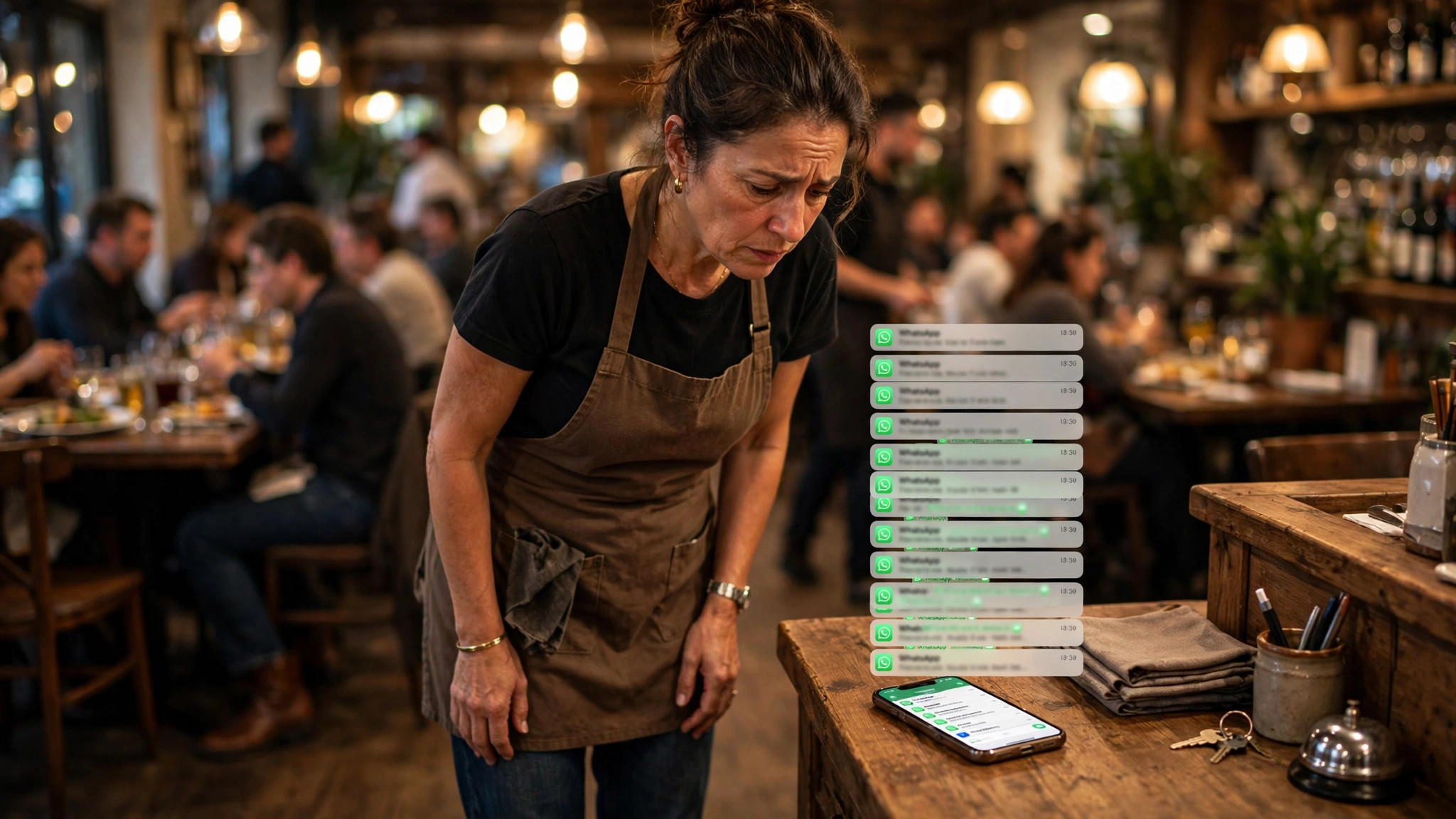
It's 11:40 PM. A couple is choosing where to eat tomorrow night, and they message your restaurant on WhatsApp: "Table for two at 8 tomorrow?" Nobody replies until the morning shift. By then, they've booked somewhere else. This happens every single day in restaurants — and it's the easiest revenue leak to fix.
WhatsApp automation gives your restaurant an always-on booking agent. It reads the message, checks your availability, confirms the table, and sends the guest a confirmation — in seconds, at any hour. No app to download, no phone tag, no missed messages. It is the same idea behind lead capture automation — meet people where they already are and remove every bit of friction.
Why WhatsApp is the right channel for restaurants
Your customers already live on WhatsApp. Unlike a booking form buried three clicks deep on your website, a WhatsApp conversation feels personal and immediate. Open rates on WhatsApp messages are dramatically higher than email, and guests can ask follow-up questions naturally — "Do you have outdoor seating?" "Is there parking nearby?" — instead of abandoning the booking. Salons deal with the exact same problem on a different app — see how Instagram DM automation for salons handles it.
What a WhatsApp booking agent actually does
- Confirms reservations instantly — party size, date, and time captured in one short conversation.
- Answers common questions — opening hours, menu, prices, location, dietary options — without staff involvement.
- Sends reminders — a friendly nudge the day before the booking, which is the single most effective way to cut no-shows.
- Handles changes gracefully — "Can we move to 8:30?" gets a yes in seconds instead of a missed call.
- Collects guest details — names and phone numbers go straight into your booking list, building a customer database you own.
The no-show problem (and how reminders fix it)
Empty tables from no-shows are pure lost revenue — the food was prepped, the staff was scheduled, and nobody came. The fix is embarrassingly simple: remind people. A WhatsApp reminder sent 24 hours before the reservation, with a one-tap "confirm" or "reschedule" option, turns forgetful guests into seated guests. Restaurants that add automated reminders typically see a meaningful drop in no-shows within the first month.
What it takes to set up
A practical setup has three ingredients. First, your availability rules — opening hours, table count, seating durations. Second, your FAQs — menu highlights, prices, parking, policies — written in your own voice. Third, the automation itself: an AI agent connected to WhatsApp that follows your rules and escalates to a human when something unusual comes up. The whole thing can be live in days, not months. For the technical background, WhatsApp’s official Business Platform documentation explains the messaging rules every setup must follow.
Start small, measure, expand
You don't need to automate everything on day one. Start with after-hours booking — the messages that currently get zero response. Track two numbers: how many bookings the agent confirms, and how your no-show rate changes. Once those move in the right direction, add reminders, then special-event bookings, then feedback collection after the visit. Each step compounds.
A real evening with the booking agent
Let us walk through a Friday night. At 6:12 PM a guest messages: “Table for four tonight around eight?” The agent checks your floor plan, sees one four-top free at 8:15, and replies: “We have 8:15 — shall I hold it under your name?” The guest says yes. At 7:58 the agent sends: “See you soon! We are at 42 Main Street, parking behind the building.” At 8:20, when the table is still empty, it sends one gentle check: “Running late? We will hold your table until 8:45.” The guests arrive at 8:35, relieved. Nobody on your team touched their phone once. That is what a good setup feels like from the inside: quiet, polite, and invisible until the moment it matters.
Common mistakes to avoid
The biggest mistake is making the agent sound like a corporate robot. Guests chose your restaurant for its personality — the automation should reflect it. Write the agent's messages the way your best host talks: warm, brief, helpful. Second mistake: no human fallback. If a guest has a complaint or a complicated request (a 20-person event, an allergy concern), the agent should hand over to a real person immediately, with the full conversation attached. Third: setting it up and forgetting it. Check the conversations weekly for the first month. You'll spot questions the agent couldn't answer — add them, and the system gets smarter.
The restaurants winning on WhatsApp aren't the ones with the fanciest technology. They're the ones that simply answer — instantly, every time. Automation is just the most reliable way to make that happen.
What Should the Agent Do When a Guest Is Angry?
A guest messages at 9pm: the food was cold, the waiter was rude, they are never coming back. This message will arrive whether you have automation or not. The difference is what happens in the first sixty seconds.
The agent should do three things: acknowledge the feeling, collect the facts, and get a human involved immediately. “I'm really sorry to hear that — that is not the experience we want for our guests. Can I take your name and booking time so our manager can call you tonight?” No defending, no excuses, no automated discount offers.
What matters most is the speed of the human follow-up. The agent's real job here is triage: flag the complaint as urgent, attach the full conversation, and alert you right away. A fast, genuine human call can save a customer. A clever automated apology cannot.
If the complaint turns abusive, the rules do not change: stay polite, do not engage with the abuse, hand over to a human. The agent should never block, ban, or argue with a guest — those decisions belong to you, with the full story in front of you. Dignity in the reply protects your reputation even when the guest has lost theirs.
Watch what happens after the complaint too. An angry guest often leaves a public review within a day. If your agent flagged the complaint fast and you called within the hour, you can sometimes resolve it before the review goes up — and if the review still appears, your fast response becomes part of the story. Speed does not just save the guest; it shapes the public record.
The Tricky Requests: Allergies, Big Groups, and Special Occasions
Not every booking is “table for two.” The agent needs clear rules for the complicated ones. Allergies first: the agent should never guess about ingredients. It collects the allergy details and answers from your kitchen policy — or hands over to a human when the answer is not in its training.
Big groups need a different flow: headcount, date, occasion, contact person, deposit policy. The agent gathers all of it neatly, then flags it for your personal confirmation. You get a complete brief instead of a vague “we're like 15 people, can we come Friday?”
Special occasions — proposals, birthdays, anniversaries — deserve a human touch. The agent can note the occasion and pass it to your team, so the table gets the candle or the corner seat. Small details, remembered automatically, are what guests tell their friends about.
Dietary questions deserve the same care as allergies. Vegan, halal, kosher, gluten-free — the agent should answer only from your confirmed menu information, never from general knowledge. “Our kitchen says” beats “typically” every time. When in doubt, it asks the kitchen through you, not the guest through guesswork.
Turning One-Time Guests Into Regulars
Most restaurants focus on filling tonight's tables and forget the guests who already came. Those past guests are your cheapest marketing — they already trust you. A simple follow-up a few weeks after their visit keeps you in mind: “Hope you enjoyed the pasta — our new seasonal menu just launched if you're planning another night out.”
Birthdays and anniversaries are gold. If a guest mentioned a birthday during booking, a message a year later — “Happy birthday! A table is waiting if you'd like to celebrate with us” — feels personal, not pushy. The agent remembers what humans forget.
Keep it light: one thoughtful message beats five promotions. Guests who feel remembered come back. Guests who feel spammed block you. The agent should know the difference.
Want this for your restaurants?
ReplyPilot builds a custom whatsapp automation setup for your restaurants — answering customer questions instantly, taking orders and bookings, and handing off to you when a human is needed.
Ask on WhatsApp — it's freeWatch for the quiet regulars — the couple who comes every other Friday, the family with the Sunday lunch tradition. When the agent spots the pattern, a simple “Shall I book your usual Friday table?” feels like magic. Regulars do not need selling. They need remembering, and remembering is what software does best.
Lapsed regulars deserve a win-back message too. The guest who came monthly and vanished three months ago gets one warm note: “We miss you — the corner table is still yours if you want it.” Not a discount, not a promotion — just noticed and missed. Win-backs like this recover guests no ad could reach, because the relationship already exists.
What the Booking Agent Should Never Do
Never confirm a table you are not sure about. If the calendar is unclear or the party size is unusual, the agent should say so honestly: “Let me check that with the team and confirm within the hour.” A wrong confirmation ruins an evening; an honest pause does not.
Never argue about policies. If a guest pushes back on a deposit or a time limit, the agent states the policy kindly once, then hands over to a human. Policies need a person, not a script.
Never message guests who did not ask to hear from you. Promotions go only to people who opted in. WhatsApp's rules are strict about this, and your guests' patience is stricter. One unwanted broadcast can cost you more goodwill than ten good bookings earn.
Never share one guest's details with another. If someone asks “who else is booked tonight?” or “is the birthday party still on?”, the agent gives nothing away. Privacy sounds obvious until a chatbot tries to be helpful. Train it: guest information stays with the guest, full stop.
Training the Agent on Your Real Messages
The best training data is sitting in your WhatsApp right now: months of real guest messages and your real replies. Collect the fifty questions you answer most — hours, parking, menu, dietary options, large parties — and write the answers exactly as you would say them.
Pay special attention to the questions that currently go unanswered. The 11pm “are you open tomorrow?” messages nobody replies to — those are pure gold for training, because they represent bookings you are losing today.
Then define the handover list: complaints, allergies, events over a certain size, anything involving money disputes. Write it down plainly. The agent is only as good as the boundaries you give it — clear rules make a calm, reliable agent.
Update the training every season. Menus change, hours shift for holidays, the patio opens and closes — and every change must reach the agent the same day it reaches your door sign. A chatbot quoting summer hours in December tells guests nobody is minding the shop. Fifteen minutes per season keeps it honest.
Test the agent the way a guest would. Once a month, message your own restaurant as a stranger: ask about parking, try to book a big table, complain about something small. If the answers feel like your restaurant, the training is working. If anything feels robotic or wrong, you just found next week's fix — before a real guest did.
How Do You Know Your Restaurant Automation Is Working? The Numbers to Watch Weekly
Number one for restaurants: response time. Before automation, guests waited hours for a reply. Now the first message should land in seconds, at any hour. If any conversation waits more than a few minutes, something in the setup needs attention.
Number two: handover rate. How often does the agent pass conversations to you? A low, steady rate means it handles the routine well. A sudden spike means something changed — a new menu item it does not know, a policy question it cannot answer. Spikes are to-do lists for your restaurant, not failures.
Number three: repeat visits. Are past guests coming back? Follow-up messages should slowly lift this number. It moves slower than the others, so judge it monthly, not weekly.
Review these every Monday morning. Ten minutes, once a week, and you will always know whether the system is earning its keep.
Bonus number: booking source. Ask the agent to note where each booking conversation started — your Google listing, Instagram, a friend's recommendation. After a few months you will know which channel fills your tables, and that tells you where your marketing effort actually belongs.
A Slow Tuesday: What the Agent Does When Nobody Books
Automation is not only for busy nights. On a quiet Tuesday, the agent is still working: answering the “are you open today?” messages, sending the menu to browsers, and collecting details from anyone planning ahead for the weekend.
Slow days are also when the agent does its quiet maintenance work — sending a few well-timed messages to past guests about the weekend, or reminding the lunch crowd about tonight's specials. Nothing pushy, just present.
And every quiet conversation is training data. The questions guests ask on slow days reveal what your menu page, your hours listing, and your Google profile are not explaining clearly. Read them monthly, fix the gaps, and even your quiet days start pulling their weight.
Use quiet days to test. Try a new reminder wording, a different follow-up message, a tweaked greeting — and compare the results with last month's Tuesdays. Low-traffic days are your laboratory: small experiments, clear results, no risk to a busy Friday. The restaurants that improve fastest are the ones that treat slow days as practice.
What it costs vs. what it saves
Do the math for your own restaurant. Add up the covers you lose each month to unanswered messages and no-shows, then multiply by your average spend per guest. For most independent restaurants that number is uncomfortably large — several thousand a month walking out the door. A WhatsApp booking agent typically costs a fraction of one part-time hire and works every hour of every day. It doesn't call in sick, doesn't forget the specials, and never has a bad night. When owners run the numbers honestly, the question stops being whether they can afford automation and becomes whether they can afford not to.
Curious what this looks like for your own restaurant? A free custom demo shows the booking agent answering in your voice, with your menu and your hours — built around your business, not a template. Request yours at https://replypilot-site.vercel.app/ and see your first automated booking happen.
The Weekend Rush: Waitlists and Walk-Ins
Friday and Saturday nights, you cannot answer the phone and the door at the same time — so the agent runs the door for you. When every table is full, it stops offering bookings and starts a waitlist: name, party size, and a phone number, with a realistic wait time based on how your tables actually turn. When a table frees up, the next party gets a message: “Your table is ready — we will hold it for ten minutes.” Walk-ins get the same treatment instead of a vague “try back later.” Nobody stands in the doorway wondering.
Keeping the Waitlist Honest
- Quote the wait generously — a party seated early is delighted, a party kept waiting is furious
- One confirmation message, then release the table — no chasing people who went elsewhere
- Offer the bar or a nearby option for long waits — a waiting guest is still your guest
Your Morning Briefing: What the Agent Hands You Before Service
Every morning, one short message lands before you open: tonight's bookings with party sizes, the special occasions noted, dietary flags the kitchen should know, and any conversation the agent handed over. You read it with your coffee and walk into service knowing everything — the proposal at table six, the nut allergy at table twelve. No surprises at the door, no scrambling mid-service. The best restaurants run on preparation, and the agent does the preparing while you sleep.
Cafés face the same rush-hour message overload as restaurants — an AI chatbot for coffee shops takes orders and answers menu questions without missing a beat.
Quick-service food and drink spots share the same ordering rush — WhatsApp automation for juice bars takes orders without the queue.
Pizza nights mean order spikes — WhatsApp automation for pizza restaurants takes orders, upsells extras and confirms delivery times automatically.
Frequently Asked Questions
Can WhatsApp automation take table reservations for my restaurant?
Yes. Diners message "Table for 4, Friday 8pm," and the automation checks your book, confirms the slot, and sends a reminder before the visit. No phone tag, no missed calls during the dinner rush.
How do WhatsApp reminders reduce restaurant no-shows?
The automation sends a confirmation right after booking and a gentle reminder a few hours before. Diners reply to confirm or cancel. Restaurants using reminders typically cut no-shows sharply, which protects your busiest nights.
How much does WhatsApp automation cost for a restaurant?
Usually a small monthly fee based on message volume. A single saved table on a Friday night often covers the cost. Small restaurants with 20–50 seats see the quickest payback.
Can the restaurant chatbot share the menu on WhatsApp?
Yes. When someone asks "What's on the menu?" or "Do you have vegetarian options?", it sends the menu instantly — with photos if you like. Hungry browsers become booked tables faster.
Can WhatsApp automation handle large party or event bookings for restaurants?
Yes. For groups above your normal table size, it collects the details — headcount, date, occasion — and flags it for your personal confirmation. You get all the facts upfront instead of a vague "we're a big group" message.