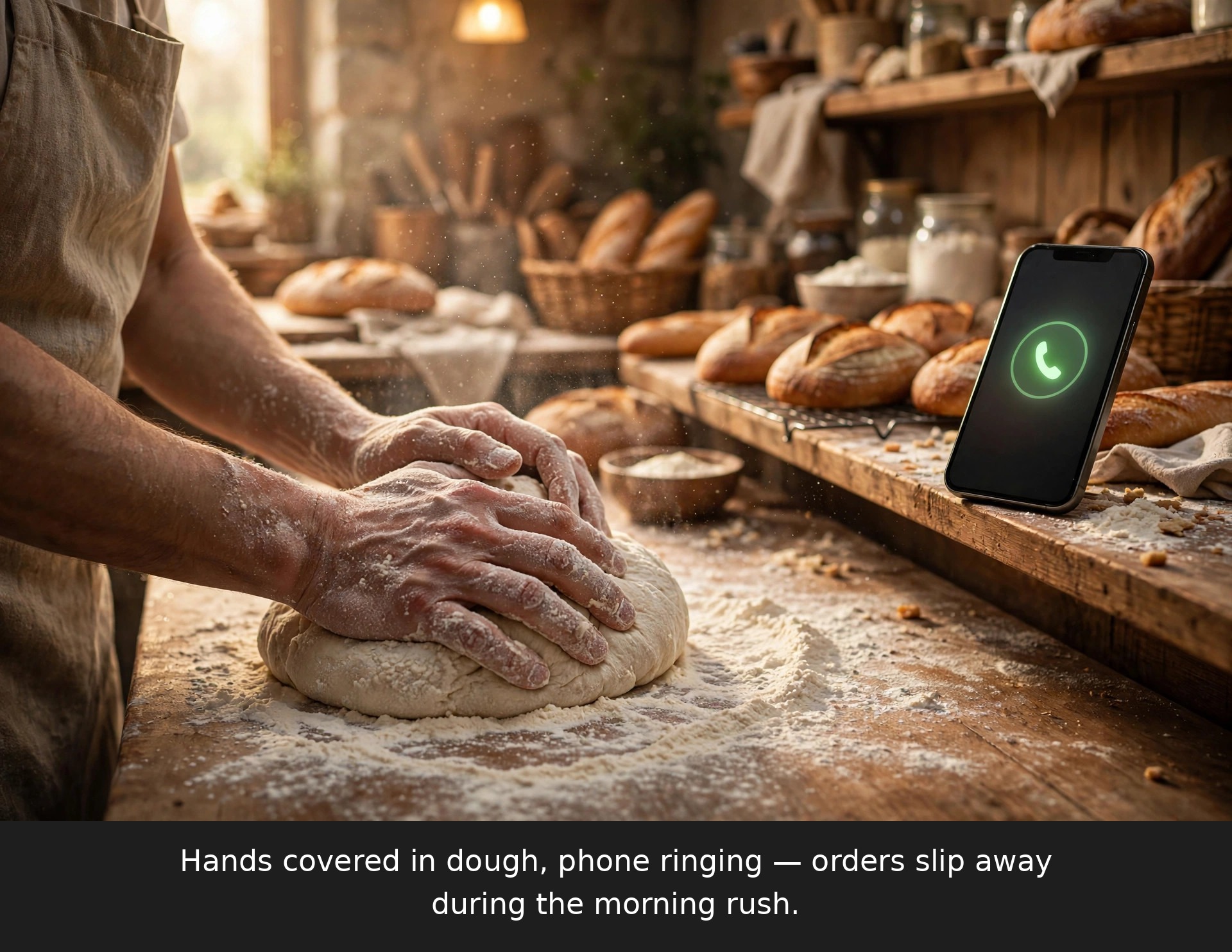
Your hands are covered in flour, a wedding cake is mid-decoration, and your phone is ringing on the shelf. It rings again. And again. Each call is a cake order - a birthday next Friday, a baby shower on Sunday - and every one of them goes to voicemail because you cannot touch your phone with buttercream on your fingers. By closing time, three of those callers have ordered from the bakery across town. An AI chatbot for bakeries fixes this exact scene. It takes the order details, answers the questions, and books the cake into your calendar - while you keep baking.
Quick answer: An AI chatbot for bakeries takes custom cake orders by collecting the four details that matter — size, flavour, date, and design — answers price and availability questions instantly, and books consultations. It works at midnight, when most cake enquiries actually arrive, so no order is lost to a missed call or a late reply.
How Is AI Being Used in Bakeries?
When people ask how AI is being used in bakeries, the answer is simpler than they expect. It is not robots baking bread. In real bakeries, AI mostly means a chatbot on the website or WhatsApp that takes custom cake orders, answers questions about ingredients and allergens, quotes prices for standard sizes, and sends pickup reminders. The oven still belongs to you. The AI just makes sure no order dies in an unread message while you are elbow-deep in dough. For bakeries that also sell through a physical counter, the same always-on logic applies to restaurants - see how WhatsApp automation for restaurants handles their version of the rush.
Custom Cake Orders Need Four Details - The Chatbot Collects All Four
Every custom cake conversation needs the same four things before you can commit: size (how many servings), flavour, date needed, and a deposit. Most orders die because collecting these takes six back-and-forth messages across two days, and the customer drifts away in between. An AI chatbot for bakeries is built around this exact problem: it asks the four questions in one smooth flow and never forgets the date the way a rushed human might. A cake order chatbot asks all four in one short chat, in the right order, and only bothers you with orders that are complete. It can also handle the details bakers forget to ask about - "any nut allergies?" - which is both good service and good sense.
- Size and servings - "1kg serves about 10-12 people" - so customers stop guessing.
- Flavour and filling options from your real menu, with prices for each tier.
- Date check - the chatbot knows your booking calendar, so it never promises a date you are fully booked.
- Deposit collection - sends your payment link and marks the order confirmed only when paid.
- Pickup reminders - a friendly nudge the day before, so cakes do not sit in your fridge unpaid.
Answer Ingredient and Allergen Questions Without Fear
Questions about ingredients come up constantly: "Is this gluten-free?" "Does the red velvet have nuts?" "Can you make it eggless?" A chatbot trained on your recipes answers these instantly and consistently - which matters, because one wrong answer about an allergen is a serious problem. You decide exactly what it says, and for anything it is unsure about, it flags the message for you to check personally. Never let it guess about allergens. That rule goes in its instructions in capital letters, and it is checked in your weekly review - the same review habit recommended in lead capture automation.
Fill the Quiet Weekdays, Not Just the Busy Weekends
Weekends sell themselves. The quiet money is in Tuesday-to-Thursday - office birthdays, small celebrations, "just because" cakes. A chatbot can gently nudge past customers: "Hi! Your daughter's birthday is coming up next month - want to book her cake early?" It can also promote your weekday specials automatically. Small bakeries do not have marketing teams; the chatbot becomes a quiet one, working the customer list you already own. Most owners underestimate this side of bakery order automation - not just taking orders, but creating them from customers you already have.
Keep the Warmth - You Are a Neighbourhood Bakery, Not a Factory
People choose small bakeries because they feel personal. A chatbot that says "How may I assist you?" breaks that spell instantly. Train it on your real voice - the way you actually text customers - and load it with your real knowledge: your flavours, your lead times, your honest limits ("I need 5 days notice for wedding cakes, 48 hours for birthdays"). Honest limits build trust. A customer who is told upfront that you cannot do a cake for tomorrow respects you more than one who is strung along.
What Should the Chatbot Do When a Customer Is Upset?
It will happen: a cake arrives with the wrong name, a pickup runs late, a flavour disappoints. The customer messages while upset, and the chatbot is the first thing they meet. This is the moment that decides whether you lose them forever.
Three rules, in this order. Acknowledge without arguing: "I'm really sorry — that's not the cake you ordered." Gather the facts: order number, what went wrong, a photo if they have one. Then get a human involved fast. A chatbot that debates a disappointed mother about spelling is a disaster. One sincere apology plus "the baker will call you within the hour" saves the relationship.
Afterward, read that transcript yourself. Complaints are free quality control — they show you exactly where orders go wrong, from misread messages to overpromising on dates. The bakeries that improve fastest are the ones that treat every complaint as a lesson, not an attack.
One more rule for the hard moments: never let the chatbot offer compensation on its own. Discounts, remakes, refunds — those are your call, not its. Its script should be: apologize, collect the facts, escalate. You decide the fix once you have seen the photo and heard the story. A chatbot handing out free cakes would be popular and ruinous.
And follow up after the fix. A day later, a short message — "just checking the replacement cake was right this time" — turns a complainer into a storyteller. People tell their friends about the bakery that messed up and made it right far more than they talk about the bakery that was merely fine. The complaint, handled well, becomes marketing.
The Wedding Cake Conversation: Your Biggest Order, Made Painless
Wedding cakes are your highest-value orders and your longest conversations — tastings, sketches, servings for 120 guests, delivery and setup. Most of that back-and-forth can start in chat, at the couple's pace, at 10pm when they finally have time to plan.
The chatbot collects the basics first: the date, the venue, the guest count, style ideas. It explains your process honestly — "wedding cakes need a tasting, which we usually schedule a couple of months out" — and books the tasting like any other appointment. It shares your flavour list and starting sizes so the couple arrives informed instead of overwhelmed.
Big orders still deserve your personal touch, and the chatbot knows that. Its job is to do the groundwork so that when you finally talk, you are discussing the fun part — the design — instead of spending forty minutes on logistics. Couples remember how easy you made the stressful part.
Use the waiting time wisely. Between the first chat and the tasting, the chatbot can send the couple two or three of your past wedding cakes as inspiration — real photos of your real work. By tasting day they have a shortlist, the conversation starts warm, and your close rate climbs. Preparation sells.
Mistakes Bakery Owners Make With Order Bots
A good idea goes stale in the same few ways. Check your bakery against this list:
- A rigid menu with no "something custom" option. Half your best orders start as "can you do something like...?" — the chatbot must capture those, not block them.
- Wrong lead times. If the chatbot promises a custom cake in 24 hours and you need 72, every order becomes a crisis. Keep lead times honest and current.
- Skipping the deposit. Orders without deposits are wishes, not orders. The chatbot should always send the payment link and confirm only when paid.
- Forgetting the human handoff for big or strange requests. A five-tier wedding cake discussed only with a bot makes customers nervous. Escalate early.
- Never updating the menu. Seasonal flavours, sold-out items, price changes — review monthly or the chatbot starts lying.
All of these are fixable in an afternoon. The bakeries that struggle are not the ones with bad software — they are the ones that set it up once and never look at it again.
The sneakiest mistake of all is the silent one: the chatbot answering confidently about a flavour you discontinued last month. Customers order it, you have to call with bad news, and the trust you built evaporates. Tie your menu updates to something you already do — when you change the chalkboard, update the chatbot. Same habit, same day.
What Your Bakery Chatbot Should Never Do
Flour, sugar, and clear boundaries. Write these down and check them monthly:
- Never promise a date you are fully booked for. The chatbot must check the real calendar, every time, no exceptions.
- Never guess about allergens. If it is not certain, it says so and flags you. This rule goes in its instructions in capital letters.
- Never confirm an order without the deposit. "Confirmed" means paid — anything else is a misunderstanding waiting to happen.
- Never invent designs. If a customer describes something elaborate, the chatbot collects the description and photos — it does not promise "yes, exactly like that" before you have seen it.
- Never replace the phone call for wedding and large event orders. It prepares them; you close them.
Customers respect a chatbot that knows its limits. "Let me check with the baker on that one" builds more trust than a confident wrong answer ever could. Limits are not weakness — they are the reason people trust the answers it does give.
Tell customers the limits upfront, briefly, in the first message: "I can take your order and answer questions about our menu — for anything tricky I'll bring in the baker." Nobody is disappointed by a boundary they knew about. They are only disappointed by a promise that breaks.
Want this for your bakeries?
ReplyPilot builds a custom ai chatbot setup for your bakeries — answering customer questions instantly, taking orders and bookings, and handing off to you when a human is needed.
Ask on WhatsApp — it's freeA Day in the Life: Saturday Morning With the Chatbot on Duty
6:00 AM — you are at the oven. An order lands: birthday cake, chocolate, 20 servings, pickup Thursday. All four details complete, deposit paid. You did not touch your phone. 8:30 AM — three people ask about today's counter stock. The chatbot answers from your morning list while you pipe cupcakes.
10:15 AM — a bride messages about a wedding in June. The chatbot collects the date, guest count, and style ideas, then books her tasting for next week. 12:40 PM — a customer running late for pickup gets the reminder, replies "running 20 minutes late" — no wasted cake, no awkwardness, no cake sitting out getting warm.
By closing time, you have taken a full day of orders without a single interrupted bake. No floury fingerprints on the phone screen. No voicemails to return at 9pm. That is the whole pitch, lived in one ordinary Saturday.
And here is the part owners forget to count: the orders that came in after closing. The 10pm browser who ordered a Friday cake while you were asleep. The Sunday-morning mum who booked before you woke up. Those orders never existed before the chatbot. They are not recovered sales — they are new ones.
Add it all up and the picture is simple: fewer missed orders, fewer forgotten pickups, calmer bake days. The chatbot does not replace the warmth of your bakery — it protects it, by handling the messages while you handle the craft.
How Do You Know It's Paying for Itself?
No spreadsheets required. Count three things at the end of each month:
- Orders that arrived while you were baking. Every complete order with a deposit that came in during kitchen hours is one you would have missed to voicemail before.
- Forgotten pickups. Compare how many cakes sat unclaimed before reminders versus after. Each saved cake is pure recovered money.
- The phone test. Is your phone ringing less during bakes? Are you finishing decorating without stopping to answer?
If the order queue is fuller, fewer cakes go unclaimed, and your hands stay in the dough — it is paying for itself. The numbers will show it, but you will feel it first: calmer bake days, fewer missed calls, and no more Sunday-night voicemail dread.
Think of it in single-cake terms. One custom cake order that would have gone to voicemail — and then to the bakery across town — is real money walking out the door. One wedding tasting booked from a 10pm chat is potentially your biggest order of the month. You do not need dozens of wins for the chatbot to earn its keep. A handful of saved orders a month does it, and most bakeries see far more than a handful.
Training It on Your Real Menu Without the Headache
Setup sounds technical. It is not. It is writing down what you already know, in the order customers ask for it.
Start with your flavours and fillings, exactly as you would list them on the phone. Add sizes with serving counts — "1kg serves 10 to 12" — because customers always guess wrong. Add your prices per size, your lead times per cake type, and your honest limits ("no same-day wedding cakes, ever"). Then add ten real questions customers have asked you, with your real answers.
Now test it like your pickiest customer. Ask about the weird flavour combo, the impossible date, the nut allergy. Fix anything that sounds off for a bakery. One focused afternoon, and it speaks your bakery's language. Then revisit the menu notes monthly — five minutes keeps it honest, and honest is what keeps customers coming back.
Do not forget the voice. Feed it three or four of your actual replies to customers — the warm, friendly ones — and tell it to match that tone. A bakery chatbot that says "How may I assist you?" feels like a bank. Yours should sound like you on a good day: warm, a little chatty, honest about limits. Customers chose a neighbourhood bakery, not a call center, and the chat should feel like it.
Want this working in your bakery?
The bakeries winning with chatbots are not doing anything exotic. They take orders while they bake, answer while they decorate, and remind while they sleep. Most custom cake orders die in unread DMs during baking hours - yours do not have to. The moment it clicks for most owners is the first order that lands while they are mid-bake: an AI chatbot for bakeries doing exactly what it was built to do. If you want to see a cake order chatbot working with your own flavours, sizes and prices, ReplyPilot will build you a free custom demo: request it at https://replypilot-site.vercel.app/ and watch your next order book itself while your hands are in the flour.
The Customer Who Sends a Photo of an Impossible Cake
It happens every week: a customer sends a Pinterest photo of a five-tier gravity-defying masterpiece and asks, “Can you make this by Friday?” The temptation is to say yes and figure it out later. That is how disasters are born — and how one-star reviews get written.
The chatbot's job is honest triage. It asks the real questions first: how many servings, what date, what budget. Then it gives an honest answer — “I can do a two-tier version of this look,” or “this design needs more time than Friday allows, but here is what I can do.” Customers respect a clear no far more than a hopeful yes that collapses.
Teach it your boundaries clearly: which techniques you do, which you do not, the minimum notice for complex designs, the largest size your oven handles. A chatbot that says “we do not do that, but here is what we do beautifully” earns more trust than one that promises everything and delivers panic.
And save every inspiration photo with the order. By the time you talk to the customer personally, you have seen exactly what they want — and they have already heard an honest yes or a kind no. The conversation starts from reality instead of fantasy, which is where good cakes come from.
What Happens When the Date Is Already Fully Booked?
Saturday in wedding season: your oven and your hands have a real limit, and pretending otherwise is how bakeries end up crying into fondant at 2 am. When a date is full, the chatbot must say so — kindly, immediately, and with an alternative in the same message.
The wrong answer is silence, or a vague “we will try.” The right answer is specific: “Saturday the 14th is fully booked, but I can do Friday the 13th for pickup, or a simpler design for the 14th.” A customer with options stays a customer. A customer with “maybe” quietly orders from the bakery across town.
Set your real capacity in the system — how many custom cakes per day, honestly, on your busiest week. When the limit hits, the chatbot stops accepting and starts offering alternatives. You never discover on Thursday night that Saturday was overbooked three cakes ago.
Keep a short waitlist, because cancellations happen. When a slot opens, one quick message — “a Saturday slot just opened up” — fills it within minutes. An empty slot you fill is pure profit; an overbooked Saturday is a reputation problem that lasts far longer than the weekend.
Deposits and Cancellations: The Money Talk Made Easy
Custom cakes cost you real money before the customer ever arrives — ingredients bought, hours spent, a box with their name on it. A deposit is not rude; it is how a serious bakery works. The chatbot states it as simple policy, the same way every time, with none of the awkwardness of asking in person.
The structure that works: a deposit to lock the date, the balance on pickup. The chatbot collects the deposit with the order, sends a receipt in chat, and reminds about the balance the day before pickup. No chasing, no end-of-month surprises, no awkward counter conversations while the next customer waits.
Cancellations need rules too, and they must be stated upfront — in the very first order chat. Full deposit back if cancelled a week out, partial after that, none for day-before cancellations. Customers accept rules they hear early. They deeply resent rules they first hear when they are already upset.
The chatbot never negotiates your policy. If someone asks for an exception, it collects the request and brings it to you with the full order attached. Your call, your judgment — the system just makes sure the request reaches you with the facts, instead of catching you off guard at the counter.
The Office That Orders Every Friday: Your Quiet Goldmine
Offices run on routine: birthdays every month, Friday treats, client meetings that need something sweet on the table. One office that orders weekly is worth more than a dozen one-time birthday cakes — and a dozen such offices are probably sitting within a mile of your shop right now.
The chatbot makes the corporate pitch painless. A standing Friday order: same time each week, rotating flavors, one monthly bill. The office manager messages once, and the rhythm runs itself — reminders, confirmations, the bill, all automatic. You become part of their week, not a decision they remake every time.
Land the first one with the offices already buying from you. “Want this every Friday without thinking about it?” One yes becomes your proof. Then walk the neighboring offices with a standing-order offer instead of just a menu — you are selling convenience, not cake.
Treat them like the gold they are. Remember their flavors, never miss a Friday, and message personally — yourself, not the bot — when something changes. A missed corporate Friday loses you fifty future cakes. A reliable one wins you the whole building, one slice at a time.
Morning-rush food businesses can't stop to answer the phone — an AI chatbot for coffee shops handles orders while the barista keeps pouring.
Food businesses with phone-order rushes need backup — WhatsApp automation for pizza restaurants never lets an order go unanswered.
Frequently Asked Questions
How much does a chatbot cost for a small bakery?
Pricing is usually a modest monthly fee based on message volume. For a small bakery it often costs less than a single custom cake order per month. Ask for a free demo first so you can judge the value with your own orders.
Can the chatbot take custom cake orders while I am baking?
Yes. It walks the customer through size, flavour, filling, the message on the cake, and pickup date — step by step. All the details land in one tidy order summary for you. You just bake; the order-taking happens on its own.
Can it answer allergen and ingredient questions for my bakery?
Yes, you feed it your recipes once, and it answers "Does this have nuts?" or "Is this eggless?" instantly. This builds trust and saves you from stopping mid-bake to reply. For unusual requests, it hands over to you.
Will the chatbot send pickup reminders to my bakery customers?
Yes. It sends an automatic reminder a day before and on the morning of pickup. This cuts down forgotten orders, which is pure lost money for a bakery. Customers appreciate the nudge.
Can the bakery chatbot take orders at night when the shop is closed?
That is one of its best features. Customers browse and order at 11pm; the chatbot collects everything and you see a neat queue in the morning. You never lose a late-night order to a competitor who answered first.