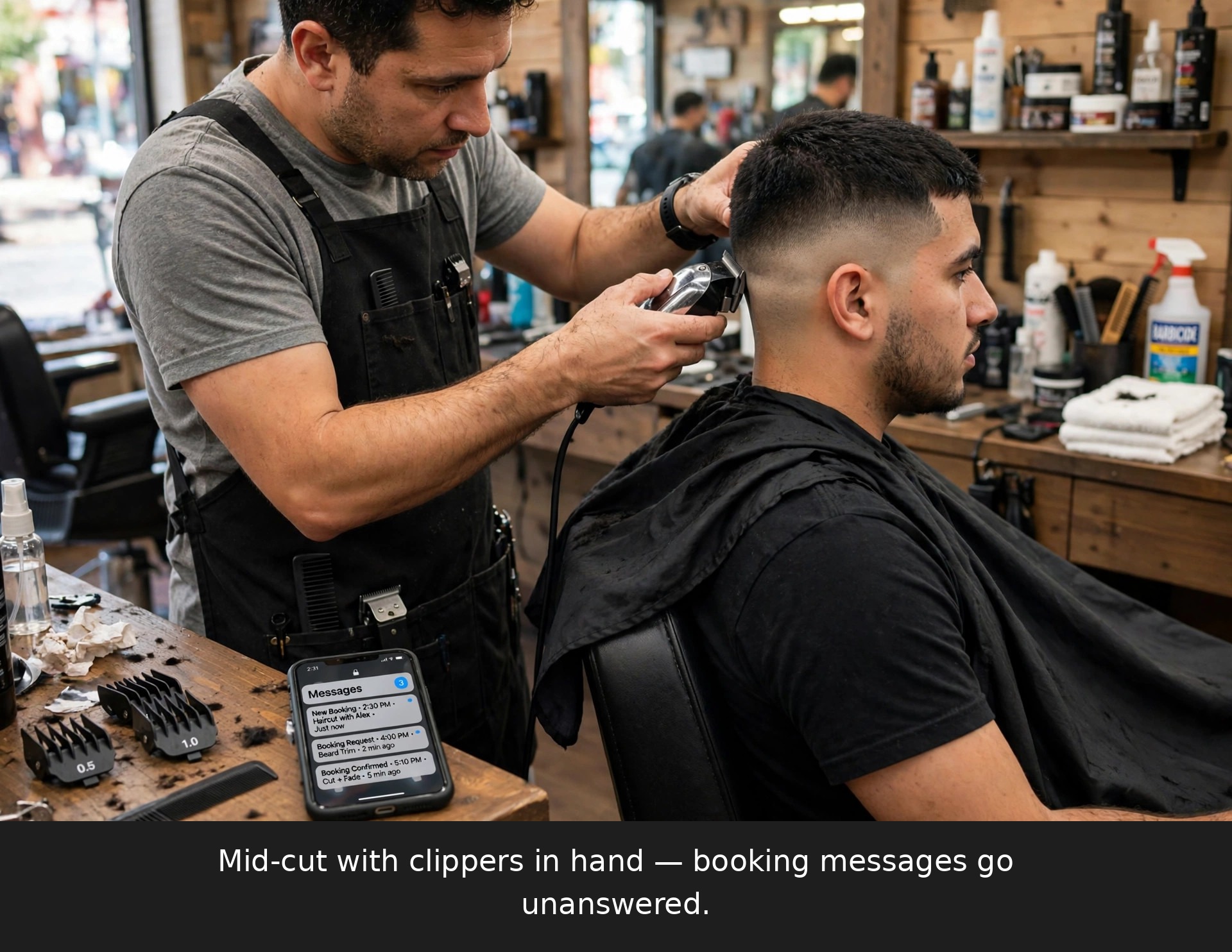
It's Saturday at 11am. You're halfway through a skin fade, clippers humming, and your phone lights up on the counter. Then it buzzes again. And again. Each buzz is money trying to reach you - a beard trim for Friday evening, a father-and-son cut for Sunday morning, a wedding party of six asking about group bookings. But your hands are covered in hair and product, and every one of those messages waits. By the time you wipe down, sanitize, and finally check your phone at 1pm, two of those people have already booked with the shop down the street. The third one? He found someone on Instagram who replied in four minutes. This is the daily reality of running a barbershop in 2026: your craft is in your hands, but your bookings live in a phone you can't touch for eight hours a day. An AI chatbot for barbershops changes this completely. It answers every message in seconds, quotes your real prices, books into your actual calendar, and fills cancellations before the chair goes cold - while you keep cutting.
Why Barbershops Lose Bookings Every Single Day
Let's be honest about how bookings actually work in most barbershops. A guy sees your work on Instagram - a clean taper, a sharp beard lineup - and he messages you. He's ready. He's already decided. He just needs three things: the price, a time that works, and confirmation. If he gets all three within ten minutes, he's yours. If he waits three hours, he's still probably yours. If he waits until tomorrow? He's gone. He's found another barber who answered faster, and he'll probably never message you again. This isn't a theory. Ask any barber who's checked their DMs after a busy Saturday - the unread messages from Friday night are bookings that died quietly while they were working.
The math is brutal. Say you miss just two bookings a week because of slow replies. At an average of $35 per cut, that's $70 a week, $280 a month, $3,360 a year - walking out the door because your hands were busy doing the actual work. And that's conservative. Busy shops in good locations lose far more. The painful irony is that the better you are at cutting hair, the more messages pile up, and the more bookings you lose. Success literally creates the problem. Your Instagram grows, your reputation spreads, more guys message you - and more of them slip through the cracks because there's only one of you and you can only hold clippers or a phone, not both.
Then there's the timing problem. Men book haircuts at odd hours. The data from booking platforms consistently shows that a huge share of barbershop bookings happen outside business hours - late evenings, early mornings, Sunday nights when guys are planning their week. Your shop is closed. You're asleep, or with family, or finally resting your feet. But the guy messaging at 11pm on Sunday is planning his Monday, and if your competitor's chatbot books him in 30 seconds while your phone sits silent until morning, you've lost him. Not because you're a worse barber. Because you were asleep, which is completely reasonable, and completely costly.
What an AI Chatbot for Barbershops Actually Does
Forget the sci-fi version of a barbershop bot. An AI chatbot for barbershops is a messaging assistant that lives in your WhatsApp or Instagram DMs - the places guys already message you - and handles the booking conversation the way your best receptionist would, if you had one working 24 hours a day. Beauty businesses run on the same Instagram booking rush - see how Instagram DM automation for salons turns DMs into appointments. When someone messages 'how much for a fade?', it doesn't send a generic reply. It knows your actual price list: skin fade $35, beard trim $20, the combo $50, kids cuts $25. It answers in your voice, the way you actually text, not like a corporate robot.
When the guy says 'okay, Saturday morning?', the chatbot checks your real calendar - the same one you use, whether that's a booking app, Google Calendar, or a simple schedule you set - and offers actual open slots. 'I have 10:30 or 11:15 open Saturday - which works?' He picks one. The chatbot confirms it, sends him a reminder the day before, and logs it where you can see it. The whole conversation takes 45 seconds. You never touched your phone once. You were doing a hot towel shave the entire time, and a booking landed in your calendar like it was always going to.
It also handles the questions that eat your evenings. 'Do you do walk-ins?' 'How long does a cut take?' 'Where are you located?' 'Do you cut kids hair?' These are the same five questions, asked fifty times a week, and every one of them used to cost you two minutes of thumb-typing between clients or after hours. The chatbot answers all of them instantly, from your real information. And here's what matters: it knows when to hand over. If someone asks something complicated - a wedding party booking, a complaint, something unusual - it doesn't guess. It says 'Let me have the boss take a look at this one' and flags it for you with the full conversation attached. You handle the exceptions. It handles everything else.
Filling Cancellations Before the Chair Goes Cold
Every barber knows the sting of a no-show. You blocked 45 minutes. You turned away a walk-in because the slot was 'taken.' Then the guy never shows, never messages, and that chair sat empty earning nothing. Industry data suggests barbershops lose 10 to 15 percent of booked slots to no-shows and late cancellations. For a shop doing 30 cuts a week, that's 3 to 4 empty chairs weekly - potentially $100 to $140 gone, every single week, for no reason except that nobody followed up.
A chatbot attacks this from two directions. First, prevention: it sends confirmation messages when someone books ('You're locked in for Saturday 10:30 - reply YES to confirm'), and a reminder the day before ('See you tomorrow at 10:30! Reply if you need to reschedule'). Guys who get reminders show up far more often. It's not complicated psychology - it's just that people forget, and a nudge fixes forgetting. Shops using automated reminders typically cut no-shows dramatically, and every saved appointment is pure recovered revenue.
Second, recovery: when someone does cancel, the chatbot doesn't just accept the empty slot. It immediately messages your waitlist - guys who asked about that day, regulars who usually come around then. 'A 2pm slot just opened today - want it?' The first one to reply gets it. In busy shops, cancelled slots get refilled within minutes instead of sitting empty. Think about what that means over a year. If you recover even two cancelled slots a week at $35 each, that's $3,640 a year in revenue that used to evaporate. The chatbot pays for itself many times over just on this one job.
- Booking confirmation the moment someone reserves - locks in commitment
- Reminder 24 hours before - cuts forgetful no-shows
- Same-day reminder option for chronic latecomers
- Instant waitlist outreach when a slot opens - refills chairs in minutes
- Easy reschedule flow - keeps the revenue instead of losing the client
Bringing Regulars Back Without Being Pushy
Here's something most barbers don't think about: your best marketing asset isn't Instagram. It's your existing client list. A regular who gets a cut every three weeks is worth roughly $600 a year. If he drifts to every five weeks because life gets busy and nobody reminded him, he's suddenly worth $360. Multiply that drift across twenty regulars and you're quietly losing thousands a year - not to competitors, just to forgetfulness. Nail salons face the same rebooking drift - Instagram DM automation for nail salons shows how appointment-based beauty businesses keep clients on schedule.
A chatbot fixes this gently. It knows when each client last came in - because it has the booking history - and it nudges at the right moment. Five weeks since his last fade? 'Hey Marcus, it's been a minute - looking sharp still or time for a cleanup? I have Thursday evening open.' That's not spam. That's the digital version of what great barbers have always done - remembering their guys and looking out for them. The difference is that now it happens automatically, for every client, without you having to track any of it in your head.
It can also run simple win-back campaigns. Guys who haven't booked in two months get a friendly check-in, maybe with a small incentive: 'Miss you in the chair - $5 off your next cut this week.' Birthday messages go out automatically. Slow Tuesday afternoons get filled by offering waitlist clients first dibs on discounted slots. None of this requires you to become a marketer. You set the rules once - who gets nudged, when, with what offer - and the chatbot runs it quietly in the background while you cut hair.
Keeping Your Shop's Personality (This Part Matters Most)
Barbershops run on personality. Guys don't just come for the cut - they come for the vibe, the conversation, the feeling that this is their spot. A chatbot that sounds like a bank's customer service line would poison that. 'Thank you for your inquiry. How may I assist you today?' - no. Absolutely not. The chatbot needs to sound like your shop. If your Instagram captions are casual and funny, the chatbot is casual and funny. If you're a premium shop with a refined tone, it matches that.
This is done by training it on your real voice. The setup process involves feeding it examples of how you actually talk to clients - your real messages, your real replies, your real personality. It learns your prices, your services, your hours, your policies, your jokes. When a regular messages, it can even recognize him: 'What's good, D - the usual fade Thursday?' That level of personal touch is what separates a great barbershop chatbot from a generic booking bot, and it's the difference between clients loving it and tolerating it.
Want this for your barbershops?
ReplyPilot builds a custom ai chatbot setup for your barbershops — answering customer questions instantly, taking orders and bookings, and handing off to you when a human is needed.
Ask on WhatsApp — it's freeThere's also a trust element. Guys need to know they're talking to your shop, not some random company. The chatbot introduces itself naturally, uses your shop's name, references your real services. And it's always clear that a human - you - is behind it and available. 'If you need anything else, Marcus is right here in the shop.' The technology disappears into the experience. Clients just notice that your shop replies fast, remembers them, and never drops the ball. That's not a tech feature. That's just good service, delivered consistently.
What It Costs vs. What It Saves (Honest Numbers)
Let's talk money plainly, because that's what matters. A part-time receptionist for a barbershop costs $1,500 to $2,500 a month, and they still go home at night - they don't answer the 11pm Sunday messages. A booking app subscription runs $30 to $100 a month, but apps don't answer questions, don't fill cancellations, and don't bring regulars back. They just sit there waiting for the client to do all the work. An AI chatbot service typically costs a fraction of a receptionist's salary - and it works every hour of every day.
Now the other side. We calculated earlier: two saved bookings a week is $3,360 a year. Two recovered cancellations a week is another $3,640. Bringing just five drifting regulars back to their normal schedule could be $1,200 a year. Add it up and a busy shop could be looking at $8,000 to $10,000 in recovered annual revenue - from messages that were already coming in, from clients who already wanted to book. The chatbot doesn't create demand. It stops demand from leaking. That's a much easier and more reliable return.
The setup takes days, not months. You provide your price list, your hours, your booking calendar access, and examples of how you talk. The chatbot is trained, tested with real conversations, and then it goes live in your WhatsApp or Instagram. You watch the first week's conversations to make sure the tone is right, tweak anything that feels off, and then it runs. Most barbers report that within the first month, they notice the difference in one specific way: they stop feeling anxious about their phone. The unread message count stops climbing during busy Saturdays. That peace of mind, honestly, is worth as much as the revenue.
Getting Started: What You Need (It's Less Than You Think)
You don't need new software, new hardware, or any technical skill. Here's the actual list: your price list (you know it by heart), your working hours, whatever calendar you use for bookings (even a paper book can work - it just gets digitized), and about an hour of your time to review how the chatbot talks. That's it. The whole thing runs inside WhatsApp or Instagram - the apps your clients already use. Nobody downloads anything. Nobody learns anything new.
- Your service menu with real prices - fade, taper, beard, combo, kids
- Your working hours and days off - including holiday schedules
- Your booking calendar - app, Google Calendar, or even a photo of your book
- Examples of your real messages - so it learns your voice
- Your policies - deposits, late arrivals, no-show rules
One thing to decide upfront: deposits. Many shops now take small deposits for bookings ($10-$15) to cut no-shows, and a chatbot can handle this smoothly - sending the payment link right in the chat, confirming only when paid. If you don't want deposits, that's fine too. The chatbot works either way. The point is that these are your business decisions; the technology just executes them consistently, every time, without you having to remember or enforce anything in the moment.
Real Scenarios: A Week With the Chatbot
Monday 9pm: You're home, feet up, done for the day. A message comes in: 'Yo, you got anything Thursday after 6?' The chatbot checks your calendar, sees the 6:30 slot open, and books it. You find out Tuesday morning when you glance at your schedule. You did nothing. The booking happened while you were watching TV.
Wednesday 2pm: You're mid-cut with a regular when a new guy messages asking about prices for a full service - cut, beard, eyebrows. The chatbot sends your full menu, answers his follow-up about how long it takes, and books him for Friday at 4pm. The regular in your chair never noticed your phone buzz. The new client never waited.
Friday 10am: A guy booked for 11am messages: 'Running 20 late, still okay?' The chatbot knows your late policy (15 minutes, then the slot goes to waitlist). It tells him honestly, offers to move him to 2pm, and simultaneously messages two waitlist guys about the 11am opening. One of them takes it. Your 11am chair stays full. The late guy still gets his cut at 2pm. Nobody lost. Everybody won.
Saturday 6pm: Your last client leaves. You check your phone - not with dread, but curiosity. Four new bookings for next week. Two reschedules handled. One waitlist slot filled. Zero unread messages that need your attention. You put the phone down and go home. This is what the technology is actually for - not replacing you, but removing the part of the job you never signed up for: being a full-time receptionist on top of being a full-time barber.
Common Worries (Answered Honestly)
'My clients want to talk to ME, not a robot.' They're right - and they still will. The chatbot handles bookings and questions. The actual relationship - the conversation in the chair, the trust, the craft - that's all you, untouched. Think of it this way: your clients already prefer texting over calling. The chatbot just makes sure someone always texts back. When they sit in your chair, it's 100% human, 100% you.
'What if it says something wrong?' It works from your real information - your prices, your hours, your policies. It doesn't invent things. And for anything it's unsure about, it's programmed to hand over to you rather than guess. You also review conversations, especially in the first few weeks, and correct anything that feels off. It learns. Within a month, it handles 90% of messages without you ever looking.
'I'm not good with technology.' You don't need to be. There's no dashboard to learn, no software to install, no new habits to build. It lives in WhatsApp or Instagram - apps you already use every day. The setup is a conversation: someone asks you about your prices, hours, and how you talk to clients, and they build it from that. If you can send a text message, you can run this.
Want the same running in your barbershop?
The barbers winning with this aren't tech people. They're craftsmen who got tired of losing bookings to a phone they couldn't answer. The moment it clicks is usually the first Saturday after going live - you're deep in back-to-back cuts, your phone is face-down on the counter, and at the end of the day you check it to find three new bookings that happened while you were working. Nobody waited. Nobody left. The chairs filled themselves. If you want to see exactly what this looks like with your own prices, your own hours, and your own shop's personality, ReplyPilot will build you a free custom demo: request it at https://replypilot-site.vercel.app/ and watch your next busy Saturday handle itself.
Personal-care bookings start with a DM — Instagram DM automation for tattoo studios answers flash, pricing and aftercare questions automatically.
Frequently Asked Questions
Can an AI chatbot fill last-minute barbershop cancellations?
Yes. When someone cancels, it instantly messages your waitlist with the freed slot. Empty chairs earn nothing, and this fills them within minutes. You set the waitlist rules once.
How much does a chatbot cost for a barbershop?
Usually a modest monthly fee for a barbershop. A single filled cancellation covers it. Barbershops with 3+ chairs see the fastest return because empty chairs multiply.
Can the barbershop chatbot take bookings after closing time?
Absolutely. Guys decide at 10pm they need a cut tomorrow. The chatbot books them into your real schedule. Morning brings a full book instead of missed DMs.
Will the chatbot know each barber's schedule?
Yes. You load each barber's hours and services. Customers pick their barber or take whoever is free. No more double-bookings or "I thought Ali was working today" confusion.
Can the chatbot send haircut reminders to regulars?
Yes. It messages regulars when their usual cut is due — "It's been 4 weeks, want your usual Friday slot?" Regulars are a barbershop's backbone, and reminders keep them coming without you remembering.