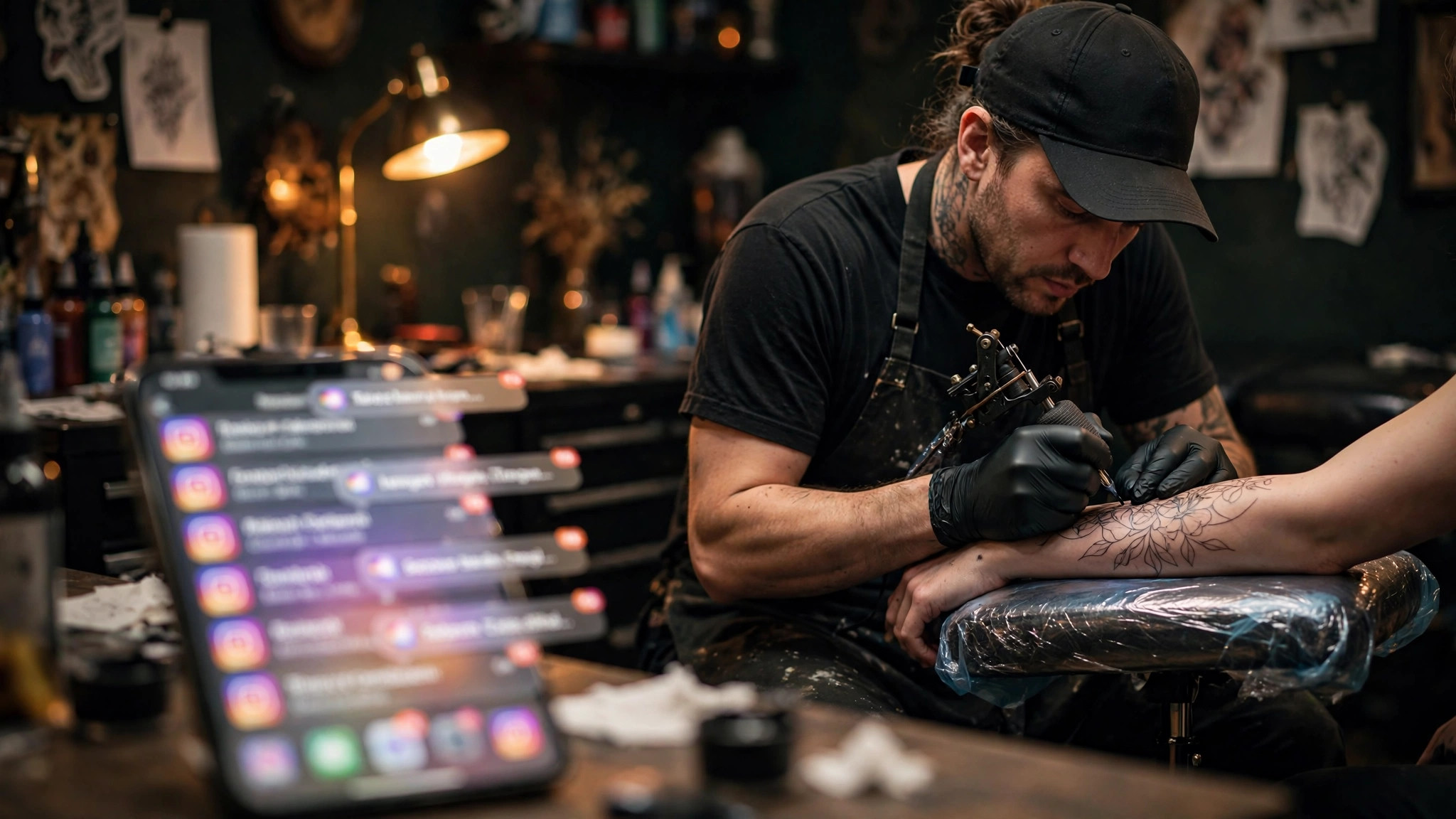
It is 9:40 on a Friday night and you are two hours into a half-sleeve. Your gloves are on, the machine is buzzing, and there is no stopping mid-line to check your phone. Meanwhile the phone keeps lighting up on the side table. A new follower asks, "How much for a forearm piece?" Someone else sends three reference photos with no message at all. A third person wants to know if you do cover-ups, whether you have anything open next week, and - this one arrives at 11:15pm - "are you still tattooing tonight?" By the time you wash up and reply, it is past midnight. Two of them have already messaged another studio. This is the nightly reality of running a tattoo studio in 2026: your portfolio lives on Instagram, so your booking desk lives there too - and it never closes, even when your hands are busy.
Instagram DM automation for tattoo studios exists for exactly that gap. It answers the messages while you tattoo. Not with cold robotic replies, but with your studio's real answers - your price ranges, your booking process, your artists, your aftercare - delivered in seconds, at 2am, while your needle is running. This guide walks through what it actually does for a tattoo studio, the consultation flow that separates serious clients from window-shoppers, and how to set it up without sounding like a machine.
Why Tattoo Studios Drown in DMs (and Why That Is Actually Good News)
For most local businesses, Instagram is a marketing channel. For a tattoo studio, Instagram is the shop window, the portfolio, the reviews page and the front desk rolled into one. Clients do not find you on Google and call a landline. They find a reel of your healed blackwork, tap your profile, scroll your highlights, and then do the most natural thing in the world: they DM you. That is a compliment. It means your work sells itself. The problem is only volume and timing.
Strip a busy studio's inbox down and you will find the same dozen questions repeating every single day. How much for this design? Do you do cover-ups? Are you taking new clients? What is your minimum? Do you tattoo minors? (The answer is no, and you still get asked weekly.) Can I bring my own design? How far out are you booked? Do you do walk-ins? Each question is simple. Each one arrives while you are tattooing, drawing, or asleep. And here is the part that stings: a person asking about a tattoo is often asking three or four studios at once. The one that answers first usually gets the consultation. Speed is not a nice extra in this trade. It is the booking.
The second problem is screening. A tattoo consultation is not like booking a haircut. Before you say yes, you need to know the design idea, the size, the placement on the body, the budget, whether it is a cover-up, and whether the client is over eighteen. Gathering that information by hand - five or six back-and-forth messages per person, most of whom were never serious - eats hours every week. Instagram DM automation for tattoo studios handles both problems at once: instant answers for the repeat questions, and a structured intake that collects everything you need before a human ever gets involved.
What Instagram DM Automation for Tattoo Studios Actually Handles
- Answers the repeat questions instantly - price ranges, minimums, booking lead time, walk-in policy, age policy - in your studio's own voice.
- Collects reference photos right in the chat, so clients send their inspiration images before the consultation instead of during it.
- Asks the five screening questions every serious booking needs: design idea, size, placement, budget range, and whether it is a cover-up.
- Matches the inquiry to the right artist on your team - fine line goes to one artist, Japanese sleeves to another - instead of everything landing on the owner.
- Shares your booking or deposit link at the right moment, after the client is qualified, not as a cold first message.
- Sends appointment reminders that cut no-shows: a confirmation right after booking, a nudge the day before, and a morning-of message.
- Follows up with aftercare instructions automatically - day one, day three, and two weeks out - so healing questions do not become panicked midnight DMs.
- Runs a waitlist: when someone cancels, the next qualified person on the list gets first refusal on the freed slot.
- Announces flash days and guest artist spots to people who asked to hear about them, filling special events in hours.
- Turns post and reel comments into private conversations - someone comments "need this" on a healed piece, and the studio's booking flow starts in their DMs.
- Handles story replies the same way, so the "is this still available?" messages on your flash designs get answered while you work.
- Hands anything complicated straight to you with full context - cover-up assessments, large custom pieces, nervous first-timers - so a human takes over exactly where the machine should stop.
The Consultation Filter: Turning DMs Into a Front Desk
Here is where most generic advice about DM automation misses the tattoo trade completely. A salon can take a booking from a name and a time slot. A tattoo studio cannot. Your consultation flow needs information, and the quality of that information decides whether the in-person consult takes fifteen minutes or an hour. Set up the automation as a filter, and it does the quiet admin work that used to eat your evenings.
It starts the moment someone messages the studio. The automation greets them warmly, names the studio, and asks what they have in mind. If they have reference photos, it invites them to send the images right there in the chat. Then it walks through the essentials one at a time, in plain language: what style are you thinking of, roughly how big (a coin, a palm, a full forearm), where on the body, and what budget range feels right. For cover-ups, it asks for a clear photo of the existing tattoo and flags honestly that cover-ups need an in-person look before anyone quotes. If the person is under eighteen, it explains the studio's age policy kindly and stops there - no awkward conversation for you to have later.
By the end of that short exchange, you have a complete intake sitting in your inbox: photos, size, placement, budget, artist preference, and whether this person is ready to book or still dreaming. You - or your shop manager - open it in the morning, glance at it for thirty seconds, and reply with a price range and two available consult slots. The client feels looked after from the first minute. You spent half a minute instead of half an hour. Consultation-heavy trades all benefit from this kind of pre-qualification - photographers, for example, run a very similar intake before a shoot, as described in AI chatbots for photographers. Multiply that across a full week of inquiries and the automation has quietly given you back hours of your life.
Deposits, No-Shows and the Clients Who Disappear
Every tattoo artist knows the pattern. A client books a three-hour session, you block the afternoon, you draw the design the night before - and they vanish. No message, no apology. The deposit is the trade's answer to that, and the DM is the natural place to collect it. Once the consultation is confirmed, the automation sends the deposit link with a short, friendly explanation of what the deposit covers and when it becomes non-refundable. People pay deposits far more readily inside a conversation they are already enjoying than from a cold email three days later - the same principle behind lead capture automation, where a warm chat at the right moment outperforms every cold follow-up.
Then comes the reminder sequence, which is where studios quietly lose the most money. A confirmation message right after booking locks the date in the client's mind. A reminder two days before - with the address, parking notes, and what to bring - clears up the practical worries that make people flake. A short morning-of message keeps the session top of mind. None of this needs your attention; it just runs. And when someone does cancel, the automation does not let that slot die. It messages the waitlist in order - people who already passed your consultation filter and said "take me if something opens" - and the first to confirm takes the slot. An empty chair on a Saturday is the most expensive thing in a tattoo studio. A waitlist that fills itself is the cheapest fix.
Aftercare on Autopilot: The Follow-Up Nobody Remembers to Send
Ask any artist what generates the most anxious DMs and the answer is always healing. "Is this normal?" "It looks dry, should I worry?" "Can I go swimming yet?" Most of those messages arrive at odd hours from clients who were given a printed aftercare sheet they lost on the way home. An automated aftercare sequence changes the whole dynamic: the evening after the session, the client gets a warm check-in with the key first-night instructions. Three days in, another message covers the itchy phase everyone panics about. Two weeks out, a final note explains what healed skin should look like and invites them to book a touch-up if anything needs attention.
This does three things at once. It calms the client, which means fewer panicked messages for you. It shows a level of care that clients remember - and talk about in reviews. And it quietly books touch-up sessions that would otherwise never happen, because the client who heals well and hears from you again is the client who comes back for piece number two. Appointment-based beauty businesses run the same playbook - see how Instagram DM automation for salons keeps clients returning. The studios that grow on repeat clients are rarely the ones with the flashiest work. They are the ones that stay in touch after the bandage comes off.
Setting Up Instagram DMs for Your Tattoo Studio, Step by Step
- Step one: list your ten most-asked questions. Open your DMs, scroll back a month, and write down the questions that repeat. Price, minimums, cover-ups, age policy, booking lead time - these become your instant answers.
- Step two: write the answers the way you actually talk. Not formal, not corporate. If you would text a client "hey! so for something like that you're looking at roughly...", write it like that. The automation should sound like your shop, not a call centre.
- Step three: build the consultation intake. Five questions, in order: design idea, reference photos, size, placement, budget. Add the cover-up branch and the under-eighteen branch. Keep each question short.
- Step four: connect your booking and deposit flow. Whatever you use - a booking link, a form, a payment page - the automation hands it over at the right moment, after the client is qualified.
- Step five: set up comment-to-DM triggers on your posts. Someone comments a keyword like "book" or "price" on a reel, and the booking conversation starts in their DMs automatically. This also lifts the post's engagement while it works.
- Step six: write the aftercare sequence. Three messages - night of, day three, week two - in your voice, with your actual aftercare advice. Review it with your artists before it goes live.
- Step seven: test it like a client. Message your own studio from a personal account, try to break it, and read every reply out loud. If anything sounds off, fix the wording before real clients see it.
What Should a Tattoo Studio's First Auto-Reply Say?
This is one of the most searched questions on the topic, and the answer is simpler than most guides make it. The first message should do three things: greet warmly, set the expectation that a human reviews everything, and ask one easy question. Something like: "Hey, thanks for messaging us! Tell me what you're thinking of getting and I'll get you sorted - a real human checks every conversation, so nothing gets missed." That is it. No menu of twenty options, no "press 1 for pricing". One warm line, one open question. The automation's job in that first exchange is to feel like the friendly front-desk person every good studio has - the one who makes a nervous first-timer feel welcome before the artist even says hello.
Two Mistakes Tattoo Studios Make With DM Automation
The first mistake is quoting exact prices through the bot. Tattoo pricing depends on too many real-world factors - exact size, detail level, skin placement, how the design sits on the body - and a fixed number given too early either scares people off or boxes you in. Give ranges, always, and let the final quote happen at consultation. The second mistake is letting the automation pretend to be the artist. Clients can tell, and in a trade built on personal trust, being caught faking it costs more than a slow reply ever would. The automation should be openly the studio's assistant: helpful, fast, honest about what it is. When a conversation needs an artist's eye - a cover-up assessment, a custom design discussion, a nervous client who needs reassurance - it hands over immediately, with the full conversation attached, so the human picks up without asking "so what did you want?" a second time.
Want this for your tattoo studios?
ReplyPilot builds a custom instagram dm automation setup for your tattoo studios — answering customer questions instantly, taking orders and bookings, and handing off to you when a human is needed.
Ask on WhatsApp — it's freeIs Instagram DM Automation Safe for Your Studio's Account?
Short answer: yes, if you use the official route. Instagram automation must run through Meta's official API, which means your account needs to be a professional account connected to a Facebook Page, and you connect the tool by logging in through Meta itself. No legitimate tool should ever ask for your Instagram password - that is the clearest red flag in this space. Done the official way, the messages come from your own account, your clients cannot tell a tool is involved, and your account stays in good standing. WhatsApp's official Business Platform documentation lays out the same consent and messaging principles that apply across Meta's messaging tools. If you want a practical walkthrough of the setup aimed specifically at tattoo shops, this Manychat tutorial for tattoo studios shows the two simplest automations - a new-follower welcome and a comment-triggered booking DM - built on a free account.
What About the Cost?
You will find no price list here, and that is deliberate - pricing in this space changes fast and depends on your message volume. What is worth knowing: many tools offer free starter tiers that cover a small studio's DM volume, and paid plans generally scale with how many conversations you handle rather than how many staff you have. When comparing options, ask three questions. Does it handle the full conversation or just send one auto-reply? Can you take over any chat manually in seconds? And does it connect with the booking or payment flow you already use? A tool that only sends "thanks for messaging, we'll reply soon" is barely better than silence. The value is in the consultation intake, the deposit handoff, and the aftercare follow-up - the parts that actually move money.
Flash Days, Guest Spots and Announcements That Fill Themselves
Tattoo studios run on events: flash days, guest artist visits, Friday-the-13th specials, walk-in afternoons. These used to be announced with a post and a prayer. With comment-to-DM automation, a flash post becomes a booking machine. You post the flash sheet as a reel, add one line to the caption - "comment FLASH and I'll send you the available designs" - and every comment triggers a private DM with the designs, the fixed prices, and the booking link for that day. The post's comment count climbs, which pushes it to more local feeds, which brings more comments. The announcement markets itself while the bookings land in your inbox.
Guest artist spots work the same way in reverse. Instead of announcing publicly and getting flooded, you message your waitlist first: people who already passed your consultation filter get first refusal on the guest's limited slots, and only the leftovers go public. Walk-in availability gets its own quiet broadcast - a short message to followers who opted in for walk-in alerts: "we've got walk-in space today from 2 to 6, first come first served." No spam, because everyone on that list asked to be on it. Studios that run regular flash events say these lists become one of their most valuable assets: a room full of people who already trust your work, one message away from a booked day.
How Long Does It Take to Set Up?
Less time than most studio owners expect. The questions-and-answers part - your ten repeat questions, your price ranges, your policies - can be written in a single sitting, because you already know every answer by heart. The consultation intake takes a little more thought, since the order of the questions matters, but a focused afternoon gets it done. The part worth spending real time on is the voice: reading every automated reply out loud and asking "would I actually text this to a client?" That single test is what separates a setup clients love from one they can smell a mile away. Most studios go from nothing to a working system inside a week, then sharpen it a little every month by reading a few conversation transcripts and adding the questions they missed.
The studios filling their books fastest on Instagram are not the ones with the most followers. They are the ones that answer first, ask the right questions, and never let a good inquiry go cold at midnight. A tattoo studio's booking conversations start in DMs, and the studio that responds in seconds - with a real consultation flow, not a "we'll get back to you" - wins the client. Instagram DM automation for tattoo studios is simply the way to be that studio while your hands are busy doing the work clients actually pay for. Want to see how this workflow could work for your tattoo studio? Request a free custom demo from ReplyPilot at https://replypilot-site.vercel.app/ - built around your questions, your voice and your booking flow, and tested before it ever talks to a client.
A Friday Night With the Bot Working
It is 8pm on a Friday. You are halfway through a thigh piece — gloves on, machine running, no phone for the next three hours. Here is what your inbox does without you.
- 8:03pm — A follower comments FLASH on your reel. The bot sends the flash sheet, fixed prices and the deposit link. She picks a design and pays before you finish the line you are on.
- 10:15pm — A man asks about a cover-up. The bot asks for a clear photo of the old tattoo, explains honestly that cover-ups need an in-person look, and offers two consultation slots. He books Wednesday.
- 11:58pm — A client from last week asks whether the peeling is normal. The bot sends the aftercare reassurance — what is fine, what is a warning sign — and flags nothing urgent. She sleeps easy.
- Saturday, 9am — You open your phone to three new bookings, one complete consultation intake, and one calmed client. You answered nothing all night.
That is the quiet value of the system: the studio keeps working while the needle keeps moving. You did not lose a single inquiry to the clock.
Cover-Ups and First-Timers: The Chats That Need a Human Eye
Most inquiries the bot can finish alone. Two kinds it should never finish: cover-ups and nervous first-timers. A cover-up assessment needs your actual eyes on the old tattoo — the darkness, the scarring, the way it will fight the new ink. The bot collects the photos and the story, then books the in-person look. That is its whole job on a cover-up.
The nervous first-timer is the other one. The signs are easy to spot once you name them: three questions about pain in a row, “I’m scared it will hurt,” or a long pause after the price is quoted. The bot hands these chats to you with the full conversation attached, so you step in already knowing everything. Nobody wants to be reassured by software about a needle going into their skin for the first time.
Teach the Bot Its Own Limits
- Cover-up photos received — always book the in-person consult, never quote.
- Three pain questions or visible anxiety — hand over to the artist.
- Any medical mention (blood thinners, pregnancy, skin conditions) — hand over immediately.
This is not automation failing. It is automation doing its real job: handling the routine so you have energy for the conversations that need a human.
The Healing Check-In That Earns You Reviews
The best moment to ask for a review is not at the shop counter — it is six weeks later, when the tattoo is healed and the client catches themselves admiring it in the mirror. By then they have forgotten to review you, even if they loved the work. The bot does not forget.
Schedule one message six weeks after each session: “Your piece should be fully healed now — how is it looking? If you are happy with it, a review on our profile would mean the world to us,” with a one-tap link to the review page. Ask only once, and only ask the clients whose earlier check-ins went well. A steady stream of five-star reviews quietly transforms a studio’s profile within a few months — earned by care, not begged at the counter.
The same check-in quietly catches problems before they become public. A client whose tattoo healed badly will tell the bot at week six — and the bot hands them to you for a personal reply and a free touch-up, long before they write anything online. That is what the system is really buying you: the chance to fix things in private.
Frequently Asked Questions
How does the consultation filter work for a tattoo studio's DMs?
The chatbot asks for the design idea, size, placement and budget range before any booking. Serious inquiries get a consultation slot; vague or unsuitable ones get honest answers — like minimum sizes or styles you do not do. Your chair time goes to real clients.
Can Instagram DM automation collect deposits for tattoo bookings?
Yes. After the consultation is booked, it sends your deposit link and only confirms the slot when it is paid. The clients who disappear stop disappearing — a paid deposit is the best no-show prevention ever invented.
What about aftercare — can the chatbot follow up after the session?
Yes, and almost no studio does this by hand. The client gets aftercare instructions right after the session, a check-in a few days later, and a reminder about touch-ups. Healed tattoos look better, and happy clients send their friends.
Can it run my flash day announcements?
That is one of its best uses. You post the flash sheet, the caption says “comment FLASH,” and every comment triggers a DM with the designs, fixed prices and the booking link. The post's comments climb, the algorithm pushes it wider, and the bookings land themselves.
How long does it take to set up tattoo studio DM automation?
Most studios go from nothing to working inside a week. The questions and answers take one focused sitting — you already know them by heart. The voice is the part worth real time: reading every reply aloud and asking whether you would actually text it to a client.