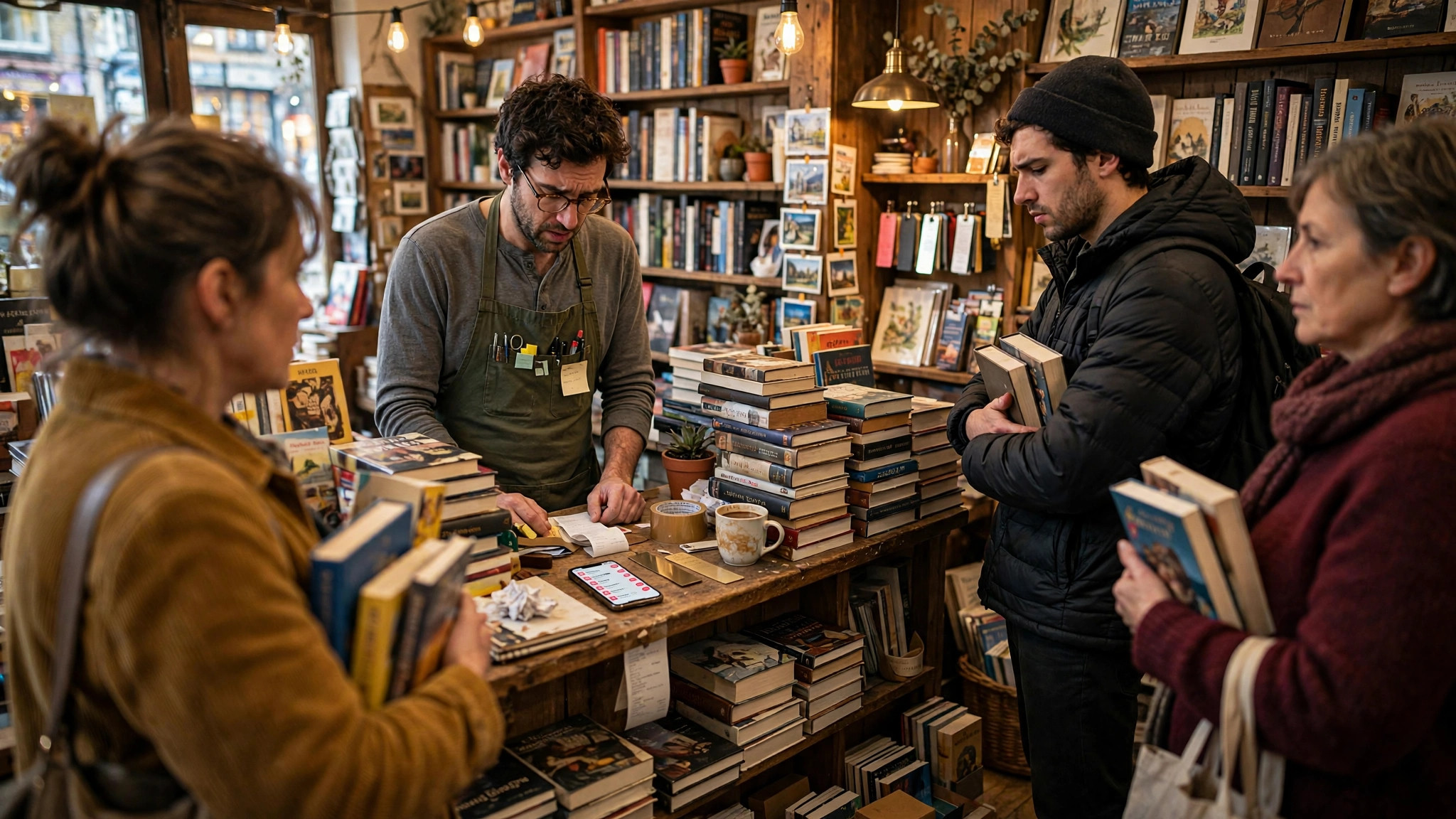
Saturday morning, 11:40. Your shop is full, three people wait at the counter, and your phone buzzes again. “Do you have the new Colleen Hoover in paperback?” A reader browsed your website at midnight and messaged you there too. You love these questions — they mean sales — but you cannot answer them and serve the room at the same time. An AI chatbot for bookstores means a chat assistant on your website or WhatsApp that answers availability questions, suggests books by genre, and coordinates order pickups. For bookstore owners, the best approach is a chatbot trained on your inventory, because it handles the repetitive “do you have this title?” messages while your staff serves the people already in the store. Tools like ReplyPilot (AI automation for small-business messaging — WhatsApp, Instagram DM, website chat) are built exactly for this kind of work. This article shows you what a bookstore chatbot can and cannot do, how it checks your shelves, where it beats social media DMs, and how to set one up in your first 30 days.
“Do You Have This Title?” — The Question That Never Stops
Walk into any independent bookshop on a busy day and you will hear it before you see it. The question arrives everywhere at once: a phone call while you are ringing up a customer, an Instagram DM at 9pm, an email on Sunday morning, and three people asking it in person across the counter. It is the same question wearing different clothes, and every single one deserves an answer. That is the cruel part of the book trade. Your customers are readers, and readers ask before they buy.
Here is the math nobody likes to do. A reader who messages you at 8pm and hears nothing back by morning does not wait around. They order from the giant online retailer and the sale is gone. You never even knew it happened. The message sits there, marked unread, while the customer buys the same book somewhere else. The math is not subtle. Every delayed answer is a quiet lost sale, and a small bookshop cannot afford many quiet losses.
What an AI Chatbot for Bookstores Actually Does
Strip away the buzzwords and the idea is simple. An AI chatbot for bookstores is a chat window on your website — and often on WhatsApp too — that talks to readers the way your best counter staff would. It is trained on your catalog, your opening hours, your ordering policy, and your frequently asked questions. When a reader types “do you have Dune in hardcover?”, it checks and answers in seconds, day or night. When someone asks when you close on Sundays, it tells them. When a parent asks for “a good adventure book for a nine-year-old”, it suggests titles from your shelves.
A bookstore chatbot is a tireless assistant, not a replacement bookseller. It never gets tired, never gets distracted by the counter queue, and never forgets to follow up. But it does not have your taste, your memory of regulars, or your instinct for the perfect unexpected recommendation. The honest way to see it: the chatbot handles the hundred repetitive questions so your humans can spend their time on the ten conversations that need a human.
- **Availability checks:** “Is this title in stock?” answered from your inventory in seconds.
- **Hours and directions:** opening times, parking, holiday hours — the questions you answer fifty times a week.
- **Pre-orders:** collecting names for big releases without a paper list behind the counter.
- **Event info:** author signings, book club nights, story time — dates, times, RSVPs.
- **Pickup coordination:** telling customers their ordered book is ready and when to collect it.
How Does the Chatbot Check Your Shelves in Real Time?
This is the question every bookstore owner asks first, and it is the right one. A chatbot is only as good as the information it can see. The best setups connect to your point-of-sale system or inventory list, so when a reader asks about a title, the answer reflects what is actually on your shelves right now. No guessing, no “let me check and get back to you”. The customer gets a straight answer: in stock, low stock, or not stocked — with an offer to order it in.
Be honest with yourself here. If your stock records are messy or months out of date, fix that first, because the chatbot will repeat whatever your system tells it. Garbage in, polite garbage out. Most modern point-of-sale tools for bookshops can share a clean inventory feed, and a good automation partner will help you connect it. This step takes a little effort once, and then the chatbot answers stock questions correctly forever.
And when the chatbot genuinely does not know? A well-built one never invents an answer. It says something like, “I am not sure about that one — want me to have a staff member check and message you back?” Then it hands the conversation to you with the full context attached. That handoff is the whole safety net. Readers do not mind a bot that admits its limits; they mind a bot that confidently lies about your shelves.
Why a Chatbot Beats Instagram DMs and Email for Book Queries
Most bookshops already get reader questions on Instagram DMs and email. So why add a chatbot? Speed is the first reason. A DM you answer in three hours is a DM answered too late — the reader has moved on. A chatbot answers in three seconds, at midnight, on a Sunday, during your busiest Saturday rush. The reader gets their answer while they are still in the mood to buy.
The second reason is focus. Instagram buries business messages under memes and reels. Email inboxes are graveyards of good intentions. But a chat window on your own website catches the reader at the exact moment of intent — they are already browsing your site, already thinking about your shop. Meeting them there is simply smarter than hoping they find your DM button. Other small retailers have made the same move; the bakery down the road solved this exact DM chaos with a chatbot of its own.
The third reason is memory. A chatbot remembers every conversation. When the same reader asks about the sequel three weeks later, the chat history is right there. No staff member has to remember anything. That continuity makes your tiny shop feel as polished as a big chain, without hiring anyone.
Genre Recommendations That Sound Like Your Best Bookseller
This is where a bookstore chatbot gets fun. Feed it your staff-picks shelf, your bestseller lists, and your genre sections, and it becomes a recommendation engine with your shop's personality. “I liked Project Hail Mary — what should I read next?” gets an answer pulled from books you actually stock, not from the entire internet. That last part matters. A recommendation for a book you do not carry is just an advertisement for a competitor.
The chatbot remembers every book on your shelves; your staff remembers every reader. That is the honest division of labor. The bot is brilliant at pattern-matching — “readers who bought this also loved these three” — and tireless at serving it up at 1am. But the magical recommendation, the one where you press a strange little novel into someone's hands because you just know, still belongs to humans. Let the chatbot handle the genre basics so your staff has time for the magic.
Ending the “Is My Order Ready?” Loop
Special orders are the lifeblood of independent bookshops, and they create a special kind of message chaos. The customer orders on Monday. They message on Wednesday: “Is it here yet?” They call on Friday. They message again on Saturday morning while standing in your doorway. None of them are being rude — they are excited about their book. But each of those messages costs you a minute, and minutes add up.
A chatbot turns this into a one-message flow. The customer orders through chat, the chatbot logs it, and when the book arrives you mark it ready — the chatbot sends the “your book is here” message with your pickup hours automatically. No phone tag, no forgotten callbacks. The customer feels looked after, and your counter stays calm. Small thing, huge difference in how professional your shop feels.
Pre-Orders and New Releases Without the Spreadsheet Chaos
Big release weeks are wonderful and terrible. The new fantasy sequel drops Tuesday, forty people want it, and your pre-order list is a notebook behind the counter with coffee stains on it. Someone's name is spelled wrong, someone else's phone number is missing a digit, and you are manually texting people at 9pm on launch day. There is a better way, and it is not complicated.
Want this for your bookstores?
ReplyPilot builds a custom ai chatbot setup for your bookstores — answering customer questions instantly, taking orders and bookings, and handing off to you when a human is needed.
Ask on WhatsApp — it's freeThe chatbot collects pre-orders conversationally: title, name, contact, done. On release day it messages everyone at once — “your copy is ready for pickup” — and tracks who has collected. You order the right quantity because you can actually see demand instead of guessing. If you want to get serious about turning chats into customers, the same lead capture principles that work for any small business apply perfectly to pre-order lists.
Filling Seats at Author Events and Book Clubs
Author signings and book club nights are how independent bookshops build community — and loyal customers. But promoting them is a chore: posters in the window, posts on social media that the algorithm shows to twelve people, and word of mouth. A chatbot gives you a direct line. It can announce the event to everyone who has chatted with you before, collect RSVPs in the conversation, and send a reminder the day before.
Think about your monthly book club. Instead of hoping people remember the date, the chatbot messages the group: “Book club meets Thursday at 7 — this month's pick is on the shelf now, want me to hold you a copy?” That single message does three jobs: reminder, sale, and pickup coordination. Events stop being a gamble and start being a system.
What Happens at 11pm When a Reader Can't Sleep?
Here is a customer you are currently losing every single night. It is 11pm, someone finishes a great novel, and they immediately want the sequel. They check your website. They have a question — is it in stock, can I pick it up tomorrow? Nobody answers, because you are sensibly asleep. By morning they have ordered it online. You lost a sale while you were sleeping, and you will never know.
The chatbot is awake. It answers the stock question at 11pm, offers to reserve the copy, and the reader walks in at noon feeling delighted. You did not lift a finger. This is the quiet superpower of chat automation for bookshops: it turns your closed hours into selling hours. Not with pushy marketing — just by being there when the reader's excitement is highest.
What Should the Chatbot Never Pretend to Do?
Honesty time, because trust is everything in a bookshop. A chatbot should never appraise a rare or antique book — that needs a specialist's eyes and years of knowledge. It should never promise a special-order delivery date it cannot verify with your distributor. And it should never handle an upset customer who needs a real apology; the moment someone is frustrated, the chatbot's job is to hand over to a human fast, with the full conversation attached so the customer never repeats themselves.
The rule is simple: the chatbot handles information, humans handle judgment. Stock levels, hours, event dates, order status — information. Taste, disputes, rare finds, genuine connection — judgment. Shops that respect this line get the best of both worlds. Shops that let a bot fake its way through a delicate situation get one-star reviews. Trust is slower to build than automation, and faster to lose.
Chatbot vs. Hiring a Part-Timer: A Simple Comparison
At some point every bookshop owner does this math: should I just hire someone to handle the messages? Here is the honest comparison, because the chatbot is not always the answer. | Question | AI chatbot | Part-time hire | | Answers at 11pm | Yes, instantly | No — they are off shift | | Knows your inventory | Yes, if connected to your catalog | Learns over weeks | | Sick days and holidays | Never | Yes, like any human | | Personal warmth | None — routes to you for that | Full human connection | | Handles 40 messages at once | Easily | Impossible | The real answer is both, doing what each does best. The chatbot absorbs the volume — the endless availability checks and hour questions. Your humans spend their paid hours on the work only humans do: curation, conversation, community. That is not replacing staff; it is protecting their time for what matters.
Mistakes That Make Readers Close the Chat
A bad bookstore chatbot is worse than no chatbot, because readers came to you for warmth and got a robot. The biggest mistakes are all avoidable. Sounding like a corporate helpdesk instead of a bookshop — your chat voice should feel like your shop. Giving wrong stock answers because the inventory feed is stale — one “yes, in stock” that turns out false burns trust for a year. Offering no escape hatch — every chat needs a visible “talk to a human” option. And the sneakiest one: aggressive upselling, pushing add-ons into every answer until the reader feels sold to instead of served.
Taste is the whole difference in a bookshop. A bookstore is a taste business, and your chatbot should reflect yours: quiet, helpful, knowledgeable, never pushy. Read every automated reply out loud before it goes live. If it sounds like something your best bookseller would never say, rewrite it. The best chatbot setups for small businesses all share this trait — they sound like the shop, not like software.
One more mistake deserves its own warning: launching and forgetting. A chatbot is not a poster you hang once. Read a handful of real conversations every week, especially in the first two months. You will find questions phrased in ways you never expected, and each one you teach the bot makes it sharper. Ten minutes a week keeps it honest; neglect turns it stale.
How Do You Know Your Bookstore Bot Is Working?
Do not measure a chatbot by how many messages it sends. A 95% response rate with zero extra sales is a vanity metric. Measure what matters: how many availability questions got answered without staff involvement, how many after-hours chats turned into next-day pickups, how many pre-orders were collected, and how many “talk to a human” handoffs actually got resolved. If those numbers climb while your counter staff reports fewer interruptions, it is working.
Give it a full month before judging. The first two weeks are training — you will spot questions the bot fumbles and teach it better answers. That is normal and expected. The American Booksellers Association (bookweb.org) has long championed the independent advantage: personal service at human scale. A chatbot does not replace that advantage — it protects it, by making sure no reader's question ever goes unanswered.
Putting It Together for Your Bookstore: The First 30 Days
You do not need a technology degree or a big budget to get started. You need your questions, your inventory, and a month of patience. Here is the simple rollout that works for most independent bookshops.
- **Week 1 — List your 20 most-asked questions:** write down what readers actually ask: stock checks, hours, ordering, events, returns. This list becomes the chatbot's brain.
- **Week 2 — Connect inventory and train:** link your point-of-sale or stock list, load your FAQs, and test every answer yourself. Fix the wrong ones now.
- **Week 3 — Soft launch on your website:** put the chat widget live quietly. Watch real conversations daily and add any question it fumbled.
- **Week 4 — Add WhatsApp and review:** once the website chat is solid, connect WhatsApp so readers can message you where they already live. Review the month's numbers.
Most shops see the difference within weeks: fewer interruptions at the counter, faster answers for readers, and pre-orders that collect themselves. If you want help setting this up properly, ReplyPilot builds exactly this kind of messaging automation for small businesses — you can request a free custom demo at https://replypilot-site.vercel.app/ and see what it would look like on your own shop's website.
Should the Chatbot Live on Your Website, WhatsApp, or Both?
Start with your website. That is where buying intent is highest — the reader is already browsing your catalog, already imagining the purchase. A chat widget in the corner catches them at the perfect moment, and it is the easiest place to connect your inventory feed. Most bookshops see their biggest wins here first: fewer abandoned browsing sessions, more “is this in stock?” questions answered, more next-day pickups.
Add WhatsApp second, once the website chat is humming. WhatsApp is where your regulars already talk to you, and it is unbeatable for proactive messages — the “your order is ready” ping, the new-release alert, the event reminder. One caution from recent experience: WhatsApp Business changed its pricing in October 2026, and businesses everywhere are rethinking what their messaging costs. Keep your proactive messages useful and welcome, not frequent, and the channel stays cheap and loved. Start with the website, earn the habit, then expand.
Frequently Asked Questions
How much does an AI chatbot for bookstores cost?
Costs vary widely by provider and features — a simple FAQ chatbot costs far less than a fully integrated system connected to your point of sale. Avoid anyone who cannot explain their pricing clearly before you sign. Many providers, including ReplyPilot, offer a free demo so you can see the value before spending anything.
Will a chatbot replace my booksellers?
No. A bookstore chatbot handles repetitive information — stock checks, hours, order status — so your staff spends more time on curation and real conversations. It protects bookseller jobs by removing the busywork, not by replacing the humans readers come to see.
Does the chatbot work with my point-of-sale system?
Most modern bookshop point-of-sale tools can share an inventory feed that the chatbot reads for live stock answers. Some older or closed systems cannot export stock data — in that case the chatbot still handles hours, events, pre-orders, and FAQs, just not live shelf checks. Check what your system can export before you commit.
Can a chatbot really recommend books well?
It recommends well within the lists you give it — staff picks, genre shelves, bestsellers. It will not match a great bookseller's instinct for the perfect unexpected book. The smart setup lets the chatbot handle genre basics and hands the interesting requests to your staff.
What happens when a customer asks something the chatbot doesn't know?
A properly built chatbot admits it does not know and offers a human handoff immediately, passing the full conversation to you or your staff. The customer never repeats themselves, and you reply when you are free. That handoff is the most important feature to test before launch.