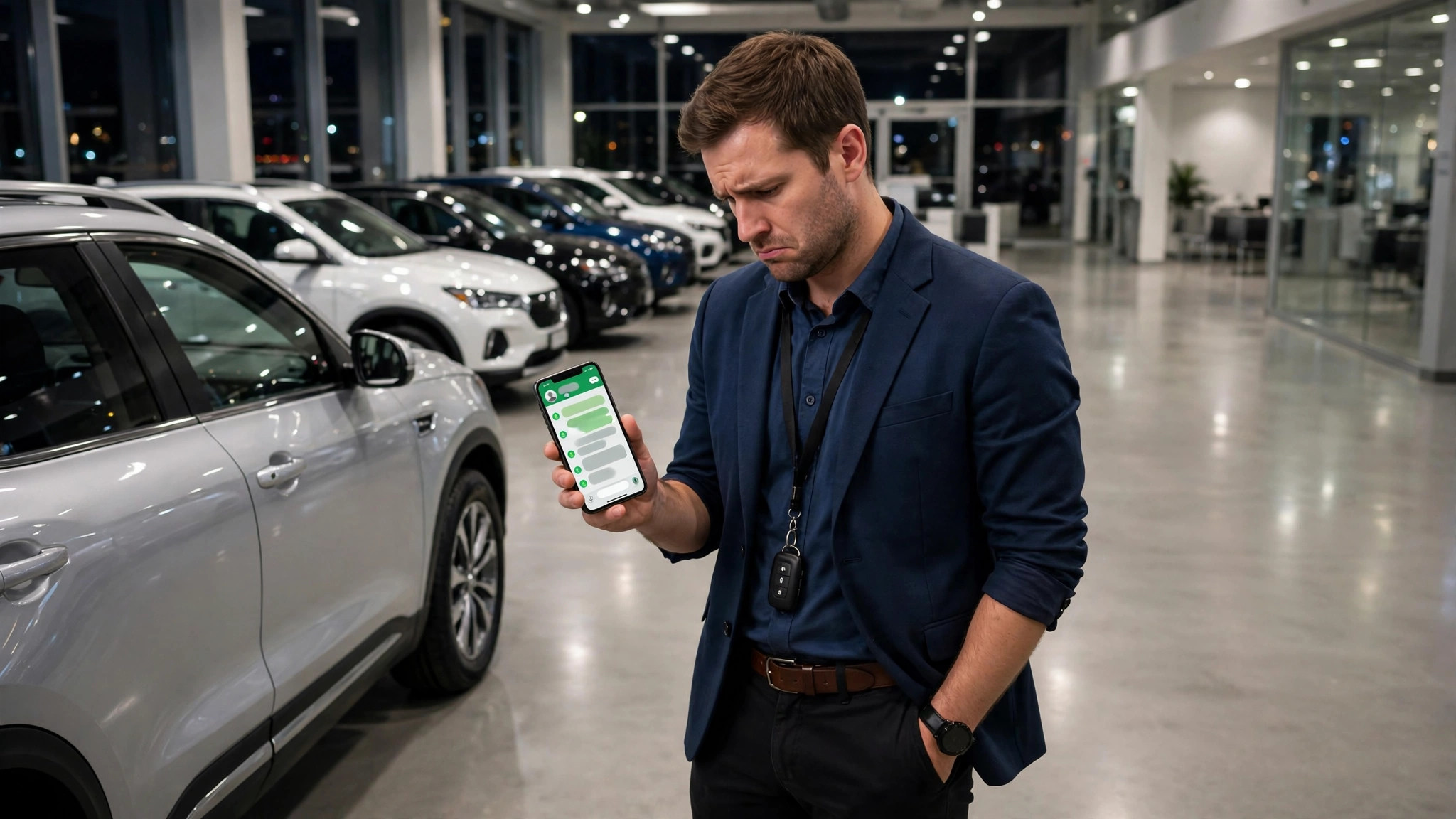
A buyer scrolls your listings at 9:40 in the evening, falls in love with a silver SUV, and messages your dealership on WhatsApp: 'Hi, is this still available?' He is ready to talk. If your answer arrives the next morning, he has already messaged two other dealers. WhatsApp automation for car dealerships closes exactly this gap — it replies in seconds, answers the availability question, and starts the test-drive conversation while interest is at its peak, even when your showroom floor is empty. Restaurants run the same instant-reply playbook for tables — see WhatsApp automation for restaurants for the dining version.
Why Car Buyers Prefer WhatsApp Over Phone Calls
For most buyers, WhatsApp is where they already live. They send voice notes, photos, and location pins all day. A phone call feels formal and interruptive; an email feels slow. WhatsApp sits in the sweet spot: conversational but not intrusive. Buyers happily send a photo of a small scratch and ask 'can this be fixed before delivery?' — something they would never put in an email. When your dealership meets them on WhatsApp, the enquiry feels easy, so more enquiries actually happen.
WhatsApp Automation for Car Dealerships Starts With the 'Is This Available?' Question
Nearly every enquiry begins with some version of 'is this still available?' plus a screenshot of a listing. This is the perfect first job for automation. The system checks your inventory, confirms the car is in stock, and replies instantly with the price, mileage, key specs, and a few recent photos. If the car has sold, it does not leave the buyer hanging — it suggests two similar vehicles from your current stock. That single instant reply turns a cold listing click into a live conversation, and it happens in under ten seconds, twenty-four hours a day.
The Test-Drive Booking Flow That Fills Your Calendar
Once the buyer is interested, the conversation moves to the one action that matters: the test drive. The flow asks which model they like, offers two or three time slots from your actual calendar, and confirms the booking with a reminder the day before. Along the way it asks a few qualifying questions — trade-in interest, financing or cash, preferred colour — so your salesperson walks into the test drive already knowing what matters to the buyer. Fewer no-shows, better-prepared salespeople, and a showroom that stays busy.
The Follow-Up Sequence Most Dealers Never Send
Here is the uncomfortable truth: most dealers send one message after a test drive and then go silent. Buyers rarely decide on the spot — they compare, think, and ask their families. A disciplined car dealer lead follow-up sequence does the quiet work that wins those buyers back. It does not nag; it stays helpful, timed around how car decisions actually happen. Test drive booking automation gets them in the seat; the follow-up sequence gets them to sign. Property agents use an identical viewing follow-up rhythm — our guide to AI chatbots for real estate agents shows the real-estate version.
- Day 1: thank the buyer for the test drive and ask one specific question about what they liked.
- Day 3: answer anything they asked on the day, and confirm the current price and any running offer.
- Day 7: send a short photo walkaround of the exact car they drove, and invite one more drive.
- Day 14: mention similar stock arriving soon and offer them first refusal.
- Day 30: check in once more with a fresh angle — a revised price, a new colour, or a trade-in valuation.
Service Reminders: The Revenue You Are Already Sitting On
Your biggest untapped revenue source is not new buyers — it is your past buyers. Automated WhatsApp messages can remind owners when a service is due, when insurance or registration renewal approaches, and when a seasonal check makes sense, like tyres before winter or air conditioning before summer. Each reminder carries a simple booking option. Because the message arrives on WhatsApp from the dealership they bought from, it feels like care, not marketing. One engaged owner returns to your service bay year after year — and buys their next car from you too.
Used-Car Inventory Moves Fast — Your Replies Must Move Faster
New cars are standard; used cars are each one of a kind. Your stock changes daily, prices shift, and the good cars sell in days. Buyers know this, which is why they message fast. Your automation should connect to your live inventory so every answer — availability, price, mileage, service history — reflects the car sitting on your lot right now, not last week's spreadsheet. It can also alert waitlisted buyers when a matching car arrives. When buyers sense your answers are current, they trust you, and trust is what closes used-car deals.
Mistakes That Get You Blocked Instead of Booked
Automation done badly is worse than no automation. The biggest mistake is sending promotional broadcasts to people who never opted in — one spam blast and your number gets reported and blocked. Always earn the opt-in inside a real conversation first. The second mistake is building a wall with no door: when the buyer says 'I want to negotiate the price', the chat must hand over to a human immediately. Negotiations are emotional and personal; a scripted bot will kill the deal. The third mistake is guessing at answers: a wrong spec or a wrong price destroys trust in seconds. When unsure, the system should say so and bring in a person. The National Automobile Dealers Association publishes dealer best practices — worth a skim so your automated messages match industry standards.
A Saturday Night Buyer, Message by Message
9:40pm, Saturday. Ahmed is on his sofa, scrolling your listings, and stops on a silver SUV. He taps the WhatsApp button: “Hi, is this still available?” Eight seconds later the answer arrives: yes, it is on the lot — here is the price, the mileage, the model year, plus three recent photos. Ahmed is still holding his phone, still interested, still yours to win.
“Can I see it tomorrow?” The system offers two real slots — 11am or 3pm — pulled from the actual calendar. He picks 11am. It asks two quick questions: cash or finance, and is there a trade-in. He says finance, no trade-in. Your salesperson's morning briefing now reads: Ahmed, silver SUV, 11am, finance buyer, first-time visitor. She walks in prepared instead of starting cold.
Sunday 11am, Ahmed drives the SUV. He likes it but wants to think — most buyers do. Monday morning he gets a thank-you message plus the answer to the warranty question he asked on the test drive. Wednesday: a short video walkaround of the exact car he drove. The following Monday: “A similar SUV in black just arrived — want first refusal before it goes online?”
Ahmed buys the silver one on day twelve. He never felt chased — every message answered something or offered something useful. And your salesperson never typed a single one of those messages. That is the difference between automation and spam: one helps the buyer decide, the other just makes noise.
What the Chatbot Must Never Do: Negotiation, Trade-In Values, and Promises
Some parts of car selling need a human being, full stop. Drawing the line clearly is what keeps automation trusted instead of resented — by buyers and by your own sales team.
It must never negotiate price. The moment a buyer says “what is your best price?” or “can you do better?”, a human takes over. Negotiation is emotional, personal, and full of reading between the lines. A scripted reply — even a clever one — will either give away margin or insult the buyer. The chatbot's only move is a smooth handover: “Let me connect you with our sales manager — he handles pricing directly.” Then it passes the full conversation along.
It must never value a trade-in sight unseen. It can collect the details — make, model, year, mileage, photos of any damage — and explain exactly how the appraisal works. But a number without seeing the car is a promise you cannot keep, and revising it downward later feels like a trick. Collect everything, promise nothing, and let your appraiser do the appraising.
And it must never promise what it cannot control: delivery dates, loan approvals, registration timelines. “Your car will be ready Friday” from a chatbot becomes your problem on Saturday morning. Teach it the safe sentence instead: “I'll confirm the exact date with the team and get back to you.” Buyers respect honesty about process far more than confident guesses that fall apart.
The Opt-In Rules That Keep You Out of Trouble
Want this for your car dealerships?
ReplyPilot builds a custom whatsapp automation setup for your car dealerships — answering customer questions instantly, taking orders and bookings, and handing off to you when a human is needed.
Ask on WhatsApp — it's freeWhatsApp is strict about one thing: you may only send marketing messages to people who said yes. Break this rule and your number gets reported, restricted, or banned — and a banned dealership number is a disaster that takes weeks to fix. The good news: doing it right is simple.
Earn the opt-in inside real conversations. After a test drive, the chatbot asks: “Shall I send you new arrivals like this SUV on WhatsApp?” After a service visit: “Want service reminders here?” A yes at that moment — recorded in the chat — is your permission. Never buy a list of numbers. Never add every enquiry to a broadcast list. The permission must be specific, recent, and easy to withdraw.
Understand the 24-hour window. When a buyer messages you, you can chat freely for 24 hours. After that, only pre-approved template messages go through — short, useful, non-promotional. This is why the follow-up sequence uses templates: “Hi Ahmed, the SUV you drove is still available — would you like another look this weekend?” Useful, personal, allowed. If you have not connected a number yet, our step-by-step WhatsApp Business API setup guide walks you through the whole process.
Keep every broadcast genuinely useful: new stock alerts for waitlisted buyers, service reminders, price drops on cars they asked about. The test is simple: would the buyer thank you for this message? If yes, send it. If it only serves you, do not. A dealership that messages well gets replies and sales. A dealership that spams gets blocked — and stays blocked.
The Questions Buyers Ask That Dealers Forget to Prepare
Dealers train their automation on price, specs, and availability — then buyers ask everything else. These are the questions that stall conversations when nobody prepared the answers.
- What documents do I need to buy? (ID, proof of address, and anything else — buyers hate discovering paperwork at the last step.)
- How does financing work here — do you arrange it, or do I bring my own loan?
- What is actually included in the warranty, and for how long? What voids it?
- For used cars: has it been in an accident? Can I see the service history?
- What are the registration and transfer costs on top of the price?
- When can I take delivery, and what happens between payment and handover?
- Do you deliver to my city, or do I collect from the showroom?
Each of these has a real answer sitting in your sales team's heads. Write them down once, in plain words, and the chatbot answers them at midnight as confidently as your best salesperson does at noon.
Pay special attention to the money-beyond-price questions — registration, transfer fees, insurance. Buyers budget for the sticker price and get nervous about the rest. A chatbot that explains the full cost honestly builds the trust that closes deals. One that dodges the question sends the buyer to a dealer who answers it.
How to Handle Negotiators, Tyre-Kickers, and Angry Service Customers
Not every conversation is a friendly buyer. Your automation meets three difficult characters regularly, and each one needs a different response.
The negotiator opens with discounts before saying hello. Do not fight and do not fold. The chatbot stays warm and factual — answers the car questions, books the test drive — and hands over the moment price comes up. Your salesperson then negotiates with full context: which car, what the buyer asked, how serious they seem. That is a far stronger position than walking in cold.
The tyre-kicker asks for seventeen photos, three videos, and the full history of a car they will never buy. The chatbot serves them patiently — it costs you nothing per message — but it should qualify as it goes: budget, timeline, decision date. When the answers stay vague after a dozen messages, it is fine for the chatbot to say: “Whenever you're ready to see it in person, here's how to book.” Polite, and it stops the endless thread without burning a bridge.
The angry service customer is different: their car has been in your workshop for four days and nobody called. This is handover territory, immediately, with the full conversation attached. The chatbot acknowledges — “I'm sorry, let me get the service manager to call you right now” — and alerts a human within minutes. An angry customer answered fast often stays a customer. An angry customer left to a bot does not.
How Do You Know It Is Paying for Itself?
A dealership runs on numbers, so measure the automation the same way. Six numbers, checked monthly, tell the whole story.
- Test drives booked per week — and how many came from after-hours messages.
- Test-drive show-up rate — reminders should keep this high; no-shows are the leak.
- First-response time — seconds, not hours. This is the number that wins the multi-dealer race.
- Follow-up conversion — buyers who went quiet, then came back and bought.
- Service bay bookings from reminders — the quiet revenue line most dealers ignore.
- Blocked or reported rate — if this rises, your messages are too pushy. Fix the tone, not the tool.
The number that matters most is the simplest: how many buyers who messaged after hours ended up in the showroom. Before automation, that number was near zero — those messages waited until morning, and morning was too late. After, it becomes a real pipeline you can watch grow week by week.
Review the conversations monthly, the same way you review your salespeople. You will find the questions the chatbot fumbled, the handover that came too late, the follow-up that worked beautifully. Fix one thing each month. In a year, the system will be unrecognisably sharper — and your competitors will still be replying “the next morning.”
Want this working in your dealership?
You do not need a bigger sales team to handle more enquiries — you need a faster, more disciplined front door. WhatsApp automation answers buyers instantly, books test drives while interest is hot, follows up with the patience most dealers lack, and keeps past buyers returning for service. If you want to see what this looks like inside your own dealership, with your own inventory and your own booking flow, book a free custom demo at https://replypilot-site.vercel.app/ and we will map it out for you.
Delivery Day: The Handover Flow That Earns Five-Star Reviews
The deal is signed, but the sale is not finished — delivery day decides how the customer remembers you. Buyers arrive nervous: paperwork, payment, insurance, and a long wait while the car is prepared. The chatbot takes the nerves out of it. The evening before, it sends one clear message: what time to arrive, what to bring — documents, payment, driving licence — and how long the handover takes. On the day, it answers the small questions — “where do I park”, “is my car ready yet” — so your team stays focused on the customer in front of them. That evening, one warm message: congratulations on the new car, here is how to reach us, and a service reminder is already scheduled.
The First Thirty Days After Delivery
- Registration and plate updates: the chatbot confirms when paperwork is ready for collection
- A gentle check-in at two weeks: “how is the car running?” — small problems get caught early
- First-service reminder timed to the mileage or date in the owner's manual
Two weeks after delivery is also the perfect moment for a review request — the new-car joy is still fresh and any small issues are already fixed. Customers who felt looked after in the first month come back for servicing, and they buy their next car from the dealer who treated the first one well.
Collecting Trade-In Details Without the Paperwork Chase
Trade-in appraisals stall for one boring reason: collecting the details takes forever. The buyer means to send photos, forgets, and the appraisal waits. The chatbot fixes this at the moment of interest. When a buyer mentions a trade-in, it asks for everything your appraiser needs — make, model, year, mileage, service history — plus photos of all four sides, the interior, and any damage. It explains exactly what happens next: your appraiser reviews the details and gives a firm figure when they visit. And the golden rule holds here too: the chatbot collects everything and guesses nothing. No invented values, no “probably around” figures that get revised downward later and feel like a trick.
Automotive businesses run on WhatsApp — WhatsApp automation for car washes turns messages into booked appointments around the clock.
Car businesses need bookings handled fast — an AI chatbot for car rental services quotes rates and confirms reservations around the clock.
Frequently Asked Questions
Can WhatsApp automation book test drives for my dealership?
Yes. A buyer messages "Can I test drive the SUV Saturday?", and the automation checks your schedule, books the slot, and sends a reminder. Test drives are where cars get sold — more booked drives means more sales.
How much does WhatsApp automation cost for a car dealership?
Typically a monthly fee based on conversation volume. A single extra sale per quarter covers the cost many times over. Dealerships with active online listings see the fastest return.
Can it follow up with buyers who went quiet after a quote?
Yes. When a buyer stops replying, the automation sends a polite follow-up a few days later — maybe with a new offer or just checking in. Most dealerships lose sales to slow follow-up; this fixes it.
Will the automation answer "Is this car still available?" instantly?
Yes — it checks your live inventory and answers in seconds. Buyers message five dealerships at once; the one that answers first usually gets the visit. Speed is everything in car sales.
Can WhatsApp automation handle part-exchange questions?
Yes. It asks for the buyer's current car details — make, model, year, mileage — and collects everything your appraiser needs. You get a complete part-exchange enquiry instead of a vague "do you take trade-ins?"