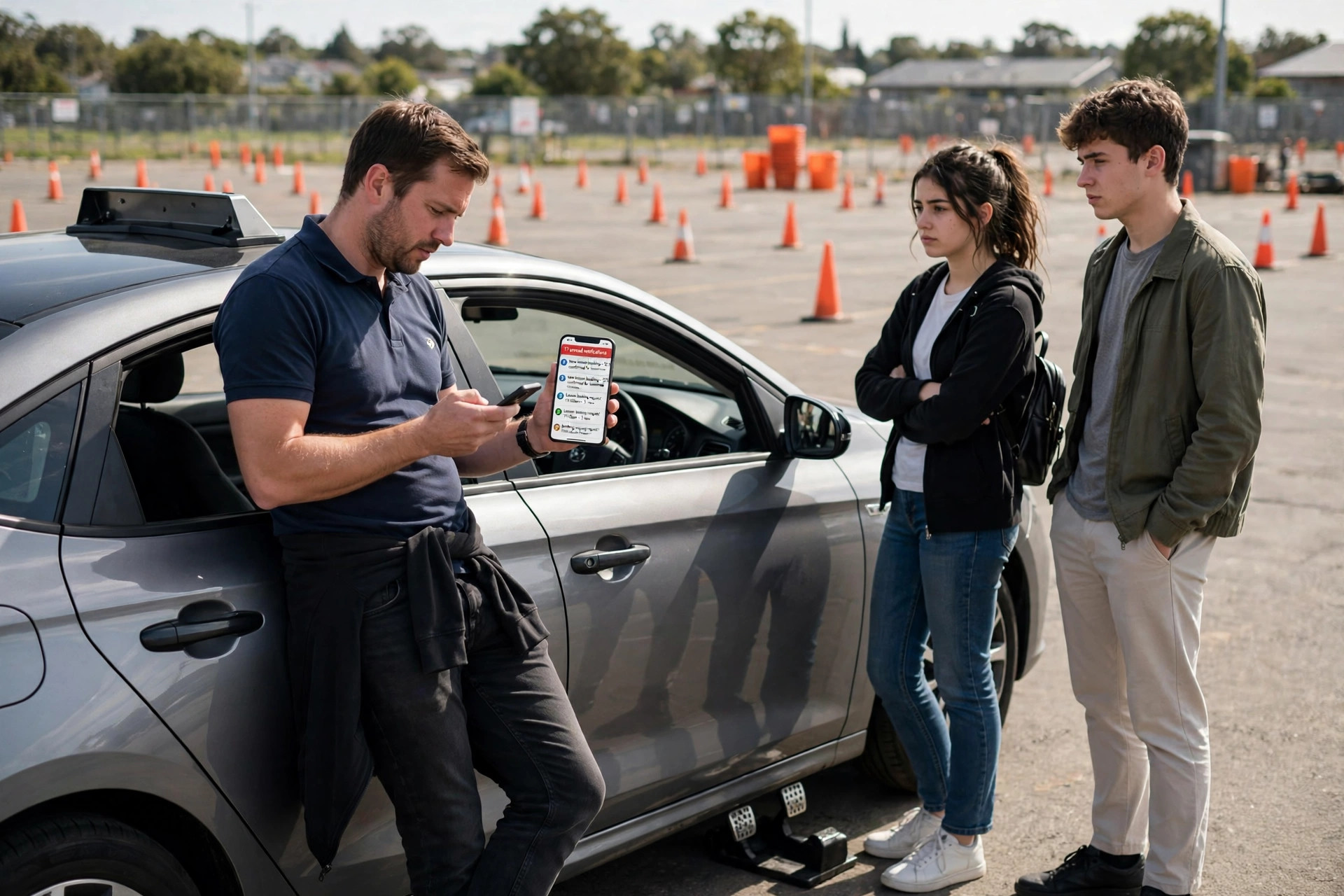
It is 6:45am. Your first lesson starts in fifteen minutes, and your phone is already buzzing. “Can I move Thursday to Friday?” “How much is the 10-lesson package?” “Do you pick up from my area?” You are standing in a parking lot trying to teach someone to parallel park while your business runs on text messages. An AI chatbot for driving schools means a chat assistant on your website or WhatsApp that books lessons, answers fee and package questions, and sends test-day reminders automatically. For driving schools, the best approach is a chatbot connected to your real lesson calendar, because it ends the late-night scheduling texts while your instructors spend their days teaching, not typing. Systems like ReplyPilot (AI automation for small-business messaging — WhatsApp, Instagram DM, website chat) are built for exactly this kind of booking-heavy small business. This article shows you how lesson booking works without the phone tag, what the chatbot should never promise, and how to get it running in your first month.
The 7am Lesson Shuffle
Every driving school owner lives this scene. You are between lessons — engine off, logbook out — and instead of breathing, you are thumbing through messages. Three reschedules, two price questions, one “my son needs lessons urgently, when can he start?”. By the time you have answered them all, your next student is climbing in and you have had no break at all. The admin never stops, because learners message at all hours: after school, after work, at midnight before their test.
Here is what that chaos really costs. Every scheduling text you answer between lessons steals focus from the student in your car — the one who paid for your full attention. Every price question you answer at 10pm is time you will never get back. And every slow reply is a learner messaging the next driving school on the list. The math is not subtle. In a business where instructors are the product, admin done by hand is the most expensive kind there is.
What an AI Chatbot Does for a Driving School
Keep it simple. A chatbot for your driving school is a chat window on your website — and usually on WhatsApp too — that talks to learners and parents the way your best receptionist would. It knows your lesson packages and prices, your pickup areas, your instructors' availability, and your test-day requirements. A learner types “I want to start lessons next week” and the chatbot walks them through packages, finds open slots, and books them in. A parent asks “do you do pickups from our neighborhood?” and gets an instant answer.
The chatbot books the lessons; your instructors teach them. That is the whole deal. It never gets flustered by five conversations at once, never forgets to confirm a booking, and never answers a price question wrong because it was tired. And when something needs a human — a nervous parent who wants reassurance, a special situation — it hands over gracefully with the full conversation attached.
- **Lesson booking:** real availability shown, slots booked and confirmed in the chat.
- **Fee and package FAQs:** prices, lesson counts, discounts — answered instantly and consistently.
- **Test-day reminders:** documents, arrival time, what to bring — sent automatically.
- **Rescheduling:** moves and cancellations handled per your policy, without bothering you.
- **Parent questions:** pickup areas, instructor info, progress updates — answered any hour.
How Does the Chatbot Book Lessons Without the Phone Tag?
Phone tag is the enemy. “Are you free Thursday?” “Which Thursday?” “Morning or afternoon?” — four messages to book one lesson, stretched over a day because neither side replies instantly. The chatbot collapses all of it into one conversation. It shows your actual open slots, the learner taps one, and the booking is confirmed on the spot — with a calendar entry, a confirmation message, and a reminder the day before. No back-and-forth, no “let me check and get back to you”.
The key word is actual. A chatbot working from a stale or guessed schedule is worse than useless — double bookings destroy trust fast. Connect it to the real calendar your instructors live by, whether that is a booking tool or a shared calendar you keep updated. When the schedule is honest, the bookings are too. Learners get the instant gratification they expect from every other service in their lives, and you get a full diary without lifting your phone.
Fee and Package Questions, Answered Once and For All
“How much for ten lessons?” You have typed that answer a thousand times. It is always the same answer, and it always arrives at the worst moment — between lessons, during dinner, at 11pm. A chatbot answers it in three seconds with your exact current pricing, package breakdowns, and any offers you are running. Every learner gets the same correct answer, which means no more “but you told my friend a different price” misunderstandings.
There is a sales angle here too. The chatbot does not just quote prices — it guides. “The 10-lesson package saves you money over singles, and most learners in your situation need around that many” is the kind of helpful nudge a good receptionist makes, and the chatbot makes it every time, consistently. Price shoppers who get instant, clear answers convert far better than ones left waiting. Speed is a sales tool, and consistency builds the trust that closes the booking.
Test-Day Reminders: The Documents Learners Always Forget
Every instructor has a test-day horror story. The learner who forgot their theory pass certificate. The one who arrived without proper ID. The one who did not know where the test center was. A failed test because of forgotten paperwork is heartbreaking — for the learner, and for your pass-rate reputation. Most of these disasters are preventable with a well-timed message.
The chatbot sends a test-day checklist automatically: three days before, the full list — documents, arrival time, test center address, what to wear, when to stop practicing. The evening before, a short reminder. The morning of, a good-luck message with the meeting point. Learners arrive prepared, tests go ahead, and your pass rate reflects teaching quality instead of admin failures. Small messages, big outcomes — and one less horror story for the staff room.
Cancellations get the same no-drama treatment. Late cancellations are the silent profit-killer of driving schools: a learner cancels at 9pm for an 8am lesson, the slot sits empty, and you eat the loss. The chatbot checks your 24-hour policy against the timing — inside the window it explains the charge politely and consistently, same words every time, no argument; outside it, the slot is freed instantly and offered to your waitlist. Learners respect a clear system far more than a human they can haggle with, and your diary stops leaking money.
What Do Nervous Parents Ask? (More Than You Think)
Here is an audience most driving schools under-serve: the parents paying for the lessons. They have their own questions, and they ask them like concerned customers, not like teenagers. Which instructor will teach my daughter? Are your cars dual-controlled? Do you do pickups from school? How will I know she is progressing? These questions deserve thoughtful answers, and they usually arrive while you are mid-lesson.
The chatbot answers the factual ones instantly — safety features, pickup areas, instructor profiles, how progress updates work — and flags the emotional ones for you. A parent who wants reassurance about their nervous 17-year-old gets a human callback, not a bot. That combination is powerful: instant answers for the facts, genuine warmth for the feelings. Parents who feel informed become your best referrers, telling every other parent at the school gate.
After-Hours Enquiries From Anxious Beginners
Think about when people decide to learn to drive. It is rarely 2pm on a Tuesday. It is Sunday evening, scrolling on the sofa, imagining freedom. It is the night before a birthday, deciding this is the year. These are emotional, high-intent moments — and right now they land on your voicemail or an unanswered DM. By morning the excitement has cooled, or a competitor has replied.
The chatbot catches them at peak motivation. It answers the beginner questions — “I have never driven, where do I start?”, “how many lessons will I need?”, “can I learn in an automatic?” — and books the first lesson on the spot. That Sunday-night browser becomes a Monday-morning booking without you touching your phone. Enthusiasm is perishable; answer it while it is fresh.
Want this for your driving schools?
ReplyPilot builds a custom ai chatbot setup for your driving schools — answering customer questions instantly, taking orders and bookings, and handing off to you when a human is needed.
Ask on WhatsApp — it's freeThere is a compounding effect most owners miss. Every after-hours conversation the chatbot handles is also a data point: which packages get asked about most, what objections come up, what times people want to book. After a month you will know your market better than ever — which offers to promote, which pages of your website need clearer pricing. The chatbot is a booking tool and a market-research tool wearing the same friendly face.
Chatbot vs. Manual Scheduling: An Honest Comparison
Let us put the two side by side, because the difference is bigger than most owners expect: | Task | AI chatbot | Manual (you, between lessons) | | New booking | Instant, any hour | When you get a free moment | | Reschedule request | Handled per your policy | 4-message negotiation | | Price questions | Same correct answer, always | Depends on your mood and memory | | Day-before reminders | Automatic, every time | When you remember | | 5 learners messaging at once | No problem | Impossible | | Nervous parent needing reassurance | Hands off to you | You — distracted mid-lesson | The last row is the point. Automation does not remove you from the human moments — it protects your availability for them. The chatbot absorbs the volume so you can be fully present for the conversations that actually need a person.
What Should the Chatbot Never Promise?
Honesty time, because driving schools live on reputation. A chatbot must never promise a pass — no “you will pass in ten lessons”, no guaranteed timelines, no implied promises about test outcomes. Every learner is different, and your credibility depends on honest expectations. It must never quote prices you have not approved, never confirm an instructor who is not available, and never give driving advice — it is a booking assistant, not a driving instructor.
The rule: the chatbot handles logistics, humans handle judgment. Scheduling, pricing, reminders, policies — logistics. Assessing readiness, calming nerves, deciding a learner needs more practice before their test — judgment. Schools that respect this line get efficiency without risk. Schools that let a bot make promises get angry reviews with the screenshots to prove it.
Should It Live on WhatsApp, Instagram, or Your Website?
Your learners are young, so meet them where they are. WhatsApp is the workhorse — bookings, reminders, reschedules all happen there, and parents use it too. Your website chat catches the comparison shoppers reading your packages page at midnight. And do not ignore Instagram DMs: teenage learners discover driving schools on Instagram, and a chatbot that answers DMs instantly turns followers into bookings. The driving-school equivalent already works for other lesson businesses — the pattern is proven.
Start with the channel where most enquiries already arrive — for most schools that is WhatsApp — then add the website chat, then Instagram. One caution worth noting: WhatsApp Business changed its pricing in October 2026, so keep your proactive messages useful and welcome rather than frequent. Reminders and confirmations earn their place; broadcast spam does not.
Mistakes That Stall Your Booking Pipeline
A bad booking chatbot leaks learners at every step. The classic mistakes: **showing fake availability** — nothing kills trust like a confirmed booking for a slot that does not exist. **Asking too many questions upfront** — every extra field loses learners; name, contact, and preferred times are enough to start. **No human escape** — a frustrated learner with a weird situation needs a person, fast. **Forgetting the parents** — if all your answers assume a teenager is reading, you are ignoring the person with the credit card. **Sounding like a call center** — your chatbot should sound like your school: friendly, patient, encouraging.
Test the booking flow yourself, on your phone, as if you were a nervous 17-year-old. If anything confuses you for even a second, it will lose real learners. Booking should feel easier than texting a friend — because texting a friend is the competition.
How Do You Know Your Driving-School Bot Is Working?
Watch the numbers that pay your bills. Booking conversion rate — what share of enquiries become booked lessons — should climb as response times drop to seconds. No-show rate should fall once day-before reminders go out automatically. Late-cancellation losses should shrink as your policy gets enforced consistently. And ask your instructors the human question: are you spending lesson gaps actually resting, or still thumbing through messages?
Ignore message volume as a success metric. A chatbot that sends a thousand messages and books ten lessons is failing; one that sends a hundred and books forty is winning. The American Driver & Traffic Safety Education Association (adtsea.org) sets the professional standard for instruction quality — your chatbot's job is to make sure admin never gets in the way of that standard. Lesson businesses with similar booking patterns, like language schools, measure exactly the same way.
A Real Booking Conversation, Start to Finish
Abstractions do not book lessons — conversations do. Here is what a good one actually looks like. Tuesday, 9:12pm. Learner: “hi do you do lessons near the station?” Bot: “We do — pickup near the station is standard. Are you a complete beginner?” Learner: “yeah never driven.” Bot: “Most beginners start with the 10-lesson package — here is the price and what is included. Want to see next week's openings?” It shows three slots. The learner taps Thursday 4pm. Bot: “Booked — Thursday 4pm, pickup from your home address? Just reply with it.” Confirmation sent, diary updated, reminder scheduled. Human time involved: zero.
Now the part content-farm articles never explain: the handoff logic. The bot handles the routine and pings you only for the exceptions — an intensive-course enquiry with a tight deadline, a parent wanting to discuss a nervous child, a booking request for a slot that filled seconds ago. Each handoff arrives with the full conversation attached — you never open with “who is this?”. Operators care about this exact moment: who gets pinged, when, with what context. Get the handoff right and the system feels like a brilliant receptionist, not a robot.
Intensive courses deserve the same treatment turned up a notch. These one- or two-week crash programs are high-value bookings with urgent buyers — “I need to pass in three weeks for a job, is it possible?” The chatbot qualifies instantly: timeline, experience level, license status, availability — then books a consultation call or hands the hot lead straight to you. The honesty rule matters double here: the bot presents the facts, the realistic daily schedule, and the honest caveats about test waiting times, and you close the human part. Tutoring businesses run the same high-trust enrolment playbook with chat automation for course sign-ups.
Putting It Together for Your Driving School: The First 30 Days
You can go from chaos to calm in a month. Here is the rollout that works: **Week 1 — List and price:** write down your packages, prices, pickup areas, and the twenty questions you answer most. This is the chatbot's brain, and the quality of everything downstream depends on how honestly you do this step. **Week 2 — Connect the calendar:** link your real lesson schedule and build the booking flow; test-book every scenario yourself. **Week 3 — Write the policies:** cancellation rules, test-day checklists, reminder timing — encode them once, enforce them forever. **Week 4 — Go live on WhatsApp:** launch quietly, watch real conversations daily, fix fumbles fast, then add website chat and Instagram DMs.
Most schools feel the difference in the first fortnight: a diary that fills itself, price questions answered while you teach, and lesson gaps that are actually gaps. If you want it built right — real calendar connection, honest policies, human handoffs where they matter — ReplyPilot sets up exactly this kind of booking automation for lesson businesses. Request a free custom demo at https://replypilot-site.vercel.app/ and see your own schedule running itself.
Turning Past Learners Into Referrals
Your cheapest marketing is a learner who just passed. They are thrilled, their friends are all learning age, and their parents know other parents. But most schools never follow up — the relationship ends at the test center car park. A chatbot fixes that with two timed messages: a congratulations the day after the pass, and a week later, a gentle ask for a review and a referral offer.
Keep it warm, not mercenary. “So proud of you — if any friends are starting lessons, we'd love to look after them” beats any discount bribe. And the review ask matters enormously: a steady stream of fresh five-star reviews is what makes the next anxious parent choose you over the cheaper school down the road. Past learners are a marketing channel you already paid for — the chatbot just switches it on.
Frequently Asked Questions
How does a driving school chatbot handle lesson bookings?
It connects to your real lesson calendar, shows learners your actual open slots, and confirms the booking in the chat with a calendar entry and reminder. Reschedules follow your cancellation policy automatically. The key requirement is an honest, up-to-date calendar — the chatbot is only as reliable as the schedule it reads.
Can it answer questions from parents too?
Yes. It answers factual parent questions instantly — instructor info, safety features, pickup areas, pricing — and flags emotional ones for a human callback. Since parents usually pay for the lessons, serving them well directly improves your conversion rate.
What if a learner wants to cancel last minute?
The chatbot checks your cancellation policy against the timing. Inside your cutoff window it explains the charge politely and consistently; outside it, the slot is freed immediately and can go to your waitlist. No awkward haggling, no inconsistent enforcement.
Will it work on Instagram where young learners find us?
Yes — Instagram DM automation answers enquiries from your profile instantly, which matters because teenage learners discover schools there. The same booking flow works across Instagram, WhatsApp, and your website, so no enquiry falls through the cracks.
Can the chatbot guarantee a learner will pass?
No, and it must never try. Promising passes or timelines destroys your credibility the first time reality disagrees. The chatbot handles logistics — booking, pricing, reminders — while instructors handle assessment and readiness. That boundary protects your reputation.