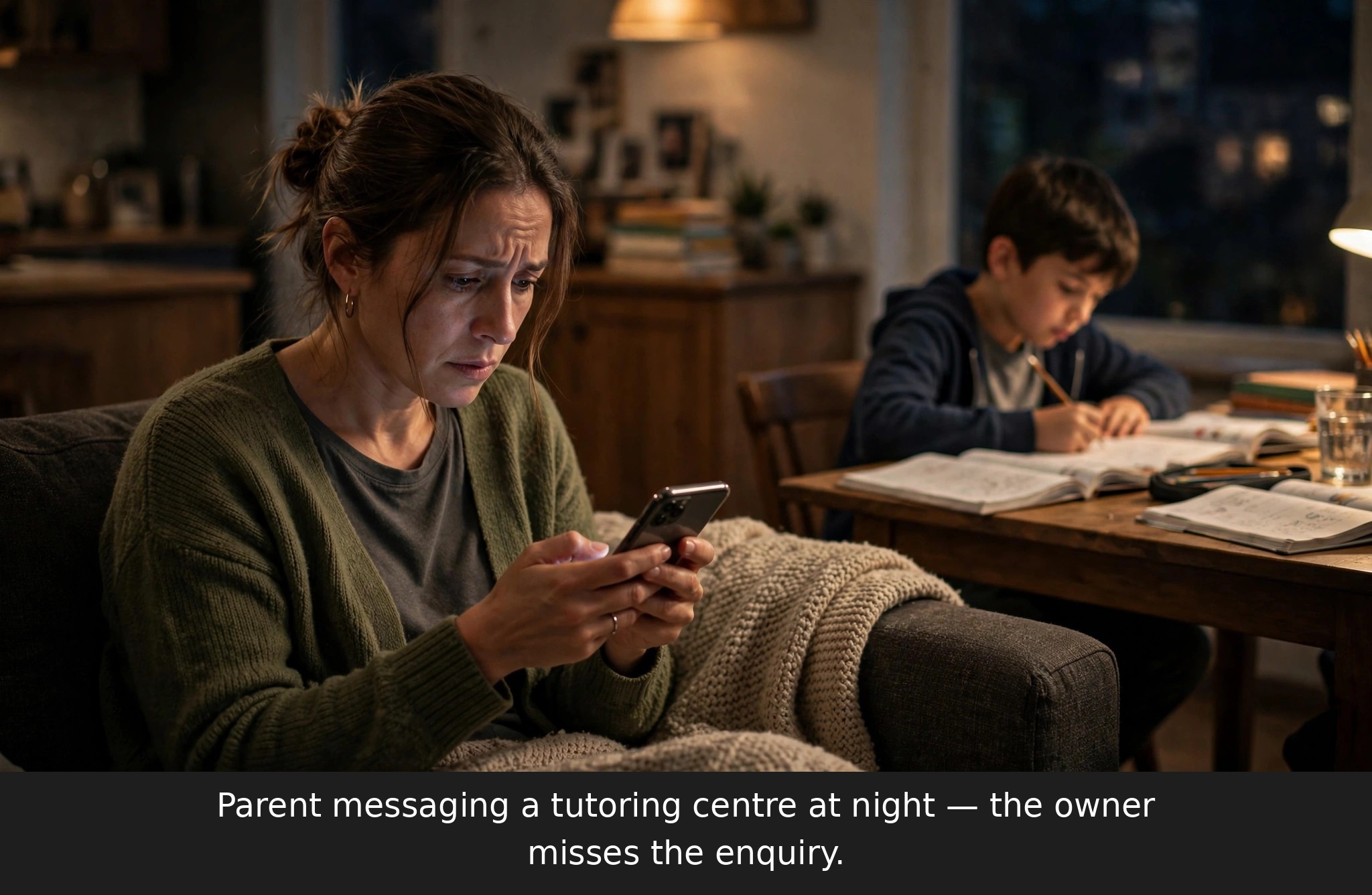
It's 9:15pm. A parent is sitting on the sofa, phone in hand, finally free after dinner. Their daughter is struggling with maths, exams are two months away, and tonight is the night they sort out a tutor. They message three tutoring centres — yours is one of them. The question is simple: who answers first? An AI chatbot for tutoring businesses answers that message in seconds. It explains your subjects, fees and timings, offers a trial class, and books it into your diary — while you are in the middle of teaching an evening class yourself.
The 9pm Enquiry Problem
Most parents research tutoring centres in the evening, after work and dinner. That is exactly when tutoring centre owners are teaching their busiest classes. Your busiest enquiry hours and your busiest teaching hours are the same hours. So the messages pile up unread, and by the time you reply the next morning, the parent has already booked a trial class with the centre that answered at 9:16pm. A parent who messages three centres usually books with the first one that gives a clear, complete answer. Being second is almost the same as never being seen.
What an AI Chatbot for Tutoring Businesses Actually Does
- Answers parents' questions instantly, day or night — which subjects you teach, your fees, class timings, batch sizes, and your location.
- Books trial classes straight into your calendar, with a confirmation message and a reminder the day before.
- Collects the details you need before the trial — the child's class level, school, weak subjects, and the parent's phone number.
- Follows up politely with parents who asked questions but never booked, so warm enquiries don't go cold.
- Hands over to you with full context whenever a parent asks something unusual, so you never walk into a conversation blind.
Parents Ask the Same Five Questions — Let the Chatbot Answer Them
Every tutoring centre owner knows the list by heart: which subjects do you teach, what are the fees, what are the timings, where are you located, and do you offer a trial class? Parents ask these in WhatsApp messages, on your website chat, and in Facebook comments. Answering them one by one eats your evenings. A chatbot trained on your real answers handles all of them in your own voice, the same way you would. You write the answers once, in plain words, and every parent gets them instantly — at midnight, on a Sunday, during your busiest class. It works the same way AI chatbots for dental clinics handle appointment questions: the business owner stops repeating themselves.
Book Trial Classes Straight Into Your Diary
A trial class is where enrolments are won. The chatbot doesn't just say 'come for a trial' — it offers your real, current trial slots, lets the parent pick one, confirms it, and sends a reminder the day before so they actually show up. No more 'call us to book' dead ends, no more playing phone tag across three days while the parent's interest cools. The parent's details — child's name, class, subjects, phone number — land in your list automatically, ready for you to review in the morning. Pair this with solid lead capture automation and every website visitor becomes a named enquiry instead of an anonymous bounce.
Follow Up With the Parents Who Went Quiet
Some parents ask about fees and timings, then disappear. They are not lost — they are busy, distracted, or comparing options. A short, friendly follow-up two days later ('Still looking for a maths tutor for Class 8? We have trial slots this Saturday') brings a surprising number of them back. Doing this by hand for every enquiry is impossible. A chatbot does it automatically, politely, and only once or twice — never pushy. Fitness studios use the exact same follow-up rhythm for trial members, as shown in AI chatbots for gyms and fitness studios. The pattern works anywhere parents or members need a gentle nudge.
This Is Not a Homework Bot — It Works for YOUR Business
Here is something worth knowing: if you search for AI and tutoring online, most of what you find is 'AI tutors for students' — homework-help bots that answer a child's questions. Almost nobody writes about AI for the tutoring business owner: the person who needs enquiries answered, trials booked, and fees explained. That is exactly what this chatbot is. It doesn't teach children. It runs your front desk — the part of your business that currently collapses every evening at 7pm when your classes start. Owning this side of the conversation is what turns a quiet website into a steady stream of trial bookings.
Make It Sound Like Your Centre, Not a Robot
Parents choose a tutoring centre they trust with their child. A stiff, corporate chatbot breaks that trust in one message. Train yours on your real voice: warm, clear, the way you talk to parents at the front desk. Use your actual fee structure, your real trial policy, your genuine answers — including honest limits like 'we don't teach Class 12 physics' if that's true. Honesty books trials; vague promises waste everyone's time. Review the chat transcripts once a month and you'll spot the questions parents keep asking — add better answers, and the chatbot (and your website) keeps getting sharper.
A Parent's Evening, Before and After the Chatbot
Meet Sana. It is 8:50pm, dinner is done, and her son's maths test is in three weeks. She messages three tutoring centres. Centre one replies at 9:02pm: a friendly chatbot answers her questions about Class 8 maths timings and fees, offers two trial slots, and books Saturday 10am. Centre two replies at 10:40pm — the owner, between classes, typing fast with one eye on the clock. Centre three replies at 9am the next day.
Guess where Sana's son goes for his trial. It is not about teaching quality — she has no way to judge that yet. It is about who made it easy. The centre that answered first looked organised and welcoming. The one that replied at 9am looked too busy for her son. Parents do not say this out loud, but they feel it: slow replies feel like a slow centre.
Now the after. Saturday morning, the chatbot reminds Sana of the trial: time, address, what to bring. Her son attends. The teacher is excellent — because that is the part the owner controls, and nobody does it better. After the trial, a message asks how it went and offers the enrolment link. Sana pays the first month's fee from her phone while the experience is still fresh.
None of this required the owner to touch her phone on a teaching evening. She taught her classes, checked the bookings in the morning, and walked into Saturday with a new student already half-enrolled. That is the whole story: the chatbot handles the evenings, the teacher handles the teaching, and neither gets in the other's way.
What Should the Chatbot Never Decide on Its Own?
Your chatbot runs the front desk — but a front desk does not set policy. Some decisions belong to you alone, and the chatbot must know exactly where to step aside.
It must never promise results. “Will my son's grades improve?” is the question every parent asks, and the chatbot's answer must be honest: “Our students work hard and our teachers support them fully, but grades depend on the student too. Let me book you a trial so you can judge the teaching yourself.” A chatbot that guarantees marks is writing cheques your teachers have to cash — and parents remember every promise.
It must never change fees or offer discounts. Not for a sad story, not for a parent enrolling three children, not at 11pm when nobody is watching. Special deals are your call, made in daylight with the full picture. The chatbot quotes the standard fee table and offers to have you call back about anything unusual. One midnight discount becomes the price every parent expects.
And it must never handle complaints about teaching. If a parent says the teacher is too strict or the batch is moving too fast, the chatbot should not defend, explain, or promise changes. It should say: “I'm sorry to hear that — let me make sure the right person calls you tomorrow.” Then it sends you the full conversation. Complaints handled personally become loyalty. Complaints handled by a bot become bad reviews.
Feeding It Your Real Details, Step by Step
A chatbot trained on vague information gives vague answers, and vague answers do not book trials. The setup takes one focused afternoon. Here is the order that works best.
First, the subjects and levels: every subject, every class or grade, and which teacher handles which batch. Be specific about what you do not teach — “we don't offer Class 12 physics” said upfront saves everyone a wasted trial and a disappointed parent.
Want this for your tutoring businesses?
ReplyPilot builds a custom ai chatbot setup for your tutoring businesses — answering customer questions instantly, taking orders and bookings, and handing off to you when a human is needed.
Ask on WhatsApp — it's freeSecond, the fee table: monthly fees per subject, admission fee if any, sibling discounts, and how payment works. Write it exactly as you tell parents at the desk — same words, same warmth. The chatbot should quote fees the way you do, because parents can tell when the numbers sound borrowed.
Third, the trial policy: is the trial free, how long does it run, how many trial classes, and what happens after the trial ends. Fourth, the practical details: address, parking, batch timings, batch sizes, and your phone number for anything urgent. Load these four blocks, then test every question you can think of. If the chatbot answers like your best front-desk person on a good day, you are ready to launch.
The Mistakes Tutoring Owners Make in the First Month
The first month decides whether parents trust the chatbot or quietly route around it. Four mistakes cause most of the trouble, and all four are easy to avoid once you know them.
- Sounding like a school circular. “Dear Parent, kindly note...” — parents message like humans; the chatbot should reply like one. Train it on your real WhatsApp voice, not office language.
- Forgetting exam-season changes. Timings shift, crash courses appear, batches fill up. If the chatbot quotes September's timetable in February, parents show up confused and unimpressed.
- No trial slots loaded. A chatbot that answers questions but says “call us to book a trial” has done half the job. Connect the calendar from day one.
- Letting it answer homework questions. It is a front desk, not a tutor. A child asking for maths help should get: “I help with admissions — let me connect you with a teacher.”
The fifth mistake is subtler: never reading the transcripts. In month one, parents will ask things you never expected — “do you teach the Federal board syllabus?” “is there a girls-only batch?” Each unexpected question is a free improvement. Add the answer, and the chatbot gets smarter every single week.
Get month one right and something nice happens: parents start recommending you with a new line. Not just “the teaching is good” but “they reply instantly, even at night.” In a business built entirely on parent trust, that sentence is worth more than any advertisement you could buy.
What Should the Chatbot Do When a Parent Is Upset?
Sooner or later a parent messages angry: the fee reminder felt rude, the batch timing changed without warning, their child is unhappy. An upset parent and a clumsy bot is a combination that ends in a public review. Handle it right and the opposite happens.
The chatbot's first move is always the same: acknowledge, do not argue. “I'm really sorry — that sounds frustrating. Let me make sure the owner sees this first thing in the morning.” No explanations, no policy quotes, no “but”. An angry person needs to feel heard before they can hear anything else, and a bot that argues is fuel on a fire.
Then it collects the facts calmly: the child's name, the batch, what happened. It promises a callback with a real time — “before 11am tomorrow” — and it keeps that promise by alerting you immediately. Vague promises (“someone will contact you soon”) make anger worse. Specific ones calm it, because they prove someone is taking charge.
What it must never do: defend the teacher, quote the fee policy mid-argument, or offer compensation on the spot. Those are your decisions, made with the full story in front of you. The chatbot's only job in a complaint is to catch it fast, record it fully, and land it on your desk. Done well, the parent who complained becomes the parent who tells friends “they sorted it out personally the next morning.”
How Do You Know Trial Bookings Are Actually Growing?
Feelings lie; numbers do not. Five numbers tell you whether the chatbot is earning its place in your centre.
- Trial bookings per week — the headline number. Compare it with the weeks before the chatbot.
- Trial show-up rate — reminders should push this up. If trials book but nobody comes, fix the reminder, not the chatbot.
- Enquiry-to-trial rate — of every parent who asks a question, how many book? This is your real conversion number.
- Response time — seconds at 10pm is the whole point. If replies slow down, something is wrong.
- Unanswered questions — the list of things the chatbot could not handle. Each one is homework for you.
Read a few transcripts every month. You will hear your own business in parents' words: the worries they keep, the comparisons they make, the exact moment they decide. That is market research no survey can buy, and it arrives free with every conversation.
One warning: do not judge in week two. The first month is training — you are filling the gaps the transcripts reveal. By month three the numbers settle, and you will see the real picture: evenings free, trials booked while you teach, and a steady line of parents who chose the centre that answered first.
Want this working for your tutoring business?
You opened a tutoring centre to teach, not to answer the same five questions every night at 11pm. An AI chatbot for tutoring businesses handles the repetitive front-desk work — instant answers, trial bookings, polite follow-ups — so your evenings go back to teaching and the parents who are ready to enrol. If you want to see what this looks like with your subjects, your fees and your voice, request a free custom demo at https://replypilot-site.vercel.app/ and ReplyPilot will build you a working preview tailored to your tutoring business.
Exam Season: When Every Parent Messages at Once
Two months before board exams, your inbox becomes a second full-time job. Every parent wants the same three things: a crash batch, extra classes, and reassurance. The bot absorbs the surge so your teaching evenings survive it.
It answers the exam-season questions from a page you write once: which crash batches are running, the timings, the fee, what each batch covers. It books trial seats into the batches that still have space — and when a batch is full, it says so honestly and offers the next one, instead of letting forty parents believe a seat exists.
The reassurance part matters more than owners expect. A parent messaging at 11pm — “my daughter is weak in physics, is it too late?” — gets a calm, honest answer: “It is not too late. Our crash batch covers exactly these chapters. Shall I book her a trial this Saturday?” Nobody panics alone at midnight on your watch. That is what parents remember when they choose between you and the centre down the road.
Siblings, Discounts and the Fee Conversation
Enrol one child and the next question is almost always: “What about a discount for the second one?” The bot handles this from your written fee policy — the sibling discount if you offer one, stated the same way to every family, with no exceptions invented at midnight. Consistency here protects you: the day one parent learns another paid less, your reputation takes the hit.
It also handles the awkward middle of fee conversations: what the fee includes, when it is due, what happens if a month is missed. Answered once in writing, clearly and kindly, these stop being repeated negotiations and start being simply your policy. Parents respect clear rules far more than flexible ones — flexibility reads as favouritism, and favouritism spreads fast in parent chat groups.
Batch Full? The Waiting List That Keeps Parents Close
A full batch is good news wearing bad clothes — it means demand, but every turned-away parent is a lost enrolment walking to your competitor. The bot turns the no into a later yes.
When the batch is full it says so warmly, then offers two things: a place on the waiting list, and the next batch’s start date with a one-tap booking. Parents who join the waiting list get messaged first when a seat opens — in order, no favourites. A good share of them convert, because they already chose you; they just needed a seat. The parents you would have lost become the enrolments that fill next month’s batch before it even starts.
Education businesses share the same enrolment enquiry flood — an AI chatbot for language schools answers course, schedule and pricing questions instantly.
Frequently Asked Questions
Can an AI chatbot answer parents' questions about my tutoring centre at night?
Yes. Parents usually research after dinner — subjects, fees, timings, teacher qualifications. The chatbot answers all of it instantly from your FAQ. By morning, the parent is ready to book instead of still shopping around.
How much does a chatbot cost for a small tutoring business?
Pricing is normally a small monthly fee based on conversation volume. One extra enrolled student typically covers several months. Ask providers about education discounts — some offer them.
Can the chatbot book trial classes for my tutoring centre?
Yes. It checks your trial slots, books the parent in, and sends a confirmation with what to bring. It also sends a reminder the day before, which cuts trial no-shows. Trials that show up convert far better.
Will the chatbot work for multiple subjects and grade levels?
Yes. You load your subjects, grades, and schedules once. The chatbot matches the parent's needs — "Grade 8 maths, weekends" — to the right class. It never mixes up timings the way a tired receptionist might.
Can the tutoring chatbot follow up with parents who asked but did not enrol?
Yes. It sends a polite follow-up a few days later with a helpful nudge — a free study tip or a trial reminder. Most tutoring centres lose enquiries to slow follow-up; this fixes it automatically.