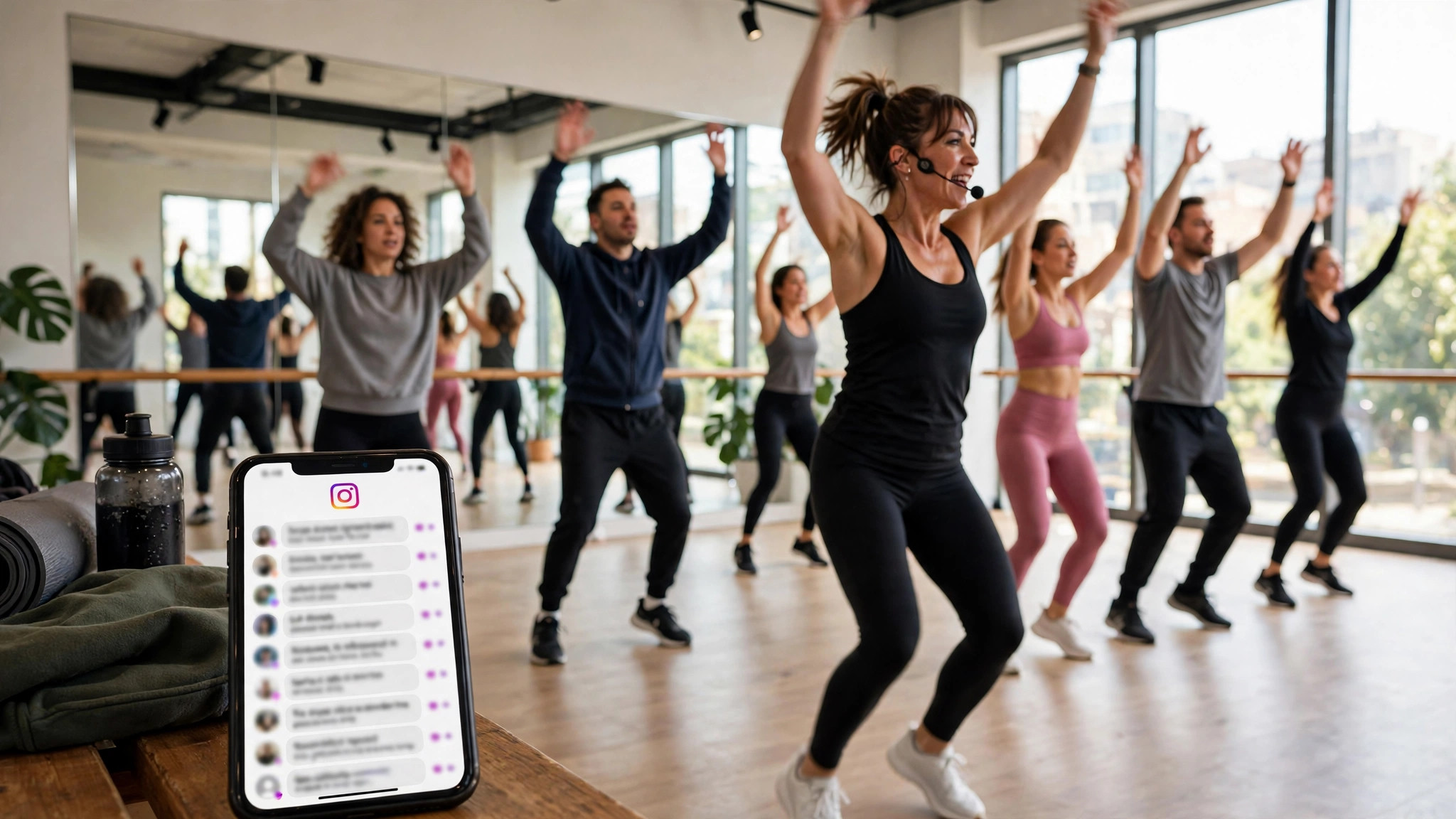
It is 6pm on a Tuesday and your intermediate hip-hop batch is in full swing. Music up, mirrors fogging, twenty students counting beats - and your phone is buzzing on the bench by the door. A mother asks whether you have weekend batches for her seven-year-old. A college student wants to know if beginners are allowed in the Thursday batch. Someone asks for the fee structure, someone else wants a trial class tomorrow, and a parent who enrolled last month asks when the annual show rehearsals start. You cannot stop the music to type. By the time class ends and you towel off, the mother has found another studio that answered in ten minutes. This is the daily arithmetic of running a dance studio: your inquiries arrive as DMs, and they arrive while you are physically unable to answer them.
Instagram DM automation for dance studios closes that gap. It answers the schedule questions, books the trial class for the right age group and level, follows up with the parent who went quiet, and tells existing students about the new batch starting next month - all while you are teaching. This guide walks through what it actually handles, the trial-class flow that fills batches, and how to set it up so it sounds like your studio's front desk at its friendliest.
Why Dance Studios Live and Die by the Trial Class
Almost nobody joins a dance studio sight unseen. The entire business runs on the trial class: one low-pressure session where a curious person discovers they love it, the instructor learns their level, and the sale practically makes itself. Which means the most valuable message your studio ever receives is some version of "can I come for a trial?" And that message has a brutally short window. The person asking is excited right now - they just watched your reel, the music is still in their head. Every hour of silence cools that excitement. Studios that answer trial inquiries within minutes fill batches. Studios that answer the next day fill them with whoever is left.
The trial question is also more complicated than it looks. A dance studio is not selling one product; it is selling a timetable. The right trial depends on the person's age, their level, the style they want, and which batches still have space. A twelve-year-old beginner does not belong in the adult advanced batch. A working professional cannot make the 4pm kids' slot. Getting this wrong wastes everyone's evening - the trial student feels lost, the regulars feel disrupted, and the instructor spends the class managing one confused newcomer instead of teaching. Instagram DM automation for dance studios earns its place by asking the three sorting questions - age, level, style - before the trial is ever booked.
What Instagram DM Automation for Dance Studios Actually Handles
- Answers timetable questions instantly - which batches run on which days, at what times, for which age groups - from your real schedule.
- Books trial classes into the right batch by asking age, level and preferred style before offering a slot.
- Explains fee structures clearly: trial pricing, monthly fees, drop-in rates, and any admission or costume charges, without the awkward money dance.
- Follows up with trial students the next day - "how did you enjoy yesterday's class?" - and guides the warm ones toward monthly enrollment.
- Nudges the parents who asked about kids' batches but went quiet, with the next available trial date for their child's age group.
- Announces new batches to the right audience: a new beginners' batch goes to everyone who asked about beginner classes and never booked.
- Handles recital and annual show communication - rehearsal schedules, costume measurements, ticket info - in one organized flow.
- Turns reel comments into trial bookings: "comment TRIAL" on a performance video starts the enrollment conversation in DMs.
- Answers story replies about same-week availability, so the "is there space in Saturday's batch?" messages get answered mid-class.
- Collects waitlist requests for full batches and fills cancellations automatically, keeping every batch at capacity.
- Sends fee reminders politely before the new month, so you stop chasing payments in person after class.
- Hands over to you with full context for anything sensitive - injury concerns, a shy child who needs reassurance, billing disputes - so a human takes it from there.
The Trial-Class Flow That Actually Fills Batches
Generic booking bots treat every appointment the same. A dance studio cannot afford that, because a misplaced trial student is worse than no trial student. The automation's first three questions do the sorting that a good front-desk person does instinctively. How old is the dancer - or is this for your child? Have they danced before, and if so, for how long? Which style caught their eye - hip-hop, contemporary, Bollywood, salsa? Three answers, and the system knows exactly which batches fit.
Then it offers the trial the way a confident studio does: two specific options, not an open-ended "when suits you?" - "we have space in the beginners' batch this Saturday at 11am or Tuesday at 6pm, which works?" Specific options get decisions; open questions get "I'll check and let you know," which usually means never. Class-based businesses all face this scheduling puzzle - gyms and fitness studios sort trial inquiries much the same way, as covered in AI chatbots for gyms and fitness studios. The confirmation message includes everything a first-timer worries about: the studio address, what to wear, that they should arrive ten minutes early, that water is available. Nervous beginners show up when they know what to expect. Confident ones show up anyway.
The follow-up is where most studios leave money on the table. The evening after the trial, the automation checks in: how was the class, any questions, and - for the ones who clearly enjoyed it - the monthly enrollment link with the next batch start date. Parents get a slightly different message, because the decision-maker was not in the room: a short note on how their child did, what the instructor noticed, and the enrollment details. That single follow-up converts a meaningful share of trials that would otherwise evaporate into "we'll think about it."
Parents Are a Separate Audience (Treat Them Like One)
Here is the structural quirk of dance studios that no generic automation guide addresses: for every kids' batch, the student and the customer are two different people. The seven-year-old dances; the mother decides, pays, and arranges transport. She has different questions than an adult student would: Is the instructor experienced with children? What is the batch timing relative to school hours? Is there somewhere to wait during class? What does the annual show cost on top of fees? The automation needs a parent branch in its conversation - triggered the moment the age answer comes back as a child - that speaks to safety, schedule practicality, and total cost transparency.
Parents also respond to different follow-ups. An adult who enjoyed a trial enrolls herself. A parent needs to discuss it with a spouse, check the school calendar, and arrange the logistics - which means the follow-up sequence for parents should be gentler and longer: a check-in the next day, the batch details in writing she can forward to her partner, and a nudge a few days later before the batch fills. Any business built around children's classes meets this same dynamic - tutoring centres, for example, navigate the parent-decides puzzle daily, as described in AI chatbots for tutoring businesses. Studios that treat the parent conversation as its own flow, rather than a copy of the adult one, consistently report stronger kids'-batch enrollment. The inquiries were always there. They just needed answers shaped for the person actually deciding.
Filling Batches: Waitlists, New Batch Alerts and Drop-Ins
A dance batch has a fixed capacity, and every empty spot in it is revenue you cannot recover later - unlike a product, an unsold class slot expires the moment the music starts. The automation protects capacity three ways. First, the waitlist: when a popular batch fills, interested people join a list instead of drifting away, and the moment someone drops out, the list gets messaged in order. It is the same principle behind lead capture automation - no warm inquiry left sitting. Second, the new-batch alert: everyone who asked about beginner classes in the last few months - but never enrolled - hears first when a new beginners' batch opens. These are warm leads by definition; they already raised their hand once.
Third, the drop-in offer for the curious-but-noncommittal. Some people will not commit to a month until they have tried twice. A drop-in rate, offered through the DM at the right moment - "not sure about the full month? come for a single class Saturday, and if you love it we'll adjust it against your enrollment" - turns hesitation into attendance, and attendance into enrollment. None of this requires the instructor's attention. It is the studio's front desk working the phones while the instructor works the floor.
Recitals, Rehearsals and the Annual Show Season
Every dance studio has one month a year when admin explodes: show season. Rehearsal schedules change weekly, costume measurements are due, parents need ticket information, and the same five questions arrive from forty families simultaneously. An automated show-season flow absorbs nearly all of it. Rehearsal updates go out as broadcasts to the relevant batch's parents. Costume and fee reminders arrive with deadlines attached. Ticket booking links land in every family's DMs the moment sales open.
The less obvious win is what show season does for next year's enrollment. The annual show is your studio's best marketing event - proud parents filming, guests in the audience thinking "my kid should do this." A comment-to-DM trigger on the show reels ("comment JOIN for trial class details") captures that audience at peak excitement, when the desire to enroll is highest. Studios that run this play describe the weeks after the show as their strongest enrollment period of the year. The performance creates the demand; the automation catches it before it cools.
Setting Up Instagram DMs for Your Dance Studio, Step by Step
- Step one: write out your real timetable - every batch, its days, times, age group, level and current availability. This is the single source of truth the automation answers from.
- Step two: define your fee structure in plain words. Trial price, monthly fee per batch, drop-in rate, any admission or costume charges. Write it the way you would explain it to a parent at the desk.
- Step three: build the sorting flow for your dance studio. Three questions - age, experience level, preferred style - asked conversationally, leading to the right batch options. Include the parent branch for kids' inquiries.
- Step four: write the trial confirmation message. Address, what to wear, arrival time, what to expect. This message decides whether nervous first-timers actually show up.
- Step five: set the follow-up sequences. Trial students get a next-day check-in; parents get a slightly longer, gentler sequence; enrolled students get fee reminders before each month.
- Step six: create the comment-to-DM triggers. "TRIAL" on performance reels, "SCHEDULE" on timetable posts, "JOIN" on show videos. Test each one from a personal account.
- Step seven: connect your enrollment or payment flow so the automation hands over at the moment of decision - after the trial, after the questions - never as a cold link in message one.
What Should a Dance Studio's First Auto-Reply Say?
Keep it warm, short, and pointed at the trial - because the trial is the product. Something like: "Hey! Thanks for messaging us - love that you want to dance with us! Is this for you or for your child, and have you danced before? I'll find you the perfect batch for a trial." Two questions, both easy, both doing real sorting work. What you must not do is open with the full timetable and fee PDF. That is the equivalent of handing someone a spreadsheet when they asked for directions. The details come after you know who they are and what they need - which, conveniently, is exactly what the next two messages establish.
Want this for your dance studios?
ReplyPilot builds a custom instagram dm automation setup for your dance studios — answering customer questions instantly, taking orders and bookings, and handing off to you when a human is needed.
Ask on WhatsApp — it's freeTwo Mistakes Dance Studios Make With DM Automation
The first mistake is letting anyone book any trial. A bot that drops every inquiry into Saturday's batch regardless of age or level will fill your trial with mismatched students - and one bad trial experience poisons the well for the whole batch. The sorting questions are not optional polish; they are the core of the system. The second mistake is forgetting the human moments that define a studio: the shy eight-year-old's first class, the adult beginner who is embarrassed to start at thirty, the parent worried about stage fright before the show. The automation should recognize emotional signals and hand over fast, with context, so the instructor or manager responds personally. Studios sell belonging as much as technique. The machine handles the timetable; the humans handle the heart.
The Fee Conversation Nobody Enjoys (Done Right)
Ask studio owners what they dread and the fee discussion ranks high - especially with parents. Is there a sibling discount? What if we join mid-month? Do you offer quarterly plans? Can we pause for exam season? These are fair questions, and they deserve clear answers, but they do not deserve to consume the instructor's evening. The automation handles the standard ones from a written fee policy you approve once: pro-rata for mid-month joins, the sibling discount if you offer one, how pauses work, what the trial costs and whether it adjusts against enrollment. When a question falls outside the policy - a scholarship request, a special circumstance - it hands over to you with the full conversation attached, so you make the judgment call with all the context.
Clarity here does something subtle but powerful: it filters for fit before feelings get involved. A family that knows the full cost - monthly fee, costume charges for the show, any exam fees - and still books the trial is a family that will not argue about money in month three. The studios with the fewest billing disputes are not the cheapest ones. They are the ones whose fee answers were clear from the very first DM.
Keeping the Students You Already Have
New enrollments get all the attention, but a studio's real profit lives in retention - the student who stays for three years is worth a dozen trial bookings. Current students and parents message with their own repeat questions: when does the next term start, is there a batch for the next level up, what are the holiday timings, can my friend join my batch for a trial? The automation answers these from the same timetable brain, which means existing families get instant answers too - and every answered question is a small deposit in the loyalty account.
It can also run the quiet retention plays that busy instructors never get around to. A student who misses two weeks gets a warm check-in, not a scolding - "we missed you in class, everything okay?" A referral nudge after the show - "know someone who'd love this? send them our way for a free trial" - turns proud parents into recruiters. A level-up congratulation when a student moves batches makes the achievement feel seen. None of these are sales tactics. They are the small human touches that make a studio feel like a second home, delivered at a scale no instructor could manage by hand between classes.
Is It Safe for Your Studio's Account?
Yes, when it runs through Meta's official API. That means a professional Instagram account connected to a Facebook Page, with the tool connected via Meta login - never by handing over your password. Any tool that asks for your Instagram password is one to walk away from; that rule alone eliminates the risky options. WhatsApp's official Business Platform documentation describes the consent and messaging principles Meta applies across its messaging tools, and this plain-English guide to comment-to-DM automation explains what Meta allows, what a comment is permitted to trigger, and where cheap tools cut corners. Read both before you connect anything to the account your studio's reputation lives on.
How Do You Know Your Dance-Studio Automation Is Working?
Watch three numbers. Trial bookings per week - the raw count of trials the automation schedules. Trial-to-enrollment conversion - how many trial students become paying members, which tells you whether the right people are being sorted into the right batches. And response time - the gap between a DM arriving and the first reply, which should now be seconds at any hour. If trials rise but conversion falls, your sorting questions need tightening. If conversion is strong but trials are flat, your comment triggers need better placement on your reels. The system improves the way a good front-desk person improves: by noticing patterns and adjusting. Review a handful of conversation transcripts each month, add the questions you missed, and the automation gets sharper every term.
The dance studios with full batches are rarely the ones with the flashiest choreography videos. They are the ones that answer the trial inquiry in seconds, sort every newcomer into the right batch, and follow up until the decision is made - while the instructor is busy teaching the class that made the student inquire in the first place. A trial-class decision is made in the minutes after the DM is sent; the studio that responds while the music is still in the person's head wins the enrollment. Instagram DM automation for dance studios makes sure that studio is yours, at 6pm on a Tuesday and at midnight on a Sunday. It answers the trial question in seconds, sorts every newcomer into the right batch, follows up with parents until the decision is made, and keeps your current students feeling looked after - all while you teach. Want to see how this workflow could work for your dance studio? Request a free custom demo from ReplyPilot at https://replypilot-site.vercel.app/ - built around your timetable, your batches and your voice, and tested before it ever talks to a student or parent.
The Night-Before Message New Students Actually Need
A trial student who does not show up is a lost enrolment — and most no-shows are not rejections, they are anxiety. The new student does not know what to wear, where exactly the studio is, or whether they will look foolish. The night-before message answers all of it.
It goes out the evening before the trial: the studio address with a landmark, what to wear (comfortable clothes, no special shoes needed), what to bring (just water), and the honest line that does the real work — “most people in the batch started as complete beginners too.” For kids’ trials, the parent gets a shorter version: drop-off time, pick-up time, and where to wait.
Studios that send this message see fewer empty trial slots. The reason is simple: you removed every small friction between the decision and the door. The trial was already sold; this message just makes sure the student walks through it.
When a Student Wants to Switch Styles
It happens every term: the hip-hop student who falls in love with contemporary, the salsa dancer whose knees say otherwise, the adult beginner ready for the intermediate batch. The bot handles the move without losing the student.
It asks which style they want to try, checks the level honestly, and books a trial in the right batch. It also explains what happens to their fee: whether it transfers, whether there is a difference to pay, all from your written policy.
The quiet win: a student who switches styles inside your studio is a student who stays. The one who has to ask a human, wait three days, and feel awkward about it is the one who quietly joins another studio instead. Make switching easy and your retention does the rest.
The “Am I Too Old to Start?” Conversation
This question arrives more than studio owners admit — from the 34-year-old who always wanted to dance, the 45-year-old mother whose kids just joined. It is asked shyly, often late at night, and the answer decides everything. The bot should get this one exactly right.
Warmth first, facts second: “You are not too old — our adult beginners’ batch has students from 25 to 52, and most of them started exactly where you are.” Then the practical part: the batch timing, the trial offer, and the night-before message telling them what to wear. No jokes about age, no poster-style cheerleading — just an honest welcome with real details.
Adult beginners who get this answer well become some of a studio’s most loyal students. They found the courage to message you; reward it with the warmest reply in your whole system.
Frequently Asked Questions
How does Instagram DM automation book trial classes for a dance studio?
When someone DMs asking about classes, the chatbot asks their age group and level, shows the matching batches with timings, and books a trial into a real slot. The parent or student gets a confirmation and a reminder before the class.
Can it answer parent questions separately from student questions?
Yes, and it should. Parents ask about fees, safety, timings and the teacher's experience; students ask about styles and batchmates. The automation detects who it is talking to and answers the right way, with fee details going to parents.
Will automation feel cold for a studio built on personal connection?
Only if it is set up badly. Trained on your real voice — the warm way you talk about your batches — it feels like texting the studio, not a machine. The personal connection still happens in the studio; the automation just makes sure the conversation starts.
Can Instagram DM automation refill empty spots in my batches?
Yes. When someone cancels or a batch has gaps, the waitlist gets messaged first — people who already asked about that style and timing. Empty spots fill without you chasing anyone by hand.
Is Instagram DM automation safe for my studio's account?
Yes, when it runs through Meta's official API. Your account must be a professional account connected to a Facebook Page, and you authorise the tool through Meta login. Never share your Instagram password with any tool.