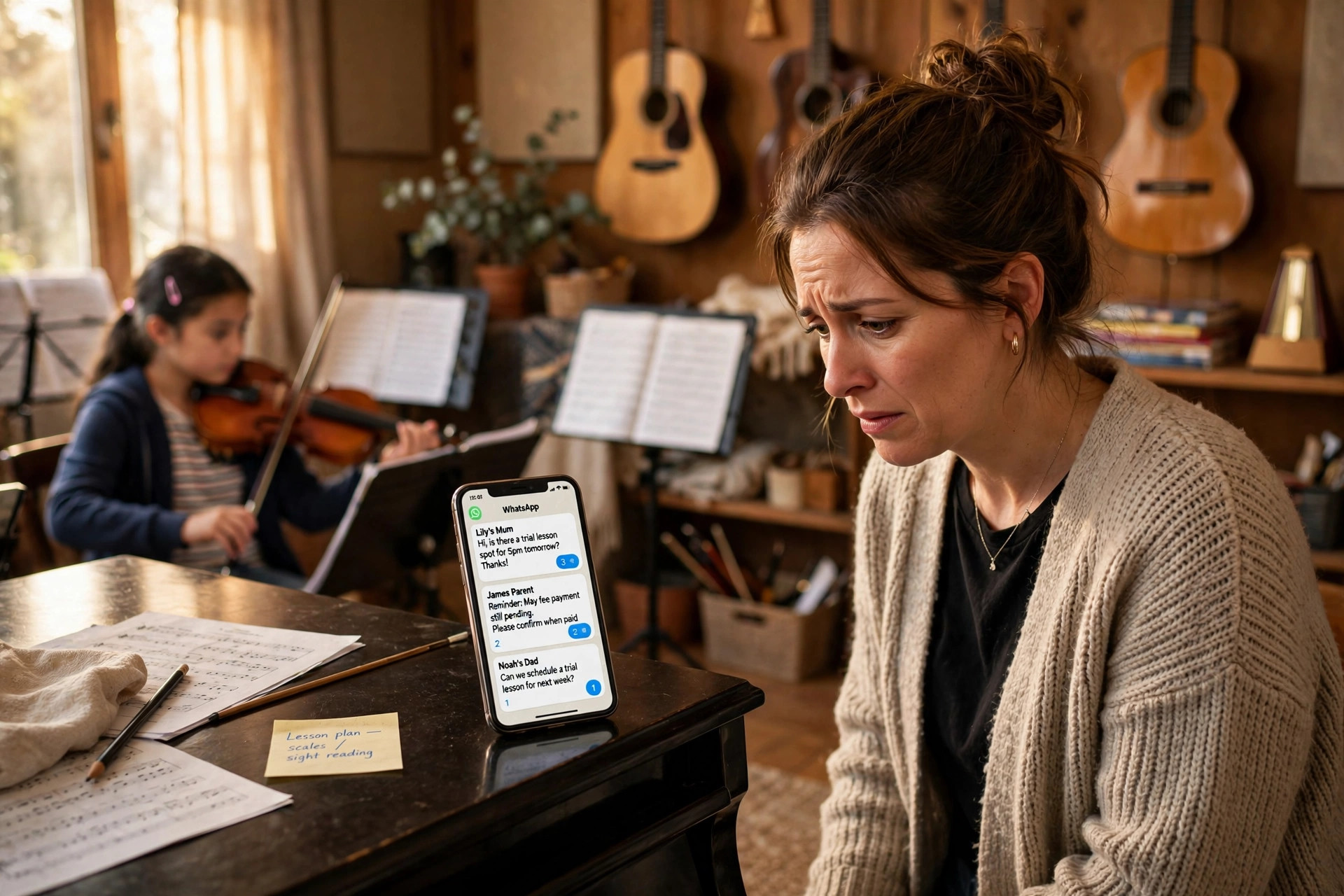
It is 4pm on a Thursday and you are mid-lesson, helping a seven-year-old hold her violin bow correctly for the first time. Your phone is on top of the piano, lighting up every few minutes. 'Is there a trial lesson slot tomorrow?' 'What are the piano fees for beginners?' 'Can we move Friday's lesson to Saturday?' 'I still have not paid last month's fee - sorry!' Four parents, four small questions, and your hands are busy teaching. You will reply at 9pm, tired, and the trial-lesson parent will already have booked with the school across town. WhatsApp automation for music schools means an AI assistant that answers those messages the second they arrive. It books trial lessons, answers fee and instrument questions, sends polite fee reminders, and keeps parents updated about schedules and recitals - while you teach. For a music school, the best approach is chat-based automation because your customers are busy parents who message between errands, their questions are practical and repetitive, and a reply that arrives in seconds books the trial while a reply that arrives tonight loses the student.
Why Music Schools Lose Students to Slow Replies
A parent deciding on music lessons for their child is shopping for trust. They message two or three schools with the same questions: trial availability, fees, teacher qualifications, location. The school that answers first with warm, complete answers feels like the school that will look after their child. The school that answers tomorrow feels disorganised - fairly or not.
The cruel part is that your teaching hours are exactly when parents message. Lessons run afternoons and evenings, which is when parents are off work and thinking about their children's activities. You are in the one place you cannot answer the phone, at the exact time the phone matters most. An assistant that answers in your voice, instantly, closes this gap completely.
A parent who waits a day for a trial-lesson reply has already booked with a faster school. In children's activities, momentum is everything - the parent is excited today, and excitement has a short shelf life. Answer while it is fresh.
What WhatsApp Automation for Music Schools Actually Does
Think of your most organised administrator - the one who knows every teacher's schedule, every fee, and every parent's name. Now she works the chat around the clock, handling dozens of conversations at once, never forgetting a follow-up. That is the assistant, on the WhatsApp number parents already message.
- Books trial lessons in the chat - instrument, teacher, day and time, confirmed with the practical details.
- Answers fee, instrument and teacher questions from your real price list and schedule.
- Sends polite fee reminders before and after due dates - firm, friendly, never awkward.
- Handles schedule changes: swaps, cancellations and make-up lesson requests.
- Sends recital, exam and holiday updates to all parents at once.
- Follows up with trial families who have not enrolled yet, and asks happy parents for reviews.
Notice the shape of this list: it is everything except the teaching. The assistant runs the business side of the school; you run the music. That is how a one-person school starts feeling like a well-staffed one.
How Does WhatsApp Automation Book a Trial Lesson in Chat?
The trial lesson is the front door of your school, and the booking should feel effortless. A parent messages 'trial piano lesson for my 8-year-old?' The assistant asks the two questions that matter - which instrument and roughly what age - then offers real available slots: 'We have Saturday 10:00 with Mr. Ahmed or Tuesday 4:30 with Ms. Sara - which suits you?' The parent picks, the assistant confirms, and the slot is in your calendar.
Then comes the message that separates good schools from great ones: the practical briefing. Address and parking, how long the trial lasts, whether the child needs to bring anything, what happens after the trial. Parents arrive relaxed instead of confused, the child has a better first experience, and your conversion from trial to enrolment climbs - because half of enrolment is the parent feeling looked after before the lesson even starts.
The evening-before confirmation does the rest: 'Looking forward to meeting you and Ayesha tomorrow at 10:00.' Trial no-shows are expensive - an empty slot you could have filled - and this one message cuts them sharply. Parents who must cancel reply to the message instead of ghosting, and a cancelled trial can be rebooked.
What Should the Chatbot Do When a Parent Asks About Fees?
Fee questions need your real numbers, stated plainly. 'Piano for beginners is X per month for one weekly lesson, including the practice diary. Guitar is Y.' The assistant answers from your actual fee structure - monthly, per-term, or per-lesson, whatever you use - and explains what is included. Parents comparing schools want clarity, not coyness. A school that states its fees confidently looks professional; a school that dodges looks expensive.
The follow-up questions matter too: sibling discounts, instrument rental, exam fees, what happens if a lesson is missed. The assistant answers each from your real policies, in your tone. And when a parent asks for a discount, it offers what you have actually approved - a free trial lesson, a waived registration, a sibling rate - never an invented deal. Your pricing stays yours; the assistant just delivers it faster.
Fee Reminders That Get Paid Without Awkwardness
Chasing fees is the conversation every music teacher dreads, so it often happens late or never - and the unpaid months pile up. The assistant removes the awkwardness entirely. Three days before the due date: 'A friendly reminder that October fees are due on the 1st - here is the payment link.' Three days after, if unpaid: 'Just a note that October fees are still pending - the link is here whenever suits you.'
The tone is everything: warm, matter-of-fact, never shaming. Parents are not avoiding payment out of malice; they forgot, or the month was tight. A polite automated reminder gets paid faster than an embarrassed human one, because nobody feels judged. Expect this pattern: the money arrives earlier, the awkwardness disappears completely, and no parent's relationship with the school is damaged by a money conversation.
For genuinely struggling families, the assistant hands over to you - because a payment plan discussion needs a human heart. The rule is simple: the machine handles the routine reminders, you handle the real conversations. ReplyPilot (AI automation for small-business messaging - WhatsApp, Instagram DM, website chat) lets you set exactly where that line sits, so the sensitive cases always reach you.
Schedule Changes, Swaps, and the Make-Up Lesson Maze
'Can we move Friday to Saturday this week?' 'We are on holiday next week - can we have a make-up lesson?' These messages arrive constantly, and each one needs your real schedule to answer. The assistant checks the teacher's actual availability, offers the genuine alternatives, and confirms the swap in writing. Both sides can scroll back and see what was agreed.
Your make-up policy should be written into the assistant's brain in plain words: how much notice is needed, how many make-ups per term, whether swaps between students are allowed. When the policy is clear and consistently applied, the arguments disappear. 'Our policy is 24 hours notice for make-up lessons - I can offer you Saturday 11:00 or Monday 5:00.' Fair, firm, friendly. Parents respect a school with clear rules far more than one that decides case by case.
Recitals, Exams, and Holidays: One Message to Every Parent
A music school runs on announcements: recital dates, exam entries, holiday closures, new term start dates. Sending these parent by parent is a full evening's work; sending them as a broadcast takes one message. 'Our winter recital is on December 14th - all students are invited to perform. Reply YES and I will add your child to the programme.'
The replies are where automation earns its keep. Fifty parents replying 'YES', 'what time?', 'can grandparents come?' would bury any teacher. The assistant answers each one, collects the confirmations, and gives you a clean list. The recital organises itself in the chat while you rehearse the students. The same flow handles exam entries, holiday notices and new-term enrolments - every broadcast becomes a two-way conversation the assistant manages. The same flow handles exam entries, holiday notices and new-term enrolments - every broadcast becomes a two-way conversation the assistant manages.
Following Up With Trial Families Who Have Not Enrolled
Want this for your music schools?
ReplyPilot builds a custom whatsapp automation setup for your music schools — answering customer questions instantly, taking orders and bookings, and handing off to you when a human is needed.
Ask on WhatsApp — it's freeThe trial went well. The child loved it. The parent said 'we will think about it.' Then silence. This is the most valuable follow-up in your whole business, because these families are one nudge from enrolling. Day two after the trial: 'It was lovely meeting you both yesterday - Ayesha did really well on the keys. Would you like me to hold the Saturday 10:00 slot for her?' Day seven: a short video of a recent student recital with 'our beginners performed this last month - thought you would like to see.'
Each message has a genuine reason to exist - never a hollow 'just checking in'. The slot hold creates gentle urgency, the recital video sells the dream, and the tone stays warm throughout. Schools that follow up systematically convert far more trials than schools that wait for parents to decide on their own, because most parents are not deciding - they are forgetting.
How Do You Answer 'Which Instrument Should My Child Learn?'
This is the question parents ask when they trust you most - and it deserves a thoughtful answer, not a sales pitch. The assistant answers from your real teaching philosophy: which instruments suit which ages, what the physical and attention demands are, and what you genuinely recommend for a five-year-old versus a twelve-year-old. 'For most five-year-olds we suggest piano or violin - the basics transfer to any instrument later, and both build reading skills early.'
The honest version of this answer is what makes a school beloved. If a child is too young for the instrument the parent has in mind, the assistant says so kindly and suggests the right starting point - maybe a year of general musicianship first. Parents remember the school that put their child first. That memory becomes enrolments, referrals, and the kind of reputation no advert can buy.
Instrument rental questions usually follow: 'Do we need to buy a piano?' The assistant explains your real options - rental schemes, starter instruments, what to avoid buying second-hand - and removes the biggest financial fear parents have. A parent who learns they can start affordably says yes faster. Removing fear is half the enrolment battle, and the assistant does it patiently, at midnight, as many times as needed. The schools that answer this question best are the schools whose trial books stay full.
When the Assistant Must Hand Over to a Human
Children's education is emotional, and some conversations need a teacher's heart. A parent worried their child is falling behind, a complaint about a teacher, a request to discuss learning difficulties, anything involving an upset child - these go to you immediately, with the full conversation attached. Your handoff rules should name these moments in plain language.
The handoff should feel like care, not escalation. 'Let me bring in the school director - she knows your child's progress personally. One moment.' You pick up the thread knowing everything that was said. Parents judge a school by how it handles the hard conversations; the assistant's job is to make sure those conversations reach you fast, with context, while you are still teaching.
Mistakes That Damage Music-School Automations
- Wrong fee figures - every number must come from your real fee structure, never invented.
- Booking trials into slots that are not actually free - calendar discipline is non-negotiable.
- Cold, corporate tone with parents - you are caring for their children; every message must feel warm.
- Letting the machine handle upset parents - complaints about teachers or progress go to a human, instantly.
- Broadcasting to cold numbers - announcements go to enrolled and opted-in families only.
- Forgetting the child's name - the assistant should use names; 'Ayesha's lesson' beats 'the lesson' every time.
The pattern is the same as in any school: trust is the product. Every message the assistant sends either builds it or spends it. Build the assistant on your real answers, your real warmth, and clear handoff rules - and parents will feel the care even in an automated message.
Manual Replies vs a Receptionist vs Automation: A Simple Comparison
First reply speed | You, mid-lesson: hours | Part-time receptionist: minutes, on shift only | Automation: seconds, day and night\nTrial booking | You: when you get to the phone | Receptionist: during office hours | Automation: instant, with real slots and confirmations\nFee reminders | You: awkward and late | Receptionist: willing but inconsistent | Automation: polite, on schedule, every month\nParent updates | You: one by one, exhausting | Receptionist: manageable for small schools | Automation: broadcast plus individual replies, handled\nCost pattern | You: your evenings | Receptionist: monthly salary | Automation: monthly plan plus per-message fees
A receptionist is wonderful if you can afford one and keep her busy. Automation gives a small school the same coverage - instant replies, bookings, reminders, broadcasts - at a fraction of the cost, and it never calls in sick during recital week.
Your First 30 Days: Setting This Up Between Lessons
Step 1: Write your music school's real answers. Fees, trial process, teacher bios, schedule-change policy, make-up rules, exam and recital basics. This document becomes the assistant's brain.\nStep 2: Connect your teaching calendar. Real trial slots only - the assistant must never offer a time you cannot keep.\nStep 3: Set handoff rules. Name the moments that come to you: upset parents, teacher complaints, payment difficulties, anything about a child's welfare.\nStep 4: Run a quiet week. Let it answer new parent messages while you watch and refine the tone. One week and it sounds like your school.\nStep 5: Switch on reminders and broadcasts. Once daily replies feel right, add the fee reminders, the recital announcements and the trial follow-ups.
Start with enquiries and trial bookings; add the money and broadcast layers once the tone is right. A school that automates one thing well beats one that automates five things badly.
Measuring What Matters for Your Music School (Beyond 'Messages Answered')
Four numbers tell a music school the truth. Trial bookings per month - your growth engine. Trial-to-enrolment rate - follow-ups should lift this steadily. Fees collected on time - reminders should shrink the overdue list. Parent response time - under a minute, always.
A 95% open rate with flat enrolments is a vanity metric. Check your school's four numbers monthly. If trials climb and overdue fees fall, the system is earning its keep. There is one more number worth watching: the quiet-parent rate - how many enrolled families message you with questions each month. When the assistant answers well, this number rises first, because parents who trust the chat ask more. More questions means more engagement, and engaged parents re-enrol every term without thinking twice. The same enrolment logic works across teaching businesses - see tutoring businesses and language schools for the parallel playbooks.
Staying Ban-Proof for Music Schools: The Rules That Matter
Your WhatsApp number is your school's front door - protect it. Only message parents who contacted you first or opted in. Announcements and reminders go to enrolled and opted-in families, never to cold numbers. Meta's Business Platform documentation covers the consent and template rules every music-school setup must follow.
The practical version for a school: the enrolment form builds your list, the list gets the school news, and any parent can leave the list with one word. Never buy numbers, never message purchased lists. A parent who opts out politely still brings their child to lessons. A stranger's spam report can cost you the number. For neighbouring-studio ideas, the dance studio automation guide covers the same parent-communication patterns.
What It Costs to Run
Two parts: the automation platform's monthly plan and WhatsApp's per-message fees for business-initiated conversations. An assistant that books a trial in one clean exchange and reminds about fees with two short messages is also the cheapest kind to run, because it wastes nothing on back-and-forth. The timing is worth noting - WhatsApp Business changed its pricing in October 2026, and schools everywhere are looking closely at messaging costs. A setup that consolidates each conversation into a few purposeful messages is exactly the efficiency this moment rewards.
The honest maths: if the assistant books two extra trials a month and the reminders pull in fees two weeks earlier, it has paid for itself many times over. The alternative is not free - it is your evenings, your awkward money conversations, and the students who enrolled somewhere faster.
Want every parent answered in seconds, starting this term? Request a free custom demo at https://replypilot-site.vercel.app/ and see your own most-asked questions handled live. ReplyPilot builds the assistant around your real fees, your teachers' schedules and your school's voice - so the front door of your school is always open, even when you are teaching.
Frequently Asked Questions
Can WhatsApp automation really book trial lessons for my music school?
Yes. It asks which instrument and the child's age, offers your real available slots, confirms the booking, and sends the parent the practical details - address, duration, what to bring. The evening-before confirmation cuts trial no-shows sharply.
How do fee reminders work without annoying parents?
The assistant sends a warm reminder before the due date and a polite follow-up after, both with a payment link. The tone stays friendly and matter-of-fact - parents pay faster when nobody feels judged. Genuinely difficult cases are handed to you for a human conversation.
What happens when a parent wants to change a lesson time?
The assistant checks the teacher's real availability, offers genuine alternatives, and confirms the swap in writing so both sides have a record. Your make-up lesson policy is built in, so swaps follow your rules consistently every time.
Can it send recital and holiday announcements to all parents?
Yes. One broadcast reaches every enrolled and opted-in family, and the assistant handles all the replies - confirmations, questions about timings, grandparent invitations - giving you a clean list at the end. Announcements that took an evening now take a minute.
Will parents know they are talking to an automated assistant?
A well-built assistant sounds like your school - warm, organised and quick. Most parents simply notice that you always reply. The goal is not to fool anyone; it is to give instant helpful answers, with a human handoff the moment a conversation needs one.
How long does setup take for a music school?
About a month: one week writing your real fees and policies, one week connecting the teaching calendar and testing quietly, then two weeks of live parent messages with you refining the tone. Most schools feel the difference in trial bookings within the first fortnight.