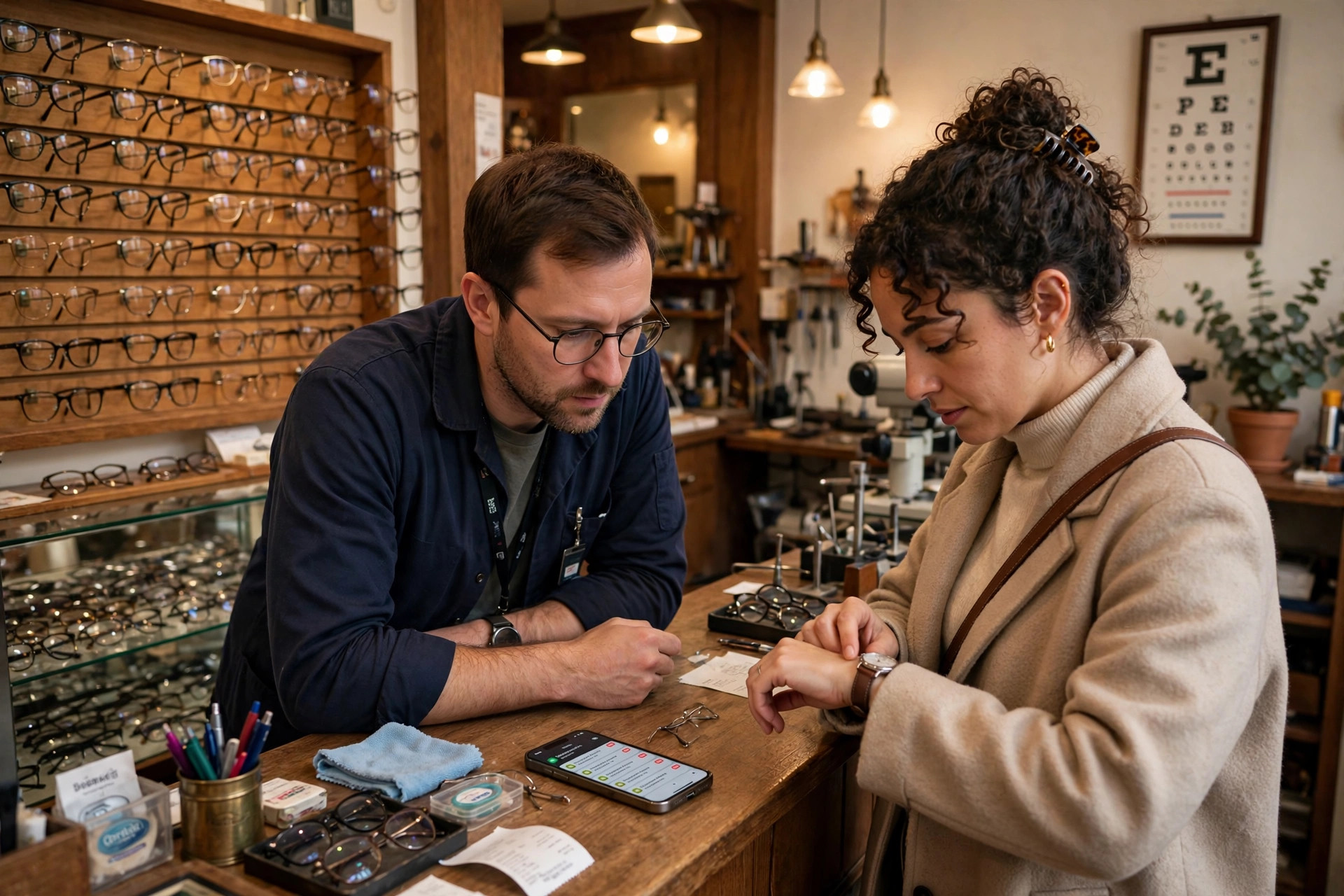
Thursday afternoon. You are mid-fitting, adjusting frames on a patient who cannot decide between two pairs, and your phone lights up for the sixth time in an hour. Someone wants an eye test next week. Someone else asks if you stock a particular brand. A third wants to know when their glasses will be ready. Every one of them is holding money, and every one of them is waiting. An AI chatbot for opticians means a chat assistant on your website or WhatsApp that books eye tests, answers frame and lens questions, and sends recall reminders. For opticians, the best approach is a chatbot tied to your appointment diary, because it fills empty slots and brings patients back on schedule while you focus on the people in your chair. Systems like ReplyPilot (AI automation for small-business messaging — WhatsApp, Instagram DM, website chat) are built for exactly this kind of appointment-heavy small business. This article shows you how eye-test booking works in chat, where the clinical boundary sits, why recall reminders are your quiet revenue engine, and how to launch in 30 days.
The Frame Question Flood
Opticians drown in a very specific kind of message. Not emergencies — questions. “Do you have Ray-Ban in stock?” “How much are varifocals?” “Can I get my lenses thinned?” “Do you do children's eye tests?” Each one takes two minutes to answer properly, and they arrive all day, every day, across phone, WhatsApp, Instagram, and email. Meanwhile the patient in front of you — the one who actually showed up — gets half your attention while you thumb-type answers.
The math is not subtle. Twenty question-messages a day at three minutes each is an hour of skilled optical time spent typing. Worse, the messages you answer late are the appointments you lose: the person asking about Saturday availability at 8pm books with whoever answers first. In a business where the diary is everything, slow answers are empty chairs. And empty chairs do not pay rent.
What an AI Chatbot Does for an Optician
Strip it to basics. A chatbot for your practice is a chat window on your website — and usually WhatsApp too — that talks to patients the way your best receptionist would. It knows your eye-test types and durations, your frame brands, your lens options, your prices, and your opening hours. A patient types “I need an eye test next week” and the chatbot shows real availability and books it. Someone asks “do you do varifocals?” and gets a clear, correct answer in seconds, at midnight, on a Sunday.
The chatbot fills the diary; you do the optics. It never double-books, never quotes last year's prices from memory, never forgets to mention the current frame offer. And when something needs a professional — anything clinical, anything anxious, anything complicated — it hands over to you or your optometrist with the full conversation attached. Routine at machine speed, expertise at human warmth.
- **Eye-test bookings:** real diary availability shown, appointments booked and confirmed in chat.
- **Frame and lens FAQs:** brands, lens types, coatings — answered instantly and accurately.
- **Recall reminders:** annual check-up nudges sent automatically, on your schedule.
- **Glasses-ready alerts:** “your glasses are ready for collection” messages that end the phone chase.
- **Contact lens reorders:** repeat orders collected in seconds, any hour.
How Does the Chatbot Book Eye Tests?
Booking an eye test by phone is a small ordeal: the patient calls during your busy hours, you put them on hold, you check the diary, you read out slots, they consult their calendar, and five minutes pass. The chatbot compresses it into one smooth minute. It asks what type of test — standard, contact lens fitting, children's — shows the real open slots for that test type, and confirms the booking with a reminder the day before. The patient never waits, and you never touch the phone.
Two details separate good booking from bad. First, the chatbot must read your real diary, not a copy someone updates weekly — a double-booked eye test is a disaster for trust. Second, it should collect the right details upfront: new or returning patient, any concerns to note for the optometrist, contact details for reminders. When the patient walks in, your team already knows the story. That is what a polished practice feels like, and it is the feeling that turns first-time visitors into lifelong patients.
Many optical questions are really diary questions in disguise: “can I just walk in?”, “how long is the wait right now?”. The chatbot answers with your actual policy and diary state — “walk-ins welcome for adjustments, eye tests need booking, and Thursday has a free slot”. Over time it gently trains patients toward the behavior you want: bookings for tests, walk-ins for quick fixes. Small practices live or die on diary discipline, and a chatbot enforces it kindly, every time. The same lead-capture thinking that fills any small-business pipeline applies here — every question is a future appointment handled right.
Frame and Lens FAQs: Answered Before the Visit
“Do you stock this brand?” “What is the difference between these lens types?” “Can you put new lenses in my old frames?” These questions are pure information — they have correct answers, your team repeats them daily, and none of them need a professional's judgment. A chatbot trained on your brands, your lens menu, and your pricing answers them instantly, complete with your current offers. The patient arrives already informed, and the in-store conversation starts three steps ahead.
There is a quiet sales benefit here. A patient who learns at 10pm that you stock the brand they want — and that you offer free adjustments for a year — walks in pre-sold. Compare that with the patient whose 10pm message sat unanswered until morning, by which time they had found a chain store's website. Information given fast is a competitive weapon; information given late is just trivia.
Your offers belong in the conversation, not just the window. When a patient asks about varifocals, the chatbot mentions the current lens upgrade; when someone books a test, it notes the second-pair discount waiting afterwards. Mentioned in context, offers feel helpful; blasted to everyone, they feel like spam. One well-timed mention during a booking chat will outsell a month of window posters — because it reached a buyer, not a passerby.
Recall Reminders: The Quiet Revenue Engine
Here is the most profitable thing a chatbot can do for an optician, and most practices barely do it at all. Patients are supposed to come back every year or two for a check-up. Most do not — not because they are unhappy, but because life happens and nobody reminds them. Every lapsed patient is an empty slot in your future diary and, frankly, an eye health risk. Recall reminders fix this automatically.
The flow is simple and respectful. Eleven months after their last test, the patient gets a friendly message: “Hi Sarah, your annual eye test is due next month — want me to find you a slot?” One tap books it. No phone tag, no “I will call them later” that never happens. Practices that run consistent recalls see their diaries fill with returning patients — the highest-value, lowest-effort appointments there are. It is the closest thing to free revenue in optics, and a chatbot runs it while you sleep.
“Your Glasses Are Ready” — Ending the Pickup Phone Chase
The lab calls you: the glasses are ready. Now the chase begins — you call the patient, they do not answer, you leave a voicemail, they call back while you are with someone else, and the dance continues for days. Meanwhile the finished glasses sit in a drawer earning nothing. Multiply by every order, every week, and the pickup chase is a genuine operational drag.
The chatbot ends it in one message. The moment you mark an order ready, the patient gets a WhatsApp: “Good news — your glasses are ready! Collect any time during opening hours.” Add a second nudge after five days for the forgetful ones. Patients collect faster, your drawer empties, and the payment lands sooner. It is a tiny automation with an outsized effect on cash flow and counter calm.
What Should the Chatbot Do When Someone Describes Eye Symptoms?
This is the line that matters most in optics, so here is the exact playbook. When someone describes symptoms — flashes, floaters, sudden vision changes, eye pain, redness — or asks anything clinical, the chatbot does three things only. It responds with care, states plainly that it cannot assess eye conditions, and connects them to your practice immediately — flagged urgent if the symptoms sound serious, with emergency eye-care guidance for anything alarming like sudden vision loss.
Want this for your opticians?
ReplyPilot builds a custom ai chatbot setup for your opticians — answering customer questions instantly, taking orders and bookings, and handing off to you when a human is needed.
Ask on WhatsApp — it's freeNo exceptions. The chatbot never interprets symptoms, never suggests what a condition might be, never recommends treatment. It is a booking and information assistant, full stop. Build this escalation first, test it with the hardest symptom descriptions you can invent, and review it regularly. For professional standards on eye care itself, the American Optometric Association at aoa.org is the profession's authority. Patients trust a practice that is honest about limits far more than one that fakes medical confidence — and in eye care, that honesty is a safety issue, not just a tone choice.
After-Hours Questions From Squinting Browsers
Eye problems do not respect opening hours. Someone notices their vision blurring on a Sunday evening and starts researching. A parent realizes at 9pm their child has been squinting at homework all week. A contact lens wearer runs out on a Friday night. These are high-intent, slightly anxious moments — exactly when a calm, instant answer matters most.
The chatbot meets them there. It books the eye test for Monday morning, answers the “do you see children?” question, takes the contact lens reorder — and routes anything symptom-related to your team first thing. The Sunday-night worrier becomes a Monday-morning patient instead of a Monday-morning chain-store customer. Being there when people are anxious is how independents win against bigger marketing budgets.
Chatbot vs. Receptionist vs. Voicemail: What Goes Where
Every patient contact has a right channel. Pin this where your team can see it: | Patient need | Best channel | Chatbot's role | | Eye-test booking | Chatbot | Shows real slots, books, confirms | | Frame / lens / price questions | Chatbot | Answers instantly from your menu | | Recall reminders | Chatbot | Sends, books the return visit | | Glasses-ready alerts | Chatbot | Notifies, nudges the forgetful | | Contact lens reorders | Chatbot | Collects the repeat order | | Eye symptoms or vision changes | Optometrist | Routes urgently, never assesses | | Anxious or upset patients | Human | Hands off with full context | | Complex insurance disputes | Human | Escalates with notes attached | The pattern: information and logistics go to the chatbot, judgment and care stay human. When everyone knows the routing, patients get faster help and nothing clinical ever waits in a queue it should not be in.
Insurance and Pricing Questions, Handled Gently
Money questions make patients awkward and staff tired. “How much is an eye test?” “Do you take my vision plan?” “What will varifocals cost me?” A chatbot answers these plainly, any hour, without anyone feeling embarrassed. It explains your test fees, which plans you work with, and typical lens price ranges — always with the honest note that exact costs depend on the prescription, confirmed at the test.
The gentleness matters. Nobody likes asking about money face to face; many patients will research prices at midnight precisely to avoid the awkward counter conversation. Let the chatbot absorb that awkwardness. Patients arrive knowing the numbers, the in-person conversation stays about their eyes, and your team never has to watch someone flinch at a price they could have prepared for.
One practical tip: review your price answers quarterly, the same week you review your fee list. Prices drift — suppliers change, offers expire — and a chatbot quoting last season's numbers creates the exact awkwardness it was built to prevent. Five minutes of maintenance, four times a year, keeps every answer honest.
Contact Lens Reorders on Autopilot
Contact lens wearers are subscription customers who do not know they are subscription customers. They reorder the same boxes every few months, and every reorder is currently a phone call or a visit. The chatbot turns it into a ten-second chat: “Need your usual lenses?” — confirm — done. It can even nudge them when their typical reorder interval passes, catching the wearers who were about to switch to an online subscription out of sheer convenience.
This is retention disguised as convenience. Online lens sellers win on price; you win on the relationship and the eye health oversight. But you only keep the reorder if reordering from you is effortless. A chatbot makes staying loyal the lazy option — and the lazy option usually wins. Similar repeat-order logic keeps physiotherapy patients coming back on schedule, and the principle is identical.
Mistakes That Make Patients Squint
Optical chatbots fail in predictable ways. **Blurring the clinical line** — the instant a bot opines about symptoms, trust is gone; test the boundary harder than anything else. **Stale diary data** — a booked slot that does not exist is worse than no booking at all. **Quoting outdated prices** — update the fee list the day it changes, not “when someone gets around to it”. **No human escape** — “speak to our team” must be visible in every conversation. **Cold robotic tone** — patients messaging an optician are often anxious about their sight; warmth is clinical-adjacent, not optional.
The deeper mistake is launching and forgetting. Read a sample of real conversations every week for the first two months. You will find phrasing patients use that you never predicted, and each one you teach the chatbot makes it sharper. Ten minutes a week keeps it excellent; neglect makes it a liability wearing your practice's name.
How Do You Know Your Optician Bot Is Working?
Measure the diary, not the chatter. Booking conversion rate — enquiries that become appointments — should rise as response times fall to seconds. Recall response rate — lapsed patients who rebook from reminders — is your purest profit metric. Glasses-collection time should shrink once ready-alerts go out automatically. And no-show rate should fall with day-before reminders doing their quiet work.
Then ask the human question: does the practice feel calmer? If your receptionist finally has time for the patient in front of them instead of the phone behind them, the system is working. Dental practices running similar front-desk automation report exactly this shift — calmer receptions, fuller diaries — as the dental clinic chatbot guide describes. The metrics confirm it, but your team will feel it first.
Why Chat Fits an Optician's Counter Better Than Voice
You may have seen guides about AI voice agents for eye clinics — usually written for ophthalmology practices, and usually about phone calls. Different tool, different job. An optician's counter is visual and browsable: patients want to see frame options, tap through lens choices, and book without making a phone call. Chat lets them do all of that silently at 11pm; a voice agent makes them talk out loud. For retail-adjacent eye care — frames, lenses, bookings, recalls — chat is simply the native medium.
The intent gap matters too. Ophthalmology content is clinical and surgical; your patients are choosing frames and booking routine eye tests. A chatbot trained on your brands, your diary, and your recall list serves that exact intent — and nothing out there covers opticians plus chat specifically yet. That is your edge: be the practice whose website answers at midnight while competitors' voicemails fill up.
Putting It Together for Your Optician Practice: The First 30 Days
A careful rollout beats a fast one in eye care. **Week 1 — Map the routine:** list your twenty most-asked non-clinical questions, your test types and durations, your brands and price bands. **Week 2 — Build the clinical boundary first:** write and hard-test the symptom-escalation responses before anything else goes live. **Week 3 — Connect the diary:** link your real appointment book, build the booking flow, and test every scenario yourself. **Week 4 — Soft launch with recalls:** go live quietly, starting with recall reminders to existing patients who already trust you, then open the booking chat to everyone.
Most practices see the diary effect within weeks: fewer phone interruptions, faster bookings, and lapsed patients drifting back on schedule. If you want it built with the clinical boundary done right from day one, ReplyPilot designs optician messaging automation around exactly these guardrails. Request a free custom demo at https://replypilot-site.vercel.app/ and see what your own appointment book could look like running itself.
Frequently Asked Questions
Can an optician chatbot assess my eye problem?
No — and your optician bot must never try. The chatbot books eye tests, answers frame and pricing questions, and sends reminders. Anything involving symptoms, vision changes, or eye health goes straight to your optometrist, flagged urgent when the wording suggests it. The clinical boundary is built first and tested hardest.
How does it book eye tests without double-booking?
It reads your real appointment diary — not a copy — so the slots it offers are genuinely open. When a patient picks one, the booking is written back to the diary immediately with a confirmation and a day-before reminder. The only requirement is keeping your diary accurate, which you already do.
Will it really bring lapsed patients back?
Recall reminders are the highest-return message an optician can send. Most lapsed patients are not unhappy — they just forgot. A friendly, well-timed reminder with one-tap booking converts far better than hoping they remember. Practices that run consistent recalls fill their diaries with returning patients.
What if a patient asks about symptoms at midnight?
The chatbot responds with care, states clearly it cannot assess eye conditions, and routes the message to your practice as a priority for first thing in the morning. For alarming symptoms like sudden vision loss, it directs the patient to emergency eye care immediately. Nothing clinical ever waits for office hours unnoticed.
Does it work for contact lens reorders too?
Yes — repeat lens orders are one of its best tasks. The patient confirms their usual lenses in seconds, any hour, and the order queues for your team. Timed nudges when their reorder interval passes keep wearers buying from you instead of drifting to online subscriptions.