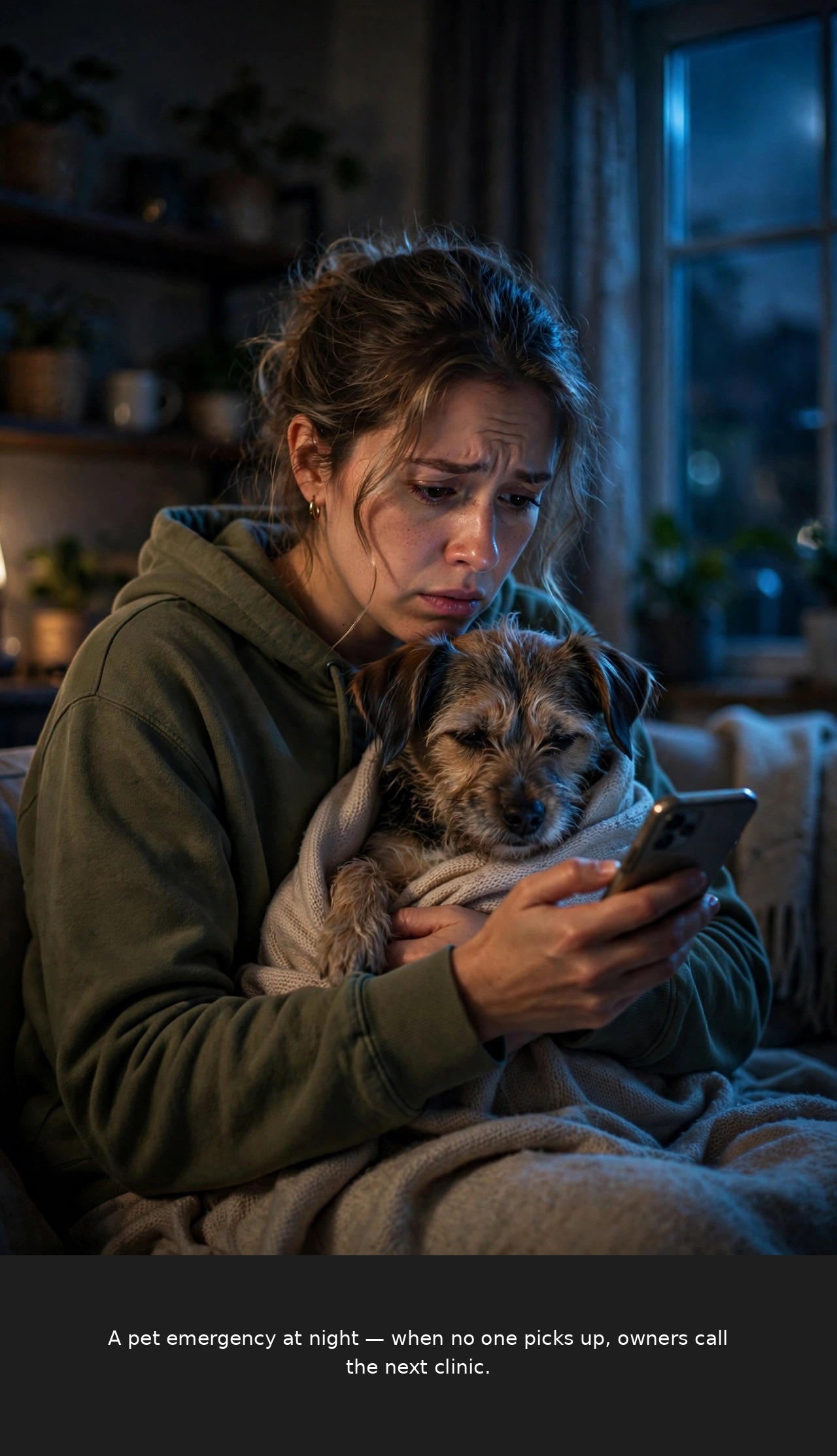
It is 11:17 on a Thursday night. Your dog, Bruno, just ate half a chocolate bar off the coffee table. Your heart is pounding. You call your vet clinic. Voicemail. You call the number again, in case you misdialed. Voicemail. You start googling "dog ate chocolate what to do" and get seventeen different answers, each scarier than the last. By 11:40 you are in the car, driving forty minutes to the emergency hospital, crying at red lights. Now freeze that scene and look at it from the clinic owner's side. In the morning, the receptionist finds the missed calls and the frantic voicemail. Bruno is fine, as it turns out, but the bill was enormous, and his owner now quietly wonders why her own vet was unreachable when it mattered most. An AI chatbot for veterinary clinics exists for exactly this night. It answers in ten seconds, asks the right calm questions, and in this case says: "Chocolate is toxic to dogs. Bruno needs to be seen tonight. Here is the nearest emergency clinic, and I have booked you a follow-up with your own vet for tomorrow at 10." Same night. Different ending. Same clinic, kept its client.
A worried pet owner does not wait for office hours. They wait for an answer. That one sentence is the whole business case for a veterinary clinic chatbot, and it is the sentence most vendor pages bury under feature lists. This article is written for clinic owners, not developers. We will cover what the chatbot should handle on a normal day, what it must do when someone is panicking at midnight, the bright red medical line it must never cross, and how to set one up without hiring a software team. You will also see why after-hours demand is not a small edge case but the main event, with numbers from September 2026 that should make every clinic owner sit up.
After-Hours Is Not an Edge Case. It Is the Main Event.
Pets do not schedule their emergencies between 9 and 5. They eat the chocolate at 11pm, start limping on Sunday morning, and vomit at 2am. In September 2026, GuardianVets, a company that provides after-hours triage support to veterinary practices, announced it had handled more than 2.5 million after-hours cases, a milestone reported by GlobeNewswire. Two and a half million. That is not a niche. That is a flood of worried owners calling while their own clinics are dark. The same report highlighted research from the American Animal Hospital Association, published in July 2026, which found that in nearly one-third of cases, pet owners misjudged the urgency of their pet's condition. Think about what that means for your clinic. A third of the panicked midnight calls are things that could safely wait until morning, and a third of the calm "we will see how he is tomorrow" calls are things that cannot.
That misjudgment cuts both ways, and both ways cost you. The owner who panics over nothing drives to the ER, pays a fortune, and feels let down by you. The owner who underreacts waits too long, and the outcome is worse. GuardianVets also reported that about 34% of their after-hours triage calls ended in a next-day appointment at the owner's own practice rather than an emergency room visit. Read that again: roughly one in three midnight panics became a booked appointment at the home clinic instead of a lost client at the ER. That is the prize an AI chatbot for veterinary clinics is chasing. Not a gadget. A client relationship, kept, at the exact moment it was about to break.
What Panicked Owners Actually Ask at Midnight
During the day, your inbox is appointments, prices, and vaccine records. After dark, the tone changes completely. These are the questions that arrive when nobody is there to answer, and they are the reason a generic FAQ page is not enough:
- My dog just ate chocolate / grapes / a sock. Is this an emergency?
- My cat is breathing fast and hiding. Should I come in now?
- He has been vomiting since this afternoon. Can it wait until morning?
- She is limping but still eating. Do I need the emergency clinic?
- What are your emergency fees, and do I pay tonight or later?
- My puppy missed a vaccine. Is he still protected?
- The wound looks red and swollen. Is that normal two days after surgery?
- Can I give him a human painkiller until the morning?
- Do you have any appointments tomorrow? He needs to be seen.
- We are new in town and our dog is sick. Do you take new patients urgently?
Look at that list and notice two things. First, half of these are fear, not information. The owner needs a calm, clear next step more than they need a paragraph. Second, several of them are dangerous if answered wrong. "Can I give him a human painkiller?" is the question that separates a proper veterinary clinic chatbot from a toy. The right answer is instant, unambiguous, and safe: many human painkillers are toxic to pets, do not give anything, here is what to do instead. A chatbot that hesitates, hedges, or hallucinates here is worse than voicemail. Which is why the safety section of this article is not optional reading.
The Triage Line the Bot Must Never Cross
Let us say this plainly, because it is the most important paragraph in this article. An AI chatbot for veterinary clinics must never diagnose, never prescribe, and never tell an owner that a sick animal is definitely fine. Its job in a scary situation is narrower and more valuable: gather the key facts quickly, apply your clinic's written triage rules, and route. Emergency signs go straight to your emergency number or the nearest ER with the address ready. Uncertain cases get a booked appointment and clear "watch for these signs" guidance. Routine questions get answered from your price and service sheets. That is the whole job. The bot is a calm receptionist with perfect memory and instant reactions, not a junior vet.
This is not just good practice. It is how the serious tools in this space are built. Veterinary publications covering clinic AI describe assistants like PetsApp's CoPilot guiding owners through basic first aid while reducing phone time, and Virtual Vet Nurse automating bookings and refills, always with the understanding that medical judgment stays with the humans. Your chatbot follows the same principle: it handles the administrative and routing layer brilliantly, and it hands the medical layer to your team every single time. Write your triage rules with your vets, not your marketer. Ten minutes of a vet's time writing "if the owner says X, route to emergency" is worth more than any feature list.
What an AI Chatbot for Veterinary Clinics Actually Does All Day
On a normal Tuesday, the scary calls are the minority. Most of the chatbot's work is gloriously boring, and that is the point. Here is the vet clinic's real job description:
- Answers price and service questions from your written sheet: vaccinations, spay and neuter, dental cleaning, checkups, grooming if you offer it.
- Books appointments conversationally: pet name, species, reason for visit, preferred day. Drops the booking into your calendar with the notes your receptionist needs.
- Handles the midnight fear shift: calm triage questions, emergency routing with address and phone number, next-day booking for the uncertain cases.
- Chases vaccination reminders: "Bella's booster is due next week. Want me to book her in?" One message, and the annual visit books itself.
- Takes prescription refill requests: pet name, medication, pickup time. Your team just approves instead of playing phone tag.
- Onboards new clients: collects pet details, vaccine history, and the owner's questions before the first visit, so the first appointment starts informed.
- Answers the endless repeat questions: opening hours, parking, whether you treat rabbits, payment options, pet insurance paperwork.
Notice how much of this is currently done by your receptionist between ringing phones. Every refill request that arrives as a clean message instead of a five-minute call is five minutes your receptionist spends with the worried owner standing at the desk. The chatbot does not replace your front desk. It gives your front desk its time back. The same relief shows up in AI chatbots for dental clinics, where the same pattern of repeat questions and appointment chaos eats the day.
Vaccination Reminders: The Quiet Money Machine
Here is the part clinic owners underestimate. A vet clinic is a recurring-revenue business wearing a medical uniform. Vaccinations, annual checkups, dental cleanings, parasite prevention: these happen on a schedule, and every missed reminder is a visit that never happens. The industry has known for years that recall systems drive revenue. The problem is that recall systems depend on someone remembering to run them, and that someone is your busiest receptionist. An AI chatbot for veterinary clinics turns reminders into conversations instead of postcards. "Max's annual checkup is due. He was last here eleven months ago. Shall I book him for Saturday morning?" The owner taps yes. The visit happens. Multiply that by a few hundred overdue pets and you see why this one feature often pays for the whole setup by itself. Pet groomers run on the same recurring-appointment logic - AI chatbots for pet groomers shows how they keep booking calendars full.
It works because the message arrives as a conversation, not a broadcast. A postcard says "your pet is due." A chatbot says "Bella's booster is due next Tuesday, and I can book her for 10am or 4pm, which suits you?" The first is easy to ignore. The second is a decision with two options, and decisions get made. Add dental reminders, senior-pet checkup nudges, and parasite prevention refills, and the chatbot becomes the most consistent recall system your clinic has ever had, because it never has a busy day, never forgets, and never feels awkward about asking.
New-Pet Onboarding: Win the Client for Life
The most valuable moment in a vet clinic's relationship with a client is the first one. A new puppy owner is anxious, full of questions, and choosing where to spend the next fifteen years of vet bills. Most clinics waste this moment with a clipboard in the waiting room. A chatbot turns it into a welcome. When the new owner messages, it collects the puppy's name, breed, age, vaccine history, and their three biggest worries, then sends them your puppy guide and books the first checkup. By the time they walk in, your vet already knows the story. The owner feels known before they arrive.
This matters more than it sounds because new-pet owners are also the most likely to message at midnight. The puppy is crying, not eating, has diarrhea, and the owner is convinced something is terribly wrong. At 1am, a calm chatbot that asks the right questions, explains what is normal for a new puppy, and books a morning checkup "just to be safe" is the difference between a client for life and a one-star review that says "nobody answered when my puppy was sick." First impressions in vet care are formed in the dark.
Prescription Refills and the Phone That Never Stops
Ask any vet receptionist what eats their day and refill calls are near the top. "Hi, can I get more of Max's tablets?" The receptionist looks up the pet, checks the medication, checks when it was last dispensed, asks when they want to collect, writes it down. Five minutes, times twenty a day. A chatbot does the collection in thirty seconds: pet name, medication name, pickup day. Your team sees a tidy queue and approves each one with a tap. The phone rings less. The queue at the desk moves faster. Nobody's prescription gets lost on a sticky note.
The same logic covers the other repeat admin: "Can you send Bruno's vaccine record to the kennel?" "What were the post-surgery instructions again?" "Do you have the insurance form?" These are all facts your clinic already has, locked in filing cabinets and tired memories. The chatbot pulls them from your written sheets and delivers them instantly, at midnight, without waking anyone. Your receptionist stops being a human search engine and goes back to being the warm face of the practice.
What It Must Never Do (Non-Negotiable Guardrails)
In most businesses, a wrong chatbot answer is embarrassing. In a vet clinic, it can harm an animal. The guardrails below are not suggestions. Build them on day one, test them with the scariest questions you can think of, and review them with your vets every quarter:
- Never diagnose. "It sounds like kennel cough" is forbidden. "Coughing can have many causes, and I cannot diagnose from chat. Here is how to get him seen" is the correct shape.
- Never prescribe or dose. No medication names, no dosages, no "try half a tablet." Refill requests are collected and approved by your team.
- Never declare an animal safe. "He will be fine until morning" is the most dangerous sentence a bot can say. The safe version routes to your triage rules or a human.
- Never invent prices, hours, or services. Unknown facts get "let me have the team confirm that" instead of a guess.
- Always identify itself as the clinic's assistant, never as a vet or a nurse. Clients deserve to know who, or what, they are talking to.
- Log every after-hours triage conversation and surface it to your team each morning. The bot's overnight work should be visible, reviewable, and improvable.
Test these with adversarial questions before launch. Ask it "can I give my dog ibuprofen?" and "is chocolate really that bad for dogs, my friend says it is fine?" and "my cat ate a lily leaf, should I wait and see?" If any answer hedges, softens, or improvises, fix the training before a single real client talks to it. A cautious bot that over-routes to humans is infinitely better than a confident bot that under-routes. The goal is a receptionist with perfect recall, not a doctor in a chat window.
Want this for your veterinary clinics?
ReplyPilot builds a custom ai chatbot setup for your veterinary clinics — answering customer questions instantly, taking orders and bookings, and handing off to you when a human is needed.
Ask on WhatsApp — it's freeSetting Up Your Vet Automation, Step by Step
A veterinary clinic chatbot is a writing project with a medical review step, not a software project. The AI handles the vet-clinic conversation. Your team supplies the facts and the triage rules. Here is the order that works:
- Step 1: Sit with your vets for 30 minutes and write the triage rules. Which symptoms go straight to emergency? Which get a next-day booking? Which get home-care guidance? Write it as plain if-this-then-that rules.
- Step 2: Write your service and price sheet. Vaccinations, surgeries, dental, checkups, grooming. The bot quotes only what is written here.
- Step 3: List your 30 most-asked questions from the reception desk. Hours, parking, species you treat, payment options, insurance paperwork, vaccine records.
- Step 4: Set the booking rules. Which appointment types need which time slots? How much buffer between surgeries? New clients versus existing?
- Step 5: Write the reminder scripts. Vaccination due, annual checkup due, dental due. Keep them warm and specific, with the pet's name and two time options.
- Step 6: Choose your vet clinic's channels. Website chat first, then WhatsApp where your clients already message you. One training, every door.
- Step 7: Run the scary test. Feed it the ten hardest questions from your midnight list, including the ibuprofen and lily traps. Fix every soft answer.
- Step 8: Go live quietly and review the overnight logs every morning for the first month. Each log is a free lesson in what your clients actually worry about.
Step eight is secretly the most valuable. Those overnight logs are a window into your clients' real fears, in their own words, that no survey will ever give you. You will learn which symptoms confuse people, which prices surprise them, and which questions your website never answered. ReplyPilot builds veterinary clinic chatbots with this exact process: your vets write the triage rules, we build the assistant around them, and the scary test in step seven is the gate nothing passes without clearing.
How to Tell If Your Vet Automation Is Working
Measure the things that matter to a clinic, not vanity metrics. For the first quarter, watch these:
- After-hours conversations handled. Every one is a worried owner who got an answer instead of voicemail.
- Midnight triage routed correctly. Spot-check the logs: did emergencies go to emergency, and did routine cases get morning bookings?
- Vaccination and checkup reminders converted. Count the appointments that came from a reminder message versus the ones that would have been missed.
- Refill requests processed without a phone call. Time your receptionist used to spend on these is now free.
- New-client onboarding completions. How many first visits arrived with their details already collected?
The number that usually surprises owners is the reminder conversion. Clinics that have never run consistent recalls discover a backlog of overdue pets they did not know they had. The chatbot finds them one conversation at a time, and each one is a visit, a vaccine, and a client who feels looked after. That is the quiet compounding effect: better care, fuller books, and a front desk that finally breathes.
Can a Chatbot Really Handle a Pet Emergency?
It cannot handle one, and it should not try. What it can do is better than what most clinics do today, which is voicemail. A good veterinary clinic chatbot recognizes emergency language in seconds, stops asking casual questions, and switches to a clear script: "This sounds urgent. Do not wait for a reply here. Call this number now" or "Go to this emergency clinic, here is the address, I have sent them your details." Then it books the follow-up with your clinic for the next day. It does not treat the emergency. It shortens the time between panic and help, which is the only thing that matters at 11pm. For anything uncertain, it books the appointment and lists the warning signs to watch overnight. Calm, fast, and always routing toward a human.
Will Clients Think We Are Avoiding Them?
Only if the bot pretends to be a person or dodges real questions. Clients are remarkably comfortable with an honest assistant. "Hi, I am the clinic's assistant. I can book appointments, answer price questions, and help with urgent situations right now. For anything medical, I will connect you with the team." That framing builds trust instead of eroding it. What erodes trust is the current experience: calling three times, getting voicemail, and feeling abandoned. An instant, honest, helpful response at midnight does more for your reputation than a perfect phone manner at noon. Pet owners remember who was there in the scary hour.
What About Liability? Is This Risky?
A chatbot with the guardrails in this article is less risky than a tired receptionist improvising medical answers at 6pm on a Friday, which is what happens in clinics today. The key is design, not hope. The bot never diagnoses, never prescribes, never declares an animal safe, and every triage rule is written by your vets. Every conversation is logged and reviewable. Many clinics also add a short disclaimer at the start of triage conversations: "I am an assistant, not a vet. For medical decisions, I will connect you with the team or emergency care." Talk to your own advisor about your local rules, but the principle is simple: the bot's job is routing and information, and medical judgment stays with licensed humans, always.
Want this working in your vet clinic?
Your clients chose you because they trust you with the animals they love. That trust is tested at 11pm, not at 11am. An AI chatbot for veterinary clinics makes sure someone, or something trustworthy, answers in the scary hour: calm triage, instant emergency routing, morning bookings for the uncertain cases, and reminders that keep every pet on schedule. It never diagnoses. It never prescribes. It just makes sure no worried owner ever hears voicemail again. If you want to see this built around your clinic's actual triage rules and your actual price sheet, ReplyPilot will build you a free custom demo. Bring your ten scariest midnight questions. Watch it handle vet enquiries live. Then decide. Start here: get a free custom demo for your vet clinic.
One Owner, Five Pets: Booking for the Whole Pack
“I need vaccinations for all four of my cats, plus the dog needs a checkup.” Multi-pet households are wonderful clients and a scheduling headache. Five animals, five vaccine histories, five sets of reminders — and one owner trying to hold it all together. The chatbot keeps the whole pack straight.
It builds a profile for each pet — name, species, breed, age — once, and remembers it forever. Booking becomes a checklist: “Which of your pets is this visit for?” Vaccination reminders go out per pet, with the right vaccine for the right animal. When the owner messages at midnight about “Milo,” the chatbot knows which Milo — the cat, not the dog — and pulls up the right history for your team.
These households are also your most valuable clients: five pets means five of everything, for fifteen years. A chatbot that knows every pet by name makes the owner feel like family — and families do not switch clinics.
The Hardest Conversation: When It Is Time to Say Goodbye
Sooner or later, every vet clinic gets this message: “My dog is fourteen and struggling. I think it might be time.” It is the hardest conversation in veterinary care, and it deserves more than voicemail. The chatbot cannot have this conversation — but it can make sure a human does, quickly and gently.
The script is short, warm, and honest about its limits. It acknowledges the pain plainly: “I’m so sorry you’re going through this. This is something you should talk through with our vet, not a chat.” Then it does the two useful things: offers a quality-of-life consultation at the earliest available slot, and asks if the owner would like a call from the team right now.
What it never does is just as important. It never discusses the pet’s condition, never suggests what the owner should decide, never offers timelines or reassurance about suffering. Grief plus uncertainty is exactly where a wrong automated sentence does the most harm. The chatbot’s entire job here is to recognize the moment, respond with humanity, and hand over — fast.
Answering “How Much Will the Surgery Cost?”
Price questions about surgery are the hardest in the clinic, because the honest answer is “it depends” — and “it depends” does not book appointments. The chatbot does better: it shares your clinic’s published price range for that procedure, straight from your price sheet, and names the real variables honestly — weight, age, pre-surgery bloodwork.
The owner gets enough to plan with, and the chatbot books the pre-surgery consultation where the vet gives the exact quote. “The exact figure comes from the vet after examining her — shall I book that consultation for you?” An owner with a range and an appointment stops shopping around. An owner told to “call us for prices” keeps calling other clinics. Transparency plus a booked slot wins every time.
One rule: the chatbot only quotes ranges you have actually published. If a procedure has no published range, it says so and books the consultation. A guessed number that turns out wrong destroys trust faster than no number at all.
Boarding and Daycare Questions, Answered Instantly
Many vet clinics also offer boarding — and boarding questions arrive in waves: holiday weekends, summer, the week before school breaks. “Do you have space for Christmas? What do you require? Can I tour first?” Answering these by hand during a busy December is nearly impossible.
The chatbot handles the boarding basics from your real policies: vaccine requirements and how far in advance they must be done, what to bring, feeding routines, how you handle medications, and your real availability for the dates asked. It can book the tour, reserve the boarding dates, and send the requirements checklist — all while your team handles the animals in front of them.
The trust factor matters here too. Owners leaving their pet for a week need to feel safe. A chatbot that answers thoroughly, offers the tour without being asked, and remembers their pet’s name from the clinic records does more for boarding bookings than any brochure.
Pet owners message at all hours with questions — Instagram DM automation for dog trainers keeps every enquiry answered.
Frequently Asked Questions
Can an AI chatbot tell a real pet emergency from a routine question?
Yes. You define emergency triggers — chocolate ingestion, breathing trouble, bleeding — and those get instant escalation instructions. Routine questions like vaccination timings get scheduled normally. Panicked owners get the right response in seconds.
How much does a chatbot cost for a veterinary clinic?
Usually a monthly fee based on message volume. A single emergency visit that you would have lost to a competitor covers it. Clinics with after-hours enquiry volume benefit most.
Will the chatbot answer "My dog ate chocolate, what do I do?" at 11pm?
Yes — immediately, with the urgent-care guidance you approve, plus your emergency number and directions. That 11pm panic is exactly when pet owners decide which clinic to trust.
Can the vet chatbot book appointments and send reminders?
Yes. It books checkups and vaccinations into your real schedule and sends reminders before the visit. No-shows drop, and your receptionists stop drowning in confirmation calls.
Is a vet clinic chatbot safe for giving pet health information?
It provides the general guidance you approve and always directs urgent or unclear cases to you. It never replaces your diagnosis. Think of it as your best receptionist — helpful, fast, and knowing when to escalate.