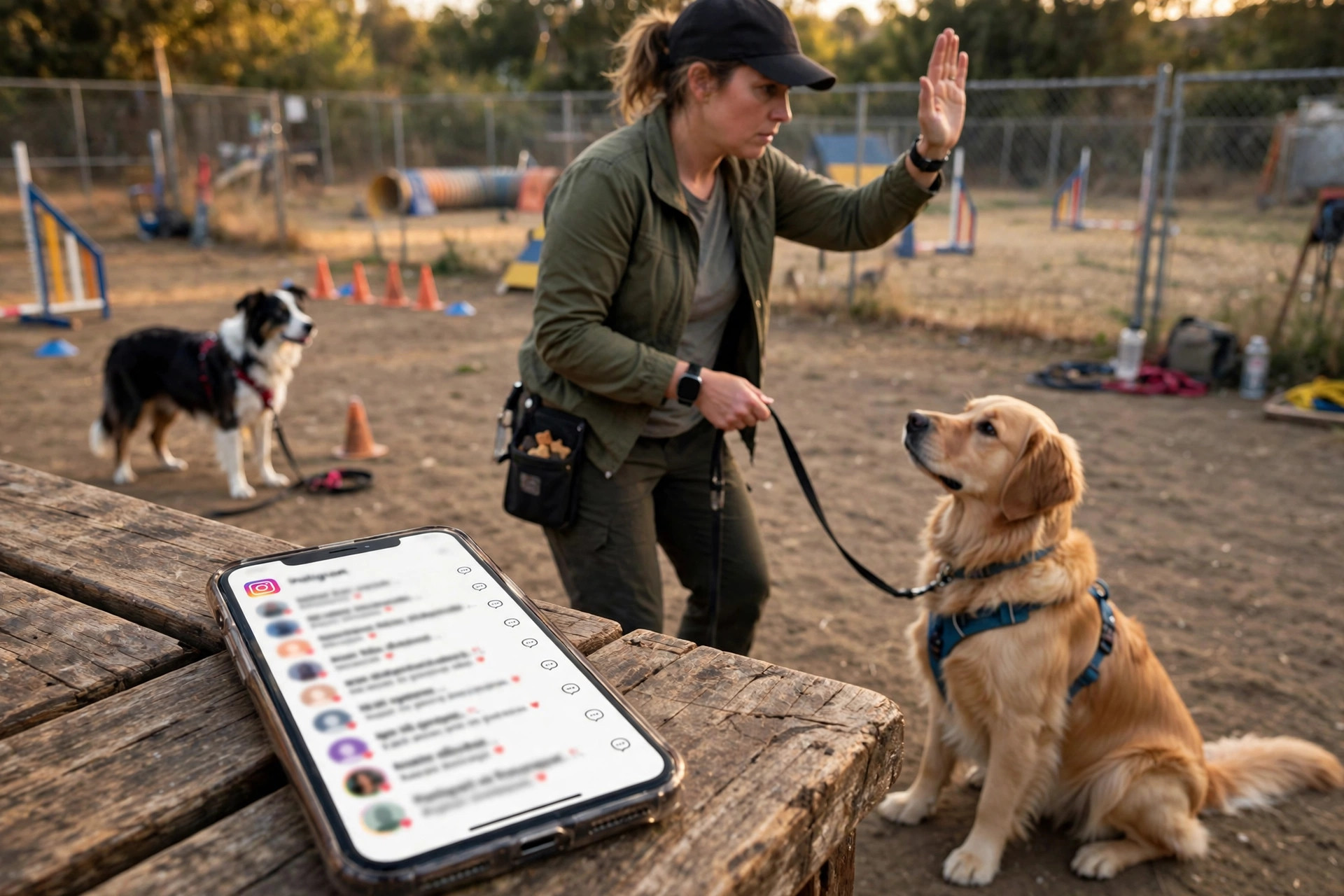
It is 4pm and you are in the training yard with a reactive shepherd. Your full attention is on the dog - timing, distance, the owner's handling - because in this trade a distracted second matters. Your phone sits on the bench, buzzing. A new puppy owner asks about your puppy program. Someone wants to know if you handle aggression cases. A third person asks your prices, a fourth wants a board-and-train spot next month, and someone sent a video of their dog lunging at the fence with the message "can you fix this?" You cannot answer any of them right now. By the time the session ends and you check the phone, the puppy owner has booked the trainer who replied in five minutes. This is the working reality of a dog trainer in 2026: your marketing is the transformation videos on Instagram, your inquiries arrive as DMs, and they arrive while your hands are literally full of dog.
Instagram DM automation for dog trainers handles that gap - with one critical difference from every other trade. A dog trainer's intake is not just scheduling; it is screening. An aggressive dog booked blindly into a group class is a safety problem, not an admin problem. This guide covers what the automation handles, the behavior-screening flow that keeps everyone safe, and how to set it up so it sounds like a trainer who genuinely cares about dogs - because the owners can tell the difference.
Why Dog Training Inquiries Are Different From Every Other Booking
Most local businesses sell a service. A dog trainer sells a transformation wrapped in emotion. The person messaging you is often stressed, embarrassed, or at their wit's end - the dog destroyed the sofa again, the neighbors complained about barking, the walks have become a battle. They found your before-and-after reel at midnight and messaged in a burst of hope. That message deserves a fast, warm, competent reply. It also deserves careful handling, because the details matter enormously: a puppy that jumps is a different case from a dog that bites, and the two need completely different programs.
Then there is the product complexity. A trainer typically offers several very different things: puppy programs, basic obedience, behavior modification, board-and-train, private sessions, group classes. Each has different pricing, different duration, different suitability - and the owner usually does not know which one they need. "My dog doesn't listen" could mean a six-week group class or a serious behavior case. The automation's job is to ask the sorting questions a good trainer asks on the first call: how old is the dog, what breed, what is the specific problem, and - the safety question - has the dog ever bitten or tried to bite a person or another dog. Instagram DM automation for dog trainers earns its keep in that screening conversation.
What Instagram DM Automation for Dog Trainers Actually Handles
- Answers program and pricing questions instantly - puppy programs, obedience courses, private sessions, board-and-train - in plain, jargon-free language.
- Screens every behavior inquiry for safety before booking: age, breed, the specific problem, and any bite history - so no risky case lands blindly in a group class.
- Books assessment or evaluation sessions into your calendar, because a proper trainer assesses the dog before prescribing the program.
- Routes cases to the right program automatically: puppies to puppy class, basic issues to group obedience, serious behavior cases to private assessment first.
- Sends your booking or consultation link at the right moment - after the screening, not as a cold first message.
- Follows up with owners who asked about training but went quiet, with the next available assessment date.
- Sends training homework reminders between sessions - "practice the loose-leash walk three times this week" - which is what actually makes training stick.
- Checks in after the program ends with progress follow-ups, turning one-time clients into advanced-course enrollments.
- Turns reel comments into consultations: "comment PUPPY" on a puppy training video starts the program conversation in DMs.
- Answers story replies about availability while you are in the yard, so the "do you have space next week?" messages never sit unanswered.
- Handles board-and-train inquiries as a premium flow - dates, the dog's routine, feeding and medical details - befitting your highest-value service.
- Hands over to you immediately for anything sensitive - aggression cases, bite history, distressed owners - with the full conversation attached, so you step in with complete context.
The Safety Screen: The Flow No Generic Bot Gets Right
This is the section that matters most, and it is the one no general automation guide covers. A dog trainer cannot auto-book the way a salon auto-books, because the wrong booking is dangerous. The screening flow must ask, early and plainly: has your dog ever bitten a person? Has it bitten or seriously fought with another dog? Does it lunge, snap or guard resources? These are not rude questions; they are professional ones, and owners with serious cases expect to be asked. The automation asks them warmly - "so I can match you with the right program and keep every dog safe" - which frames screening as care, not interrogation.
The answers route the conversation three ways. Clear-cut obedience and puppy cases flow toward the assessment booking. Mild reactivity goes to a private assessment first, never straight into group class. Anything involving bites, severe aggression or a clearly distressed owner gets handed to you personally, immediately, with the full transcript - because these cases need a trainer's judgment, not a chatbot's confidence. This triage protects your dogs, your clients, your reputation and frankly your liability. A trainer whose intake screens properly is a trainer who never has the story of "the aggressive dog in the wrong class" - and in this business, one such story can end a career.
The Assessment Session: Your Trial Class Equivalent
Good trainers do not prescribe before they diagnose, which is why the assessment or evaluation session is the hinge of the whole business. It is where you meet the dog, watch the owner handle it, identify the real problem (often different from what the owner described), and recommend the right program. The automation treats the assessment as the conversion event: it explains what happens in the session, how long it takes, what to bring, and books it into your calendar with a confirmation message that sets expectations.
The confirmation message does quiet, important work. It tells the owner what the assessment is and is not - an evaluation, not a full training session - so nobody arrives expecting miracles in an hour. It asks them to bring the dog's regular collar and leash, vaccination records if your facility requires them, and an honest account of the problems. Owners who arrive prepared get more from the session; sessions that run well convert to programs. And the post-assessment follow-up - "great meeting you and Max today, here's the program I'd recommend, shall we get you started?" - sent while the session is fresh in the owner's mind, is where programs get sold.
Puppy Owners: Your Most Valuable (and Most Anxious) Audience
Puppy owners are a special category. They are new, overwhelmed, guilty about everything, and searching for guidance at 1am while the puppy chews the furniture. They ask the same questions every trainer has answered a thousand times: when do we start training, is my puppy too young, how do we stop the biting, is crate training cruel. The automation answers these patiently, any hour, which builds enormous goodwill - and then guides the owner toward the puppy program with the right start date for the puppy's age.
The puppy flow also carries your best long-term economics. A puppy client who trains with you at twelve weeks is a client for basic obedience at six months, advanced work at a year, and possibly board-and-train or sport training later. Pet businesses that nurture the relationship from the start keep clients for years - groomers know this well, as described in AI chatbots for pet groomers. Each program completion triggers the next recommendation: "Max did brilliantly in puppy class - the adolescent obedience course starting next month would be perfect for him." The automation remembers the journey so you do not have to, and the client feels known rather than processed.
Homework Reminders: Where Training Actually Succeeds or Fails
Every trainer knows the uncomfortable truth: the sessions are the easy part. Training works or fails in the week between sessions, when the owner either practices or does not. Most owners start keen and fade by week three. Automated homework reminders - short, encouraging, specific - are the difference between a client who progresses and a client who stalls and quietly blames the program. "Week 3 check-in: how's the settle-on-mat practice going? Three short sessions beat one long one - you've got this." It takes the owner thirty seconds to read and it keeps the training alive.
These messages also surface problems early. An owner who replies "he's still lunging at every dog" is telling you the program needs adjusting before the next session - information you would otherwise discover a week later, mid-class. The automation flags such replies for your attention, so you can respond personally with guidance or move the next session's plan. Coaches in every field face this same between-session gap - tutoring businesses, for instance, run similar check-in flows, as shown in AI chatbots for tutoring businesses. The principle is universal: the work between sessions decides the outcome, and a nudge is what keeps it happening.
Board-and-Train: Your Premium Service Deserves a Premium Flow
Board-and-train - the dog stays with you for intensive training over weeks - is typically a trainer's highest-value offering, and its inquiries deserve white-glove handling. The automation runs a dedicated intake: the dog's age and breed, the goals for the stay, feeding routine and any medical needs, the owner's schedule, and the all-important safety screen. It explains what board-and-train includes (and what it honestly cannot promise - no ethical trainer guarantees behavior outcomes, and the automation must never imply otherwise), shares available start dates, and then hands the conversation to you for the personal discussion that closes premium bookings.
The honesty requirement here is a trust issue, not just a legal one. Dog training has its share of overpromising, and owners have learned to be skeptical. An automation that speaks plainly - about timelines, about the owner's role after the dog comes home, about what success realistically looks like - stands out precisely because so many competitors exaggerate. The follow-up after a board-and-train stay matters just as much: check-ins at one week and one month, refresher session offers, and the honest guidance that keeps the training alive at home. Premium clients who feel looked after become your loudest referrers.
Want this for your dog trainers?
ReplyPilot builds a custom instagram dm automation setup for your dog trainers — answering customer questions instantly, taking orders and bookings, and handing off to you when a human is needed.
Ask on WhatsApp — it's freeSetting Up Instagram DMs for Dog Training, Step by Step
- Step one: write your program menu in plain language. Puppy program, basic obedience, behavior modification, private sessions, board-and-train - what each includes, how long it runs, who it suits. No jargon.
- Step two: design the safety screen. Bite history, aggression signals, reactivity - write the questions warmly but directly, and define exactly which answers trigger your personal handover.
- Step three: build the sorting flow for dog training. Dog's age, breed, the specific problem in the owner's words, then the safety questions, then the program match. Test it with tricky cases, not easy ones.
- Step four: connect your assessment booking. Whatever calendar you use, the automation offers real assessment slots after screening - never before.
- Step five: write the homework and follow-up sequences. Between-session reminders for active clients, post-program check-ins, next-course recommendations. Keep every message encouraging and specific.
- Step six: create the comment triggers for dog training. "PUPPY" on puppy reels, "TRAIN" on transformation videos. Each trigger should start the screening conversation, not dump a price list.
- Step seven: test as a worried owner. Message your own account at midnight about an aggressive dog, a biting puppy, a hopeless case. Read every reply out loud. If anything sounds careless, rewrite it before it goes live.
What Should a Dog Trainer's First Auto-Reply Say?
Warm, competent, and curious about the dog - never salesy. Something like: "Hey, thanks for reaching out! I'd love to help - tell me a bit about your dog: how old, what breed, and what's the main thing you'd like to work on?" Three easy questions that start the sorting while showing you care about the individual dog. What it must not do is open with prices or promise results. An owner with a difficult dog needs to feel heard before they hear numbers, and no ethical setup ever guarantees outcomes. For aggression-related inquiries, the tone matters even more - the automation should acknowledge the stress honestly ("that sounds really tough - you're doing the right thing asking for help") before moving to the safety questions. The first message sets the tone for the whole relationship: this trainer listens first.
Two Mistakes Dog Trainers Make With DM Automation
The first mistake is skipping the safety screen to reduce friction. It is tempting - fewer questions means more bookings - but one aggressive dog placed in the wrong program can injure another dog, traumatize an owner, and destroy the reputation you spent years building. The screen is not friction; it is professionalism, and serious owners respect it. The second mistake is letting the automation give behavior advice. "How do I stop my dog biting?" is not a question for a chatbot - wrong advice here can get someone hurt. The automation's answer to behavior questions should always be: that's exactly what the assessment is for, here's how to book one. Advice belongs to the trainer, in person, watching the dog. Everything else is just scheduling around that truth.
Is It Safe for Your Trainer Account?
Yes, through Meta's official API - the only route to consider. Your Instagram needs to be a professional account connected to a Facebook Page, and you authorize the tool through Meta's own login. If any tool asks for your Instagram password, walk away; that single rule filters out the risky options. WhatsApp's official Business Platform documentation sets out the consent and messaging principles Meta applies across its messaging tools. And this plain-English guide to comment-to-DM automation explains what a comment is allowed to trigger, what happens when someone replies, and where cheap tools cut corners - worth reading before you connect anything to the account your reputation lives on.
Referrals and Reviews: The Engine That Compounds
Dog training is one of the most referral-driven trades in existence. Owners talk - at the dog park, in breed groups, in the neighborhood chat. A single transformed "problem dog" generates more business than any advertising, because every owner with a difficult dog knows three others in the same boat. The automation feeds this engine deliberately. After a program ends and the follow-up confirms the owner is happy, a short message asks for a review - with the direct link, while the gratitude is fresh. Happy owners also get the referral nudge: "know someone struggling with their dog? send them our way for an assessment."
Video testimonials deserve special attention in this trade, because transformation is visual. An owner willing to share a before-and-after clip is handing you your most persuasive marketing asset. The automation can request these gently after successful programs - never pushy, always optional - and the resulting reels become the top of your next funnel, complete with comment triggers that start the whole cycle again. This is the compounding loop the best trainers run: great results become content, content becomes inquiries, inquiries become clients, clients become results. The automation does not create the loop - your training does that - but it makes sure no part of it leaks. Even a modest version of this - ten reviews a year, a handful of shared transformation clips - changes the trajectory of a training business, because every new inquiry arrives pre-sold by someone else's success story.
How Do You Know Your Dog-Training Automation Is Working?
Watch the numbers that match your business. Assessment bookings per week - the raw count the automation schedules. Assessment-to-program conversion - whether the right dogs are being matched to the right programs, which validates your screening flow. Response time - seconds, at any hour, instead of "whenever the trainer gets off the field." And the safety metric only you can track: zero unsuitable dogs placed in group settings, because the screen caught them first. It is the same discipline behind lead capture automation - measure the conversations that matter, not vanity metrics. Review a few transcripts monthly, sharpen the questions that misfire, and the system gets wiser every season.
The dog trainers with full programs are not necessarily the ones with the most dramatic transformation reels. They are the ones who answer the worried owner in seconds, screen every case properly, book the assessment without delay, and stay in touch between sessions - while their attention stays exactly where it belongs: on the dog in front of them. An owner's decision to trust you with their dog is made in the minutes after they send the DM; the trainer who replies like a professional who listens wins that trust. Instagram DM automation for dog trainers makes sure that trainer is you, at 4pm in the yard and at 1am when the puppy owner can't sleep. Want to see how this workflow could work for your training business? Request a free custom demo from ReplyPilot at https://replypilot-site.vercel.app/ - built around your programs, your screening questions and your voice, and tested before it ever talks to an owner.
What Should the Bot Say to “Can You Fix My Dog in One Session?”
Almost every trainer gets this message, and it comes from hope, not rudeness. The owner is exhausted and wants to believe one session could end it. A bad bot either promises the world or lectures about realistic timelines. A good bot does neither — it validates, then redirects to the assessment: “I understand wanting this sorted quickly — most owners feel exactly the same. Every dog is different, which is why we start with an assessment: we meet your dog, see what is really going on, and then give you an honest plan with a realistic timeline.” No promises, no scolding, just a clear next step. Owners who hear an honest timeline upfront become your most loyal clients, because every bit of progress feels like a bonus instead of a broken promise.
The Midnight Message From a Frightened Owner
Some messages are not enquiries — they are distress signals. “My dog just bit my neighbour’s dog, I don’t know what to do.” The owner is panicked, possibly in tears, and a chipper sales bot would be a disaster. Teach your automation to recognise crisis language and switch tone instantly: calm, warm, human. It should say the three things a frightened owner needs: this is more common than they think, they did the right thing reaching out, and a trainer will personally review their message first thing in the morning. It must never attempt behaviour advice in that moment — no calming tips, nothing that could be read as professional guidance. It collects the key facts gently, flags the conversation as urgent for you, and confirms a human is coming. That message, handled with care at 1am, is often the reason the owner chooses you over everyone else.
How Do You Explain Program Prices Without Sticker Shock?
Dog training prices cause sticker shock because owners compare a program fee to a single session in their head — and the program always looks expensive that way. Your bot should reframe before it reveals. First the shape of the program: how many sessions, over how many weeks, what is included between sessions. Then the outcome it is designed for. Only then the price — and next to it, the per-session maths, which almost always looks reasonable. “The six-week program is twelve sessions with homework support between each one — that works out to less per session than our single-session rate, and it is the structure that actually changes behaviour.” If you offer payment plans, the bot mentions them as a plain fact, not a sales tactic. Owners do not object to prices; they object to surprises. A bot that explains the value before the number gets far fewer “oh…” replies.
What Happens After the Last Session?
Most trainers end the relationship at graduation: a handshake, a “well done,” and silence. That is where the money quietly leaks, because a trained dog still needs maintenance and the owner still needs you. Build a graduation flow into the automation. A week after the final session, a check-in: how is the dog doing with the new routine? A month later, a refresher offer — one session to polish what slipped. Twice a year, alumni get first refusal on new group classes or workshops. And graduation is the perfect moment for the review request, while the transformation is fresh and the gratitude is high. This flow does three jobs: it catches backsliding before the owner gives up, it fills your advanced programs with warm graduates, and it keeps your happiest clients talking about you at the dog park for years.
Frequently Asked Questions
How does the safety screen work in a dog trainer's DM automation?
Before any booking, the chatbot asks about the dog's age, breed, and behaviour issues — especially aggression or bite history. Dogs that need one-on-one work are routed to private sessions, never mixed into group classes. Safety comes before bookings.
Can Instagram DM automation book assessment sessions for my training business?
Yes. It explains what the assessment covers, shows your available slots, and books the owner in. It also tells them what to bring and what to expect, so they arrive prepared instead of nervous.
What about puppy owners who message at 1am panicking?
They get an instant, calming reply with answers to the most common puppy questions — biting, toilet training, crate crying — plus an easy path to book a puppy program. Anxious owners become clients when someone answers while they are worried.
Can the chatbot remind owners about training homework?
Yes, and this is where training programs actually succeed. After each session, the owner gets their homework — the exercises and repetitions — with a check-in a few days later. Dogs improve faster, and owners renew more often.
Is Instagram DM automation safe for my trainer account?
Yes, through Meta's official API: a professional account connected to a Facebook Page, authorised via Meta login. Any tool that asks for your Instagram password is one to avoid completely.