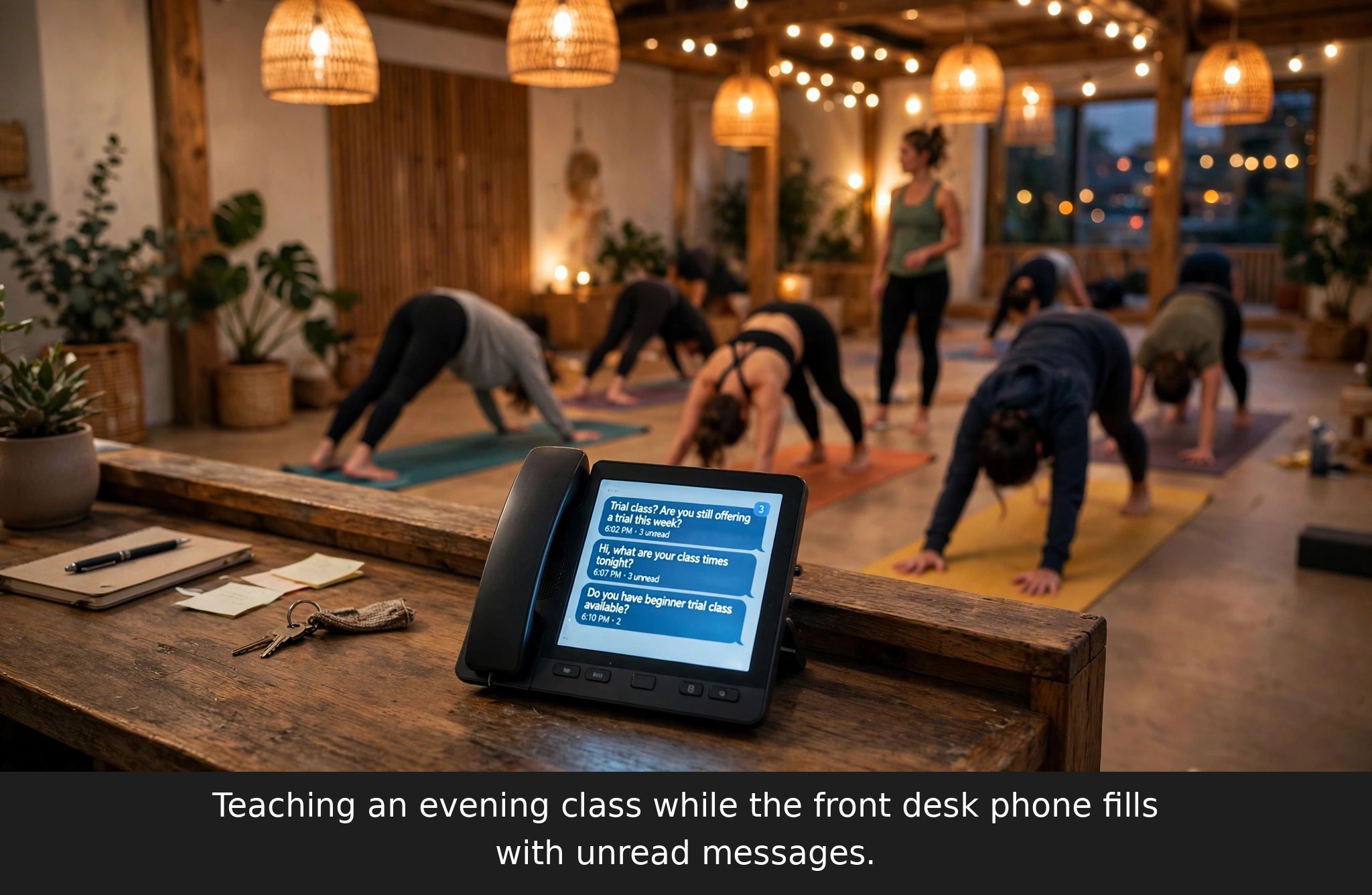
It is 6:40 on a Saturday morning. You are unrolling mats, lighting the diffuser, and trying to get the playlist right before the 7am class. Your phone vibrates in your bag. Then again. Then again. You cannot check it, because twelve students are about to walk through the door and you are the teacher, the receptionist, and the cleaner this morning. At 8:30, when class ends and you finally look, there are four messages. Three are simple: "Do you have a beginner class?" "How much is a trial?" "Is tonight's class full?" The fourth is the one that hurts: "Hi, I messaged last night about trying yoga for the first time. I was really nervous. I guess I will try somewhere else." That woman was ready to become your student. She did not need a sales pitch. She needed one warm answer at 9pm, when the courage to ask was fresh. An AI chatbot for yoga studios exists for exactly this moment. It answers the nervous beginner at 9pm, matches her to the gentle Tuesday class, books her trial, and tells her what to bring. You never once picked up your phone. She walks in Tuesday anyway.
A yoga studio does not sell stretches. It sells the courage to walk in the door for the first time. That is why the chatbot conversation matters more in yoga than in almost any other fitness business. Nobody is nervous about messaging a gym. Plenty of people are nervous about messaging a yoga studio: Am I flexible enough? Will I look silly? Is everyone already advanced? The chatbot's real job is to lower that wall, one kind answer at a time, at whatever hour the courage arrives. This article is the full owner playbook: what a yoga studio chatbot should handle, how it deals with the sensitive questions about injuries and pregnancy, how it fills waitlists and renews memberships, and the step-by-step setup that needs no developer.
The Beginner Problem: Your Hardest Sale Is Courage
Think about who your best future students are. They are not the flexible twenty-somethings. They are the forty-year-old with back pain who has been meaning to try yoga for two years, the new mother who needs an hour for herself, the man who thinks yoga is not for men and is quietly curious anyway. These people do not call. Calling feels like commitment. They message, usually late at night, usually with a question that is really a fear wearing a disguise: "I have never done yoga, is that okay?" "I am not flexible at all, will I be able to do it?" "What should I wear, I do not own yoga clothes?" Each of these is a person standing at the edge of your door. A fast, warm, specific answer pulls them in. Silence lets the fear win.
This is where most studio websites fail. The schedule page says "Gentle Hatha, Tuesdays 6pm." The nervous beginner reads that and thinks: is gentle actually gentle? Will the teacher help me? What if everyone else is advanced? A chatbot turns that static schedule into a conversation. "I have never done yoga and I have a bad knee." "Then Tuesday's gentle class is perfect for you. The teacher gives knee-friendly options for every pose, and half the class started as beginners this year. Want me to book you a trial for Tuesday?" That is not a feature list. That is a hand reaching out. The beginner who messages "I've never done yoga, is it okay?" is one warm answer away from a trial class, or one unanswered message away from never trying.
What Prospects Actually Ask (Before They Ever Visit)
A yoga studio's inbox is different from a gym's. Fewer questions about prices, more questions about belonging. Train your yoga chatbot on the real list:
- I have never done yoga. Which class should I start with?
- I am not flexible at all. Will I be able to keep up?
- I have a bad back / knee / shoulder. Can I still do yoga?
- I am pregnant. Do you have classes that are safe for me?
- How much is a trial class, and what do I need to bring?
- What should I wear? I do not own yoga clothes.
- Are your classes very spiritual, or is it mostly exercise?
- How big are the classes? I do not want to be the only beginner.
- Do you have early morning or late evening classes? I work full time.
- What is the difference between Hatha, Vinyasa, and Yin?
Read that list as a marketer and it is gold. Every question is a buying signal wrapped in anxiety. The person asking about pregnancy yoga is not browsing. She is choosing where to spend the next six months. The person asking about class size is picturing themselves in the room. A chatbot that answers these in seconds, kindly and specifically, converts at a rate no schedule page can touch. Compare the experience: a static FAQ page versus a conversation that ends with "shall I save you a mat for Tuesday?" One informs. The other enrolls.
What an AI Chatbot for Yoga Studios Actually Does All Day
Here is the honest job description, on a normal week at a normal studio:
- Matches people to the right class: level, schedule, physical needs, and temperament. Beginner with a bad knee goes to gentle Hatha, not power Vinyasa.
- Books trial classes conversationally: name, class, day, what to bring, where to park. Sends a confirmation and a "see you Tuesday" reminder the day before.
- Answers pricing and membership questions from your real sheet: drop-in rates, class packs, monthly unlimited, what happens when you go on holiday.
- Manages the waitlist: when a popular class fills, it offers the waitlist, and the moment a spot opens, it messages the next person in line.
- Introduces instructors: who teaches what, their style, their specialties. New students pick classes partly by teacher, and the bot knows them all.
- Announces workshops and retreats to the right people: the Yin regulars hear about the sound bath, the Vinyasa crowd hears about the arm-balance workshop.
- Nudges quiet members back: a warm check-in when someone has not booked in three weeks, with an easy path back to the mat.
Your instructors teach the class. Your chatbot fills the mats. That division of labor is the whole point. Nobody opened a yoga studio because they love answering "what is Yin yoga?" forty times a week. The bot takes the repetition. You keep the teaching, the adjusting, the community. The same split works in AI chatbots for gyms and fitness studios, but yoga's emotional barrier makes the warm, patient conversation style matter even more here.
The Injury and Pregnancy Questions: Handle With Care
Two categories of questions need special design: injuries and pregnancy. These arrive constantly, they are sensitive, and the wrong answer is worse than no answer. A good yoga studio chatbot treats them with a fixed, careful pattern. For injuries: acknowledge, ask which class they are considering, explain that teachers offer modifications for common issues, share which classes are gentlest, and always add that they should check with their doctor or physio first and tell the teacher before class. For pregnancy: point to the dedicated prenatal classes if you have them, explain which regular classes are suitable in which trimester according to your teachers' guidance, and again, doctor first.
What the bot must never do is play doctor. "Your back pain sounds like a disc issue, try this pose" is forbidden territory. The line is simple: the bot shares your studio's written guidance about class suitability, and anything medical goes to a professional. Write those guidance paragraphs with your senior teachers, review them twice a year, and test the bot with tricky phrasing: "I am 7 months pregnant, can I do hot yoga?" The answer must be safe, specific, and humble. In wellness, trust is the product. One reckless answer can undo years of it.
Waitlists That Fill Themselves
Every popular studio has the same quiet tragedy: a full class, a waitlist on paper, and three no-shows on the night. The mats sit empty while five people who wanted them stayed home thinking there was no room. A chatbot fixes this without anyone lifting a finger. When someone tries to book a full class, the bot offers the waitlist in one message. When a cancellation comes in, it messages the first waitlisted person instantly: "A spot opened in tonight's 6pm Vinyasa. Want it? Reply yes in the next 30 minutes." No reply, and it moves to the next person. The mat fills. The studio earns. Nobody made a phone call.
The reminder side matters just as much. A huge share of no-shows is not flakiness, it is forgetfulness. The bot sends a friendly reminder the evening before and the morning of: "See you at 6pm! Need to cancel? Tap here and your spot goes to someone on the waitlist." Making cancellation easy sounds like losing money, but it is the opposite. An early cancellation becomes someone else's booking. A no-show becomes an empty mat. Studios that pair reminders with instant waitlist backfill stop fearing cancellations and start welcoming them.
Memberships: Renewals and the Ghost Members
Here is the math every studio owner knows in their bones. Getting a new student costs far more than keeping one. Yet most studios run renewals on hope: the membership expires, nobody says anything, and the student drifts away. A chatbot runs renewals as conversations, not invoices. Two weeks before a membership ends, it messages: "Your unlimited is up on the 30th. You have come to 14 classes this month, that is wonderful consistency. Shall I renew it for next month?" The message references their real attendance, celebrates it, and makes renewal one tap. That is not a billing reminder. That is a coach noticing your effort.
Then there are the ghost members: people who pay monthly and have not shown up in three weeks. They are one guilty feeling away from cancelling. The worst thing you can do is nothing, because silence lets the guilt harden into a cancellation. The bot sends a warm, zero-pressure check-in: "We have missed you on the mat. Everything okay? There is a gentle Sunday class this week if you fancy easing back in." No discount needed, no desperation. Just being noticed. Many quiet members return after a single kind check-in, because the reason they drifted was usually life getting busy, not your studio.
Workshops and Retreats: Your Highest-Margin Sales
A Saturday sound-bath workshop or a weekend retreat can earn more than a week of regular classes, but only if the right people hear about it. The usual approach is a generic email blast that most members skim and delete. A chatbot does it the smarter way: it knows who comes to Yin, who comes to Vinyasa, who asked about meditation last month. So the sound-bath announcement goes to the Yin regulars and the meditation-curious, personally: "You have been to six Yin classes this month. We are doing a candlelit sound bath on Saturday, and I thought of you." That message converts like nothing else because it is not marketing. It is attention.
The bot also handles the fiddly logistics that make workshops painful: limited spots, early-bird pricing deadlines, what to bring, dietary needs for retreat catering, payment plans. Each of those is a question that would otherwise land on your phone while you are teaching. Instead the bot answers, collects, and confirms, and you see a tidy list of paid bookings. Studios that run regular workshops find this is where the chatbot quietly earns its keep, because workshop seats are perishable. An empty retreat bed is money that never comes back.
Real Studios Are Already Doing This
This is not theory. Independent studios have been adding AI chat assistants to their websites through 2026, and the pattern is consistent. One published case study of a London yoga studio describes a floating AI assistant that recommends classes by level and schedule, answers pricing questions in plain language, guides visitors toward booking, and hands off to WhatsApp when someone is ready to talk to a human, all branded as the studio's own assistant rather than a generic bot (case study). That last detail matters: students talk to "the studio's assistant," not to a software logo. The technology disappears and the studio's personality remains.
The broader direction is clear from how wellness businesses are adopting automation this year: the winners are not the studios with the flashiest bots, but the ones whose bots sound like their best receptionist on her best day. Warm, unhurried, specific. A yoga studio chatbot that rushes people or pushes packages hard will feel wrong to exactly the audience you want. Calm converts in this business. Design every message as if the student is nervous, because often, they are.
Setting Up Your Yoga Automation, Step by Step
A yoga studio chatbot is a writing project with a teaching review, not a tech project. Your teachers supply the knowledge. The AI supplies the patience a yoga studio needs. Here is the order:
Want this for your yoga studios?
ReplyPilot builds a custom ai chatbot setup for your yoga studios — answering customer questions instantly, taking orders and bookings, and handing off to you when a human is needed.
Ask on WhatsApp — it's free- Step 1: Write your class guide in plain words. Every class type, who it suits, how intense it really is, what a first-timer should expect. Be honest; "gentle" must mean gentle.
- Step 2: List your 25 most-asked questions from DMs, email, and the front desk. The nervous-beginner questions go first; they are your highest-value answers.
- Step 3: Write the injury and pregnancy guidance with your senior teachers. Which classes suit which situations, what to tell the teacher, when to see a doctor first.
- Step 4: Set your yoga studio's booking rules. Trial class price and process, class pack options, cancellation window, waitlist order. The bot enforces these exactly.
- Step 5: Write your instructor introductions. Two warm sentences each: style, specialties, who loves their classes. Students choose teachers, not timetables.
- Step 6: Choose your yoga studio's channels. Website chat first, then Instagram and WhatsApp where your prospects already message you.
- Step 7: Set your yoga studio's handoff rule. Medical questions beyond your written guidance, complaints, and anything unusual go to a human with the full conversation attached.
- Step 8: Test as a nervous beginner. Send it the ten scariest first-timer questions. If any answer feels cold, rushed, or pushy, rewrite it before launch.
Step eight is the soul of the whole project. Read every answer out loud and ask: would this make a nervous forty-year-old feel welcome? If yes, launch. If not, keep writing. ReplyPilot builds yoga studio chatbots with this exact process, and the nervous-beginner test is the gate every setup must pass. Your studio's warmth is the product. The bot just extends its hours.
What It Should Never Do
- Never play doctor. No diagnoses, no pose prescriptions for injuries, no pregnancy medical advice beyond your teachers' written guidance.
- Never pressure. No countdown timers, no "only 2 spots left" tricks, no guilt about missed classes. Calm converts here; pressure repels.
- Never invent class details, prices, or teacher credentials. Unknown facts get a human handoff, not a guess.
- Never pretend to be a teacher or a human receptionist. It introduces itself as the studio's assistant, honestly and warmly.
- Never ignore the emotional tone. If someone sounds anxious, the bot slows down, reassures, and offers the gentlest next step, not the full timetable.
How to Tell If Your Yoga Automation Is Working
- Trial class bookings from chat. Count how many first-timers arrived via a bot conversation each month.
- Response time to beginner questions. From hours to seconds is the whole game.
- Waitlist conversion. How many cancelled spots got refilled instead of sitting empty?
- Renewal conversations completed. Memberships renewed through a chat message instead of drifting away.
- Ghost member returns. How many quiet members came back after a check-in?
Track these monthly and the story tells itself. Most studios see the trial-booking number move first, usually within weeks, because the nervous-beginner questions were always there, just unanswered. The renewal and return numbers compound quietly over quarters. Together they describe a studio that never sleeps on its relationships, even when its teachers are on the mat.
Will a Chatbot Not Feel Wrong for a Wellness Brand?
It will feel wrong if it acts like a sales bot. It will feel right if it acts like your warmest receptionist. The difference is entirely in the writing: unhurried messages, no pressure, specific answers, honest handoffs. Wellness customers are not anti-technology; they book everything else in their lives through their phones. What they reject is being rushed or processed. A chatbot that says "take your time, the Tuesday class will be here when you are ready" is more on-brand than a human who is too busy to reply. The medium is not the message here. The tone is.
What If Someone Has a Serious Injury?
Then the bot does the safest and most helpful thing: it shares your studio's written guidance about which classes are gentlest, tells them to check with their doctor or physio first, asks them to tell the teacher before class, and offers to connect them with a human to discuss further. It never names the injury, never suggests it knows what is wrong, and never recommends specific poses as treatment. This is the same boundary that AI chatbots for tutoring businesses and other advisory businesses respect: share your published guidance freely, route everything else to the qualified human.
Does It Handle Class Cancellations and Schedule Changes?
Yes, and this is one of its most underrated jobs. When a teacher is sick or a class time changes, the bot messages everyone booked: "Tomorrow's 7am class is cancelled, really sorry. I can move you to the 9am or refund the credit, your choice." No frantic group email, no students arriving to a locked door. For regular schedule changes, it answers "when is the next Yin class?" from the live timetable, so your Instagram DMs stop being a schedule hotline. Your students experience a studio that communicates, and you experience mornings without crisis management.
Want this working in your yoga studio?
Every empty mat in your studio is a conversation that never happened. A nervous beginner who got no answer. A waitlisted student who never heard about the opening. A member whose renewal drifted past unnoticed. An AI chatbot for yoga studios holds those conversations for you: warmly, patiently, at 9pm and at 6am, in your studio's voice. It matches beginners to the right class, fills waitlists automatically, renews memberships with a personal touch, and announces your workshops to exactly the right students. It never replaces your teaching. It makes sure your teaching reaches the people who need it. If you want to see this with your actual class schedule and your actual teachers' guidance, ReplyPilot will build you a free custom demo. Bring your ten most-asked beginner questions and watch it answer them live. Start here: get a free custom demo for your yoga studio.
What Should First-Timers Know Before They Walk In?
Ask any studio owner what stops beginners, and half the answer is logistics anxiety. Not fear of the poses — fear of looking foolish in the wrong clothes, arriving at the wrong time, or not knowing where to put their shoes. These tiny worries keep people home. The chatbot answers all of them before the courage fades.
What to wear: comfortable clothes you can move in, nothing fancy. What to bring: just yourself and water — mats and props are provided. When to arrive: ten minutes early, so the teacher can show you where everything is. Whether to eat: a light snack is fine, a full meal is not. Where to park, which door to use, what happens when you walk in — the whole first visit, described like a friend explaining it.
This is also where the chatbot quietly handles the questions people are embarrassed to ask: “Is there somewhere to change?” “What if I need the bathroom mid-class?” “Will everyone stare at me?” — and the honest answer to the last one is no; everyone is thinking about their own balance. Answer these warmly and specifically, and the nervous beginner walks through your door instead of staying home.
Can the Chatbot Fill Your Private Sessions Too?
Group classes pay the rent, but private sessions are where the real margin lives. A one-on-one session costs several times a class pass — and the people who want them are often the same nervous beginners who will not call to ask. The chatbot is the perfect quiet salesperson for this.
When someone mentions an injury, a specific goal, or feeling too nervous for group classes, the chatbot can gently offer: “Many of our students start with a private session — just you and the teacher, at your pace. Would you like to hear how it works?” No pressure, just an open door at the exact moment the need appears.
The booking itself is simple: the chatbot shows which teachers offer privates, their real availability, and your real prices. It asks about the student’s goal in a few words so the teacher arrives prepared. Private students become the most loyal members a studio has — and every one of them started with a question the chatbot answered at 10pm.
How Do You Handle “Can I Pause My Membership?”
This message makes every studio owner’s heart sink. A member wants to pause — and a paused membership often becomes a cancelled one. The instinct is to make it difficult. That instinct is wrong. The member who pauses easily comes back. The member who fights to pause leaves angry and tells friends.
The chatbot handles it with grace. First, it makes pausing simple — a few taps, done, no guilt trip. Then, gently, it asks why: travel, money, injury, lost motivation? The answer decides what happens next. Travelling? “We’ll see you in two months — want me to hold your favorite class spot?” Money tight? “We have a lighter plan that might fit better — want to see it?” Injured? “Take care of yourself — shall I check in with you in a few weeks?”
Notice the pattern: solve the real problem behind the pause, and the pause often disappears on its own. And when it does not, the member leaves feeling respected — which is exactly why they come back later. Retention is not about locking doors. It is about being the studio people want to return to.
Should the Chatbot Introduce Your Teachers?
Here is something studio websites get wrong: they list class times, but beginners choose teachers, not timetables. “Who teaches the Tuesday morning class? Is she good with beginners? Is he the strict one?” These are real questions real students ask — usually to the receptionist, usually while you are teaching.
Give the chatbot a short, honest profile of each teacher: their style, their classes, who they are great for. For example: “Tuesday Vinyasa with Sara — strong but kind, brilliant with beginners, expect good music.” Written by you, in your voice, with each teacher’s approval. The chatbot matches the nervous beginner to the gentlest teacher and the ambitious one to the challenging class.
This does something subtle and powerful: it makes your studio feel human before the first visit. A timetable is a grid. A teacher with a personality is a reason to show up. And when a teacher is away and a substitute steps in, the chatbot tells booked students who is teaching instead — no surprises at the door, no disappointed regulars.
Class-based businesses need bookings handled between sessions — see how an AI chatbot for language schools manages trial bookings and FAQs.
Movement studios fill classes through DMs — Instagram DM automation for dance studios answers schedule questions and books trial classes.
Frequently Asked Questions
Can an AI chatbot answer nervous beginner questions for my yoga studio?
Yes. "I've never done yoga, will I cope?" gets a warm, encouraging answer plus a beginner class recommendation. Beginners are your best growth source, and their questions need kindness, not sales pressure.
How much does a chatbot cost for a yoga studio?
Typically a modest monthly fee for a yoga studio. A single new monthly member covers it. Studios running intro offers convert better with instant answers — hesitation kills signups.
Can the yoga chatbot manage class waitlists?
Yes. When a class fills, it adds people to the waitlist and messages them the moment a spot opens. Full classes stay full, and members love the fairness of an automatic waitlist.
Will the chatbot match people to the right class level?
Yes. It asks about experience, fitness, and goals, then recommends the right class — gentle beginners, power flow, prenatal. Right-fit students stay longer; mismatched ones quit.
Can the studio chatbot fill trial classes while I am teaching?
Absolutely. You are on the mat at 7am; enquiries come in at 7:05. The chatbot books them into your next trial slot. Every empty mat is a conversation that never happened — this fixes that.