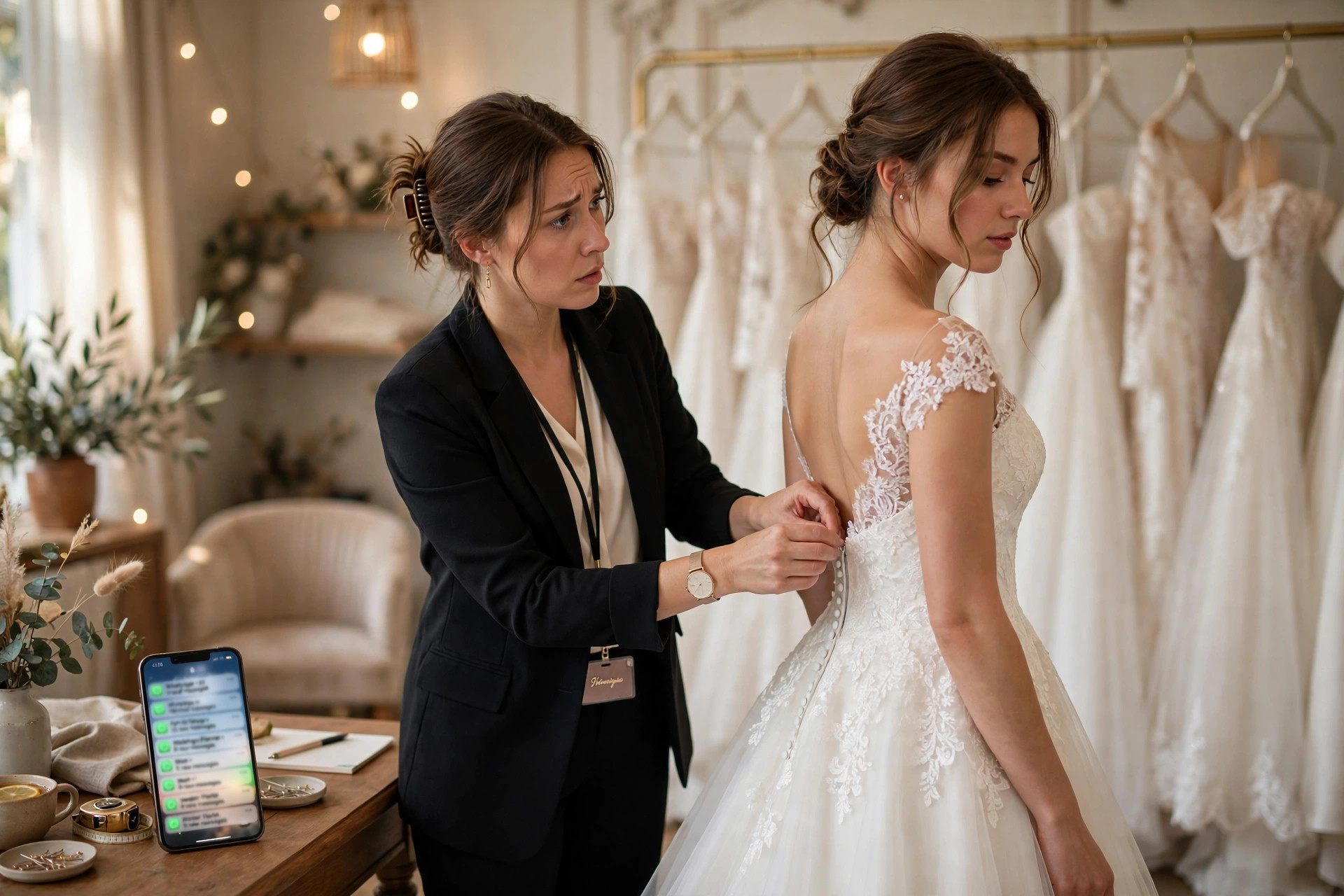
It is Saturday morning at your bridal shop and a bride is standing on the fitting platform in a gown she almost loves. Her mother is wiping her eyes. You are pinning the hem, giving her your full attention, exactly as you should. On the counter, your phone is lighting up again and again. 'Is there a trial slot this weekend?' 'What is the starting price for the red collection?' 'Do you deliver to another city?' Three brides with real money in their pockets, asking you to take it. You will read their messages at 9pm, when you are tired, and two of them will already have booked a trial somewhere else. WhatsApp automation for bridal shops means an AI assistant that answers those messages in seconds while you stay in the fitting room. It books trial appointments, answers price and collection questions in your shop's own tone, follows up with brides who go quiet, and hands over to you when a human touch matters. For a bridal shop, the best approach is chat-based automation because brides message at odd hours with high-emotion, high-value questions about the biggest purchase of their lives, and a reply that arrives in seconds keeps the sale while a reply that arrives tomorrow loses it.
Why a Bride's First Message Deserves an Answer in Seconds
A bridal gown is one of the most expensive single purchases of a woman's life, and the buying journey starts with a message, not a visit. She sees your reel at midnight, opens your profile, and taps the WhatsApp button. That tap is a moment of excitement. Every hour it sits unanswered, the excitement cools and another shop answers faster. Brides comparison-shop. Your shop is almost never the only chat on her phone.
The hard part is that your busiest hours are exactly when messages arrive. Weekends and evenings are peak enquiry time, and they are also peak fitting time. You cannot be in the fitting room and in the chat at once. An automation does not get tired, does not forget, and does not answer with one-word replies at midnight. It answers with the same care at 1am as you would at 11am.
A bride who waits six hours for a reply has already tried on three dresses somewhere else. That sentence should be on the wall of every bridal shop. Speed is the entire game in this business, and speed is the one thing automation gives you without hiring a single extra person.
What WhatsApp Automation for Bridal Shops Actually Does
Forget the word 'chatbot' for a moment and think of a well-trained assistant who knows your shop by heart. She knows your price ranges, which collections are in store, how long alterations take, and what to say when a bride asks for a discount. She never sleeps. That is what a good setup does inside WhatsApp, on the same number your customers already message.
- Answers collection, size-range and price-range questions instantly, in your tone - never robotic.
- Books trial appointments in the chat, offering real available slots from your calendar.
- Follows up with brides who enquire and go quiet - warmly, at sensible gaps, with new reasons to come in.
- Confirms appointments the evening before, which cuts no-shows sharply.
- Sends alteration and delivery updates so brides stop calling for status.
- Hands over to you with the full conversation attached when a question needs a human.
Notice what is missing from that list: it does not close the sale. Nobody buys a wedding gown from a machine. The automation wins the conversation and gets the bride into your shop. You and your team win the fitting room. That division of labour is the whole point.
How Does WhatsApp Automation Book a Trial Appointment in Chat?
It works the way a good receptionist would, just faster. A bride asks, 'Is there a trial slot this Saturday?' The assistant checks your connected calendar and replies with the real open slots: 'Saturday morning at 10:30 or 12:00 - which works for you?' She picks 10:30. The assistant confirms the booking, asks her name and phone number if it does not have them, and saves it to your calendar with a note that this is a trial booking.
Then it sends her a short message with everything she needs: your address, parking notes, how long the trial takes, and whether she should bring heels or a strapless bra. That one message removes half the no-shows by itself, because uncertainty is what makes people cancel. Finally, the evening before the trial, she gets a warm confirmation: 'Looking forward to seeing you tomorrow at 10:30.' Simple, human, automatic.
The setup needs one thing from you to work well: honest calendar discipline. If your paper diary says a slot is free but the fitting room is actually booked, the automation will promise a slot you cannot keep. The fix is boring but non-negotiable - keep one real calendar and let the assistant read it. Owners who do this find the booking flow becomes the most reliable part of their week.
How Does WhatsApp Automation Handle Price Negotiations for a Bridal Shop?
Price questions are the trickiest messages a bridal shop gets, because the answer is rarely a single number. 'What is the price of the red lehenga?' depends on which one, with what work, and whether alterations are included. A badly trained assistant invents a number or dodges the question. Both kill trust. A well-built one answers with your real price ranges and a clear next step.
The trick is to give the assistant your genuine ranges, written the way you would say them. 'Our bridal lehengas start from X and most brides spend between Y and Z, alterations included.' The assistant shares the range, names two or three pieces she can actually try in store, and invites her to book a trial. This is honest and it works, because most brides are not hunting the cheapest dress - they are hunting a dress worth the money, and they need to see it to believe it.
When someone pushes for a discount, the assistant does not haggle and does not give anything away. It offers what you have actually approved: 'We include the alteration and a complimentary dupatta drape session with every bridal booking.' Value beats discounting in this business. The sale of a lifetime should never feel like a street bargain.
The Follow-Up Sequence: From First Enquiry to Yes
Most bridal shops lose the sale in the follow-up, not the first reply. A bride visits, tries six gowns, loves one, and says she needs to think. Then nothing happens. Two weeks later she buys somewhere else, because someone else stayed in touch. A follow-up sequence fixes this without you lifting a finger.
The sequence should feel like a thoughtful consultant, not a sales drip. Day two after the trial: 'It was lovely meeting you yesterday - the ivory gown really suited you. Would you like me to hold it for another look this weekend?' Day seven: a photo of a new arrival in her style, with a simple 'Thought of you when this arrived.' Day fourteen: 'Just checking in - happy to answer anything about alterations or delivery timelines.' Each message has a reason to exist. None of them say 'BUY NOW'.
The brides who say 'not now' are often the best future buyers - weddings get postponed, budgets shift, mothers change their minds. A shop that stays in warm contact for months wins the postponed weddings too. Your assistant keeps the thread alive politely while you run the shop. One recovered booking per month pays for the whole system many times over.
What Should the Chatbot Do When a Bride Asks About Alterations and Delivery Dates?
After the gown is chosen, the bride's anxiety shifts from the dress to the timeline. 'When will my alterations be done?' 'Can it reach me before the 18th?' These questions arrive in bursts and they are all urgent to her. The assistant answers with your real timeline rules: how many fittings a gown usually needs, how many weeks before the wedding the final fitting happens, and what happens if dates change.
The honest approach wins here. If a bride's wedding is six weeks away and your standard timeline is eight, the assistant should say so immediately and offer the real options: a rush plan if you offer one, or gowns that are ready sooner. Brides remember honesty in a stressful season. The shops that over-promise delivery dates are the shops that get the angry reviews.
For out-of-city brides, the assistant collects the details you need: delivery address, courier preferences, and the wedding date, then confirms the dispatch plan in writing. Everything is in the chat history, which ends the 'but you said' misunderstandings that cost shops money and sleep.
Trunk Shows, New Collections, and the Broadcast That Fills a Weekend
A trunk show or new collection arrival is the easiest money a bridal shop makes - if the right people hear about it. WhatsApp broadcasts let you tell your past enquirers and trial clients directly, on the app they check constantly. A message like 'Our new hand-embroidered collection arrives Thursday - first looks go to our WhatsApp list, would you like a preview slot?' can fill a weekend before you post a single reel.
Want this for your bridal shops?
ReplyPilot builds a custom whatsapp automation setup for your bridal shops — answering customer questions instantly, taking orders and bookings, and handing off to you when a human is needed.
Ask on WhatsApp — it's freeThe rule that keeps this welcome instead of spammy is simple: only message people who asked to hear from you, and only about things worth their attention. Your WhatsApp list is not a megaphone for daily offers. It is an invitation list. Brides open invitations; they mute megaphones. ReplyPilot (AI automation for small-business messaging - WhatsApp, Instagram DM, website chat) can manage the opt-ins and send these broadcasts only to the people who said yes.
Timing matters too. Send collection news in the early evening when brides scroll with their mothers or friends, not at 8am when everyone is rushing. One well-timed broadcast per event beats five forgettable ones. Your assistant can schedule it, handle the replies, and book the preview slots from the same message thread.
No-Shows: The Silent Killer of a Bridal Calendar
An empty trial slot is the most expensive hour in your shop. You turned away another bride to hold it, your stylist is waiting, and nobody shows up. No-shows happen for small reasons: she forgot, the address confused her, her friend cancelled. Each of these is fixable with a message.
The standard fix is two confirmations: one the evening before with the practical details, one on the morning of the trial with a warm one-line note. Brides who need to cancel will cancel in reply to these messages instead of ghosting you - and that reply is gold, because a cancelled slot can be rebooked while a ghosted slot cannot. The assistant also watches for the replies and flags cancellations to you instantly.
Some shops go further and ask for a small refundable booking amount for peak Saturday slots. Whether you do this is a business call, but if you do, the assistant can collect it and explain the policy politely, which is a conversation most owners hate having in person.
When the Assistant Must Hand Over to a Human (and How to Do It Smoothly)
No automation should pretend to be you forever. The handoff is where trust is won or lost. The assistant should hand over the moment a bride asks something it cannot answer honestly, shows real upset, or is ready to discuss money in detail. The signal list should be written by you, in plain language: 'If she asks for the owner by name, hand over. If she mentions another shop's price, hand over. If she is crying, hand over immediately.'
A good handoff feels like being introduced, not abandoned. The assistant says, 'Let me bring in our bridal consultant - she knows this collection best. One moment.' Then you receive the full conversation history, so you never ask the bride to repeat herself. You pick up mid-sentence, warm and informed. That is how automation makes your personal service feel more personal, not less.
Mistakes That Kill Bridal Automations
- Sounding like a robot on the most emotional purchase of her life - every message must read like your best staff member wrote it.
- Answering price questions with invented numbers - one wrong figure in writing can cost you the sale and your reputation.
- Following up too hard - three 'just checking in' messages in four days feels desperate; space them with real reasons.
- No handoff rules - an assistant that argues with an upset bride is worse than no assistant at all.
- Forgetting the mother - brides bring decision-makers; the assistant should welcome questions from mums and friends too.
- Launching before training it on your real collections - a generic assistant in a bridal shop is obvious within two messages.
The pattern behind every one of these mistakes is the same: treating the automation as a gadget instead of a team member. Train it the way you would train a new stylist - with your real answers, your real tone, and clear rules for when to call you. Shops that do this get an assistant. Shops that skip it get a toy.
Manual Replies vs Hiring Help vs Automation: A Simple Comparison
Speed of first reply | You, between fittings: hours | Part-time receptionist: minutes to hours, only on shift | Automation: seconds, day and night\nAfter-hours cover | You: none, you are asleep | Receptionist: none, she has gone home | Automation: full cover, same quality\nConsistency | You: excellent when fresh, terse when tired | Receptionist: depends on the person | Automation: identical every time\nCost pattern | You: your own evenings | Receptionist: monthly salary plus training | Automation: a monthly plan plus per-message fees\nBest for | You: closing the sale in person | Receptionist: walk-in desk work | Automation: winning the chat before the visit
Most bridal shops end up with a mix: automation wins the chat, humans win the fitting room. That mix is also the cheapest reliable one, because one recovered Saturday booking covers the automation's running cost many times over. The comparison is not really close once you price in the bookings you were losing to slow replies.
Your First 30 Days: Setting This Up Without Disrupting Appointments
Step 1: List your real answers. Write down the answers to your ten most-asked questions - price ranges, trial length, alteration timelines, delivery policy. Treat this document as the assistant's brain, then move to Step 2: Connect your calendar. Give the assistant read-and-write access to your trial calendar so slot offers are always real.\nStep 3: Set handoff rules. Write the plain-language list of when the assistant brings you in - upset brides, money discussions, anything odd.\nStep 4: Run a quiet week. Let the assistant handle new enquiries while you watch the chats and correct its tone. One week of this and it sounds like your shop.\nStep 5: Switch on broadcasts and reminders. Once the daily replies feel right, add the evening-before confirmations and the collection announcements.
Do not try to automate the whole bridal shop on day one. The shops that win start with enquiries and bookings, watch for a week, then add follow-ups and broadcasts. Slow is smooth, and smooth is fast in the bridal business.
Measuring What Matters (Beyond 'Replies Sent')
Vendors will show you reply counts and call it success. A bridal shop should measure four numbers and ignore the rest. First, trial bookings per week from WhatsApp - the only number that pays. Second, no-show rate - it should fall once confirmations go out. Third, enquiry-to-trial conversion - what share of first messages become booked appointments. Fourth, response time - it should sit under a minute, always.
A 95% open rate with zero new trials is a vanity metric. Check your four numbers every Sunday evening. If trial bookings are climbing and no-shows are falling, the automation is doing its job. If not, the problem is almost always the answers you fed it - fix the brain, not the tool. Similar booking logic works for neighbouring niches too, like the flow described in AI chatbot for wedding planners.
Staying Ban-Proof for Bridal Shops: The Rules That Matter
WhatsApp protects its users from spam, and a bridal shop lives on this app, so the rules are not optional. Only ever message people who contacted you first or explicitly opted in. Marketing messages need consent - your broadcast list must be people who said yes, not every number in your phone. Meta's Business Platform documentation lays out the messaging rules every setup must follow, including how templates and consent work.
The practical version: never bulk-message cold numbers, never buy contact lists, and give every broadcast a clear way to stop hearing from you. A bride who opts out gracefully may still buy from you. A bride who reports you as spam costs you your number. The shops that stay safe treat the rules as customer service, not red tape.
What It Costs to Run
Two cost pieces make up any WhatsApp automation: the platform's monthly plan for the assistant itself, and per-message fees that WhatsApp charges for business-initiated conversations. Both are small next to one bridal booking. And there is a timely reason to think about this now - WhatsApp Business changed its pricing in October 2026, and businesses everywhere are rethinking what their messaging costs. A setup that answers in one message instead of five, and consolidates threads instead of scattering them, keeps those per-message costs exactly where they should be: tiny.
The honest maths for a bridal shop: if the automation books two extra trials a month and one of them buys, it has paid for itself many times over. Compare that with a part-time receptionist's salary for the same coverage, or with the cost of the bookings you are losing right now to 9pm replies. Most owners find the question is not whether they can afford it, but whether they can afford the silence.
If you want this working before your next busy season, request a free custom demo at https://replypilot-site.vercel.app/ and see your own shop's questions answered live. ReplyPilot builds the assistant around your collections, your calendar and your tone - bridal shops included, alongside neighbours like tailoring shops and clothing boutiques that run on the same booking logic.
Frequently Asked Questions
How much does WhatsApp automation cost for a bridal shop?
Costs come in two parts: a monthly plan for the automation platform and per-message fees for business-initiated WhatsApp conversations. For most bridal shops the total is small next to a single gown sale, and one extra booked trial per month typically covers the whole running cost.
Will brides know they are talking to an automated assistant?
A well-built assistant sounds like your shop, not like a machine - warm, knowledgeable and quick. Many brides never think about it. The goal is not to fool anyone; it is to give instant, helpful answers, and a good setup hands over to a human the moment the conversation needs one.
Can it really book trial appointments without my involvement?
Yes, when it is connected to your real calendar. It offers only genuinely free slots, confirms the booking, sends the bride the practical details, and adds the appointment to your calendar with notes. You just show up to a fuller appointment book.
What happens when a bride asks something the assistant cannot answer?
It hands over to you with the full conversation attached, so you pick up mid-thread without asking her to repeat herself. You define the handoff rules in advance - upset customers, price discussions and unusual requests all go straight to a human.
Is it safe to send promotional broadcasts to brides on WhatsApp?
Yes, but only to people who opted in - past enquirers and clients who agreed to hear from you. Cold bulk messages risk your number being flagged. Keep broadcasts rare, relevant and easy to opt out of, and they become your best-performing channel for trunk shows and new collections.
How long does it take to set up for a bridal shop?
A focused setup takes about a month: one week writing your real answers, one week connecting the calendar and testing quietly, then two weeks of live chats with you watching and refining the tone. Most shops see the difference in booking speed within the first fortnight.