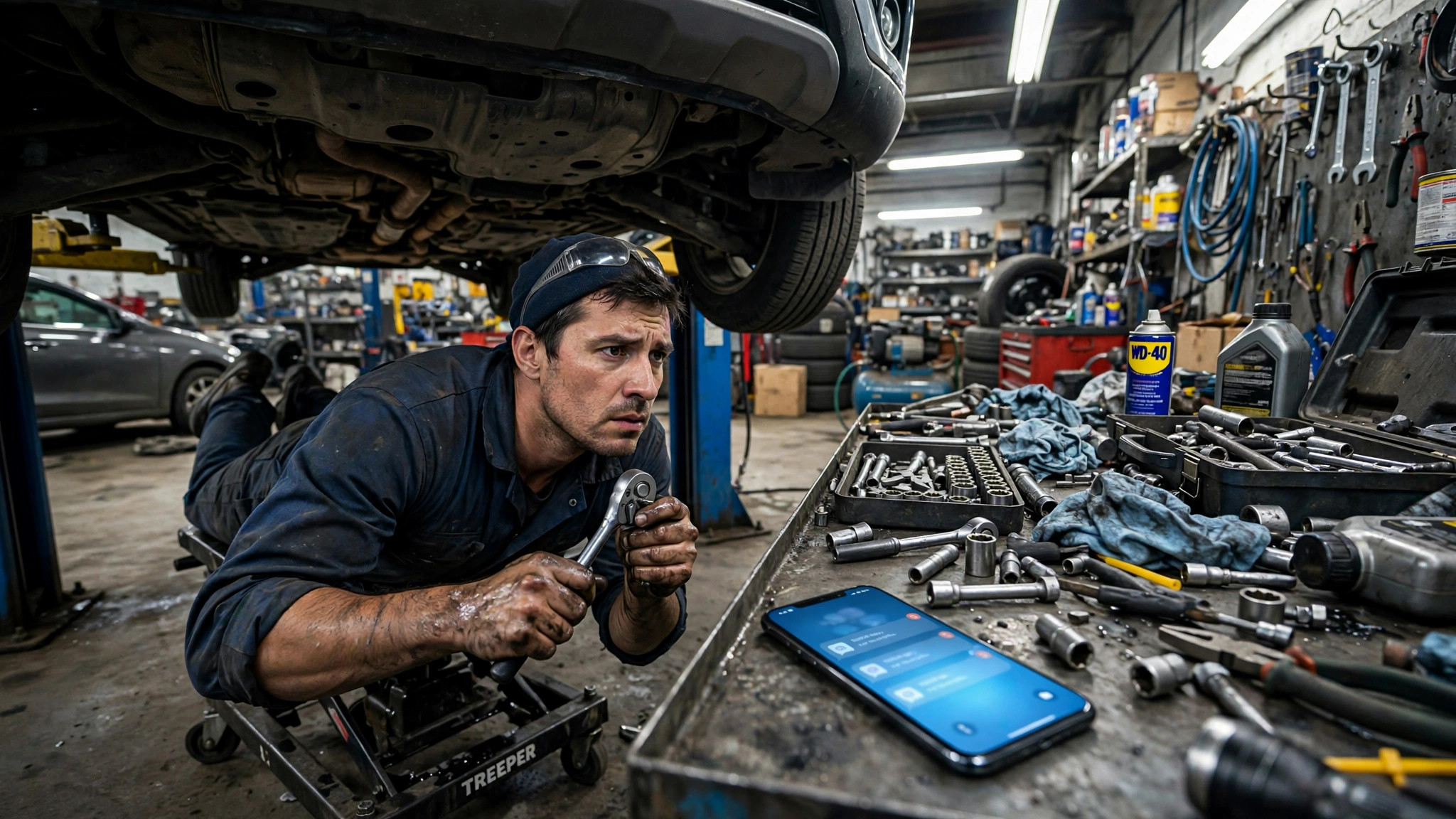
It is 3:15pm and you are under a car with your hands covered in oil, halfway through a brake job that is already running late. Your phone is on the workbench, lighting up every ten minutes. 'Is my car ready?' 'How much will the clutch cost?' 'Can I collect at 5?' You will wipe your hands and reply at 6pm, when the shop is closed — and by then the clutch customer has already rung two other garages. WhatsApp automation for auto repair shops means an AI assistant that answers those messages in seconds while you stay under the car. It sends service updates, answers price and timing questions, books jobs into your diary, reminds customers to collect their cars, and brings them back for their next service — all inside WhatsApp, the app your customers already use. For an auto repair shop, the best approach is chat-based automation because customers message about their car when they are anxious — at lunch, after work, while stuck without transport — and a fast answer keeps the job while a slow one sends it to the garage down the road.
Why Your Phone Rings Loudest When Your Hands Are Dirtiest
Every mechanic knows the pattern. The phone goes quiet when you are free, and it explodes the moment you are under a car, in the middle of a diagnosis, or elbow-deep in an engine bay. That is not bad luck — it is because customers message when THEY are free, and their free moments rarely match yours.
A car in the shop is a small crisis for the customer. They have no transport, they do not know the bill yet, and they are imagining the worst. Silence makes it worse. Every hour without an update, the anxiety grows — and so does the temptation to call the garage that answers faster.
The painful truth: your best hours for answering are your worst hours for earning. Every minute you spend wiping your hands to type a reply is a minute you are not fixing cars. Automation breaks that trade-off. The messages get answered in seconds, and you never leave the lift.
What WhatsApp Automation for Auto Repair Shops Actually Does
Think of it as the world's most organised service adviser — one who knows every job in your shop, never forgets a customer, and answers messages at 11pm without complaint. It lives on your shop's WhatsApp number, the one customers already have saved.
- Sends automatic service updates: 'Your brakes are done — final checks at 4pm, ready to collect from 5.'
- Answers 'is my car ready?' instantly, with the real status from your job board.
- Books jobs into your diary: service, repair, MOT-style inspections, tyre changes.
- Gives honest estimate ranges for common jobs, from your real price list — never invented numbers.
- Reminds customers to collect their cars, which frees your parking and your bays.
- Brings customers back with service-interval reminders and MOT-style expiry nudges.
Notice what is missing: it does not diagnose cars and it does not promise prices you cannot keep. The automation handles the communication around the work. You handle the work. That is the division that makes this trustworthy.
How Do You Send Service Updates Without Leaving the Lift?
The update does not come from your hands — it comes from your job board. The setup connects to whatever you use to track jobs: a whiteboard app, a garage management system, even a shared spreadsheet. When a job moves from 'in progress' to 'waiting for parts' to 'ready', the assistant tells the customer automatically, in plain words.
The message sounds like your best service adviser wrote it: 'Good news — the brakes are done and passed the road test. We are just finishing the paperwork. You can collect from 5pm today.' Specific, warm, and it answers the two questions every customer has: what happened and when can I get my car.
Here is the quotable truth: customers do not mind waiting when they know what is happening. They mind being ignored. A garage that sends three short updates during a repair looks more professional than a garage that finishes faster but says nothing. Communication is the service, not just the repair.
The 'Is My Car Ready?' Message, Handled for Good
'Is my car ready?' is the most-asked question in every garage on earth, and it is pure anxiety in message form. The customer is not being difficult — they are arranging lifts, childcare, and their workday around your answer. A fast, accurate reply is a kindness.
The assistant answers with the real status, not a guess. If the car is ready, it says so and gives collection details: your hours, what to bring, the final bill if it is confirmed. If the car is not ready, it gives the honest timeline and the reason: 'Still waiting on the part — it arrives tomorrow morning, so we are looking at tomorrow afternoon.' Honest bad news beats silent bad news every single time.
One rule keeps this trustworthy: the assistant must NEVER invent a status. If the job board is out of date, the assistant says 'Let me check with the team and get back to you' — and flags you instantly. A wrong 'it is ready' that sends a customer to a closed garage destroys trust in one trip. Keep the job board honest and the assistant stays honest.
There is a loyalty angle here too. The customer who got three calm updates during a long repair tells friends about your garage. The customer who heard nothing tells friends to go elsewhere. Updates are not admin — they are the cheapest marketing you will ever do, delivered one reassured customer at a time.
Booking Jobs in Chat: Quotes, Slots and Reminders
Booking a service should take thirty seconds, not three phone calls. A customer messages 'need a service next week' and the assistant asks the three things that matter: the car's registration or make and model, what kind of service, and which day suits. Then it offers real slots from your diary: 'Tuesday morning or Thursday afternoon — which works?'
For quote questions, the assistant uses YOUR real price ranges — the ones you wrote down, not ones it invented. 'A full service on your car runs between X and Y depending on parts — I can confirm the exact figure when we see the car.' Ranges are honest. Fake precision is a trap. The booking is confirmed in chat, and the customer gets the practical details: drop-off time, how long it takes, whether you offer a courtesy car or a lift.
The evening before, the assistant sends a reminder: 'See you tomorrow at 9am for the service — bring your service book if you have one.' Reminders cut no-shows, and in a garage a no-show is an empty lift — the most expensive hour of your day.
How Does WhatsApp Automation Do Pickup Reminders?
Cars sitting in your bays after the job is done are a silent cost: blocked parking, blocked lifts, and a customer who forgot. The assistant sends a pickup reminder the moment the job is marked complete: 'Your car is ready — collect any time before 6pm today, the bill is £X.'
If the customer does not come, a gentle follow-up the next morning: 'Still have your car here — any time today works. Just reply and we will have it at the front.' No nagging, just a nudge. Most customers collect within hours of the first message, because they simply forgot — not because they did not want to pay.
The payoff is twofold: your bays turn over faster, and your cash flow speeds up because bills get paid sooner. One garage owner described it as 'the cheapest employee I never hired.' ReplyPilot (AI automation for small-business messaging — WhatsApp, Instagram DM, website chat) can run these pickup sequences in your shop's own tone, and hand over to you the moment a customer raises a billing question.
Repeat Bookings: The Service-Interval Goldmine
The most profitable customer is the one who comes back without being chased. But most garages do zero follow-up, so customers drift — to the dealership, to the cheap place, to wherever they remember. A service-interval reminder fixes this with one message a year.
Six months after a service, or a month before an inspection expiry, the customer gets a friendly message: 'Your car is due its service next month — want me to book you in? I have Tuesday or Thursday free.' That single message, sent at the right time, wins back customers who were already halfway to booking elsewhere.
The timing is the whole trick. Too early feels like spam; too late and they have booked elsewhere. Your assistant knows each car's date because it recorded it at the last visit. One well-timed reminder per car per year — that is not marketing, that is service. And it is the highest-return message your garage will ever send.
Want this for your auto repair shops?
ReplyPilot builds a custom whatsapp automation setup for your auto repair shops — answering customer questions instantly, taking orders and bookings, and handing off to you when a human is needed.
Ask on WhatsApp — it's freeWhen the News Is Bad: Delivering Repair Estimates Honestly
Every garage dreads the 'the clutch needs replacing' conversation, because customers hear bad news and immediately suspect they are being overcharged. The assistant cannot have that conversation for you — but it can set it up properly.
The right flow: the assistant tells the customer the car needs attention, gives the honest range from your price list, and explains the next step in plain words: 'The mechanic found the clutch is worn. Replacing it runs between X and Y — shall I ask him to call you and talk you through it?' The human call still happens. But the customer arrives at that call informed instead of ambushed.
Trust is the currency of this business. Garages that explain before they charge get customers for life. Garages that surprise people with bills get one visit and a bad review. Your assistant's job in the hard moments is to prepare, not to hide. Honest setup, human conversation, happy customer.
Why Does WhatsApp Beat Phone Calls for a Busy Garage?
Phone calls interrupt. WhatsApp waits. That single difference is why customers prefer messaging — they can ask at midnight, read your reply at lunch, and never play phone tag. For your shop, the difference is even bigger: a message can be answered by the assistant in seconds, while a call stops everything.
There is a second advantage: the chat history. 'But you said £200' arguments die instantly when the quote is in writing, with a timestamp, in the customer's own phone. Every promise, every estimate, every collection time — recorded. Fewer misunderstandings, fewer disputes, calmer days.
And the photos. Customers can send a photo of the warning light, the scratch, the strange noise described in words. Your assistant can collect these and attach them to the booking. A mechanic who has seen the dashboard light before the car arrives starts the diagnosis ahead of time. That is real, practical value from a messaging app.
What Happens When a Customer Ghosts Their Booking?
It happens in every garage: a customer books, then vanishes. The lift sits empty, the mechanic waits, and you lose the hour. Most garages just accept it. A chatbot does not accept it — it follows up, politely and automatically.
The sequence is simple. An hour before the appointment, a reminder with the practical details. If the customer does not show, a message ten minutes after: 'We had you booked for 10am — running late or need to reschedule?' Most ghosts reply to that one, because it is easier to reschedule than to feel guilty. The customers who were never going to come free up the slot fast enough to rebook it.
For repeat no-shows, the assistant can apply your policy gently: 'For next time, we ask for a small deposit on Saturday bookings.' You write the policy; the assistant enforces it without the awkward face-to-face conversation. Empty lifts are the most expensive hours in your shop — this sequence recovers them.
Step-by-Step: Your First 30 Days With Automation
Step 1: Write your ten most-asked questions. The real ones — 'how much is a service?', 'do you do tyres?', 'when can I collect?' Write the answers exactly as your best service adviser says them. Step 2: Write your honest price ranges for the twenty most common jobs. Step 3: Connect your job board or diary so statuses and slots are always real. Step 4: Set handoff rules — billing disputes, angry customers, anything odd goes straight to you.
Step 5: Run a quiet week. Let the assistant handle new messages while you read the chats and correct the tone. Step 6: Switch on service updates and pickup reminders. Step 7: Add service-interval reminders for past customers. By day thirty, the system runs itself — and you will wonder how you ever managed the phone while holding a spanner.
Start small and train carefully. The garages that win switch on enquiries first, watch for a week, then add updates and reminders. Slow is smooth, and smooth is fast in this business too.
Mistakes That Kill Garage Automations
- Inventing prices or statuses — one wrong 'it is ready' or fake quote destroys trust instantly.
- Diagnosing cars over chat — the assistant collects symptoms, never names the fault; that is the mechanic's job.
- No handoff for angry customers — a machine arguing about a bill is a disaster; bring in a human fast.
- Spamming past customers with offers — one service reminder per year is service; weekly promotions are spam.
- Launching before writing your real answers — a generic assistant in a garage is obvious within two messages.
- Forgetting the photos — customers send pictures; your setup must accept and file them.
The pattern is identical every time: treat the assistant as a team member, not a gadget. Train it with your real answers, your real tone, and clear rules for when to call you. Garages that do this get an organised service adviser. Garages that skip it get an expensive toy.
Receptionist vs Automation vs You: A Simple Comparison
- Speed of first reply | You, under a car: hours | Receptionist: minutes on shift, nothing after hours | Automation: seconds, day and night
- Service updates | You: when you remember | Receptionist: solid on shift | Automation: every status change, instantly
- After-hours cover | You: asleep | Receptionist: gone home | Automation: full cover, same quality
- Repeat bookings | You: none, too busy | Receptionist: some, if reminded | Automation: every car, every interval
- Cost pattern | You: your own evenings | Receptionist: monthly salary plus training | Automation: a monthly plan plus per-message fees
- Best for | You: fixing cars | Receptionist: walk-in counter work | Automation: winning the chat and filling the diary
Most garages end up with the mix: automation handles the messages, humans handle the metal. One recovered job per week — the customer who would have rung the garage down the road — covers the running cost many times over. Neighbouring trades run the same playbook: car dealerships use it for test-drive bookings, car detailing shops for appointment reminders, and car rental services for pickup confirmations.
Measuring What Matters for Your Garage (Beyond 'Messages Answered')
Vendors will show your garage message counts and call it success. A garage should watch four numbers. First, jobs booked from chat per week — the only number that fills your bays. Second, average first-response time — it should sit under a minute, always. Third, bay turnover — how fast finished cars get collected after pickup reminders start. Fourth, repeat booking rate — what share of past customers return when reminded.
A 100% 'reply rate' with empty bays is a vanity metric. Check your garage's four numbers every Sunday. If jobs booked are climbing and bays are turning faster, the automation is doing its job. If not, the problem is almost always the answers you fed it — fix the source material, not the app.
Staying Ban-Proof for Auto-Repair Shops: The Rules That Matter
WhatsApp protects its users from spam, and your garage lives on this app, so the rules are not optional. Only message people who contacted your garage first or explicitly opted in. Service updates and reminders to existing customers are fine. Cold promotional blasts to bought numbers are not — and they will get your number banned.
The practical version: never bulk-message cold numbers, never buy contact lists, and give every marketing-style message a clear way to opt out. A customer who opts out gracefully may still service their car with you. One customer reporting you as spam can cost you the number. Meta's WhatsApp Business Platform documentation lays out the messaging rules, and garages across the industry use the same approach — worth planning alongside your own setup.
Putting It Together Without Disrupting the Workshop
You do not need to change how you fix cars. You need to change how the shop talks while you fix them. Write your real answers, connect your job board, set the handoff rules, and run a quiet week of observation. Then switch on updates, then reminders, then repeat bookings. Each layer pays for itself before the next one goes live.
The garages winning this game are not the most technical — they are the most honest about their own chaos. Write down how you actually work, feed it to the assistant, and let it talk while you work. If you want it running without the DIY work, ReplyPilot builds the assistant around your job board, your price list, and your tone — you just approve the answers. If you want this running before your next busy season, request a free custom demo at https://replypilot-site.vercel.app/ and see your own shop's questions answered live.
Frequently Asked Questions
Can WhatsApp automation really know when my car is ready?
Yes — because it reads your job board, not because it guesses. When your team marks a job 'ready', the assistant tells the customer instantly. The setup is only as honest as the board behind it, so keep your job statuses current and the updates stay accurate.
Will customers be annoyed talking to a bot instead of a person?
Customers are annoyed by waiting, not by chatbots. A fast, accurate, warm reply beats a slow human reply every time. And the assistant hands over to you the moment something needs a human — a billing dispute, an upset customer, a complicated diagnosis. It is a filter, not a wall.
How does it handle price questions without inventing numbers?
You write your real price ranges for common jobs, and the assistant uses only those. For anything unusual, it collects the details and asks a human to call back with the figure. The rule is simple: real ranges from your list, or a callback — never a guess.
What if a customer sends photos of the problem?
The assistant accepts photos and attaches them to the booking, so your mechanic sees the warning light or the damage before the car arrives. This is one of the most practical features — a picture of a dashboard light tells the story better than three paragraphs of description.
Does this work for a one-man garage or only big workshops?
It works best for small garages, because small garages have nobody else answering. A one-man shop gains a full-time service adviser for a fraction of a salary. Big workshops benefit too, but the transformation is biggest where the owner was previously answering between jobs.
How much does WhatsApp automation cost for a repair shop?
Two cost pieces: the platform's monthly plan for the assistant, and per-message fees WhatsApp charges for business-initiated conversations. Both are small next to a single brake job. One recovered customer per week covers the running cost many times over — before counting the hours you stop spending on the phone.