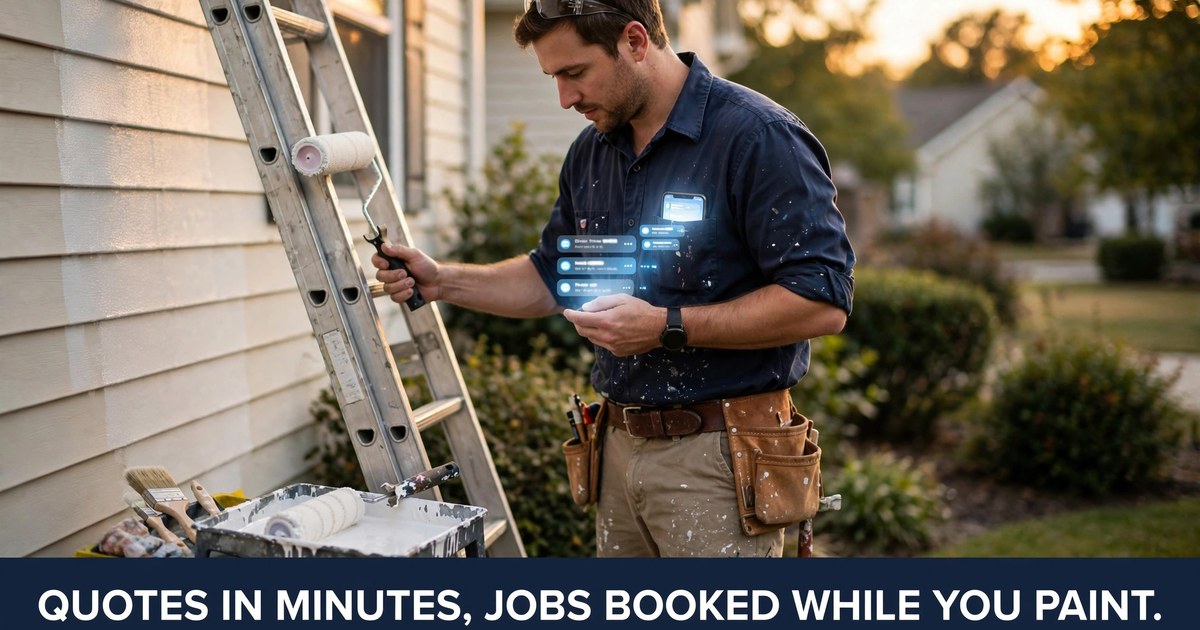
Up a ladder, roller in hand, and six quote requests are already waiting.
Quick answer: It is a smart helper on your business WhatsApp. It answers price questions, asks for room photos, shares price ranges from your prices, and books jobs in minutes — day or night. It helps painters who lose work by replying too late. It does not replace your final visit to see the job.
Introduction
It is Saturday morning. You are up a ladder, painting a ceiling. Your phone buzzes. Then again. And again. Six new messages in one hour. A mom wants a price for three bedrooms. A landlord needs a hallway painted fast. A couple asks if you do outside walls too. All of them will hire someone this week. Most will hire the one who replies first.
Here is the hard truth about painting work: when you are busiest with a brush in your hand, that is exactly when new jobs are won or lost. You cannot stop mid-wall to type a price. By the time you climb down and open WhatsApp, two of those six people have already hired someone else. Not because he paints better. Just because he replied faster.
WhatsApp automation for house painters fixes this. It is a smart helper that lives on the WhatsApp number your customers already use. It replies in seconds. It asks the right questions. It collects room photos. It shares price ranges from your real prices. And it books the job in your calendar — while you keep painting. In this guide, I will show you what it can do, where to draw the line, and how to set it up so it sounds like you, not a robot.
Why Painting Quotes Can't Wait
Painting is a race. When a homeowner decides to repaint, they have been thinking about it for months. Once they decide, they want it done now. They message three painters on the same night. The first one who gives a clear answer and a price range gets the job visit. The other two hear nothing back.
Here is the thing: homeowners decide fast. A person who messages on Monday and hears nothing till Wednesday has already moved on. They are not rude. They just needed the work done, and someone else did it.
Then there is the busy season. In spring and early summer, everyone wants painting done at once. Your team is stretched thin. Your calendar is full. And quote requests keep coming in waves. A slow reply in May does not just lose you one bedroom. It loses the full-house job that bedroom could have led to — plus the neighbor who wanted your number.
Replying fast does half your selling for you.
What WhatsApp Automation for House Painters Actually Does
Think of it as your best helper, living inside WhatsApp on the number clients already message. It has your price list, your service areas, and your booking rules memorised. Customers get an answer before they have put the phone down. Nothing slips through the cracks: no missed quote, no forgotten follow-up, no 11pm message you will regret in the morning.
- Replies to price questions with your real price ranges — per room or per project — instead of "call me Monday."
- Asks for room photos and rough sizes right in the chat, so your price is based on something real.
- Asks what you would ask on the phone: inside or outside walls, how many rooms, what shape are the walls in, when do you need it done.
- Books job visits from your real calendar, and sends a reminder the day before so no one forgets.
- Follows up on quotes that went quiet — one gentle nudge, then one good reason.
- Sends prep tips before the job (move the furniture, clear the walls) so your team walks into a ready house.
- Hands the chat to you the moment a human is needed — unhappy clients, strange requests, big office jobs.
What it does NOT do is just as important: it does not replace your final visit to see the job. It does not promise an exact price without seeing the walls. And it does not paint. It wins the chat and fills your calendar. You win the job with your brush. That is the whole idea.
The 3-Minute Quote: How Fast Estimates Work
A painting quote is really three simple things: the right questions, your real numbers, and a fast reply. The helper asks what you would ask — how many rooms, rough sizes, inside or outside, any wall damage — but it asks in a chat, where people actually reply. No one likes a long phone call at 9pm. But almost everyone will answer four quick questions on WhatsApp from their sofa.
But wait — here is where most painters go wrong. They think a quote must be exact to be useful. It does not. What the homeowner needs in the first three minutes is a price range and a next step. Something like: "For three bedrooms in normal shape, most of our clients pay between X and Y. I can give you the exact price after a free 20-minute visit — I am free Thursday or Friday. Which day works for you?"
That one message does three jobs. It sets the price early so there are no shocks later. It moves things forward with real open days. And it reaches the homeowner while they are still excited — not three days later when they have already picked someone else. And one rule: never make up numbers. You feed in your real prices once, and the helper only ever uses those.
Photos: Your Secret Weapon for Faster Quotes
Here is what makes a painting setup better than a normal chatbot — and almost no general guide talks about it. Painters can quote from photos better than almost any other trade. When a homeowner sends four photos — the living room walls, the ceiling marks, the peeling outside paint, the hallway — you learn 80% of what a visit would tell you.
The helper asks for photos early, right after the basic questions. "Could you send a few photos of the rooms? It helps me give you a better price range." Most people say yes right away — they are already in a messaging app, and the camera is right there. The photos stay saved with the job chat. So when you do visit, you already know what you will find. No surprises. No wasted trips.
It also saves you from time-wasters, gently. A homeowner who will not send even one photo after three messages is telling you how serious they are. Your calendar stays full of real jobs — not hopeful visits across town.
Booking the Job Without the Back-and-Forth
Most painting jobs die between "sounds good" and a fixed date. The homeowner says yes on Tuesday night. You answer Wednesday morning, right when they are in meetings. Two days of missed calls follow. By Friday, they have signed with the painter who confirmed on the spot. The helper kills this back-and-forth completely.
It offers real open days from your calendar the moment the homeowner says yes — or even before, as the natural next step after the price range. "I can start the week of the 12th — does Monday or Wednesday work for a visit?" The booking gets locked in the chat while the homeowner is still thinking about fresh paint. A reminder goes out the day before, with prep tips. On the morning of the job, one short message: "Team arrives at 8:30, please clear the walls."
Want this for your house painters?
ReplyPilot builds a custom whatsapp automation setup for your house painters — answering customer questions instantly, taking orders and bookings, and handing off to you when a human is needed.
Ask on WhatsApp — it's freeWant to know the best part? This same habit is what makes follow-ups work too — every booked job becomes a finished job with a review request at the end, instead of a "we will call you back" that never happens.
Follow-Ups That Fill Next Month's Calendar
You sent the price. They said "looks good, we will talk." Then silence. This is where painting money quietly dies — not on the ladder, but in the follow-up no one had time to send. The homeowner is not ignoring you. They got two other prices, life got busy, and your quote sank to the bottom of their chats.
A good follow-up is gentle and clear. A few days after the quote: "Hi there — just making sure the price for the three bedrooms reached you. Happy to talk through any part of it." A week or so later, give a reason, not just a nudge: "Our June slots are filling fast — want me to hold a week for you while you decide?" Every message has a reason. None of them beg.
And here is the follow-up most painters never send: checking in with old clients. Six months after a job, one simple message — "Hope the paint still looks great! If you need any touch-ups, just reply here." Old clients are your cheapest source of new work. The painter who checks in gets the call when the neighbor asks for a recommendation. The helper sends these on time, every time, without you having to remember.
The Honesty Line: Price Ranges vs. Final Quotes
Painting has a trust problem, and every honest painter knows it. Homeowners have heard the stories: the price that doubled after the furniture was moved, the "one coat" that needed three, the extra charges that appeared out of nowhere. Your helper's job is to be the opposite of all that.
It gives ranges, not promises. It says what the range depends on — room sizes, paint quality, wall repairs needed. And it says clearly that the final price comes after a real visit. "This is our normal range for rooms like yours. The exact price comes after a free 20-minute visit where we see the walls properly."
Three rules your setup should always follow: never make up a price, never promise a start date you cannot keep, and never let the helper argue about money. If a chat touches final pricing, discounts, or complaints, a human takes over — with the full chat history attached, so you jump in mid-talk instead of starting over.
Homeowners trust an honest range more, not less. In a trade where some people promise everything, honesty is what sells. Speed wins the reply. Honesty wins the job.
Mistakes That Kill Painting Automations
- Giving exact prices without seeing the job — one wrong fixed price in writing can cost you the job and your profit. Ranges only, until the visit.
- Sounding like a robot — painting is personal. Clients invite you into their home. Every message should read like your best worker wrote it.
- No handover rules — a helper that argues with an angry homeowner about a paint drip is worse than no helper at all.
- Forgetting the prep tips — if your team arrives and the house is not ready, the client blames everything, helper included.
- Messaging people who never asked — one spam complaint can get your business number blocked. Only message people who contacted you first.
- Going live without testing — let it handle ten real chats quietly while you read every one. Then open it up fully.
Every one of these mistakes comes down to the same thing: people set the helper up like a gadget instead of onboarding it like staff. Onboard it the way you would bring on an apprentice — load your actual prices and services, teach it your tone of voice, and set firm rules for when it must hand the chat to you. Painters who skip that onboarding end up with a gimmick that texts strangers awkward things.
Doing It Yourself vs Hiring Help vs Automation
First-reply speed: You, mid-ladder: hours later. A part-time helper: minutes to hours, and only while they are on shift. The automation: seconds, around the clock.
Nights and weekends: You: nothing until morning. Office help: nobody there. The automation: full cover, the same careful answer at midnight as at noon.
Price consistency: You: solid until fatigue sets in. Office help: decent with a rate card. The automation: your numbers, phrased the same way, every single time.
Remembering details: You: fine until the day explodes. Office help: fine with a notebook. The automation: total recall — every photo, measurement, and promise kept in the chat.
Best at: You: the painting itself. Office help: calls and walk-ins. The automation: landing the quote before anyone visits.
Most painting businesses end up with a mix: the helper wins the chat and books the visit, humans win the job with the brush.
Ban-Proof Rules That Matter
That WhatsApp number is how clients reach you — guard it like your reputation. Message only people who wrote to you first or clearly opted in to updates. If you use the official WhatsApp Business API, starting a chat yourself needs an approved template message. For the official rulebook, read Meta's WhatsApp Business Platform documentation before you switch any automation on — the short version below is common sense, but the official page is what WhatsApp actually enforces.
The simple version: never bulk-message strangers, never buy phone number lists, and let anyone opt out with one tap. A homeowner who opts out politely might still call you next spring. A polite opt-out still leaves the door open for next spring. A spam report against you, though, can take the whole number down — and with it every client thread you ever had. New to the official API? Our WhatsApp Business API setup guide shows the two setup paths and what each one permits, while the broadcast marketing playbook shows how to message your own list without tripping spam filters.
How Will You Know It Is Working?
Ignore the fancy numbers. A painting business should watch four simple things. First, quotes sent per week from chat — this is where everything starts. Second, visits booked per month — this is what pays. Third, reply speed — going from hours to seconds is the whole game. Fourth, follow-up wins — how many quiet quotes turn into jobs after the reminder message.
Check these once a month for the first three months. You will spot the questions the helper got wrong, the price ranges that need fixing, and the moments it should have handed over to you sooner. Every fix goes back into the setup. Systems do not improve on their own — they improve because the owner reads the results. For the bigger picture on turning chats into money, see how lead capture automation splits the work between helper and human.
Conclusion
WhatsApp automation does not paint walls. It does something almost as valuable: it makes sure no price question ever waits, no quote ever goes cold, and no job ever dies in back-and-forth calls. The painters who win the next five years will not always be the best painters — they will be the ones who reply first, quote honestly, and follow up every time.
So here is my question for you: how many jobs did you lose last month, just because you were up a ladder when the message came in?
Frequently Asked Questions
How much does WhatsApp automation cost for a house painting business?
It depends on the setup, but running costs are small. The AI costs a few cents per chat, and WhatsApp charges a small fee per day-long chat through Meta. Most small painting businesses can run everything for well under fifty dollars a month — though exact costs change with your provider and message volume. Your real investment is week one: feeding in your real prices and testing with real chats.
Can the automation give exact painting quotes?
No — and it should not try. It gives honest price ranges from your real prices, then books a free visit where you fix the exact number. Any system that promises exact quotes without seeing the walls is guessing. And guessing in writing is how painters lose money and trust.
Will customers know they are talking to AI?
The helper writes naturally, like your worker texting. If a customer asks directly, it honestly says it is an AI helper. Most homeowners just want a fast, helpful answer — they do not care who typed it. The visit and the painting are always human.
What happens when a customer is unhappy with the paint job?
Complaints go straight to you, at once, with the full chat attached. The helper is trained to spot unhappy language and hand over — never to argue, defend, or offer discounts by itself. Handling complaints is human work. It is also where reputations are built.
Do I need a separate phone number for the automation?
You can run it on your current business WhatsApp number. But many painters prefer the official WhatsApp Business API on their business number, so work and personal chats stay separate. The setup guide compares both options and lays out what each one allows.