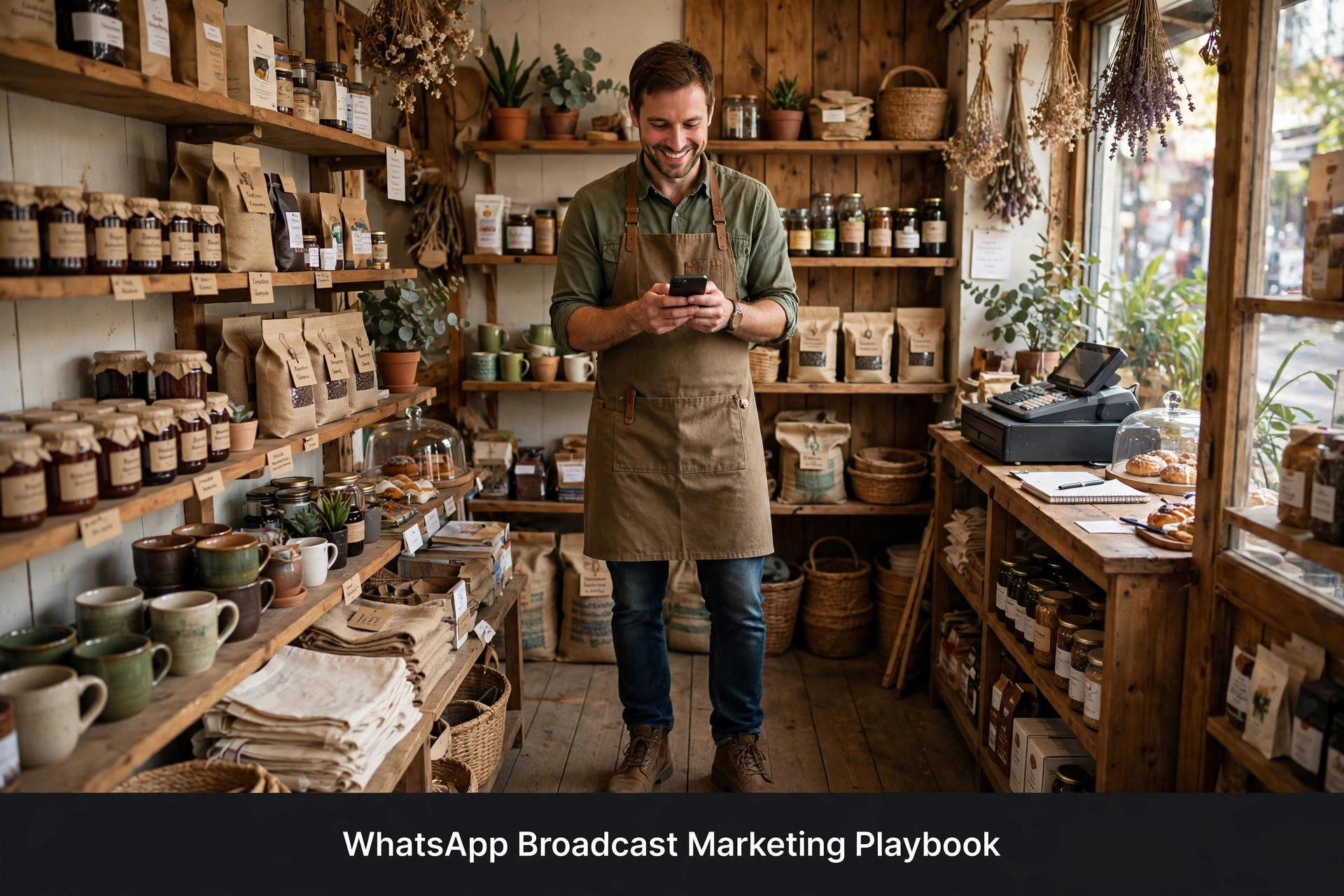
Email open rates hover around 20 percent on a good day. Instagram posts reach a fraction of your followers. But WhatsApp broadcasts? They get opened by nearly everyone - industry data consistently puts WhatsApp open rates above 90 percent, with some businesses reporting 98. When you send a message on WhatsApp, people actually read it. For a small business, that is not a marginal advantage; it is a different universe of attention. This playbook shows you how to build a WhatsApp broadcast marketing system properly: growing the list, writing messages people welcome, timing them right, and staying firmly inside WhatsApp's rules so your number never gets in trouble.
Why Broadcast Beats Every Other Channel You Have
Attention is the scarcest resource in marketing, and WhatsApp has more of it per message than anything else available to a small business. The reasons are structural. WhatsApp is where people talk to family and friends, so the notification gets instant priority - nobody batches their WhatsApp like email. The message arrives as a personal notification, not buried in a promotions tab or an algorithmic feed. And the format is intimate: short text, maybe an image, from a business the customer chose to hear from.
Compare the economics. Sending a thousand emails costs almost nothing but reaches two hundred people. Boosting an Instagram post to reach a thousand costs real money and the attention is shallow. A WhatsApp broadcast to a thousand opted-in customers costs a few dollars in API charges and gets read by nine hundred-plus. The math is not subtle. That is why businesses from clothing boutiques announcing new drops to restaurants filling Tuesday tables treat broadcast as their highest-ROI channel. Some report that a single well-timed broadcast outperforms a month of social media posting - not because social is useless, but because nothing else puts your message directly in front of nearly every customer simultaneously.
But the power is exactly why the rules matter. WhatsApp protects this attention fiercely - spammy broadcasters get restricted fast. Everything in this playbook is built around the principle that earns the 98 percent open rate in the first place: every message must feel welcome. The moment your broadcasts feel like spam, the channel dies for you. Treat the privilege accordingly.
Building Your Broadcast List (The Right Way)
Your list is everything. A thousand engaged contacts who asked to hear from you outperform ten thousand scraped numbers every time - and the scraped list will get you banned. Build opt-in at every customer touchpoint. In-store: a small sign at checkout - "Get new-drop alerts on WhatsApp" with a QR code. On your website: a checkbox at checkout or a pop-up offering first-order updates by WhatsApp. After a purchase: the order confirmation message itself can invite them - "Want restock alerts for this brand? Reply YES."
The highest-converting list builder is the lead magnet delivered by WhatsApp. Offer something genuinely useful - a discount code, a free guide, early access to a sale - in exchange for the WhatsApp opt-in. A salon might offer "10% off your next visit - get the code on WhatsApp." A fitness studio: "Free 7-day meal plan - delivered on WhatsApp." The offer must be real value, not a trick; people who opt in for a real benefit stay subscribed, people tricked into it report you.
Segment from day one. Do not keep one giant list - tag contacts by what they bought, what they asked about, and where they are in your funnel. The boutique tags customers by category interest: new arrivals, sale hunters, bridal. The restaurant tags by visit frequency and preferences. Segmentation is what turns broadcast from a megaphone into a scalpel - and it is the difference between messages people welcome and messages they mute. Your BSP's contact management should support tags or lists; if it does not, that is a reason to switch providers. The ten minutes you spend tagging a new contact today saves you from sending them irrelevant messages for years.
Message Templates That Get Approved (And Read)
On the WhatsApp Business API, business-initiated messages need pre-approved templates - and the template is where most broadcasts succeed or fail. WhatsApp approves templates in categories: utility (order updates, reminders), authentication (OTP codes), and marketing (promotions, offers). Marketing templates face the strictest review and require explicit opt-in, which is another reason your list must be clean.
Write templates like a helpful human, not a flyer. Compare: "MEGA SALE!!! 50% OFF EVERYTHING THIS WEEKEND ONLY!!!" versus "Hi {{1}}, our festive collection just landed - 50 pieces, and subscribers shop first. Want a look?" The first reads as spam and risks rejection; the second reads as a personal note and sails through. Use the customer's name via the variable, keep it conversational, make the value obvious in the first line, and always include a clear next step - a link, a reply keyword, a question.
Build a library of fifteen to twenty approved templates covering your recurring situations: new arrival announcements, sale alerts, restock notifications, appointment reminders, order updates, review requests, birthday offers, re-engagement win-backs. Having them pre-approved means you can launch a campaign in minutes when the moment is right - a surprise restock, a slow Tuesday - instead of waiting hours for approval while the opportunity passes.
Timing and Frequency: The Line Between Welcome and Spam
The most common broadcast killer is not content - it is frequency. Businesses get excited by the open rates and start messaging weekly, then twice weekly, then daily. Open rates crater, blocks spike, and the quality rating tanks. The sustainable rhythm for most small businesses: two to four broadcasts per month for promotions, plus transactional messages (order updates, reminders) as needed. Every broadcast you send should feel like news, not noise.
Timing within the day matters too. Late morning and early evening consistently outperform - people check WhatsApp during breaks and after work. Avoid early mornings, late nights, and prayer or meal times in your market; a promotion at 6am reads as disrespect regardless of content. And watch your audience's calendar: a restaurant's Friday lunch offer sent Thursday evening books tables; sent Friday at noon, it is too late. A boutique's festive drop announced two days before the festival sells out; announced the morning of, it is noise.
The golden rule: before every broadcast, ask "would I be glad to receive this?" If the honest answer is anything but yes, do not send it. Your list is an asset that compounds - every welcome message makes the next one more welcome. Every annoying message taxes all future ones. Owners who internalise this build lists that print money for years; owners who chase the quick hit burn the channel in months.
The 24-Hour Window: Your Secret Weapon
Here is the mechanic most businesses underuse. When a customer messages you, a 24-hour window opens during which you can send any message - no template needed, no category restrictions. Smart broadcast strategy engineers these windows deliberately. The chatbot asks a question; the customer replies; now you have 24 hours of free-form conversation. A post-purchase check-in - "How did the fitting go?" - often triggers a reply that opens the window right before you want to mention the new collection.
Design your flows to create windows naturally. Order confirmations invite replies. Appointment reminders ask for confirmation. Delivery updates ask about satisfaction. Each reply reopens the window, and inside the window you can have the real conversation - the personal recommendation, the limited offer, the genuine check-in - that templates cannot match. The businesses that master this treat broadcast templates as the door-opener and window conversations as the living room where sales actually happen. If you run a chatbot on the same number, program it to recognise window opportunities automatically - a customer asking about sizing at 8pm is an invitation to mention tomorrow's drop, not just to answer the sizing question and go quiet.
Measuring What Matters (Beyond Open Rates)
Open rates will flatter you - 95 percent feels amazing and means almost nothing by itself. Track the metrics that connect to money. Click-through rate on your links: are people acting, or just reading? Reply rate: are messages starting conversations? Conversion rate: how many broadcasts turn into orders, bookings, or visits? Use unique links or reply keywords per campaign so you can attribute precisely - "this Tuesday broadcast drove 23 orders" beats "broadcasts seem to work."
Want this for your business?
ReplyPilot builds a custom whatsapp automation setup for your business — answering customer questions instantly, taking orders and bookings, and handing off to you when a human is needed.
Ask on WhatsApp — it's freeAlso track the health metrics: opt-out rate per campaign and your number's quality rating. A campaign with great sales but a spike in blocks is borrowing from the future - dial back frequency or relevance before the rating slips. The best broadcast marketers review these numbers monthly and prune ruthlessly: kill the message types that underperform, double down on what converts, and retire segments that never engage. A smaller, hotter list always beats a bigger, colder one.
Staying Ban-Proof on Broadcasts: The Rules That Matter
WhatsApp bans numbers that behave like spammers, and recovery is painful. The rules are simple but non-negotiable. One: only message opted-in contacts for marketing - never buy lists, never scrape numbers, never add people who merely inquired once. Two: honour opt-outs instantly and permanently; every marketing template should make opting out obvious. Three: respect frequency - even welcome messages become spam when they arrive daily.
Four: keep your quality rating green by monitoring it weekly in your BSP dashboard. If it slips to yellow, pause all marketing immediately and diagnose - usually frequency, relevance, or a bad list segment. Five: never use unofficial API workarounds or bulk-sending tools that violate WhatsApp's terms; they work until they do not, and the ban is permanent. Six: keep your business information current and your display name compliant. Legitimate businesses following these rules essentially never get banned; banned numbers are almost always businesses that cut corners.
Putting Broadcasts Together: Your First 30 Days
Week one: set up your BSP, get five core templates approved, and place opt-in QR codes at every customer touchpoint. Do not broadcast yet - just build the list and watch it grow. Week two: send your first broadcast to the small early list - a genuine piece of news, like a new arrival or a limited offer. Keep it personal, measure everything, and read every reply yourself.
Week three: segment the list based on what you learned, approve five more templates for the patterns you see, and try your second broadcast to a specific segment rather than everyone. Week four: review the numbers - open rate, click rate, conversions, opt-outs, quality rating. Double down on what worked, fix what did not. By day thirty you will have a working broadcast channel, a growing list, and real data on what your customers respond to. From there, it compounds - which is exactly why starting this month beats starting next quarter. The businesses that win at broadcast are not the ones with the biggest lists; they are the ones that started building earliest and treated every single subscriber like a real relationship, not just a number.
Advanced Segmentation: From Broadcast to Sniper
The businesses getting the highest returns from broadcast do not really broadcast at all - they snipe. Instead of one message to everyone, they send five variations to five segments, each feeling personally written. The boutique sends the new modest-wear drop to customers tagged "modest," the party-wear drop to "party," and the sale alert to "bargain-hunters" - three messages, three audiences, triple the relevance. The dental clinic sends whitening offers to patients tagged "cosmetic-interest" and checkup reminders to "overdue-6-months" - different needs, different messages, sent on different days.
Behavioural triggers take this further. A customer who browsed but did not buy gets a different message than a repeat buyer. Someone who clicked but did not convert gets a follow-up with a question - "What held you back?" - instead of another discount. Someone who bought twice gets early access, not a coupon; rewarding loyalty with exclusivity beats training customers to wait for sales. Build these segments gradually: start with purchase history and stated interests, add behavioural tags as your data grows, and review segment performance monthly. The goal is a list where every message feels like it was written for the person reading it - because effectively, it was.
Realistic Results: What to Expect
Set expectations honestly. In month one, with a small list of a few hundred contacts, a good broadcast might drive a handful of orders or bookings - encouraging, not life-changing. The power compounds: as the list grows through every transaction and the segments sharpen through data, month six looks very different from month one. Businesses that commit to the system for two quarters typically report broadcast becoming a top-three revenue channel - behind only walk-ins and referrals, ahead of paid ads they used to depend on.
The failures follow a pattern too. Businesses that blast daily promotions see engagement collapse within weeks and blame the channel instead of the strategy. Businesses that never segment wonder why response rates stall. Businesses that ignore the quality rating learn about it the hard way. Every one of these is avoidable by following this playbook's core discipline: welcome messages only, to the right people, at the right time, measured honestly. Do that, and WhatsApp becomes the highest-ROI channel most small businesses have ever had.
Winning Back the Quiet Ones
Every list has a silent majority — contacts who opted in months ago and never bought, never replied, never clicked. Most businesses ignore them. Smart ones run a quarterly win-back broadcast, because a quiet contact is not a dead contact; they just have not heard the right message yet.
The win-back message must acknowledge the silence honestly, not pretend it did not happen. Something like: we noticed you have not ordered in a while, so here is 15 percent off your next order — no strings, just a hello. One offer, one question (is there anything we could do better?), and an easy opt-out. Send it once per quarter to the quiet segment only — never to your active buyers, who do not need a discount to stay.
Expect a small response rate and be happy about it. If five percent of quiet contacts re-engage, that is five percent of revenue you had written off, recovered for the cost of one message. And the ones who opt out were never going to buy anyway — a cleaner list is a gift, not a loss. The discipline is in the targeting: win-back goes to the quiet, never to everyone, and never more than four times a year.
Broadcast Plus Chatbot: The One-Two Punch
Broadcast alone is a megaphone. A chatbot alone waits for customers to speak first. Together, they are the highest-converting combination most small businesses can build — and hardly anyone runs both properly.
Here is how the combination works. Your broadcast goes out: new collection just dropped, reply YES for the catalogue. Interested customers reply — and instead of you manually answering two hundred messages, your chatbot takes over instantly. It sends the catalogue, answers sizing questions, collects the order, and books the delivery. The broadcast created the demand; the chatbot harvested it. Without the bot, a successful broadcast buries you in replies you cannot answer fast enough, and the hottest leads go cold waiting.
Set this up before your next big broadcast, not after. Connect the chatbot to the same number, give it the campaign details — the offer, the catalogue link, the stock limits — and test it with your own phone first. Then when the broadcast lands, every reply gets an instant, intelligent response at any hour. Businesses that run this combination consistently report the same thing: broadcasts stop being stressful and start being the best day of the month.
Frequently Asked Questions
What is a good open rate for WhatsApp broadcasts?
WhatsApp broadcasts typically see 90-98% open rates - dramatically higher than email's 20% or social media's single-digit reach. But open rate alone means little; track click-through, reply rate, and actual conversions per campaign. High open rates with zero replies are a vanity metric.
How often should I send WhatsApp broadcasts?
For most small businesses: two to four promotional broadcasts per month, plus transactional messages as needed. Every broadcast you send should feel like news, not noise. More frequent messaging craters engagement and risks your quality rating. When in doubt, send less - a smaller number of welcome messages beats frequent annoying ones.
Do I need customer permission before sending WhatsApp broadcasts?
Absolutely - this is both a WhatsApp rule and the foundation of the channel's effectiveness. Only send marketing messages to contacts who explicitly opted in, and make opting out easy in every message. Bought lists and scraped numbers lead to blocks, a tanked quality rating, and potential bans.
What is the difference between WhatsApp broadcast and WhatsApp groups?
Broadcasts send a personal one-to-one message to each recipient - they cannot see each other. Groups put everyone in one shared chat. For marketing, broadcasts are almost always better: they feel personal, avoid the chaos of group replies, and comply with WhatsApp's business messaging rules. Groups work for communities, not campaigns.
How do I avoid getting my WhatsApp business number banned?
Follow six rules: message only opted-in contacts, honour opt-outs instantly, control frequency, monitor your quality rating weekly, never use unofficial bulk tools, and keep business info current. Legitimate businesses following these rules essentially never get banned - bans happen to spammers and corner-cutters.