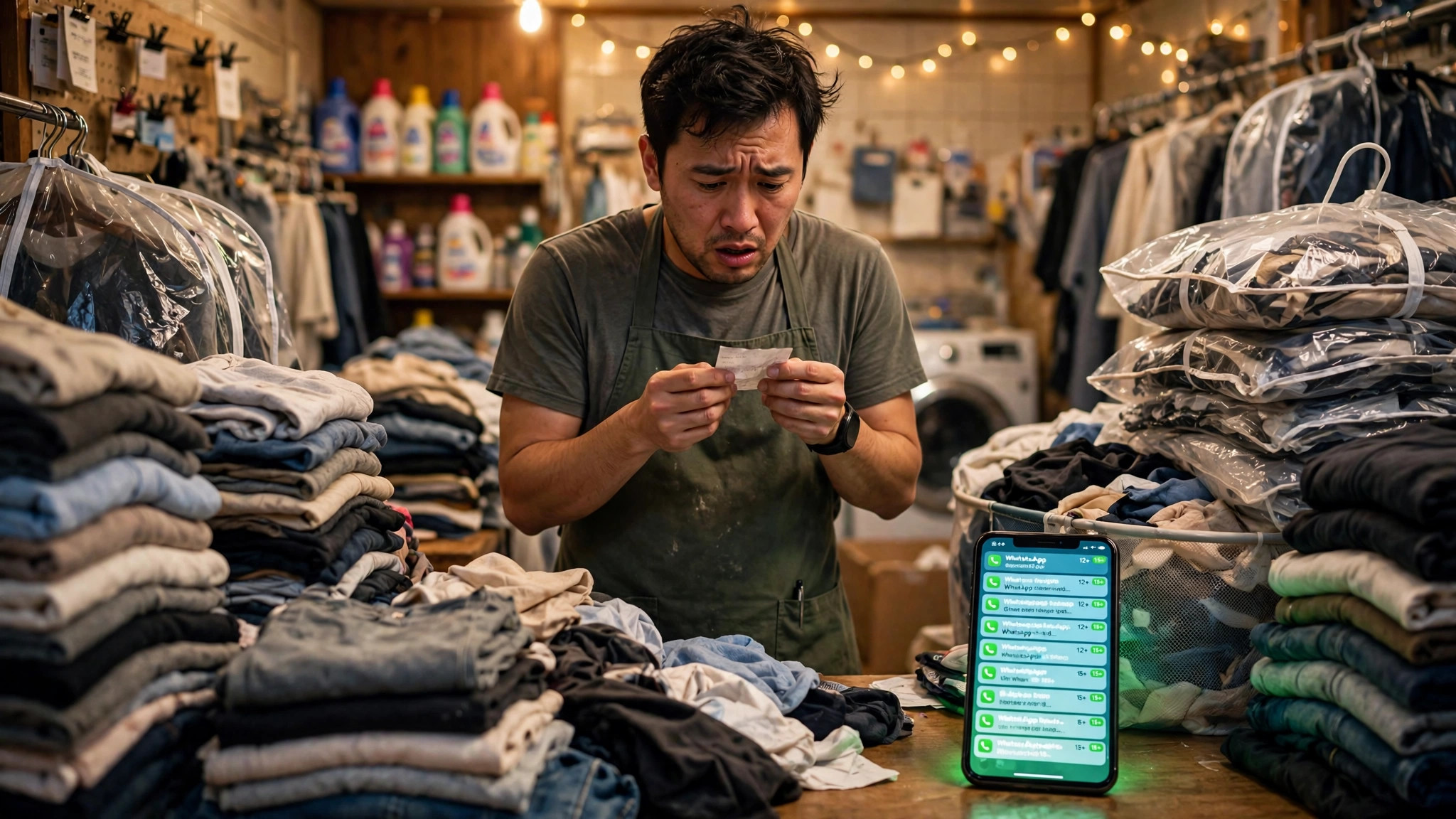
It is Tuesday morning at your laundry shop. Three garment bags are waiting for pickup, the ironing table is buried under shirts, and your driver is standing at the door asking, "Which houses today?" Your phone will not stop buzzing. "Can you pick up my clothes today?" "Where are my shirts? I gave them last Thursday." "The address for pickup — I sent it yesterday, did you get it?" Meanwhile, a customer walks in, drops a bag of clothes on the counter and says, "I need these by Friday," and you write the details on a paper slip that will be smudged beyond reading by Thursday. Somewhere in this mess, a blue shirt is missing, and nobody knows whose it is. This is the daily life of a laundry business — and it is exactly what WhatsApp automation for laundry services is built to fix. Every pickup booked, every garment tracked, every customer updated, every driver notified. The paper slips retire. The chaos ends.
A Laundry Business Has Two Fronts — and Both Are Messy
Most businesses deal with customers in one place. A laundry deals with them in three: at the counter, at their doorstep for pickup, and at their doorstep again for delivery. Every handoff is a chance for something to go wrong. The driver goes to the wrong house because the address was a voice note. The customer swears they gave five shirts but the bag had four. The ironing is done but nobody told the customer, so the clothes sit for three days. The payment is pending but nobody follows up, because chasing money feels awkward.
A laundry pickup delivery WhatsApp chatbot sits in the middle of all of this and keeps every thread tidy. It books the pickup with a proper address and time slot. It confirms exactly what was collected. It updates the customer at every stage. It tells the driver where to go. It sends the payment link when the clothes are ready. And it reminds the weekly customer that it is pickup day again. One system, handling the three fronts at once.
What WhatsApp Automation for Laundry Services Actually Does
Here is the full picture of what a well-built system handles for a laundry or dry-cleaning business:
- Books pickups in chat — the customer types "pickup", picks a day and time slot, shares a location pin, and gets an instant confirmation.
- Records exactly what was collected — item counts and types confirmed with the customer at pickup, so "I gave six shirts" disputes become rare.
- Sends stage-by-stage updates: pickup done, washing in progress, ironing, ready for delivery, out for delivery — the customer always knows where their clothes are.
- Notifies your driver automatically with the day's pickup and delivery list, addresses and phone numbers — no more morning confusion at the door.
- Answers price questions instantly: per-item rates for wash, iron, dry-clean, express service and stain treatment.
- Sends a payment link with the "ready" message, so customers pay before or at delivery instead of payments dragging on for weeks.
- Reminds weekly and fortnightly customers that pickup day is coming — "Hi, your usual Tuesday pickup? Reply YES to confirm."
- Handles complaints and special instructions — "please starch the collars," "this stain needs attention" — and attaches them to the order.
The Pickup Booking That Ends Morning Chaos
The most chaotic hour in any laundry is the morning, when the driver needs to know where to go. Today it works like this: customers called at random times, you scribbled addresses on paper, the driver squints at your handwriting. With dry cleaning order automation, it works like this: every pickup was booked through WhatsApp with a time slot and a location pin. In the morning, the driver opens his list — sorted by area, each stop with an address, a phone number and the expected items. He taps to navigate. When he collects the bag, he confirms the item count in the chat, and the customer gets an instant message: "We have picked up 5 shirts and 2 trousers. Expected delivery: Thursday."
Notice what this does to disputes. The single most common fight in a laundry is "you lost my shirt." When the pickup confirmation lists exactly what was collected and the customer saw it in writing at the moment of pickup, that fight almost never starts. You have not just automated booking — you have built a paper trail that protects you.
"Where Are My Clothes?" — The Question That Should Answer Itself
If you counted the messages, "where are my clothes?" would probably be the number one question in your WhatsApp. It arrives because customers have no visibility — they handed over a bag days ago and heard nothing since. Every one of those messages interrupts your work, and every one of them carries a little anxiety. Stage updates eliminate the question by answering it before it is asked. When the customer gets "Your clothes are being ironed now" on Wednesday and "Ready for delivery tomorrow" on Thursday, they feel looked after. They do not message you. Your phone stays quiet. Their trust goes up.
There is a business lesson hiding here that applies far beyond laundry: most customer anxiety comes from silence, not from problems. A two-day delay with clear updates feels better than on-time delivery with no communication. The automation gives you the communication for free.
Drivers, Routes and the Delivery Side
The delivery side of a laundry is a small logistics company hiding inside a shop. Multiple addresses, time windows, cash or digital payments at the door, and customers who are not home. WhatsApp automation for laundry services treats it like the operation it is:
- Groups the day's deliveries by area so the driver takes a sensible route instead of zigzagging across town.
- Messages each customer when their order is out for delivery — "Your clothes are on the way, expected within the hour" — so someone is home to receive them.
- Lets the customer confirm or reschedule the delivery window in chat, cutting down failed delivery attempts.
- Attaches the payment link to the delivery message, so the driver does not have to collect cash at every door.
- Logs completed, failed and rescheduled deliveries automatically, so you see the real picture at the end of each day.
Failed deliveries are pure waste — fuel, driver time and a second trip. Even cutting them in half changes your weekly economics. And customers who get a heads-up message before the driver arrives rate the service higher, every time.
The Weekly Customer: Your Steadiest Income
Every laundry has a backbone of regulars — the family whose clothes you collect every Tuesday, the bachelor who sends a bag every Sunday, the office worker with the fortnightly dry-cleaning. These customers are wonderful, but they are also fragile: miss their pickup twice because you forgot, and they start looking elsewhere. Or they forget themselves, the bag piles up, and your weekly revenue wobbles.
This is where the automation quietly becomes your best employee. It knows each customer's rhythm and sends a gentle reminder before pickup day: "Hi Ayesha, your usual Tuesday pickup is tomorrow — reply YES to confirm, or pick another day." The customer taps one word. The driver gets the stop added. Nobody forgot anything. Over months, this keeps your regulars regular — and regulars are the difference between a laundry that survives and one that grows. If you run a guesthouse or hotel with similar repeat-service rhythms, our guide to WhatsApp automation for guesthouses shows the same reminder logic applied to bookings.
Pricing Questions, Express Charges and the Awkward Conversations
Laundry pricing confuses customers: wash vs. iron vs. dry-clean, per-item vs. per-kilo, express surcharges, stain treatment extras. When a human explains it, the explanation changes every time and sometimes sounds defensive — especially the express charge. ("Why is same-day double?" is a question every laundry owner dreads.) An automated price list solves this with calm consistency: the full rate card, the express policy, the minimum order, all available instantly, in the same friendly wording, every time. Nobody feels argued with. And because the system quotes from the same rate card you use, there are no more "the boy at the counter told me a different price" arguments.
Getting Paid Without the Awkward Chase
Ask laundry owners about their biggest headache after lost clothes, and most will say the same thing: pending payments. The clothes were delivered two weeks ago, the customer said "I will send it," and now reminding them feels uncomfortable. So the money sits. Multiply that by twenty customers and it is a real hole in your cash flow. The fix is embarrassingly simple: send the payment link at the exact moment the customer is happiest — when their clean, pressed clothes arrive. The message writes itself: "Your clothes have been delivered! The total is shown below. Pay here." Paying takes ten seconds while the satisfaction is fresh.
For the stragglers, a polite automated reminder does the chasing so you do not have to: "Hi, just a friendly reminder — your payment from the delivery on the 3rd is still pending. Pay here whenever ready." It is firm, friendly and — crucially — not you having an awkward conversation. Nobody's feelings get hurt, and the money comes in faster.
Festival Seasons and the Capacity Problem
Twice a year, every laundry faces the same storm: the festival season, when everyone wants their best clothes washed, pressed and delivered before the big day. Orders triple. Your shop cannot triple. This is when automation pays for itself most visibly. The system keeps taking bookings around the clock, but — and this is the key — it takes them against your real capacity. When Thursday's slots are full, it offers Friday. When express service is overloaded, it says so honestly and offers the standard timeline. Customers would rather hear "we can deliver by Saturday" upfront than be promised Thursday and disappointed.
It also lets you sell the season properly. A message to your customer list two weeks before the festival — "Festival rush starts soon — book your pickup slot early to get delivery before the big day" — fills your calendar in advance instead of drowning you in last-minute panic. Planning beats scrambling, every time.
Mistakes Laundry Owners Make With Automation
Honest warnings, from real-world use:
- Skipping the item-count confirmation — the pickup message must list what was collected; without it, you lose your best protection against disputes.
- Vague stage updates — "your order is being processed" means nothing; use concrete stages: washed, ironed, ready, out for delivery.
- Letting the driver work outside the system — if the driver takes verbal orders that never enter the chat, tracking breaks; every job goes through the booking.
- Broadcasting too often — customers welcome pickup reminders and festival notices; they block numbers that send weekly "deals".
- No process for damaged or lost items — decide in advance what the system says and when it hands the conversation to you personally.
- Forgetting new staff training — the system is only as good as the humans updating the stages; teach every worker to mark stages as clothes move.
How to Set Up WhatsApp for Your Laundry, Step by Step
You can build this yourself with the right tools, or have ReplyPilot build it around your rate card, stages and driver routes. Either way, the order of work is the same:
Want this for your laundry services?
ReplyPilot builds a custom whatsapp automation setup for your laundry services — answering customer questions instantly, taking orders and bookings, and handing off to you when a human is needed.
Ask on WhatsApp — it's free- 1. Write your complete rate card — every service, every item type, express charges, minimums — in one clean document.
- 2. Define your stages clearly — the exact moments a customer should hear from you between pickup and delivery.
- 3. Map your pickup and delivery areas and time slots — which areas on which days, and how many stops your driver can realistically handle.
- 4. Write down the 15 questions customers ask most, with your exact answers — prices, timings, "can you remove this stain?", lost-item policy.
- 5. Set your payment flow — when the link goes out, what happens on failure, and how reminders are worded.
- 6. Run it for one area or one driver route first, read the chats every evening for two weeks, fix the rough edges, then roll it out everywhere.
The same behind-the-scenes workflow thinking applies to other local services — our guide to n8n workflow automation for small business shows how the moving parts connect, and WhatsApp automation for pharmacies covers another business where delivery logistics and repeat customers decide everything.
The Stain Conversation: Special Instructions Done Right
Every laundry owner knows the sinking feeling of discovering a special instruction too late — the "please go easy on the silk" note that was on a paper slip nobody read, or the stain the customer mentioned on a phone call nobody wrote down. Special instructions are where laundries win or lose trust, because they are the moments the customer cares about most. WhatsApp automation for laundry services captures these instructions at the source and pins them to the order where they cannot be lost.
It works like this: during booking, the system asks, "Any special instructions — stains, delicate fabrics, starch preferences?" The customer types or even sends a photo of the stain. That note travels with the order through every stage and shows up wherever your staff looks. When the clothes come back clean and the stain is gone, the customer does not just feel satisfied — they feel heard. And a customer who feels heard tells their neighbours. In a business built almost entirely on word of mouth, that is the most valuable marketing there is.
Corporate Clients and Hostels: The Market Most Laundries Ignore
Here is an opportunity sitting in plain sight: offices, hostels, gyms, salons and small hotels all generate laundry every single week — uniforms, towels, bed linen — and most of them handle it badly, with whoever remembers to call the laundry. A laundry with proper automation can walk in and offer something the competition cannot: a dedicated pickup schedule, itemised digital records for their accounts department, stage updates for their manager, and one monthly invoice instead of forty cash payments.
The automation makes this practical. A corporate client gets their own booking flow — "20 uniforms every Monday and Thursday" — with counts confirmed at each pickup and a monthly summary the accounts person can actually file. You get predictable, high-volume revenue on fixed days. They get reliability and paperwork. Landing even two or three such clients can transform a small laundry's monthly income, and the system that serves them is the same one serving your walk-in customers. It scales without extra staff.
When Things Go Wrong: The Lost-Item Protocol
Let us talk about the nightmare honestly, because every laundry owner has lived it: a customer says a shirt is missing, and you cannot prove otherwise. Without records, this argument has no winner — you either pay for a shirt you never lost, or you lose a customer who believes you lost it. With automation, you walk into that conversation holding facts: the pickup confirmation listed 5 shirts, here is the message the customer saw and acknowledged, here is every stage the order passed through, here is the delivery confirmation. Most disputes evaporate on the spot.
And for the rare case where something genuinely went wrong, decide your policy in advance and let the system execute it gracefully: an immediate apology message, your personal phone number for a direct conversation, and your compensation rule applied without argument. Customers forgive mistakes far more easily than they forgive being ignored or argued with. The system's real job in a crisis is speed — making sure you hear about the problem within minutes, not days, while there is still time to make it right.
What It Costs Your Laundry — and What It Saves
The costs are straightforward: setup, the monthly WhatsApp Business API conversation fees, and the discipline of keeping stages updated as clothes move. The savings are less obvious but larger: pickups that never get missed, disputes that never start because the item count was confirmed in writing, payments that arrive in days instead of weeks, and regulars who stay regular because the reminder always comes. For most laundries, preventing just a handful of lost-customer incidents and speeding up payment collection covers the cost comfortably. In June 2026, Meta introduced Business Agent, an AI layer for WhatsApp and Messenger that answers business-specific questions and books appointments, with over a million businesses already using it at launch — a sign that conversational service management on WhatsApp is becoming the standard customers expect, not a novelty.
Start with the pickup booking and the stage updates — those two alone remove most of the daily chaos. Add payment links next, then the weekly reminders. Each layer makes the previous ones more valuable, and within a month your laundry will feel like a different business: calmer at the counter, clearer on the road, and steadier in the bank.
Your Next Step
Picture next Tuesday morning. The driver leaves with a clean, sorted list. Every customer already got their pickup confirmation. Nobody is messaging "where are my clothes?" because the stage updates went out on their own. The pending payments from last week arrived because the reminders did the asking. That is not a fantasy — it is what happens when the communication runs itself and your people focus on the clothes. WhatsApp automation for laundry services does not wash a single shirt. It makes sure every shirt is accounted for, every customer is informed, and every rupee is collected.
ReplyPilot builds custom WhatsApp automation for service businesses — pickup booking, stage tracking, driver notifications and payment links, all trained on your rate card and your routes. If you want to see your own laundry running this smoothly, get a free custom demo and watch a pickup book itself.
The First Month: Moving Your Regulars From Phone Calls to Chat
Nobody changes habits because you ask nicely once. The move from phone calls to chat happens one pickup at a time. When a customer calls to book, take the booking warmly — then say, “Next time, just message us on WhatsApp, it takes ten seconds.” Send them the chat link right after the call, while they still remember the conversation.
Your counter is the best classroom you have. A small sign helps, but your staff mentioning it helps more. And your driver is your secret weapon: at pickup he says, “You will get the updates on WhatsApp,” and the customer watches the “clothes collected” message arrive while he is still at the door. That single message sells the whole system better than any explanation ever could.
Do not force it, and do not switch off the phone on day one. The chat wins naturally because it is easier — saved addresses, visible history, no repeating the same details every Tuesday. Within a month, most regulars move on their own. The ones who still call get the same good service, and nobody feels pushed.
Mistakes that slow the switch
- Turning off the phone before the chat habit exists
- A welcome message that asks for five things at once
- Staff who never mention it because nobody asked them to
- Treating the chat as a side project instead of the main counter
What Does a Normal Tuesday Look Like With the System Running?
7:30 am. Your driver opens his route: six pickups, sorted by area, each with a location pin, a phone number, and the expected bags. No paper, no squinting at handwriting, no calling you to ask which house. He taps to navigate and drives.
10 am. You watch orders move through the stages as your staff tap — picked up, washing, ironing — and customers get each update without calling. The phone that used to ring forty times with “where are my clothes” stays quiet. The quiet is the sound of the system working.
4 pm. Three orders are ready, and the payment links go out with the “ready for delivery” message. Two customers pay within minutes. The third gets a gentle reminder tomorrow — from the system, not from you, with none of the awkwardness.
7 pm. The weekly customers get their “pickup tomorrow?” nudge, and two confirm before dinner. Tomorrow's route starts filling itself tonight. The chaos did not disappear — it just stopped being yours to carry personally.
How Do You Stop Your Driver and Staff Ignoring the System?
The most expensive automation is the one your team quietly bypasses. If the driver keeps his notebook and the counter keeps its paper slips, the system rots from disuse — and you paid for a dashboard nobody opens. Adoption is a design problem, not a discipline problem.
Rule one: the system must be easier than the old way. If tapping “collected” takes longer than scribbling in a notebook, they will scribble. One tap, big buttons, works with wet hands and gloves on. Every extra step is a reason to go back to paper.
Rule two: show them what it does for them, not for you. The driver gets a sorted route instead of deciphering your handwriting. The counter staff stops answering “where are my clothes” fifty times a day. People adopt tools that remove their annoyances. Lead with their relief, not your reports.
Rule three: you use it first. When the team sees you checking the dashboard instead of shouting across the shop, they follow. When you ask “did you tap it?” instead of “where is the paper?”, the message lands. Habits flow downhill — start at the top.
The Customer Who Always Wants Everything “Urgent”
Every laundry has one: the customer who marks every single order express, questions the express charge every time, and still asks why it is not ready in two hours. Handled badly, this customer eats your margins and your patience. Handled well, they are actually profitable.
The chatbot handles this personality better than a tired human, because it never gets defensive. It states the express terms the same calm way every time: what counts as express, the surcharge, the real timeline. No sighing, no eye-rolling, no accidental rudeness at 6 pm — just the policy, kindly and consistently.
The real power is capacity honesty. When the express slots for today are full, the system says so and offers the next available express window — instead of you saying yes at the counter and suffering at the ironing table at midnight. A no delivered early and politely beats a yes that breaks you.
And for the chronic case, the history helps gently. “Just so you know, your last three orders were express too — want me to set express as your default?” Some customers see the pattern and switch to the standard timeline. The rest keep paying the surcharge happily — which, with honest pricing, is also perfectly fine.
Finally, protect your standard customers too. When one person's urgency starts pushing everyone else's clothes back, the system should say so honestly — express work jumps the queue only when there is real room for it. Fairness, stated calmly in chat, is something every customer quietly respects.
Frequently Asked Questions
How does pickup booking work with laundry WhatsApp automation?
The customer picks a day and time slot, enters their address, and gets an instant confirmation. Your driver gets a clean sorted list every morning. No more missed pickups because someone forgot to write the address down.
Can the chatbot track my customer's clothes through wash and iron?
Yes. Each order moves through stages — picked up, washing, ironing, ready — and the customer gets an update at every stage. The daily flood of “where are my clothes?” messages simply stops.
What happens if a laundry item goes missing?
The system has the confirmed item count in writing from pickup, so every dispute starts from facts instead of memory. The chatbot triggers your lost-item protocol immediately and routes the case to you with all the details attached.
Can WhatsApp automation collect laundry payments for me?
Yes. It sends payment links when the order is ready, or on a weekly cycle for regular customers, and follows up politely on overdue amounts. Most laundries see their payments arrive days faster than before.
Do I need the WhatsApp Business API for laundry automation?
For bookings, broadcasts and payment links, yes — the free WhatsApp Business app cannot do all of this. Your provider handles the approval and setup for you. Most laundries are up and running within a week or two.