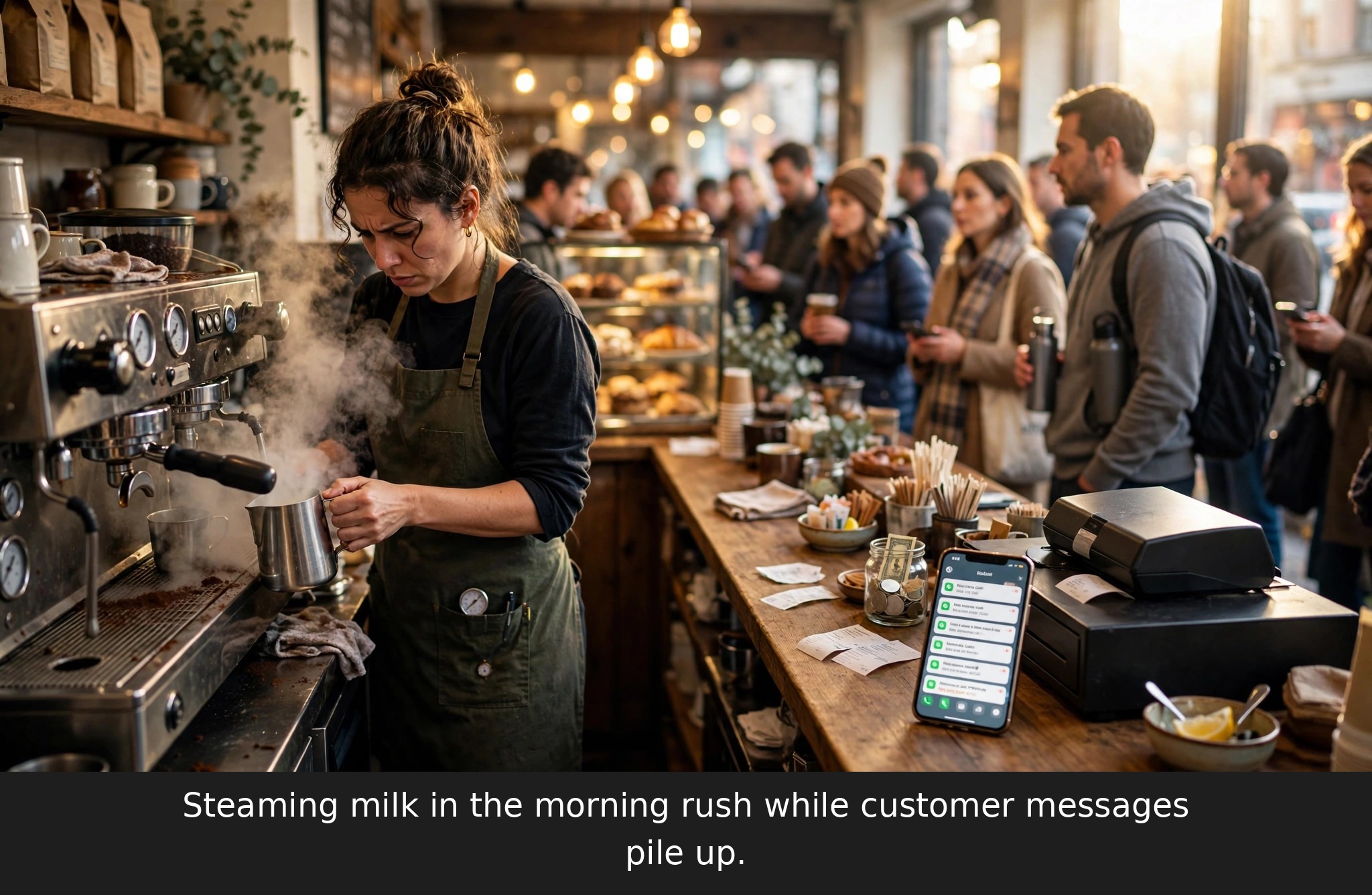
It is 7:42 on a Tuesday morning. The espresso machine is hissing, the milk is steaming, and the line stretches from your counter to the door. Your phone is buzzing on the shelf under the register, face down, where you left it. By the time the rush ends at nine, there are eleven unread messages waiting: "Are you guys open right now?" "Do you have oat milk?" "Can I order two dozen croissants for Friday's office meeting?" "How much is a large cold brew?" You type back what you can between customers. The office order is the one that stings. That admin messaged six coffee shops at 6pm yesterday. Whoever answered first got the Friday order. You answered at 2pm today. An AI chatbot for coffee shops exists for exactly this moment. It reads every message the second it arrives, answers it in your shop's voice, takes the preorder, and flags the catering request for you while your hands stay on the milk pitcher.
Most coffee shop owners hear "chatbot" and picture a cold little robot popup that annoys their customers. Forget that picture. The useful version is quieter and much simpler. It is a trained helper that lives inside your website chat and your messaging apps, knows your menu better than your newest hire, remembers how preorders work at your shop, and never sleeps. This article is the full playbook for coffee shop owners: what it should handle, what it should never touch, how to set one up without hiring a developer, and how to tell whether it is actually making you money. An AI chatbot for a coffee shop earns its keep at 7:42 in the morning, when every barista's hands are full and every message is money waiting to leave.
The Quiet Leak in Most Coffee Shops: Unanswered Messages
Ask a coffee shop owner what hurts most and you will hear about rent, bean prices, or staffing. Rarely does anyone say "messages." But walk through the math with me. A regular sends "can I preorder my usual for 8:15?" while you are three drinks deep in the queue. You do not see it. She walks in at 8:15, waits six minutes, and tomorrow she tries the drive-through instead. A student asks "do you have wifi and plugs?" at 10pm, planning tomorrow's study spot. No answer by morning, so she picks the other place. A bride asks about coffee catering for 80 guests. She messages five shops and books the one that replies before lunch. None of these people were lost because your coffee was bad. They were lost because nobody answered. An AI chatbot for coffee shops plugs this exact leak. It does not make your coffee better. It makes sure the people who already want your coffee actually reach you.
The pattern is painfully consistent across independent shops. Messages arrive in two waves: the morning wave between 6 and 9, when your staff cannot touch a phone, and the night wave between 9pm and midnight, when the shop is dark and nobody is home. The morning wave is preorders and "are you open" questions. The night wave is catering inquiries, bulk orders, and "do you have decaf?" type questions from people planning tomorrow. Both waves are pure buying intent. Someone who asks "can I get 40 pastries Friday?" is not browsing. They are holding money. Shops that answer within minutes win a wildly unfair share of these. Shops that answer at 2pm get the polite "we already sorted it, thanks."
What Customers Actually Ask (It Is the Same Ten Questions)
Strip a coffee shop's inbox down to its bones and you find the same questions repeated every single day, in slightly different words. Training a coffee shop chatbot starts here, because these are the answers it will give hundreds of times without getting tired:
- Are you open right now, and what are your hours today?
- Do you have oat milk, almond milk, or other dairy-free options?
- Can I preorder for pickup, and how far ahead should I order?
- How much is a large cold brew / latte / seasonal drink?
- Do you have decaf, and which beans do you use?
- Is there wifi and somewhere to sit and work?
- Do you sell coffee beans or brewing gear to take home?
- Do you cater offices and events, and what does that cost?
- Do you have gluten-free or vegan pastries?
- Where do I park, and do you do curbside pickup?
Answer each of these once and it takes two minutes. Answer each of them forty times a day, in between steaming milk and wiping tables, and it quietly eats an hour of someone's shift. That is before the follow-ups: "is the oat milk one sweetened?" "how big is the large?" A trained coffee shop chatbot answers all of these from your real menu and your real hours, in seconds, at 7am and at midnight, while your team does the work only humans can do. It is the same idea as the AI chatbot for bakeries that handles cake and pastry questions, except your menu changes with the seasons and your rush is more violent.
What an AI Chatbot for Coffee Shops Actually Does All Day
Let us get concrete. Forget the marketing brochures. Here is the actual job description of a well-set-up coffee shop chatbot on a normal Tuesday:
- Greets website and message visitors in your shop's tone and answers menu, price, hours and allergen questions from your written menu sheet.
- Takes preorders: drink, size, milk choice, extras, name, pickup time. Sends the ticket to the till or the barista's screen in your format.
- Handles the "is the line long?" crowd by offering preorder-ahead so regulars skip the queue entirely.
- Captures catering and bulk orders: date, headcount, items, delivery or pickup, budget range. Packages it into a clean summary and pings you to confirm.
- Signs people up for your loyalty program with one question instead of a clipboard nobody fills in.
- Sells the retail shelf: beans, mugs, brewing gear. Answers "which beans are good for espresso at home?" and offers pickup or local delivery.
- Hands off to a human the moment something is unusual: a wedding, a complaint, a question it has not seen before. With the full conversation attached.
Notice what is not on that list. It does not pull shots. It does not remember a regular's face. It does not replace the warmth of your shop. It does the repetitive talking so your people can do the human work. Most coffee shops do not lose catering orders to a better shop. They lose them to a faster reply.
The Regulars Problem: "The Usual" Should Work Over Text Too
People do not come back to a coffee shop only for the coffee. They come back for the feeling of being known. The best moment in any shop is when the barista sees someone walk in and starts their drink. A chatbot cannot see faces, but it can learn patterns. When a returning customer messages "my usual for 8:15," a trained coffee shop chatbot can confirm the exact drink they ordered the last three times: "Large oat milk latte, one pump vanilla, pickup at 8:15? Say yes and I will send it to the bar." That small moment of recognition is worth more than any discount. It turns a transaction back into a relationship, even when the message arrives at 6am and the barista is someone new.
This is also where loyalty programs quietly double in value. Most shops have a loyalty card that half the customers never activate because signing up means spelling their email at a busy counter. A chatbot asks one question: "Want me to add this order to your loyalty account? Just your phone number." No clipboard, no spelling, no queue pressure. The customer gets their points, you get their number for the next seasonal-drink announcement, and the barista never stops moving. Over a few months, that list becomes the cheapest marketing channel the shop owns, and it cost nothing to build.
Catering: The Money You Never See
Here is the part most coffee shop chatbot articles skip, and it is the biggest one. Walk-in coffee is your daily bread. Catering is your bonus month. One office order for 30 coffees and 50 pastries can be worth more than an entire slow weekday. And where do catering inquiries live? In your messages, at 7pm, when you are mopping the floor. An office manager needs Friday covered. She messages six shops. She books the first one that gives her a straight answer. This is a race you keep losing without knowing you entered.
A coffee shop chatbot treats catering like the serious business it is. It does not try to close the deal itself, which would be risky. Instead it runs a clean intake: What date? What time? How many people? Coffee only, or pastries too? Delivery or pickup? Any dietary needs? Then it turns that into a one-screen summary and sends it to you with the customer's number. You reply with one message: "Yes, we can do Friday 9am, it will be X, confirm?" You just won a catering order while watching TV. The chatbot did not make the coffee. It made sure you were in the race at all.
The Night-Shift Problem Nobody Talks About
There is a second inbox disaster that owners only notice when someone points it out. Open your Instagram DMs and your WhatsApp Business at 10pm some night and scroll back. You will find questions sitting unanswered for nine hours: "do you have matcha?" "are dogs allowed on the patio?" "can I book the back table for 10 people Saturday?" Each one is a person who was ready to spend money and got silence instead. A few will wait. Most will not. They message the next shop, and now they are the next shop's regular. An AI chatbot for coffee shops works the night shift without complaint. It answers the matcha question, it explains the patio policy, it takes the Saturday table request with a name and a time. In the morning you wake up to a tidy list of warm leads instead of a graveyard of cold ones.
This matters even more on weekends. Saturday morning is when your shop is busiest and when the most messages arrive. Your staff is at full stretch, the grinder is screaming, and the messages pile up exactly when each one is most valuable. A chatbot that takes preorders during the Saturday rush does two jobs at once: it keeps customers from waiting in a twenty-minute line, and it keeps your baristas from stopping the line to read a phone. Preordering also removes the rushed-line pressure, which is when add-ons like a pastry quietly get skipped.
What the Big Chains Are Already Testing (And What It Means for You)
The trend is not coming. It is here. Starbucks began testing a ChatGPT integration in April 2026 that lets customers describe a mood, a craving, or even upload a photo, and get drink suggestions to match, a move reported by Daily Coffee News. Their own digital chief put it plainly: customers are not always starting with a menu anymore. They are starting with a feeling. "I need an iced pick-me-up." "Something warm and not too sweet." That is exactly how a chatbot conversation works, and it is why an independent shop can now offer the same convenience the chains are spending millions to build. The same report noted that Adobe found AI-driven traffic to US retail sites jumped 1,200% between July 2024 and February 2025. People are getting comfortable asking AI for what they want instead of hunting through menus.
The honest read on this trend for a small shop owner: you do not need Starbucks' technology, but you should prepare for Starbucks' customers. The person who ordered by describing a vibe to an app will message your shop the same way: "something iced, not too sweet, with oat milk." A trained coffee shop chatbot understands that sentence and replies with your actual menu item, not a lecture about menu categories. That is the bar now. Starbucks tested mood-based ordering through ChatGPT in April 2026. The lesson for independents is not the technology, it is the expectation: customers now want to order by describing what they feel like, and the shop that understands them wins.
Zooming out, the pattern is bigger than coffee. Industry forecasts for 2026 expect AI agents to handle the majority of routine customer conversations, with some analysts projecting they will manage up to 95% of customer engagements, according to Infobip's 2026 trends report. For a coffee shop, that does not mean firing anyone. It means the repetitive half of your inbox gets handled while your team handles people. The shops that adopt early get a quiet advantage while everyone else is still typing "let me check and get back to you."
Setting It Up, Step by Step (No Developer Needed)
This is the part where owners usually expect a painful tech project. It does not have to be. A coffee shop chatbot is mostly writing, not coding. The AI does the talking. Your job is to give it the right facts. Here is the setup in the order that works:
- Step 1: Write down your 20 most-asked questions. Pull them from your Instagram DMs, WhatsApp, and Google reviews. These become the chatbot's core training.
- Step 2: Type out your full menu with prices, sizes, milk options, and allergen notes exactly as you want them quoted. The bot only knows what you write here, so write it once and write it right.
- Step 3: Set your preorder rules. How far ahead can someone order? What is the cutoff before closing? Do you do curbside? The bot enforces your rules every time.
- Step 4: Write your catering intake. Date, headcount, items, delivery or pickup, dietary needs, budget. Decide what the bot collects and what needs your personal reply.
- Step 5: Choose your channels. Start with your website chat, then add WhatsApp or Instagram where your customers already message you. Meet them where they are.
- Step 6: Set the handoff rule. "If the question is about an allergy I have not listed, a complaint, or anything unusual, take their number and tell them a human will reply within the hour."
- Step 7: Test with ten real messages from last week. Send them to the bot yourself. Fix anything that sounds off for a coffee shop. Only then put it live.
The whole thing usually takes an afternoon of writing and a day or two of testing. Compare that with training a new hire to answer the phone well, which takes weeks, and the new hire still cannot answer at midnight. ReplyPilot builds exactly this kind of setup for coffee shops: your menu, your rules, your tone, working on your website and messaging apps. The setup flow above is what we follow, and step seven, the real-message test, is the one step we never skip.
What It Should Never Do (The Guardrails That Matter)
A chatbot that answers wrong is worse than no chatbot. Coffee has real safety edges: nut milks, gluten-free claims, caffeine for kids, hot drinks for toddlers. The guardrails are not optional. Here is the short list every coffee shop chatbot needs:
Want this for your coffee shops?
ReplyPilot builds a custom ai chatbot setup for your coffee shops — answering customer questions instantly, taking orders and bookings, and handing off to you when a human is needed.
Ask on WhatsApp — it's free- Never invent menu items, prices, or hours. If it is not in your written sheet, the bot says "let me get someone to confirm that" instead of guessing.
- Never give confident allergen advice. It can quote your written allergen notes and must add "please double-check with our staff in store" for anything not listed.
- Never confirm a catering order or a large preorder on its own. It collects the details and sends them to you. You confirm. Always.
- Never pretend to be a human. It introduces itself as the shop's assistant. Customers are fine talking to a bot as long as they know it is one.
- Never keep chatting when it is confused. Three unclear exchanges, then it offers a callback or a human. A graceful handoff beats a confident wrong answer.
These rules are the difference between a tool and a liability. Set them on day one, test them with tricky questions ("is your almond croissant safe for a nut allergy?" is the classic trap), and sleep easy. The same safety-first thinking applies to lead capture automation setups in other local businesses: capture cleanly, confirm carefully, hand off gracefully.
How to Tell If It Is Actually Working
Do not measure vibes. Measure these five numbers for the first month, and you will know exactly what the chatbot is worth:
- Preorders taken by the bot per week. Each one is a customer who skipped the line and a barista who never stopped moving.
- After-hours questions answered. Count the messages that arrived when the shop was closed and got a real answer instead of silence.
- Catering inquiries captured. Compare with last quarter's guess. Even two extra catering orders a month usually pays for the setup many times over.
- Response time. Before the bot, your average reply time might have been hours. After, it should be seconds. That gap is the whole game.
- Staff interruptions avoided. Ask your baristas after two weeks whether they touch the shop phone less. Their answer is your real review.
If the preorder number is climbing and the staff say the phone rings less, keep it. If catering inquiries are up, celebrate. If nothing moves after a month, the problem is usually the training sheet, not the technology. Go back to step one, add the questions you missed, and test again. A chatbot is only as good as the facts you feed it.
Will Customers Actually Trust a Chatbot With Their Coffee Order?
Short answer: yes, if it is accurate and fast. People already order coffee through apps with zero human contact. They do not need a human to take "large oat latte." They need it right and ready at 8:15. What customers hate is not bots. They hate wrong bots and slow bots. A chatbot that confirms the exact order, repeats the pickup time, and says "see you at 8:15" feels more reliable than a rushed human scribbling on a cup. The trust question solves itself the first time someone's complicated order arrives exactly right.
What If the Chatbot Gives a Wrong Answer About an Allergen?
This is the right fear to have, and the design answers it. A properly set up coffee shop chatbot does not freelance on allergens. It quotes only your written allergen sheet, word for word, and for anything not on the sheet it says "I want to make sure I get this exactly right, so I am passing this to our team." That is safer than a tired teenager at the register guessing from memory at 7am. You control the sheet. Update it when the menu changes, and the bot updates with it. No memory, no guessing, no improvising.
Does It Work on Instagram and WhatsApp, or Only My Website?
It works wherever your customers message you, and that is usually not your website. Most coffee shop inquiries arrive through Instagram DMs and WhatsApp, especially from younger customers and especially for catering. A chatbot that only lives on your website misses the actual inbox. The right setup connects the same trained assistant to your website chat, your Instagram DMs, and your WhatsApp Business number, so a customer gets the same correct answer in every channel. One training sheet, every door covered. That multi-channel habit is the same reason WhatsApp automation for restaurants took off: the customers were already there.
How Long Does It Take Before It Pays for Itself?
Honest answer: it depends on your catering and preorder volume, but the math is friendly. Add up one month of lost preorders and one missed catering inquiry. For most busy shops, that number is uncomfortable. The chatbot costs a fraction of it. The payback usually comes from the first catering order it captures that you would have missed, or the first month of Saturday preorders that kept the line moving. Track the five numbers above, give it sixty days, and decide with data instead of hope.
Want this running in your coffee shop?
Your coffee is the reason people come. Your replies are the reason they come back, and the reason the office down the street books Friday with you instead of the chain. An AI chatbot for coffee shops makes sure every message gets an answer in seconds, every preorder gets taken, and every catering inquiry lands on your desk while you are still mopping the floor. It does not change your shop. It stops your shop from leaking money through its inbox. If you want to see what this looks like with your actual menu and your actual rush hours, ReplyPilot will build you a free custom demo. You bring the menu. We bring the bot. Watch it answer your ten hardest questions live, and then decide. Start here: get a free custom demo for your coffee shop.
The Complicated Order: Six Modifications and Zero Mistakes
“Large oat-milk latte, half-caf, extra hot, two pumps sugar-free vanilla, light foam.” Read that once on a phone screen during the rush and try to get it right. This is where chat ordering quietly beats the counter — the customer types it carefully at their own pace, and nothing gets misheard over the espresso machine.
The read-back is the whole trick. Before confirming, the chatbot shows the full order in plain words, and the customer checks it while calm — not while a line presses behind them. Mistakes get caught before the milk is steamed, not after the cup is handed over.
Save the complicated ones. The regular with the six-modification drink reorders it in one tap tomorrow, exact every time, no matter who is on the bar. Their “usual” stops depending on which barista remembers it — and the barista stops dreading the complicated order.
And keep one kindness rule: if the chatbot is unsure about a combination, it asks instead of guessing. “Just to check — did you mean decaf with an extra shot?” One clarifying question beats one remade drink, and customers would far rather correct a message than send back a cup.
Selling Bags of Beans and Brew Gear Without Being Pushy
Your regulars love your coffee, and some of them want to brew it at home. Bags of beans, a pour-over dripper, maybe a grinder — this is real money sitting on your shelf, and most shops sell it only when someone happens to ask. Which is almost never.
The chatbot mentions it naturally, at the right moment. After a regular reorders their usual, a light touch: “Want a bag of these beans for home? Same roast.” Not a pop-up, not a pitch — a suggestion that is easy to ignore and easy to accept. Timing is what makes it feel like service instead of sales.
Bean subscriptions are the quiet winner: a bag every two weeks, charged automatically, ready for pickup or delivered. The chatbot runs the whole rhythm — reminders, payments, “skip this week” — and you get recurring revenue from customers you already have, without selling a single extra cup.
Keep it honest and personal. Recommend the beans for the drink they actually buy — the regular who drinks your house blend does not want a lecture about single-origin tasting notes. Match the suggestion to the person, and it feels like being known. That is the whole game.
How Do You Launch a Seasonal Drink Without a Big Budget?
Autumn comes, and you create a spiced honey latte that is genuinely worth talking about. The chains spend a fortune launching theirs. You have something better: a chat list full of people who already love your shop and asked to hear from you.
One message, one good photo, one honest reason: “Our spiced honey latte is back — real honey, our own spice mix, this month only.” Send it once, to people who opted in. The regulars who loved it last year will be in this week, and they will bring friends.
Then let the chatbot answer the follow-ups: “Is it very sweet?” “Can I get it iced?” “Is it back for good?” Every question answered instantly, every curious customer one tap from ordering. A launch becomes a conversation instead of a poster — and the orders tell you within days whether the drink deserves a permanent spot.
The honest limit: one launch message per season, maybe one reminder near the end. Your chat list is trust, not a billboard. A seasonal drink announced to warm customers will always beat a poster in the window — and it costs you nothing but the photo.
Saturday Rush Hour: The Chatbot's Busiest Two Hours
8 to 10 on Saturday morning: the line is out the door, every table is taken, and your phone is lighting up with preorders. This is the moment the chatbot earns its entire month — by keeping half the rush out of the line.
The preorders flow straight to the bar: name, drink, modifications, paid or pay-at-pickup. The barista works down the list without stopping to read a phone. The line moves because half of it never joined the line — those customers walk in, grab their cup, and leave while the queue shuffles forward.
New customers get guided fast instead of freezing at the menu board. “First time here? Tell me what you usually drink and I will match it.” The chatbot translates “I like sweet iced coffee” into your menu in seconds — no holding up the counter with questions while ten people wait behind.
And the questions that used to interrupt everything — “Are you open?” “Do you have oat milk today?” “How long is the wait?” — get answered in chat, instantly, while your team keeps pouring. By 10:30 the rush breaks, the phone goes quiet, and nobody on your team touched a single message. That is the job, done.
Frequently Asked Questions
Can an AI chatbot take coffee preorders during the morning rush?
Yes. Regulars message "Large latte, oat milk, in 10 minutes," and it queues the order. Your baristas work through a calm list instead of a shouting line. Preorders also mean fewer walkaways.
How much does a chatbot cost for a coffee shop?
Typically a modest monthly fee for a coffee shop. Coffee margins are thin but volume is high — a handful of extra orders a day covers it. Shops near offices see the fastest return from preorder regulars.
Can the coffee shop chatbot handle catering and bulk orders?
Yes. "30 coffees for our office meeting Friday" gets a proper quote and confirmation — not a missed DM. Catering orders are high-value; the chatbot makes sure you never miss one.
Will the chatbot answer menu and allergen questions?
Yes. "Do you have decaf?" "Is the banana bread gluten-free?" — answered instantly from your menu. Customers with dietary needs become loyal when answers are easy.
Can the chatbot run a loyalty programme for my coffee shop?
Yes. It tracks visits and tells customers "Two more coffees until a free one." Digital loyalty beats punch cards — customers never lose it, and you get their contact for promotions.