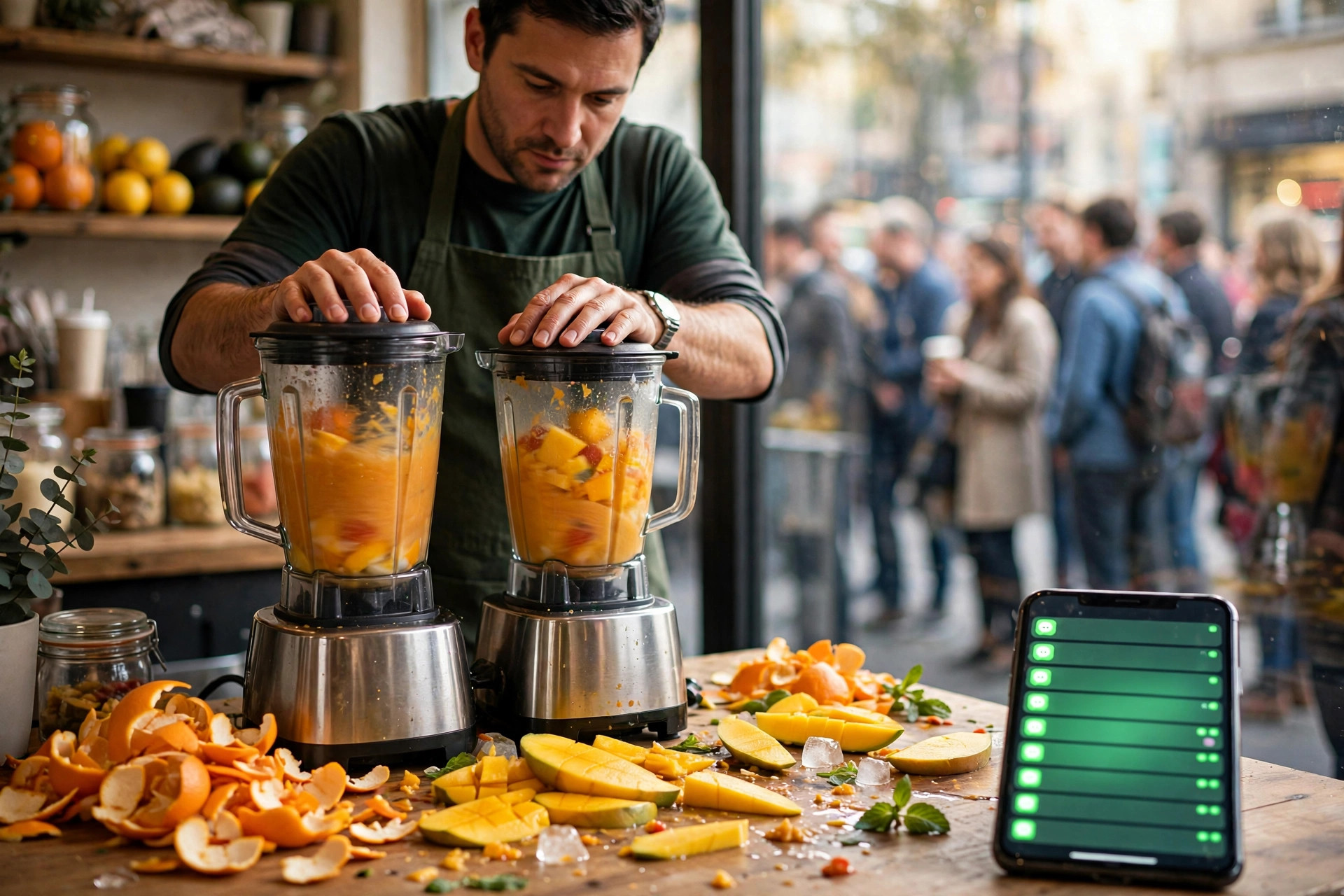
It is 8:15 on a weekday morning. Your juice bar sits between two office buildings, and the queue is already out the door. Three blenders are roaring, the counter is covered in orange peels, and your one helper is slicing mangoes as fast as his hands allow. Your phone is on the shelf behind the counter, buzzing: "One detox green, less ginger." "Can you make 6 juices for our office? We need them by 9:30." "How long is the wait right now?" You glance at the phone, then at the queue, then at the blenders. You cannot answer and blend at the same time. The office group that needed six juices by 9:30 gives up and walks to the cafe next door. The person asking about the wait leaves the queue. By 9 am the rush is over — and so is the money it could have brought. This is the daily mathematics of a juice bar: a short, intense rush where every unanswered message is a lost sale. WhatsApp automation for juice bars exists for exactly this window. It takes the orders while you blend, tells each customer when their drink is ready, and turns the chaos of the morning rush into an orderly line of sales.
Watch it working for a juice bar:
The Rush-Hour Problem: Too Many Customers, Too Few Minutes
A juice bar is not like a restaurant with a steady flow all day. Your business lives in spikes: the morning office rush, the post-gym wave, the hot afternoon crowd. In those spikes, demand exceeds what your counter can handle — not because you are slow, but because taking an order, confirming customisation and taking payment eats a full minute per customer. Ten customers in the queue means the eleventh person waits ten minutes. Many will not.
A juice bar WhatsApp ordering chatbot removes the counter bottleneck entirely. Customers order from the queue — or from their office desk before they even leave — and your team just blends in the order the requests arrive. The counter stops being a choke point and becomes what it should be: a pickup point. The same two people who used to serve fifteen customers in a rush can now serve thirty, because the ordering, the customisation and the payment all happened in the chat.
What WhatsApp Automation for Juice Bars Actually Does
Here is the full picture of what a well-built system handles for a juice or smoothie bar:
- Takes order-ahead requests — customers order from the queue, the street or their office, and get a pickup time instead of standing in line.
- Handles customisation naturally — "less sugar, no ice, extra ginger" — and attaches it to the order so the person blending gets it right.
- Manages office group orders — one person collects the team's juices in a single chat with a running total, instead of six people queuing separately.
- Sends "your drink is ready" notifications, so customers arrive exactly when their juice is done — fresh, not watered down from waiting.
- Runs daily and weekly juice subscriptions for gym-goers and health-conscious regulars, with automatic reminders and easy pauses.
- Answers the everyday questions instantly: today's menu, prices, "do you have fresh orange today?", opening hours, location.
- Collects payment in chat, so the counter never slows down for cash handling during the rush.
- Brings customers back with well-timed messages — a new seasonal flavour, a hot-day offer, a nudge to the regular who has not visited in two weeks.
Order-Ahead: The Feature That Changes Everything
The single most powerful thing a juice bar can automate is the order-ahead. Here is how the morning works with it running. At 8 am, an office worker messages your WhatsApp number from her desk: "Large mango smoothie, no added sugar." The system confirms: "Large mango smoothie, no added sugar — ready for pickup at 8:25." She finishes her email, walks down at 8:25, picks up a fresh smoothie, and walks out. She never stood in your queue. Your blender made her drink during a gap between walk-in orders, and she will do the same thing tomorrow. Multiply her by twenty office workers and you have added a whole second stream of revenue that your counter never had to process.
Order-ahead also smooths your production. Instead of ten orders hitting you at once at 8:30, they arrive spread across the morning, each with a promised pickup time you set based on how busy you actually are. When the rush peaks, the system starts quoting slightly later pickup times automatically — honest, calm, and far better than a frazzled "ten minutes" that becomes twenty-five. If you run a restaurant with similar rush dynamics, our guide to WhatsApp automation for restaurants covers the same order-flow thinking for full meals.
The 11 AM Office Order: Your Most Valuable Habit
Every juice bar near offices knows the 11 am phenomenon: someone in the office decides everyone wants juice, collects preferences verbally, and either sends one person with a confusing list or gives up. Smoothie shop order automation turns this chaos into your most reliable revenue. One person opens the chat, adds "2 orange, 1 ABC detox, 3 mango, 1 watermelon mint," and the system keeps the running list and total visible. Everyone in the office can see what was ordered. The order is confirmed once, paid once, and delivered or picked up as one job.
The real prize is making this a habit. Offices run on routine — the same team, the same mid-morning break, day after day. After the first few orders, the system can nudge the organiser: "Hi Daniyal, time for the team's 11 am juices? Tap to repeat last Tuesday's order." One tap, and you have a bulk order without lifting a finger. Three offices doing this regularly can be worth more than your entire walk-in afternoon trade. And because the order comes with names attached to each drink, your team labels cups correctly — no more "whose is the green one?" at handover.
Subscriptions: The Gym Crowd That Pays You Monthly
Juice bars have a natural subscription audience that most never capture: the gym-goers, the dieters, the health-conscious regulars who drink the same juice almost every day. Selling them one drink at a time leaves money on the table. A subscription — "30 detox juices, one every weekday morning" — locks in their habit and your revenue.
WhatsApp automation makes subscriptions practical for a small shop. The system explains the plans, signs the customer up, and then runs the daily rhythm by itself: a morning message — "Your detox green will be ready at 7:30 am as usual. Reply SKIP if you are resting today" — tracks how many drinks have been used, and reminds the customer before the plan runs out: "3 juices left on your plan — renew now and keep your morning streak." Pauses for travel, skips for rest days, renewals — all handled in chat, no spreadsheets, no memory needed. For subscription-style repeat business in another trade, AI chatbots for gyms and fitness studios shows how memberships and class packs run on the same reminder logic.
Fresh Stock, Daily Menu and the Waste Problem
Fresh fruit is your biggest cost and your biggest risk. Mangoes that do not sell today are lost money tomorrow. Most juice bars handle this with a static menu and silent waste. A smarter approach: let the automation publish a short daily menu based on what is actually fresh and abundant. "Today's specials: mango madness and watermelon cooler — mangoes are at their best this week." Customers love the feeling of a living menu, and you quietly steer demand toward the fruit that needs selling.
The system can also be honest about what is NOT available, which saves more awkwardness than owners realise. "Sorry, we are out of fresh oranges today — can I suggest the mosambi instead?" — sent instantly when someone asks, instead of the customer queuing for ten minutes to hear it at the counter. And at the end of the day, the order data tells you what sold and what did not, so tomorrow's fruit buying gets sharper. Less waste, better buying, happier customers — from one small daily habit.
Customisation Without the Confusion
Juice customers customise everything: less sugar, no ice, extra ginger, half-and-half blends, protein powder added, "make it thick." In a shouted queue, half of these instructions get lost or misheard. In a chat, they are written down, attached to the order, and shown to the person blending. The difference in accuracy is enormous — and accuracy matters more for juice than almost any other food, because a "no sugar" customer who gets sugar may never come back.
The system should also know your limits and state them kindly. If you cannot do a particular combination, it says so before the order is confirmed, not after the customer has paid and waited. And it remembers preferences: the regular who always takes "less ice" never has to say it again. That memory is what makes people feel like regulars — and regulars are the foundation of every successful juice bar.
Loyalty That Actually Brings People Back
Paper stamp cards get lost. App-based loyalty never gets downloaded. But a loyalty count inside the WhatsApp chat the customer already uses? That works. Every purchase is logged automatically, and the customer can check anytime: "You have 7 stamps — 3 more for a free large juice." When they hit ten, the free drink is offered in chat, no awkward asking at the counter.
The quiet power of chat-based loyalty is the data behind it. You learn who your real regulars are, what they drink, and when they usually come. The customer who always orders on weekdays but vanished for two weeks gets a personal-feeling nudge: "Haven't seen you in a while — your usual mango smoothie is waiting." That is not a mass promotion. That is a relationship, maintained automatically. For loyalty ideas in a retail setting, our guide to WhatsApp automation for clothing boutiques covers repeat-shopper win-back with the same personal-touch approach.
One more loyalty lever most juice bars miss: referrals. A happy regular with a free-drink reward is the perfect person to bring a friend — "Give a free juice to a friend, get one yourself when they visit." The automation generates a simple personal referral message the customer can forward in one tap, and tracks who came from whom. Because it all happens inside WhatsApp, forwarding feels natural, not salesy. A small, steady stream of referred customers is the cheapest growth a juice bar can get.
The QR Code on the Cup: Turning Drinkers Into Subscribers
Here is a growth trick that costs almost nothing: print a small QR code on every cup that opens your WhatsApp chat with a welcome offer — "Scan for a free upsize on your next visit." Every cup becomes a flyer that the customer carries out of your shop. The automation handles the rest: the welcome message, the offer, the saved contact, and — with permission — the occasional well-timed message afterwards. Your customer list grows every day without you doing anything.
This list is an asset most juice bars never build. When summer hits and you launch a new seasonal cooler, you are not hoping people walk past — you are telling hundreds of past customers directly. Meta's click-to-WhatsApp ads work on the same principle online, turning social media traffic directly into WhatsApp conversations (source) — but the QR code on the cup does it offline, for free, with every single sale. One honest caution from the platform rules: the regular WhatsApp Business App caps broadcast lists at 256 contacts, so once your list grows past that, the official WhatsApp Business API is the right route for announcements.
Hot Afternoons and Slow Evenings: Filling the Dead Hours
Want this for your juice bars?
ReplyPilot builds a custom whatsapp automation setup for your juice bars — answering customer questions instantly, taking orders and bookings, and handing off to you when a human is needed.
Ask on WhatsApp — it's freeThe morning rush is only half the story. Most juice bars sit half-empty between 2 pm and 6 pm, blenders idle, fruit slowly losing freshness. This dead window is where your customer list becomes a money-maker. A well-timed afternoon message to people who opted in — "Hot afternoon? Cool down with a fresh watermelon mint — order ahead and skip any wait" — speaks to exactly the right people at exactly the right moment. It is not spam, because it is useful, timely and rare.
You can also use these hours for the business the rush never allows: catering small office events, supplying gyms with post-workout smoothies, or running a "happy hours" window with a special price on slow-moving stock. The automation announces it, takes the orders and tracks them — the same system, working a second shift for the hours your counter cannot fill on its own.
Allergies and Health Claims: Where Honesty Is Non-Negotiable
Juice bars sit at the intersection of food and health claims, and this is one area where the automation must be strictly honest. If a customer asks "is this good for diabetes?" or "does this have dairy?", the system must answer from your verified ingredient lists — never invent health advice. Train it to give factual answers ("the ABC detox contains apple, beetroot and carrot, no added sugar") and to route medical-sounding questions to a safe, humble response: "I'm not qualified to give health advice — please check with your doctor. I can share our full ingredient list if that helps."
This honesty is not just ethical — it is good business. Health-conscious customers are your most loyal segment, and they notice when a business is careful with claims. A juice bar that is precise about ingredients earns a trust that no marketing can buy. Make sure your ingredient lists are complete and current, because the system's answers are only as truthful as the information you give it.
Mistakes Juice Bars Make With Automation
- Quoting pickup times you cannot meet — set the promised time from your real blending speed during rush, not your quiet-hour speed.
- Letting the menu go stale — if the chat says mango is available and the counter says it is finished, trust breaks fast; update availability daily.
- No "ready" notification — without it, order-ahead customers hover at the counter asking, which recreates the queue you were trying to remove.
- Ignoring customisation notes — if the chat promises "less sugar," the blender must see it; the system is only as good as the handoff to your team.
- Spamming the list — one or two genuinely useful messages a month (new seasonal flavour, hot-day offer) is welcome; daily blasts get you blocked.
- Forgetting the walk-in customer — the queue still exists; use the chat to give wait-time estimates so people in line know what to expect too.
How to Set Up WhatsApp for Your Juice Bar, Step by Step
- 1. Write your full menu with every customisation option and price in one clean sheet — this becomes the system's knowledge.
- 2. Time your real blending and serving speed during a rush — your order-ahead pickup promises must be built on this number.
- 3. Decide your daily rhythm — when the "menu of the day" message goes out, when subscription reminders fire, when the shop is too busy for instant pickup.
- 4. Set up the stages you will announce: order confirmed, being prepared, ready for pickup.
- 5. Write the 15 questions customers ask most — "is the mango fresh today?", prices, timings, location — with your exact answers.
- 6. Start with order-ahead and the ready notification for two weeks, read the chats every evening, then add subscriptions, loyalty and the QR-code list building.
What It Costs Your Juice Bar — and What It Saves
The costs are the setup, the monthly WhatsApp Business API conversation fees, and a few minutes a day updating the menu and fruit availability. The returns come from the rush hours you currently waste: the office workers who give up on the queue, the group orders that never happen because organising them is too hard, the subscriptions you never sold because tracking them manually was impossible. For most juice bars, capturing even a fraction of the lost rush-hour demand covers the cost many times over. And there is a compounding effect: every cup with a QR code grows your customer list, every subscription locks in future revenue, and every accurate customisation builds a regular. In June 2026, Meta introduced Business Agent, an AI layer for WhatsApp and Messenger that answers business-specific questions and books appointments, with over a million businesses already using it at launch — more evidence that customers increasingly expect to handle everyday transactions in chat, and the small food businesses that meet them there first win the habit.
Your Next Step
Tomorrow morning at 8:15, the queue will form again. The blenders will roar. The phone will buzz. The only question is whether those messages turn into sales or into silence. WhatsApp automation for juice bars does not change your recipes or your fruit — it changes what happens around them: orders taken while you blend, customers told exactly when to arrive, office groups ordering in one tap, subscriptions running themselves, and a customer list that grows with every cup. The rush stays. The chaos goes.
ReplyPilot builds custom WhatsApp automation for food and drink businesses — order-ahead flows, subscriptions, loyalty and group orders, all trained on your menu and your rush-hour reality. Want to see how this workflow could work for your business? Request a free custom demo from ReplyPilot and watch your menu sell itself during the morning rush.
How Do Payments Work When the Order Happens in Chat?
During the morning rush, the slowest part of your counter is not the blending — it is the paying. The customer waits for the drink, then waits again to pay, then waits for change or for the card machine to wake up. If the order already came through chat, the payment can happen there too, and the counter goes back to being what it should be: just a pickup point.
The simplest setup is a payment link sent with the order confirmation. The customer orders from her desk at 8 am, pays in ten seconds, and walks in at 8:40 to a cup with her name on it. No queue at the register, no fumbling for cash with a cup in each hand. For office group orders, one person can collect everyone's share through the link instead of doing awkward math at the counter while the line grows behind them.
But do not force prepayment on everyone. Some customers only trust paying when the cup is in their hand, and that is fair. Offer both: pay now in chat, or pay at pickup. The chatbot asks once, remembers the answer, and stops asking. The regular who always pays at the counter gets a shorter chat every time — and notices that you remembered.
One honest rule for prepaid orders: decide your refund policy before you need it. If you run out of mangoes after someone already paid, the swap or refund must happen in one message, before the customer arrives — never at the counter with a queue behind them. Write the rule down, teach it to the chatbot, and honor it every single time. A prepaid customer you refund fast ends up trusting you more, not less.
What about subscription billing?
Subscriptions need their own rhythm: one charge a month, a receipt in chat, and a gentle heads-up before the renewal — never a surprise charge. When a payment fails, the chatbot says so plainly and offers a retry link, the way a polite cashier would. Money handled calmly in chat is money your regulars stop thinking about, and that is exactly what a subscription should feel like.
What Happens When the Order Is Wrong?
It will happen. A large instead of a regular, pineapple instead of mango, the protein powder forgotten. The customer messages while annoyed, and the chatbot is the first thing they meet. Its job is simple: say sorry in plain words, ask what went wrong, and fix it fast.
Decide the fixes in advance, because the chatbot should never invent them. A wrong drink gets a free remake, ready in ten minutes. A drink that never arrived gets a refund or a fresh cup, the customer's choice. Write these rules once, in your own words, and the system applies them the same way every time — no arguing, no awkward counter negotiation.
The late-pickup version matters just as much. When the rush runs long, the system should message first: “Your juice will be ready at 9:20, not 9:05 — sorry for the wait.” A delay you announce feels like honesty. A delay the customer discovers by standing at your counter feels like neglect. Same delay, completely different feeling.
And plan for the broken-blender morning. One machine dies during the rush, and suddenly half the menu is impossible. The chatbot tells waiting customers honestly, offers a later pickup or a simpler drink, and stops taking orders you cannot make. People forgive a broken blender. They do not forgive silence.
- Say it first — never let the customer discover the problem
- Say it plainly — no excuses, no jargon
- Fix it fast — a remake, a refund, or a new time, decided in advance
The First Two Weeks: Getting Your Regulars to Actually Use It
The system only works if people use it, and nobody changes habits because of a poster. The first two weeks are about your staff, not your customers. Your counter person must mention it to every single customer: “Next time, order on WhatsApp and skip the line.” A printed sign helps. A human voice helps more.
Start with your regulars — the office worker who comes every day, the gym-goer with the subscription. Tell them first, walk them through their first order-ahead, and make sure that first pickup is perfect. Their success teaches the whole office. The 11 am group-order habit starts with exactly one person who tries it and tells the others.
Make the first message effortless. The welcome chat should take an order in under a minute: pick a drink, pick a size, pick a time. If the first chat asks for five things or reads like a form, people will not come back. One minute, one order, one happy pickup — that is the whole onboarding.
The mistakes that kill adoption
- Launching silently — a QR code nobody notices changes nothing
- Staff who never mention it because nobody told them why it matters
- A clunky welcome chat that feels like paperwork
- Giving up after three quiet days — habits take two weeks, not two days
How Do You Sell a New Seasonal Drink Without Spending on Ads?
Summer arrives and you invent a watermelon-mint cooler that is genuinely great. Normally you would hope walk-ins notice the chalkboard. With a customer list, you tell hundreds of past customers in a single message — for free. This is what the QR code on the cup was building toward all along.
The trick is making it feel like news, not spam. One message, one good photo, one honest reason it is special: “Alphonso mangoes are here — our mango cooler is back for three weeks only.” Send it only to people who opted in, and only when something is genuinely new. News gets opened. Noise gets blocked.
Then let the chatbot do the selling. It answers “how much,” “is it very sweet,” “does it have ice,” and takes the order right there. A seasonal launch becomes a conversation instead of a poster — and you learn within a day which drinks deserve a permanent menu spot, because the orders tell you.
The honest limit: do not message the list more than once or twice a month. Every message must earn the next one. A list that only hears from you when something is genuinely new stays warm for years. A list that gets weekly noise gets muted — and you lose the most valuable marketing channel a small shop can own.
Frequently Asked Questions
How does order-ahead work for a juice bar on WhatsApp?
The customer sends their order before arriving — drink, size, customisations — and gets a pickup time back. They walk in, grab their cup, and leave. Your blenders keep running without the queue chaos around the counter.
Can a juice bar WhatsApp chatbot handle daily subscriptions?
Yes, and that is its best money feature. Gym-goers and office workers subscribe to a daily juice, pay monthly, and simply confirm or skip each day. You know exactly how many cups to prep before the morning rush.
What about customisations — less ice, no sugar, extra protein?
The chatbot asks each customisation question in order and records the answers clearly, so the person at the blender never mishears. Regulars can save their usual order and reorder it in a single tap the next day.
Can WhatsApp automation reduce fruit waste in my juice bar?
It helps a lot. Because subscriptions and order-ahead tell you demand in advance, you buy and prep closer to what you will actually sell. Fewer overripe bananas in the bin means more profit from every crate.
Do my juice bar customers need to download an app?
No app needed at all. Everything happens inside WhatsApp, which your customers already have. Many juice bars put a QR code on the cup — one scan and the customer is on your list.