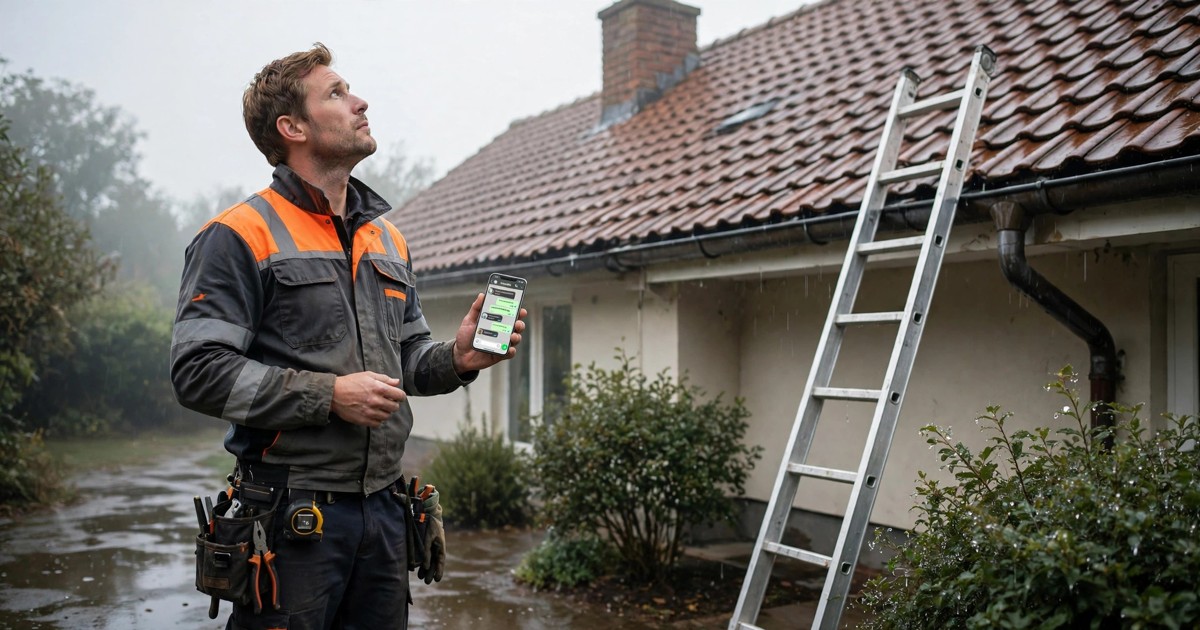
It rained hard on a Thursday night, and by Friday morning there was a brown stain spreading across the spare-room ceiling of a house on Maple Drive. The homeowner, Sarah, did what most people do now. She did not ring around. She opened WhatsApp, found the roofing company her neighbour had recommended, and sent a photo of the stain with one line: "Water is coming in. Can someone come and look?"
The roofing crew was already on a roof two streets away, hammers going, phones in the van. By the time anyone read her message that evening, she had already booked the company that answered her at 9:12 in the morning. That company did not have more staff. It had an assistant on WhatsApp that answered while the crew worked.
If you run a roofing company, this is your normal week. Your customers message when they are worried, which is usually after rain, after a storm, or the morning they notice a stain they swear was not there last week. Your crew is on a roof, on a ladder, or driving between jobs. Somebody has to answer, and the answer has to be good, because a homeowner with water coming in does not wait politely for office hours.
This guide shows you, step by step, how WhatsApp automation handles that first conversation for a roofing company: the photo intake, the leak triage, the ballpark range, the booked estimate visit, the insurance photos, and the job-day messages that keep your phone quiet. You will also see what it must never do, because roof work has safety and honesty lines that no bot should cross. By the end you will have a two-week plan to set it up without stopping a single job.
For the wider picture of how WhatsApp booking works across the trades, the best WhatsApp automation tools guide explains the setup choices in plain language, and the tree service guide covers the storm-damage triage that pairs with roof work after a bad night of weather. If you have never connected a business number to WhatsApp properly, start with the WhatsApp Business API setup guide before you automate anything.
The quick answer
For a roofing company, WhatsApp automation means a helper living on the firm's business WhatsApp number, replying to homeowners at any hour. It gathers photos taken from the ground, a picture of damp indoors, plus the roof's age and covering, then reserves an estimate visit and keeps updates in the same thread. No roof gets a final price from photographs.
Roofers sell visits, not repairs
Most trades sell a job over the phone. Roofers do not, or should not. Nobody can honestly price a leak without standing on the roof and looking in the loft, because water rarely appears where it gets in. It travels along battens, drips off a nail, and shows up two rooms away from the failed flashing. A company that quotes a firm repair price from a single photo is either guessing or planning to revise the price on site, and customers notice both.
So the real product of the first conversation is not a price. It is a visit slot that the customer keeps. Everything automation does for a roofer should be judged against that test: does it make the customer more likely to keep the visit, and does it give the estimator a head start? A fast reply that asks nothing useful fails the test. A slow reply that asks everything fails it too, because the customer has already messaged two competitors.
Good automation threads the needle. It replies in seconds, asks four or five questions that an estimator would ask anyway, and offers a real window from the real diary. The customer feels heard, the estimator arrives knowing the roof's age, material, and problem area, and the visit converts more often because the groundwork is done. That conversion lift is the whole business case. Roofing margins are made at the estimate visit, not in the chat window.
There is a second, quieter benefit. Roofing customers are often landlords, letting agents, or facilities managers with several properties, like Paul above. They judge a company on how easy it is to deal with across many jobs, not on one repair. A company whose WhatsApp thread keeps every property's photos, quotes, and dates in one place becomes the default call for the next roof too. Automation builds that record without anyone filing anything.
The first message: a leak diary, not an interrogation
When a homeowner messages about a leak, they usually write one vague sentence: "Roof leaking, can you help?" The assistant's job is to turn that sentence into a short leak diary, without making the customer feel interrogated. Four questions do it, asked one at a time, in this order.
When did it start? A leak that began in last night's storm is a different job from a stain that has grown slowly for months. The first may be storm damage with an insurance angle. The second may be a long-failed flashing or a perished flat-roof covering. The date matters for the claim, for the urgency, and for the estimator's first guess.
Where does the water show? The room, the wall, the position relative to the chimney or the valley. The assistant should ask for the room name in the customer's words, not for a compass direction nobody knows. "Which room, and is it near the chimney?" beats "which elevation?" every time.
What kind of roof is it? Tiles, slate, or flat, and roughly how old. An 18-year-old tiled roof and a 30-year-old flat roof point to different conversations. If the customer does not know, the assistant should say that is fine and move on, because guessing wrong here is worse than not knowing.
Is water still coming in, or is it a stain from earlier rain? This one question sets the urgency. Active water near electrics or a sagging ceiling is a human-now case. A dry stain that appears only in heavy rain is an estimate-this-week case. The assistant must not treat them the same, and must not leave the first one waiting for a diary slot.
Notice what is not asked in the first message: budget, full address, or availability for three different days. Those come after the customer has a reason to stay, which is the held visit slot. Asking for a postcode before offering anything useful is how chats die.
Evidence the estimator actually wants
Estimators who work from WhatsApp threads will tell you the same thing: they want a small set of specific evidence, and they want it before they drive out. A thread that arrives with that evidence turns a 45-minute first visit into a 20-minute confirmation, and it lets the estimator quote on the spot instead of going away to think.
The useful set is small. A wide shot of the roof slope from the ground, taken from across the street if possible, so the estimator can see the pitch and the side that faces the weather. A photo of the damp inside, with something in frame that shows scale, a door frame or a window, so a small stain is not mistaken for a large one. A ground-level shot of the chimney, valley, or flat-roof edge nearest the leak, because most leaks begin at a junction, not in the middle of a slope. A shot of the gutters on that side, showing whether they are blocked or overflowing. And a note on access: side gate width, driveway parking, and anything the crew must work around, like a conservatory roof that cannot bear weight.
Every request should carry its reason in one short sentence. "A photo from across the street shows us which slope the water crosses." People send useful photos when they understand the point. They send a blurry close-up of one tile when they do not, and no estimator has ever priced a job from a blurry tile.
Two rules govern this evidence. First, nobody is ever asked to climb up. Every photo is from the ground or from inside the house, and the assistant says so. A company that asks a homeowner onto a roof for a photo has already failed its duty of care. Second, the evidence stays in the thread. If photos live in one person's camera roll, the estimator starts blind and the insurance file starts empty. The thread is the job file, from first drip to finished roof.
Urgency: who gets a person today
Not every roofing message deserves the same speed, and pretending otherwise is how urgent jobs wait behind routine ones. A simple three-way sort, applied to every message, keeps the diary honest.
A person today means water is active, a ceiling is sagging or bulging, water is near lights or sockets, or a storm has removed a large section of roof. The assistant gives immediate safety guidance, stays off the subject of price, and hands the thread to a human at once with the photos attached. It does not offer a diary slot for next Tuesday to someone with a sagging ceiling. It raises the case.
An estimate this week means damage that is stable: slipped tiles, a cracked flashing, a gutter come loose, a stain that shows only in heavy rain. The assistant offers a real window, confirms it, and sends a reminder the day before with a one-tap way to move it. This is most roofing work, and it is where most companies lose money by answering late.
A longer conversation means a full replacement enquiry, a roof at the end of its life, or damage wide enough that patching may be false economy. The assistant books a longer visit, gathers the age and material details, and leaves the repair-versus-replacement decision to the visit itself. Selling a replacement in chat, before anyone has stood on the roof, is the fastest way to lose a customer's trust, and trust is the only asset a roofer has that a cheaper competitor cannot copy.
Your customers are already on WhatsApp
ReplyPilot turns your business WhatsApp into an always-on front desk — instant answers, real bookings in your calendar, and a clean handoff to you the moment a conversation needs a person.
Ask on WhatsApp — it's freeOn storm nights the assistant has one more duty that a tired human forgets: the same safety lines to every customer, every time. And when a storm has also dropped a tree onto the roof, the tree comes first, because no roofer should climb up until the tree is dealt with; the tree service guide sets out that triage order. Stay off the roof. Keep clear of a sagging ceiling. Move valuables from under a drip. If water is near electrics, switch that circuit off and call an electrician. Sent automatically, those lines protect people and they protect the company.
Repair or replacement: the honest conversation
Sooner or later every roofer faces the customer whose roof is old enough that a repair is a sticking plaster. The chat is the wrong place to settle it, but it is the right place to prepare it, because a customer who arrives at the visit already understanding the trade-off makes a better decision and blames nobody afterwards.
The honest framing is simple. A repair fixes a failed point: a flashing, a cracked tile, a valley section. A replacement fixes a failed system: underlay perished across the slope, battens rotten in several places, a flat roof covering at the end of its life. The estimator's job at the visit is to say which one this roof is, with the evidence in front of the customer. The assistant's job beforehand is to gather the age, the material, and the history: has this roof been patched before, and did the patch hold?
Customers also need to hear the cost shape before the visit, in general terms, not as a quote. A repair is usually a smaller, faster job with a shorter guarantee on that repair. A replacement is a bigger, slower job, often needing scaffolding and a skip, with a longer guarantee on the whole roof. Stating that shape in chat, without numbers attached to this particular roof, lets the customer arrive ready for either answer. Attaching a firm number before the visit does the opposite: it anchors the customer to a figure the estimator may have to break, and a broken anchor feels like a trick even when it is honest.
One question the assistant should always ask on replacement enquiries: what is driving the timing? A landlord with a void property, a homeowner selling next spring, and a family planning to stay twenty years need different advice, and the estimator who knows the answer before arriving gives better advice in the room.
The insurance folder, weather moves, and the diary
Storm damage claims are where roofing companies earn customers for life, and where sloppy paperwork loses them. A claim needs dated evidence, a clear account of what happened and when, and a written estimate. Most homeowners have none of it organised when they first message. Automation builds the folder while the customer is still engaged, message by message.
The folder needs five things. The storm date, in the customer's own words, recorded in the thread. The dated photos already collected, kept in the same thread rather than scattered across email and calls. A note of whether the insurer has been contacted yet, and if not, a reminder to photograph the damage as found before any repair begins, because insurers want to see it unrepaired. The written estimate after the visit, sent on WhatsApp so the customer can forward it to the insurer from the same thread. And a record of what was agreed, so a claim query months later can be answered from the thread instead of from memory.
The assistant must never promise a claim will be paid, and must never suggest exaggerating damage. It gathers evidence and leaves the decision to the insurer. Companies that chase storm claims by knocking on doors and promising free roofs are a different business from the one this guide describes, and homeowners can tell the difference within one message.
When a claim is refused, the folder still pays. The customer has a clear repair quote, a company they trust, and a thread full of evidence. Many refused claims still become paid jobs, because the customer would rather pay a company that handled the paperwork honestly than start again with a stranger.
Weather and scaffolding move the diary more than anything else. Roofing diaries are harder than most trades' diaries, because two things outside anyone's control move them: weather and scaffolding. A system that ignores either will double-book a crew into rain or send a crew to a roof with no scaffold. Both waste a day and both annoy a customer who took time off work.
Weather handling should be built in from day one, not improvised after the first washed-out week. When a job day is lost to rain, one message goes to every affected customer, with the new date and a one-tap way to accept it. Nobody rings around by hand, and nobody is left wondering whether the crew is coming. The message should be honest about the reason: a roof cannot be sealed properly in driving rain, and a rushed wet job fails within a year. Customers accept a weather move when they understand it. They do not accept silence.
Scaffolding and materials need the same early treatment. The chat should establish, before a date is promised, whether the job needs scaffolding, a skip, or materials that are not in stock. A crew that arrives to find a roof needing scaffold that was never ordered has lost the day before it starts. The access note collected in the first conversation, gate width, driveway room, conservatory below, is what prevents that, provided someone reads it before loading the van. Automation's job is to make sure the note is in the thread and flagged, not buried in a phone call nobody wrote down.
Job-day messages then do the rest: crew on the way with a rough arrival time, a finished message with a photo of the completed roof, the payment link, and the review ask that evening, when the customer is standing under a dry ceiling for the first time in weeks. That evening is when good reviews are written. A week later, people have forgotten. The assistant does not forget.
The tools on the market show why a roofing-specific setup matters more than a generic sales system. A roofing CRM page, for example, sells a full pipeline with lead scoring and forecasting, which is a bigger purchase than most small roofers need for answering WhatsApp well. You can read that roofing CRM page to see what a full CRM offers, and then notice how little of it is about the first hour with a worried homeowner. A good setup starts from that first hour, not from a sales pipeline.
What automation must never do on a roof
Roof work can hurt people, and a careless automated reply can cause real harm, so these lines belong in writing before anything is switched on.
It must never finally price a leak from photos. Ranges with conditions are fine. Firm prices for active leaks, chimney flashing, and storm damage are set on site, by a person, after seeing the roof and the loft.
It must never tell a customer a roof is sound. It can say a visit is needed soon, or that a stain should be looked at this week. It cannot say a roof looks fine from a ground photo. Only a visit says that.
It must never send a customer onto a roof, or talk them through replacing a tile themselves. The safety line is always the same: stay off the roof, leave it to the crew.
It must never promise a date before weather, scaffolding, and materials are checked. A date that moves twice feels worse than an honest wait for confirmation.
It must never promise an insurance payout, or hint that damage should be described more dramatically than it is. Evidence is gathered; decisions belong to the insurer.
It must never masquerade as a member of staff. The chat should be upfront that an assistant is replying, with a real person reachable in a single message. When someone asks to speak to a human, the whole thread, photos and leak diary included, passes across, so nothing has to be repeated.
These lines are not edge cases. They are what makes a roofing company's automation trustworthy, and trust is the reason a homeowner, or a landlord with six houses, picks one company over the next listing.
Your two-week setup plan
Roofing firms generally answer enquiries in one of three ways. The owner doing it personally replies between jobs, from a roof, late at night, whenever a gap appears. That costs nothing and feels personal, yet it falls apart during the busiest week, which is precisely when enquiries matter most. Employing someone to sit on the phone works well, but the salary arrives before the workload justifies it, and for a two-crew firm that salary can swallow a quiet month's margin. The third way hands the opening conversation, the leak diary, the evidence, and the diary messages to an assistant, while people keep final pricing, urgent cases, and anything odd. It runs for a fraction of a salary, including on storm nights, and its real price is the one-off effort of writing good questions, ranges, and handover rules.
Spend week one listening, not installing anything. Pull up your last twenty customer chats and note the questions that keep repeating, the photographs you wish had arrived, and the jobs that went wrong because the opening message missed something. Turn those twenty chats into four leak-diary questions, photo requests that each carry a reason, and urgency rules written in your own phrasing. Then draft the ranges for a minor repair, a flashing repair, and a storm repair, plus the shape of a replacement discussion, each with the conditions that shift it. By Friday the assistant's thinking exists on paper, and no software has been opened.
Week two is construction and testing with realistic messages. Wire up the business number, load the questions, ranges, and safety lines, and shape the diary around reality, weather-move notes and scaffolding flags included. Then try it as customers would: a night-time active leak, a dry stain, a landlord's replacement enquiry, a sagging ceiling, and a claim where nobody has rung the insurer yet. Every test ought to land in its proper lane. Let it run for a week beside normal phone answering and compare the results: speed of useful replies to leaks, visits held, and whether the estimator arrived carrying the evidence. A message in the wrong lane usually means one question asked out of order, so repair that question. After launch, upkeep runs to roughly an hour weekly.
Cost, stated without dressing it up: having someone build the assistant around your questions, ranges, and diary, and keep it running afterwards, is a single setup charge of $249, split as $125 to begin and $124 at go-live, plus an optional $99 monthly Care Plan covering tweaks, review follow-ups, and seasonal messages. Build it yourself over a fortnight or have it built, and the leak diary and safety lines stay identical. Software is the straightforward half. Knowing what customers genuinely ask, and which answers must never be careless, is the harder half.
Five mistakes are worth naming before you start. Answering fast but empty: a bot that replies instantly with "send a photo" and then goes quiet is just a faster way to lose someone. Pricing blind: a firm figure from one photo that doubles on site leaves a customer feeling tricked, and a bad review follows. Forgetting weather: a diary with no rain message will strand customers who took a day off. Losing the evidence: photos in one person's camera roll instead of the job thread leave the estimator blind and the claim empty. And sounding like a machine: short sentences, plain words, one question at a time, and a human one message away will always beat a polished paragraph that answers nothing.
Frequently asked questions
Will this work for a one-crew roofing company?
Yes, and a single-crew firm gains the most, since nobody else can answer while the crew is up on a roof. The assistant replies, assembles the leak diary, and reserves the visit, while the owner still fixes every final price on site. A single crew needs sound questions and safety lines, not a large system.
Does it handle flat roofs as well as tiled and slate roofs?
Yes, but the questions change, and that is the point of writing your own setup. A flat roof enquiry needs the covering type, the age, and whether water ponds after rain. A tiled roof enquiry needs the slope, the chimney and valley details, and the tile type. The assistant should branch on roof type in the first few questions, not ask every customer the same list.
Can it help with insurance claims, or only with bookings?
It helps with the evidence side of a claim: the storm date in the customer's words, dated photos kept in the thread, the written estimate sent on WhatsApp for forwarding, and a record of what was agreed. It does not decide claims, promise payouts, or advise on policy wording. The insurer decides, and your evidence should be complete enough that the decision is easy.
What happens when rain cancels a booked job?
One weather message goes to every affected customer, with a new date and a one-tap way to accept it. The message should say plainly why the job cannot go ahead in driving rain, because customers accept a weather move they understand. Silence is what loses the job, not rain.
Will customers mind talking to an assistant instead of a person?
Most do not, provided the assistant is open about being automated and a person is reachable in one message. A two-day wait bothers customers far more than a quick, candid, automated first hour. When they request a human, the leak diary and photographs travel with the handover, so nothing gets repeated.
If you want to see what this looks like on your own jobs, the next step is a free custom demo on the ReplyPilot site, built around your questions, your ranges, and your diary, so you can test it with a leak message of your own before changing anything about how you answer today.