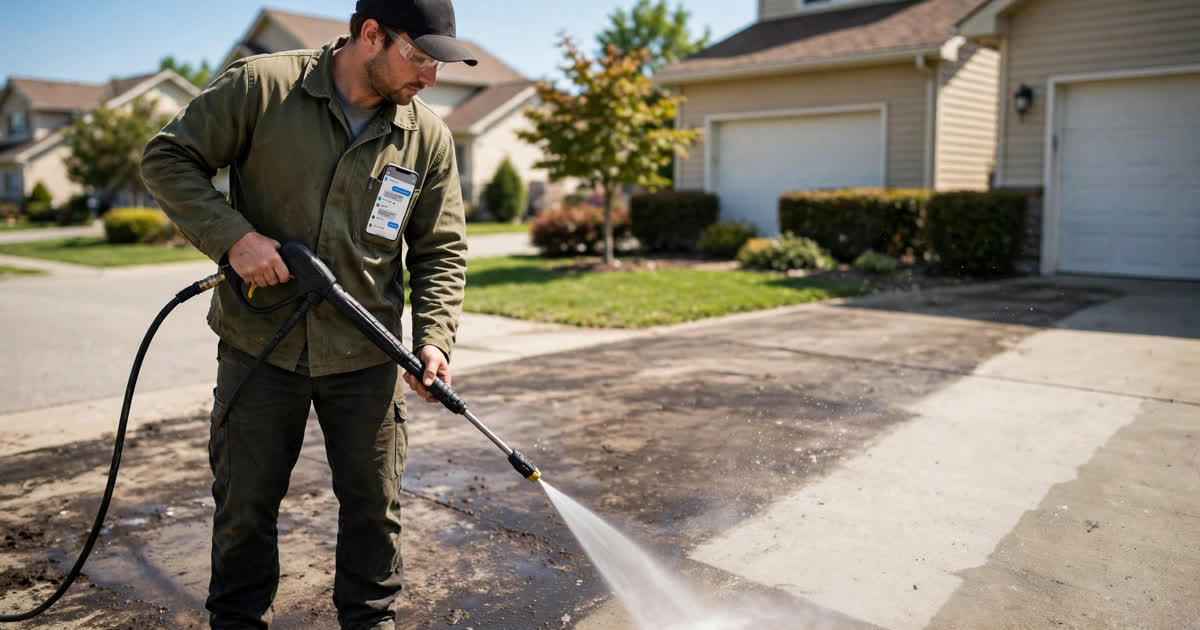
Tom runs one van and a trailer, and most mornings he is already on a driveway by eight. His phone sits in the cab, face down, because the wand is in his hands and the water is running. By the time he stops for lunch, three or four WhatsApp messages have arrived. One is a photo of a driveway gone dark green. One asks how much for a patio. One is a neighbour asking whether Tom also does fences. Two of them will have found someone else by evening, not because Tom is expensive or slow at the job, but because nobody answered while the question was fresh.
That is the whole problem this guide solves. It is not about buying a bigger machine or learning a new sales trick. It is about the first hour after a customer messages, when a pressure washing job is won or quietly lost.
For a pressure washing company, WhatsApp automation means an assistant that answers every message in seconds, asks for one photo and the surface type, sorts a slippery algae job from a routine spring clean, and holds a visit slot. The owner still prices the job on site; the assistant only starts the conversation properly.
ReplyPilot builds AI chat agents for local businesses that answer customer messages on WhatsApp, Instagram and the web. WhatsApp automation is the version of that idea built for the way pressure washing customers actually behave: they message, they send a photo, and they want a time, not a brochure.
If you want the wider picture first, the best WhatsApp automation tools guide compares the main approaches side by side. If you want the technical starting point, the WhatsApp Business API setup guide walks through getting a proper business number live. This article stays on one trade: what a pressure washing firm should automate, what it should never hand to a bot, and how a two-week setup looks in practice.
Why pressure washing enquiries go cold so fast
A pressure washing enquiry is almost always visual. The customer is standing on the thing that bothers them. They can see the green film on the drive, the black streaks on the patio, the mildew creeping up the fence panels. So they take a photo and send it, and in that moment they are ready to book. An hour later they are at work. By evening they have messaged a second firm. The job does not go to the best washer. It goes to the first firm that gives a sensible next step.
Phone calls make this worse, not better. A washer on a job cannot take a call and hold a wand at the same time, and a customer who hears voicemail twice stops calling. WhatsApp fits because it is asynchronous in the right way: the customer sends the photo when they see the problem, the assistant replies at once, and the owner reads a tidy summary later instead of a pile of half-heard voicemails. Nothing here replaces the owner. It protects the owner's working day so the owner can still be the person who turns up, looks at the surface, and says the price face to face.
Tom's change was small. His assistant now replies to every first message within seconds, even at seven in the morning when he is loading the van. It asks one question at a time, it never guesses a price, and it holds a slot the customer can confirm with one word. His close rate did not change because he learned to sell. It changed because fewer conversations died in the gap between the photo and the reply.
What a pressure washing customer actually wants in the first message
Most pressure washing customers are not shopping for technology. They want four things, in this order: am I talking to a real local firm, can you do my surface, roughly what will it cost, and when can you come. An assistant that opens with a long list of services fails the test. An assistant that answers those four things, in plain language, passes it.
The first reply should sound like a person who knows the trade. It confirms the area covered, it asks for the photo if one has not arrived, and it asks what the surface is. Concrete, block paving, tarmac, decking, patio slabs, render, and fencing all wash differently, and a customer who says "driveway" has not yet told you enough. A good assistant names the options rather than asking an open question that invites a paragraph. "Is it concrete, block paving or tarmac?" gets an answer. "Tell me about your driveway" gets silence.
Access matters just as much, and it is the question most firms forget until they arrive. Is there an outside tap? Is the gate wide enough for a hose? Is the drive steep, or parked full of cars on weekdays? The assistant can collect those answers while the owner is working, so the visit is not wasted on a job that cannot start. A customer who has answered three short questions feels looked after. A customer who has been asked twelve feels interrogated. Three is the right number for a first conversation.
How the assistant sizes a job without guessing a price
This is where pressure washing firms get automation wrong most often. A photo cannot price a job, and any assistant that tries will embarrass the owner. A photo can show the size of the area, the type of staining, and whether there is heavy moss, oil, or paint to deal with. It cannot show how porous the surface is, how deep the staining goes, or how long the rinse and treatment will take. So the assistant's job is to size, not to price.
The sizing conversation runs in a fixed order. First, the surface. Second, the size in rough terms: a single-car drive, a double, a patio plus paths, a full house wash. Third, the problem: green algae, black spots, oil stains, chewing gum, paint, or just a general tidy-up. Fourth, access and water. Fifth, timing: does the customer need it before a house sale, a party, or a tenant move-in, or is any weekday fine?
Each answer narrows the visit. A double concrete drive with algae and an outside tap is a different morning from a small tarmac drive with oil stains and no tap, even though both customers wrote "how much for a driveway clean". The assistant passes the owner a short job sheet: surface, size, problem, access, timing, and the photos. The owner arrives knowing what to look at first, and the customer is not asked the same questions twice. That is the real time saving. It is not measured in minutes of typing. It is measured in visits that start on time because nobody is still figuring out the job at the gate.
One line belongs in every sizing conversation, and it should never be softened: the final price is confirmed on site. Customers respect that line when it comes with a reason. "Photos hide how deep staining goes, so we confirm the price when we see it" is honest and easy to accept. A firm number in chat, given from one photo, is how disputes start, because the customer remembers the number and forgets the caveats.
Sorting urgent from routine: slippery algae, spring cleans and pre-sale washes
Not every pressure washing message deserves the same speed, and a good assistant knows the difference. Three kinds of job arrive, and they need three different replies.
The first is the safety job. Algae on a path or steps, a slippery patio where an older relative walks, a school run route gone green. These customers are worried, not browsing, and they should be offered the earliest visit, with a simple safety note in the meantime: keep off the worst patch if you can, and do not try a home jet wash on a steep slope. The assistant can also flag these jobs to the owner first, so a safety job is not sitting behind five routine quotes in the inbox.
The second is the seasonal job. A spring clean, a summer patio refresh, a driveway tidy before the holidays. These customers are happy with a slot next week, and they respond well to a held time they can confirm with one word. Rushing them feels pushy. Giving them a clear slot and a reminder the day before feels organised.
The third is the deadline job. A house going on the market, a landlord handover, a shop front before an opening, a wedding at home. These customers need a date they can plan around, and they need to know honestly whether the firm can meet it. If the diary is full, the assistant should say so and offer the next real date, not hold a slot that will later move. A moved deadline job costs more than a lost one, because it costs a review as well.
Sorting is not about treating customers differently in value. It is about matching the reply to the reason they messaged. A safety job answered like a routine quote feels careless. A routine job answered like an emergency feels like pressure. The assistant's quiet skill is getting that tone right before a human has read a word.
The visit script: what happens on site, and what never gets promised in chat
Customers trust a firm more when they know what the visit looks like before it happens. The assistant can set that out in three short messages after the slot is held: what to expect, what to prepare, and what will not happen.
Your customers are already on WhatsApp
ReplyPilot turns your business WhatsApp into an always-on front desk — instant answers, real bookings in your calendar, and a clean handoff to you the moment a conversation needs a person.
Ask on WhatsApp — it's freeWhat to expect is simple. The washer walks the area, checks the surface and the staining up close, confirms the price, and then starts, usually in the same visit if the customer agrees. What to prepare is practical: move cars off the drive if possible, close windows near the work area, keep pets inside for the first hour, and leave the outside tap accessible. What will not happen is the honesty part: no price change without being told first, no chemical treatment on a surface that should only be soft washed, and no promise that a deep oil stain will vanish completely when it may only fade.
That last point deserves emphasis, because it is where pressure washing reputations are made. Some stains lift fully. Some, especially old oil on porous concrete, lighten but leave a shadow. An assistant that promises a like-new result in chat sets the owner up for an argument on site. An assistant that says "most algae and dirt comes off fully; old oil usually fades rather than disappears, and your washer will show you on site" sets the owner up for a customer who is pleased with a good result instead of disappointed by an impossible one.
The visit script also covers the surfaces a firm will not jet wash at high pressure. Old render, soft stone, painted wood, and some roof tiles need a soft wash or a different method, and a customer who asked for a jet wash may need that explained gently. A good assistant does not argue the point. It books the visit, notes the surface, and lets the owner explain the method face to face, where a demonstration carries more weight than a paragraph.
Rain, wind and rescheduling without a day of phone calls
Pressure washing lives outdoors, so weather moves jobs. Rain does not always stop a wash, but heavy rain, high wind, and freezing temperatures do, and a firm that spends a wet morning ringing round its diary loses the morning twice: once to the weather, once to the phone.
This is the least glamorous part of automation and the most useful. When a day moves, the assistant sends one clear message to every affected customer: the job has moved, here is the new date, reply yes to confirm or no to pick another. Customers who confirm are rebooked without a call. Customers who cannot make the new date get the next two options in the same thread, not a promise that someone will ring back.
The message should never blame the weather in a way that sounds like an excuse. "Heavy rain means the treatment will not sit properly, so we have moved you to Thursday" is a reason, not an excuse. Customers accept a move they understand. They resent a move that arrives as a vague "sorry, we need to reschedule" with no new date attached.
Other outdoor trades face the same diary problem, and the pattern is worth studying. The roofing companies guide shows how a roofing firm handles weather moves and scaffolding diary changes in the same kind of thread, because a roof crew and a wash crew lose the same kind of day to rain. The principle transfers directly: one message, one new date, one-tap confirmation.
Seasonal planning belongs here too. The assistant can quietly build the next season's diary from this season's jobs. A customer washed in spring is a customer who may want the same wash next spring, and a short message in March, "same time as last year?", books work before competitors start advertising. That is not a sales blast. It is a reminder to a customer who already trusts the firm, sent once, at the right time of year.
After the wash: photos, reviews and the next clean
The job is not finished when the wand stops. The hour after a wash is when the customer is happiest, and it is when the follow-up should happen. The assistant sends the before and after photos in the same thread the customer already knows, with a short note: this is how it looked, this is how it looks now, and here is anything to watch, like a patch that faded rather than vanished, or a drain that needs clearing.
That thread is also the right place for a review request, but only once, and only after the photos. "If you are happy, a short Google review helps other local customers find us" works because the customer has just seen the result. A review request sent a week later, with no photos, feels like admin. A review request sent three times feels like pestering. Once, with photos, is the rule.
The next clean is a separate conversation, and it should be timed to the surface, not to a generic schedule. A shaded north-facing drive greens faster than a sunny patio. A house under trees needs attention sooner than an open drive. The assistant can note the surface and the shade at the visit, and then suggest the next wash when it makes sense for that property, not when a marketing calendar says to send a blast. A customer who gets one well-timed reminder a year trusts the firm more than a customer who gets a monthly offer.
Sealing and treatment upsells belong in this same honest frame. Some surfaces benefit from a sealer after washing, and some do not need one at all. The assistant should never sell a sealer in chat. It can note that the washer will advise on site whether sealing suits the surface, and leave the decision to the visit. Customers who feel sold to in chat arrive defensive. Customers who feel advised on site often say yes, because they can see the surface and ask questions.
What WhatsApp automation does not do
Honesty about limits is what separates a useful assistant from a gimmick, so here are the limits plainly.
It does not diagnose damage. A cracked slab, a loose block, a leaking gutter, or a damp patch on a wall may need a builder, a paver, or a roofer, not a wash. The assistant should flag anything that looks like damage and pass it to the owner, not reassure the customer that washing will fix it.
It does not handle complaints well on its own. A customer who is unhappy about a result, a price, or a missed slot should reach a person quickly, with the full thread attached so they do not repeat themselves. An assistant that keeps a frustrated customer in a loop of polite deflections turns a fixable complaint into a bad review.
It does not replace the site visit, the price conversation, or the work itself. Any firm that promises a fully automated pressure washing business is selling a fantasy. The machine does not wash driveways. People do. Automation only makes sure the right people hear about the right jobs at the right time.
It also does not fix a bad service. If visits run late without warning, if prices change on site without explanation, or if messages promise what the crew cannot deliver, automation will spread those problems faster, not hide them. Fix the visit first, then automate the conversation around it. That order matters, and reversing it is the most common reason automation gets a bad name in a trade.
Setting it up in two weeks
A sensible setup takes about two weeks, and most of that time is writing answers in the firm's own words, not wiring software. Week one is the conversation: the first reply, the sizing questions, the safety sorting, the visit script, the weather move, and the aftercare message. Each one is written once, in the owner's voice, and tested on real past messages. If an old enquiry would have been answered badly by the draft, the draft is wrong, not the customer.
Week two is the diary and the handover. The assistant connects to the firm's calendar, learns which slots are real, and learns exactly when to hand over to a person: damage, complaints, large commercial jobs, and anything it does not understand. The handover rule is the most important line in the whole setup. When the assistant is unsure, it says so and passes the thread to the owner with a summary, rather than guessing. A short honest handover beats a confident wrong answer every time.
One practical rule from the wider WhatsApp world belongs here. Free-form replies are allowed within 24 hours of a customer's last message; outside that window, a business must use pre-approved message templates, as the Eleova WhatsApp chatbot setup guide explains. That rule shapes the weather-move and reminder messages, which are templates by design, and it is why a firm should set its templates up before it needs them, not on a wet Monday morning.
For firms that want the setup done for them, the product step is deliberately small. A done-for-you setup costs $249 in total, split as $125 to start and $124 at go-live, with a Care Plan at $99 per month after that for upkeep and changes. That is the whole pricing picture, and it sits in this section rather than in the headline because the decision should follow the method, not lead it. A firm that reads this guide and builds its own version has still had the full method for free. A firm that wants it built and maintained can take the ready-made next step, and the price is stated here so there is no surprise later.
Frequently asked questions
Can WhatsApp automation price my driveway from a photo?
No, and it should not try. A photo sizes the job: surface, rough size, type of staining, and access. The final price is confirmed on site, where the washer can see how deep the staining goes and how porous the surface is. Any firm that gives a firm number from one photo is guessing, and the customer will remember that number.
Will customers know they are talking to an assistant?
They should be told, plainly, in the first reply. Most customers do not mind an assistant that answers fast and hands over cleanly. What they mind is feeling tricked. A short line, such as noting the assistant takes the first details and the owner confirms the visit, keeps trust intact and sets up the handover properly.
What happens when a job needs to move because of rain?
The assistant messages every affected customer with a new date in the same thread, and the customer confirms with one word. If the new date does not suit, the next two options follow in the same conversation. Nobody spends the morning ringing round, and nobody is left waiting for a callback that never comes.
Does automation work for commercial pressure washing too?
Yes, with a different first conversation. A shop front, car park, or yard enquiry usually involves a site survey, a written quote, and a recurring schedule rather than a single visit. The assistant collects the site details and books the survey, and the owner handles the quote. The same handover rule applies: commercial scale means a person sooner, not later.
How long before the assistant sounds like my firm?
About two weeks, if the setup uses the firm's real past messages as the test. The assistant should be tried against old enquiries: the awkward ones, the vague ones, the price-only ones. If it handles those in the firm's voice, it is ready. If it only handles easy messages, it needs another round of writing before it goes live.
Start with one change, not ten. Answer every first message in seconds, ask for the photo and the surface, and hold a slot. That single change fixes the leak that loses most pressure washing jobs: the silent gap between the photo and the reply. Add the weather move next, then the aftercare photos, then the seasonal reminder. Each step earns its place by saving a visit, a phone call, or a lost enquiry.
If you want to see the same idea running on a real conversation, the free custom demo on the ReplyPilot site shows an assistant answering a pressure washing enquiry from photo to held slot. That is the specific next step from this article: watch one conversation, then decide whether your firm wants its own version built the same way.