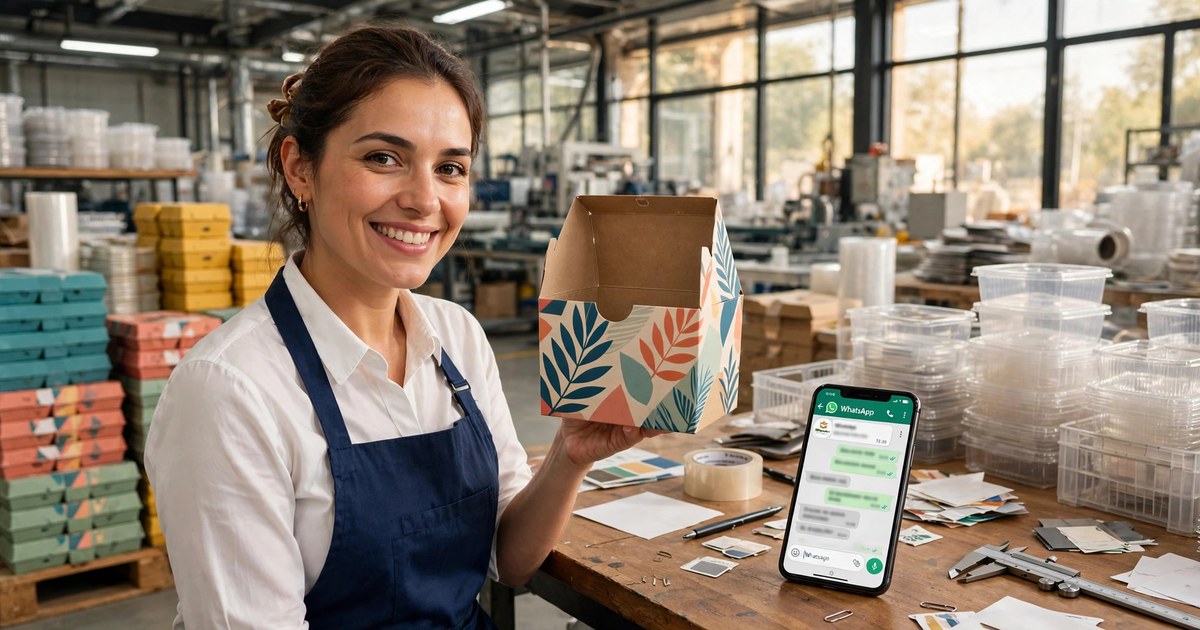
It is half past nine on a Tuesday night in Cleveland, and Dan Mercer is still at his desk at Riverside Packaging Co., a forty-person maker of cartons and pouches. The presses are quiet. His phone lights up with a WhatsApp message from a buyer at a snack brand he has been chasing for months: a photo of a folding carton, the words "can you make something like this?", and nothing else. No size. No board grade. No quantity. Dan types a reply, asks for the missing pieces, and waits. By morning she has sent the same photo to two other packaging firms, because nobody answered her with a next step while the idea was fresh.
A folding carton is not a pair of shoes. You cannot buy it from a photo, yet the buyer still sends the photo first. For the wider picture on choosing the software behind a setup like this, the best WhatsApp automation tools guide sets out the main options with their real prices.
A WhatsApp bot for lead generation in the plastic packaging industry is a chat helper on your business WhatsApp number that greets buyers, asks for the seven details a quote needs, and passes a clean spec to your estimating team. It answers in seconds and never guesses a price. A person still checks every quote before it goes out.
Why packaging enquiries die in the inbox
In cleaning, the customer knows the job and wants a time. In packaging, the customer knows the feeling she wants and almost never knows the spec. She has a carton in her hand and wants one like it, only hers. So she sends a photo and three words, and the conversation stalls, because the gap between a photo and a price is seven questions wide, and nobody is awake to ask them. Buyers message after hours, while your estimator works nine to five. The pressure washing guide shows the same gap in a trade where the customer also starts with a photo: the job goes to the firm that gives a sensible next step while the question is fresh.
The first reply usually makes it worse. "Please send your requirements" is not a next step. It is homework, handed back to a buyer who is already busy. She will not write a paragraph about board grades at ten at night. She will message the next supplier. A good first reply names the thing in her photo and asks one small question: "Thanks for the photo, that looks like a folding carton with a tuck end. Roughly how many do you need?" One question, one answer, and the buyer is still talking. Most packaging firms treat WhatsApp as a phone with typing, and their inbox becomes a pile of half-finished chats with no owner. A bot gives every enquiry the same shape. ReplyPilot builds AI chat agents for local businesses that answer customer messages on WhatsApp, Instagram and the web. For a packaging manufacturer, a spec sheet with a missing field is not a lead, it is a guessing game. The house cleaning guide shows the same idea in a trade where every booking must carry the same notes.
What does the bot actually do, step by step?
Strip the sales language away and the bot does five things, in order, every single time. First, it greets the buyer and names what it sees. If a photo arrived, it says so. "Hi, thanks for messaging Riverside Packaging. I can see you sent a photo of a folding carton, and I will take the details and pass them to our estimating team." Short and specific. Second, it asks the spec questions one by one, in a fixed order. A buyer who sees one question answers it; a buyer who sees seven closes the chat.
Third, it collects the photo and any file the buyer sends, and keeps them attached to the enquiry, so the estimator sees the photo beside the dimensions instead of hunting through a thread. Fourth, it sorts the enquiry: a buyer with a real spec, quantity and date is a hot lead and goes to estimating the same day. A buyer who needs ten cartons for a school fair gets a polite answer and a different lane. Fifth, it hands over: a tidy summary to your team, and a message to the buyer: "I have passed your details to our estimating team. They will send your quote by Thursday, and I will message you here the moment it is ready." The bot never gives a price, never promises a delivery date, and never answers a technical question it does not understand.
The spec-capture checklist: seven fields no quote can skip
Seven fields, in this order. A quote built without any one of them is a guess.
One, packaging type. Folding carton, rigid box, flexible pouch, stand-up pouch, flow wrap, blister, label, or something else. Ask it as a choice, not an open question: "Is this a folding carton, a pouch, or something else?"
Two, dimensions. Length, width and depth, or height and diameter for a pouch or tube. Buyers often give the size of the product inside rather than the pack. Ask for the pack itself, and accept rough numbers: "Roughly how big is the carton, in inches or centimetres?"
Three, material. Board grade and thickness for cartons, film structure for pouches. Buyers rarely know this, and that is fine. Offer plain choices: "Do you know the board grade, or would you like us to suggest one for a snack box?" The estimator still makes the final call, and the spec sheet should say where the material was suggested rather than specified.
Four, quantity. How many, and is that a one-off run or a repeat order? Quantity changes everything: the unit price, the tooling, the print method, the lead time. Ask for the number and then, gently, for the repeat picture: "Is this a one-off order, or will you need the same pack again?"
Five, print. How many colours, and is there artwork ready? Both are fine. The spec sheet just has to say which one it is, so the estimator prices the artwork work honestly instead of discovering it later.
Six, finishing. Lamination, matte or gloss, spot UV, embossing, foil, window patching, a tear notch on a pouch, a hang hole, a zip lock. Let the buyer pick from the common options, or say none: "Any finishing, like a matte laminate or foil, or plain for now?" Plain for now is a real answer.
Seven, delivery. Where, and by when? Ask for the date and the delivery town, and never promise the date. Record it, and let the estimator decide whether it can be met. Seven fields, one at a time.
How does the WhatsApp-to-quotation chain work?
A lead is not a quote. The bot starts the chain; a person finishes it. The moment the seventh field is answered, the bot sends the buyer a short recap in the same thread: type, size, material, quantity, print, finishing, delivery date, and the photo. "Here is what I have so far. Can you check it reads right?" That recap catches mistakes while the buyer is still there to fix them.
Then the summary goes to your team as a short spec sheet, not a forwarded chat: the buyer's name and company at the top, the seven fields in order, the photos attached, and the full chat linked underneath. One page, one spec, one named owner: "Priya in estimating, by Thursday", not "the estimating team". The estimator then checks the spec: board grade against the weight inside, quantity against the tooling, delivery date against the press schedule. If something is missing, she asks one question in the same thread. If the spec is sound, she prices it, sends the quote, and the bot messages the buyer the moment it is sent.
The FastBots guide to collecting leads on WhatsApp reports that form abandonment runs above 60 percent: the share of people who start a web form and never finish it. A chat that asks one question at a time does not feel like a form, which is why it keeps buyers who would have closed the tab. The same guide puts WhatsApp open rates at around 98 percent, which is why the quote follow-up belongs in the chat thread, not in an email the buyer may never open. Both figures come from the FastBots guide to collecting leads on WhatsApp, and they describe the channel, not your own numbers. A quote sent is not a quote read, so the follow-up matters. Two working days after the quote goes out, the bot sends one short message: "Hi, just checking you received the quote for the folding cartons. Is there anything you would like changed?" Once only. If she does not reply, leave her alone. A buyer chased three times blocks the number, and a blocked number stops delivering messages at all.
Your customers are already on WhatsApp
ReplyPilot turns your business WhatsApp into an always-on front desk — instant answers, real bookings in your calendar, and a clean handoff to you the moment a conversation needs a person.
Ask on WhatsApp — it's freeThe worked example: a folding carton enquiry from first photo to clean spec
Meet a fictional buyer: Carla Reyes, who buys packaging for a granola brand in Austin called Golden Hour Foods. On a Wednesday evening she stands in her kitchen holding a competitor's folding carton, a tuck-end carton with a small window so shoppers can see the granola, and messages Riverside Packaging Co. with a photo and the words "can you make one like this for our granola?"
The bot replies in seconds: "Hi Carla, thanks for the photo. That looks like a tuck-end folding carton with a window. Roughly how many do you need to start?" She answers: 10,000, with a repeat run every two months if it sells. That one answer already tells estimating this is a real repeat buyer, not a one-off. "And roughly what size is the carton you have there?" Carla measures it with a kitchen ruler: about seven inches tall, four wide, two deep. The bot records the numbers as rough. "Thanks, I have marked those as rough sizes. Our estimator will confirm them before quoting."
Then material. Carla does not know the board grade. "No problem at all. For a granola carton, most brands use a coated board around 18 point. Shall I ask our estimator to suggest the right grade for the weight?" She says yes. Print: four colours, artwork a PDF her designer is finishing this week. Finishing: matte lamination and the window, no foil. Delivery: the first run in five weeks, to a warehouse outside Austin. The bot sends the recap: tuck-end carton with a window, roughly 7 by 4 by 2 inches, board to be suggested, 10,000 to start with repeats every two months, four-colour print, matte lamination, delivery in five weeks. "Does that read right?" Carla corrects one thing: the window should be a little smaller, because her granola is darker and she wants less of it showing. That correction, caught before the quote, saved a week.
The summary goes to Priya in estimating, with the photo, the measurements, and Carla's note attached. Priya checks the board grade, confirms the five-week date, and prices it. The quote goes out on Thursday, and the bot messages Carla the moment it is sent. The bot never gave Carla a price, never promised the five-week date, and never said the board grade was right, because it did not know. It asked, recorded, checked back, and handed over. That restraint is the product.
QR codes on cartons: the lead door your competitors forgot
Here is the opinion that belongs only in a packaging article. A QR code printed on the carton beats a website form for repeat buyers, and it is not close. A form asks a buyer who already holds your product to put it down, open a browser, find your site, and type her details into boxes. A QR code asks her to point her phone at the thing she is already holding. The code opens a chat with your business, with the product already named.
A carton lives on a shelf, in a warehouse, in a kitchen, in a buyer's hand at a trade show. Every one of those is a place where the next order starts, and none of them is a place where a person fills in a web form. A small line under the code says what happens when she scans it: "Scan to reorder, or to ask about a new size."
Each product line gets its own code, so the chat opens with the product already known, and the bot can ask quantity and delivery date instead of starting from zero. One code per product, not one for the whole company: a generic code forces the buyer to explain which product she means, and she has already answered that by holding the pack. Print the code on the pack itself, and on the shipping carton, where the person receiving the delivery sees it as the order lands. Test it with three different phones, old and new, in warehouse light, before the run goes out: a code that does not scan is worse than no code. The pressure washing guide shows the same photo-first idea in a trade where the picture is the whole job. The carton version is sitting in your warehouse right now, waiting for a code.
What should the bot never do?
A bot that tries to do everything will embarrass you in front of the buyers you most want to keep. Forbid these in writing, before the bot goes live.
Never quote a price. A carton priced from a photo, without a board grade, a quantity, or a tooling check, is a number the buyer will remember and the firm will regret. The bot sizes and records. The estimator prices. If a buyer pushes hard for a number in chat, the bot should say so plainly: "I can take the details and our estimator will send a proper quote by Thursday. A number from a photo would only mislead you." A wrong quote teaches the buyer that your numbers cannot be trusted.
Never promise a date. Lead times depend on the press schedule, the board stock, the tooling, and the print queue, none of which the bot can see. Record the date the buyer needs, pass it to estimating, and let a person confirm it. A date confirmed by a person is a promise. A date promised by a bot is a hope with a deadline. Never answer a technical question it does not understand: can this board hold a two-kilo fill, is this film food-safe for hot fill, will this pouch stand on a shelf? Those are for a person who knows the materials. The right reply is a clean handover: "That is one for our estimating team. I have passed your question on, and they will answer it with your quote."
Never pretend to be a person. Say in the first reply that an assistant is taking the first details and a person will handle the quote. Buyers are fine with a helper that replies at once and brings a real person in when it matters. Finding out they were misled costs more trust than any slow reply. Never chase a buyer who has gone quiet: one follow-up after the quote, once, in the same thread. Then stop. And never collect details you do not need, like a home address or a budget question before the spec exists. Take the seven fields, the photo, and the company name. That is enough to price the job.
Build it yourself or buy it done-for-you?
The first route is to build it with a tool: open an account with a chatbot platform, write the seven questions yourself, and connect it to your WhatsApp number. The monthly bill is small, and the cost is your evenings. It fits a firm where someone has the hours to test it against real past enquiries. It does not fit a firm where the owner is already the estimator, the salesperson, and the person who answers the phone.
The second route is to hire a developer for a one-off build, shaped to your brand and your quoting rules. The bill is larger and one-off, with a monthly tool fee underneath. It fits a firm with an unusual need, like a quoting calculator wired into the chat. Before you sign, ask what happens after handover: who fixes it when a template gets rejected, and who updates the questions when you add a product line?
The third route is done-for-you: someone builds it, tests it against your real past enquiries, launches it, and keeps it current. This fits a firm that wants the result without the homework. ReplyPilot setup is $249, made up of a $125 deposit and $124 at go-live, with a Care Plan at $99 a month. The SendPulse guide to WhatsApp lead generation covers the tool route in detail, with chatbot and CRM sync for firms that want to build it themselves. Whichever route you pick, test it the same way: send it your five hardest past enquiries, including the vague ones and the buyer who asks for a price in the first message. If it handles those cleanly, in your firm's voice, it is ready. The Wati guide to WhatsApp lead generation shows the same job done through WhatsApp Flows and click-to-WhatsApp ads, which suits firms that already run ads. If your buyers find you through a carton on a shelf, the QR code in the last-but-one section is the cheaper door.
How do you know it is working after thirty days?
After a month, judge the bot by three numbers, not by how clever it sounds. First, how many enquiries became clean spec sheets: all seven fields answered, the photo attached, the summary sent to estimating. If half your chats stall after the second question, the second question is the problem, not the buyer. Rewrite it in plainer words: asking "roughly how many?" instead of "what is your required quantity?" is often enough.
Second, how many spec sheets became quotes, and how fast? A spec sheet that sits for a week before anyone prices it is a lead the bot did its half of and the firm did not. If the bot says Thursday, the quote goes out by Thursday. Third, how many quotes became orders? Read the chats of the buyers who went quiet after the quote: did they ask a question nobody answered, did the price surprise them, did the delivery date move? Those chats are free market research.
Then test it yourself: send the bot five of your hardest past enquiries, as a stranger would, with typos and half sentences. Right, warm answers that end with a next step mean you have a good one. One wider fact: a live check on 7 November 2026 found five of the six top results for this topic were generic lead-generation pages, and none was a plastic-packaging-specific guide. Semrush recorded 260 searches a month in the United States for this keyword, with a keyword difficulty of 0 percent, in its 6 November 2026 check. If the numbers are weak after thirty days, change one thing at a time, never five at once.
Frequently asked questions
What is a WhatsApp bot for lead generation in the plastic packaging industry?
It is a chat helper on your business WhatsApp number that greets packaging buyers, asks for the seven details a quote needs, and passes a clean spec to your estimating team before any price or date is promised.
Can a WhatsApp bot give a packaging quote from a photo?
No. A photo shows the shape and the idea, but the price depends on the board grade, the exact size, the quantity, and the tooling, none of which a picture can prove. The bot gathers those details for an estimator to price.
What details does the bot need before a quote?
Seven fields, in order: packaging type, dimensions, material, quantity, print, finishing, and delivery date and place. The bot asks for each one separately so the buyer never faces seven questions at once.
Will buyers mind talking to a bot first?
In practice, no, provided the bot is upfront about what it is and quick with a useful reply. Buyers get annoyed by silence and by being asked the same thing twice, not by a helper that takes their details at ten at night and brings a person in for the quote.
How long does it take to set up, and what does it cost done-for-you?
About two weeks, mostly writing the questions and testing them against real past enquiries. Done-for-you, ReplyPilot setup is $249, made up of a $125 deposit and $124 at go-live, with a Care Plan at $99 a month.
If you want to see this flow running on a packaging enquiry like Carla's, book a ReplyPilot demo and walk through a WhatsApp bot built around your own cartons or pouches before you decide anything.