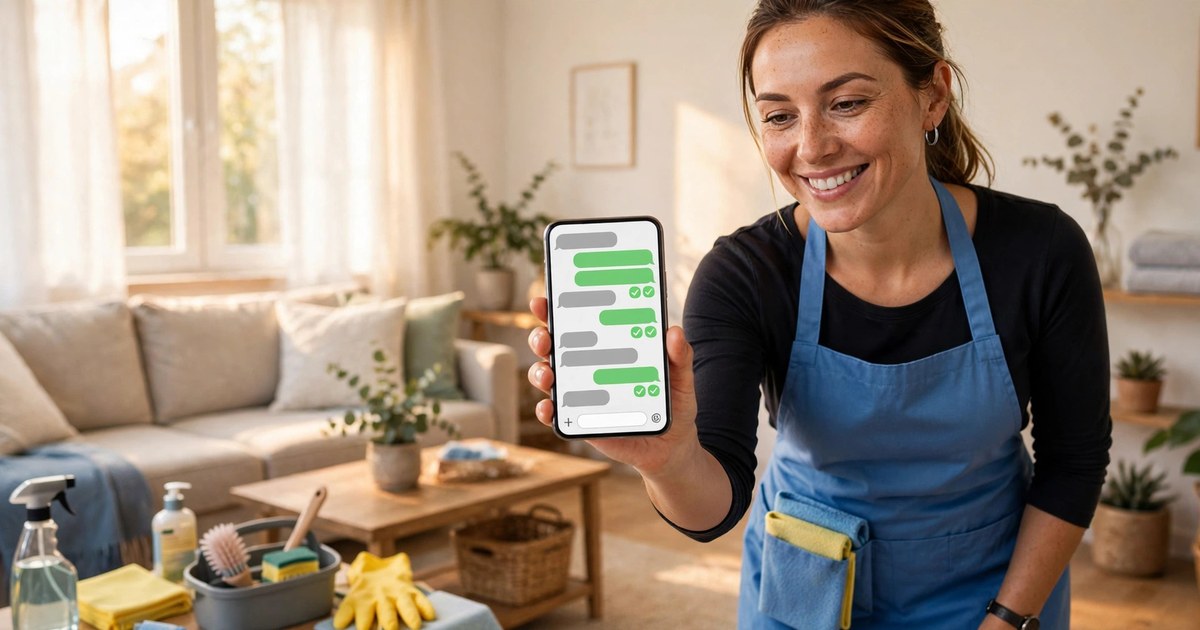
WhatsApp automation for house cleaning services answers every message within seconds, sizes the clean with five short questions, books regular and deep cleans into a standing round, warns the customer before a late cleaner becomes a problem, and asks for a review while the house still smells clean. That last part matters more in house cleaning than in almost any other trade. A cleaning business is not built on one-off jobs. It is built on a round: the same homes, the same days, week after week. Lose one regular customer because nobody answered her message on a Tuesday, and you have not lost one clean. You have lost fifty-two.
What WhatsApp automation is for a house cleaning company
WhatsApp automation is a helper that answers customer messages on your business WhatsApp number the moment they arrive, using your own prices, your own services, and your own calendar. It is not a robot that cleans houses. It is the front desk you cannot staff while your team is inside someone else's home with a mop in hand.
ReplyPilot builds AI chat agents for local businesses that answer customer messages on WhatsApp, Instagram and the web. For a cleaning firm, that means one thread per customer holding the first reply, the booking, the reminder, the key note, the late-cleaner message, and the after-clean photo. Nothing gets lost between a phone call, a text, and a sticky note.
For the wider picture, the best WhatsApp automation tools guide compares the main approaches side by side. Two cousin guides are worth a look: the pressure washing guide for weather moves, and the carpet cleaning guide for photo quotes. House cleaning differs from both: the job repeats, the cleaner enters the home alone, and the details that matter are a key code and a cat, not a surface and a stain.
Why cleaning enquiries go stale while you are mid-clean
Picture a Tuesday at ten in the morning. Your team is inside a three-bedroom house, phones in pockets or in the van, because nobody cleans a bathroom one-handed while holding a phone. In that hour, four messages arrive. A new customer asks what a biweekly clean costs for a two-bedroom apartment. A regular asks to move Thursday to Friday because her mother is visiting. A landlord asks about a move-out clean for next week.
None of those people will wait until evening. The new customer messages a second cleaner at lunch. The regular, hearing nothing, assumes Friday is not possible and books someone else. The landlord, who needs a fast turnaround between tenants, takes the first firm that replies with a date. By the time you sit down with a coffee and read them, two of those jobs are gone, and you never knew you were competing.
This is a timing problem, not a sales problem. Customers message when the thought strikes them, usually while standing in the kitchen looking at the floor, and they expect an answer in minutes, because that is how WhatsApp works with everyone else in their life. A reply at seven in the evening to a message sent at ten arrives too late. Automation fixes the timing: it answers at once, asks the right questions, and holds a slot, while you read a tidy summary later.
How do you size a clean in five short questions?
A house clean has no single price, and any assistant that gives one from a single message is guessing. A regular clean of a two-bedroom apartment and a deep clean of a four-bedroom house with two dogs are different jobs with different times and prices. The assistant sorts that out in five questions, asked one at a time, in the same order every time.
Question one: what kind of clean? Regular, deep, or move-out. A regular clean keeps a lived-in home tidy: kitchen, bathrooms, floors, dusting, bins. A deep clean goes further: inside the oven and fridge, skirting boards, shower limescale. A move-out clean is a different job entirely, usually empty, judged by a landlord or an agent, and needed by a fixed date. If the customer is not sure, the assistant explains each in one line and lets them pick. Never price a deep clean as a regular clean.
Question two: how many bedrooms and bathrooms? This is the backbone of the price. A two-bedroom, one-bathroom apartment is a different morning from a four-bedroom, three-bathroom house.
Question three: are there pets, and where do they go during the clean? A dog that needs to be in the garden, a cat that hides under the bed. This is not small talk. It decides which cleaner goes, what time the visit starts, and whether the front door can be left open while equipment is carried in. A firm that asks about the dog by name next time is a firm that gets kept.
Question four: how do we get in? Key, lockbox code, someone home, or a neighbour holds a key. Parking matters too, especially in apartment blocks. Ask this early, not on the morning of the visit, because a visit that cannot start is a visit wasted.
Question five: how often? One-off, weekly, or biweekly. A one-off customer gets a date. A weekly or biweekly customer gets a standing slot in the round, covered in its own section below.
Five questions, in that order, and the assistant can price the job from your own sheet, or flag it for you where it is unusual. A hoarder clear-out, a post-builder clean, or a home with mould on the walls goes to you personally, with the thread attached. The customer still got a fast first reply. You still make the hard call.
What should the first reply say?
The first reply is the whole game in miniature. It should be short, warm, and useful. It should confirm you cover the customer's area, ask the first sizing question, and make clear a person is behind the system. Here is a template that works for a cleaning firm, in plain words you can copy and adjust:
"Hi, thanks for messaging. We clean homes across the city and nearby suburbs. To give you the right price, can I ask a quick question first? Is this a regular clean, a deep clean, or a move-out clean?"
Once the customer answers, the assistant follows the five questions in order, then offers the next real slots. Not "we will call you back with availability." Real slots, from your real calendar: "We have Tuesday at 9am or Thursday at 1pm this week. Which suits you?" The customer picks one, and the booking is confirmed in the same thread, with the clean type, rooms, price, and access note listed back to them.
One more template belongs in every cleaning firm's first week, the reschedule reply:
"No problem at all. I have moved your clean from Thursday to Friday at the same time, 9am. Same team, same price. Just reply here if anything else changes."
One note about templates: outside the first 24 hours after a customer's last message, WhatsApp requires businesses to use pre-approved message templates rather than free-form replies. That rule shapes the reminder and rebooking messages here, which are templates by design.
Recurring cleans: the round that books itself
A one-off clean pays once. A regular customer pays fifty times. The difference between a cleaning business that scrapes by and one that grows is rarely the quality of the mopping. It is whether the round holds together.
Your customers are already on WhatsApp
ReplyPilot turns your business WhatsApp into an always-on front desk — instant answers, real bookings in your calendar, and a clean handoff to you the moment a conversation needs a person.
Ask on WhatsApp — it's freeThe round is the list of regular customers, each with a day, a time, a team, and a rhythm: weekly, or every two weeks. Automation holds that round without a spreadsheet and without memory. A week before each visit, the customer gets a reminder naming the day, time, and team. The day before, a shorter reminder asks for one reply: yes, or a new date if something changed.
No other trade matches this rhythm. A window cleaner reminds a customer every six months; a carpet cleaner at six and twelve months. A house cleaner talks to the same customer every single week, so every week is a chance to lose her or keep her. A reminder naming her usual cleaner and usual time feels like a relationship. Silence followed by a missed visit feels like a firm that forgot her.
Rebooking a lapsed customer works the same way, but gentler. A customer who paused for a holiday or a busy month gets one message, not a campaign: "It has been a while since your last clean. Your usual slot on Tuesdays at 9am is open next week, if you would like it back." One message, one real slot, one easy yes. If she does not reply, leave her alone. A firm that pesters ex-customers gets blocked, and a blocked number stops delivering messages at all.
A steady round has a second benefit. New customers can be offered the gaps, not the whole diary. When a new enquiry arrives for a Tuesday morning and the round already has a Tuesday customer two streets away, the assistant offers that slot first, because the team is already in the area.
The carpet cleaning guide shows the same rebooking idea at six and twelve months. For house cleaning, the rhythm is weekly, which is why these reminders are the highest-value automation in the business.
What happens when the cleaner runs late or calls in sick?
This is the moment customers actually judge you. A cleaner who is twenty minutes late without a word is a cleaner the customer starts to doubt. A cleaner who never arrives, with no message at all, is a customer lost for good.
The rule is simple: tell the customer before they notice. The moment a cleaner reports a delay, the assistant sends a short message in the same thread: who is coming, how late, and what happens next. Here is a template that works:
"Hi, this is a quick heads-up. Maria is running about 25 minutes late today because her last job overran. She will arrive around 10:25 instead of 10:00. The clean will still take the usual time. Sorry for the wait, and reply here if the new time does not work for you."
That message names the cleaner, gives a real time, explains the reason in one line, and gives the customer a way out.
A sick cleaner is harder. The assistant should not pretend a cover cleaner is the usual cleaner. The message names the change: "Maria is unwell today, so Ahmed will cover your clean at the same time. He has your key note, your pet note, and your usual checklist. If you would rather move to next week instead, just say so." The cover cleaner gets the same notes in his own message: the key code, the dog, the rooms, the supplies. That handover only works because the notes live in the thread, not in one cleaner's head.
Here is the opinion that belongs only in a house cleaning article: the visit is won or lost before anyone touches a surface. A window cleaner can ring the bell and start. A carpet cleaner can look at the stain and start. A house cleaner who cannot get in, who lets the cat out, or who arrives to find the customer did not know the team had changed, has lost the customer before a mop is lifted. The key code and the pet note are not admin details. They are the job. Automation that treats them as a footnote keeps booking visits that fail at the front door.
Keys, lockboxes, pets and supplies: the small details that decide the visit
Every failed house clean has a small cause. The key was under the mat last time, but the customer moved it. The lockbox code changed and nobody told the team. The dog was supposed to be in the garden, but it rained, so the dog is in the living room. None of these are dramatic. All of them waste a morning.
The fix is unglamorous and it works: collect these notes once, keep them in the customer's thread, and show them to whoever does the visit, including a cover cleaner. The assistant asks about access at booking, confirms it the day before, and updates it whenever the customer changes it.
Pets deserve a note of their own. The note should say the pet's name, where it goes during the clean, and anything the cleaner must not do: do not open the back gate, the cat is an escape artist; the dog is friendly but jumps, so keep the front door closed. A cleaner who reads that note before arriving looks professional. A cleaner who learns it by chasing a cat down the street looks careless.
Supplies are the other half of this section, and the rule is to agree them at booking, not at the door. Some firms bring everything. Some ask the customer to supply the vacuum and mop, and bring the chemicals. Some charge a small fee for supplies. Whatever your rule is, the assistant states it in the booking confirmation, and the customer agrees to it in the chat. When the usual spray runs out mid-round, the assistant handles the restock message: a note to the customer that the team will bring a replacement next time, or a note to the owner that supplies are low on that round.
After the clean: the photo check and the review
The hour after a clean is when the customer is happiest, and it is the only hour when a review request feels natural. The assistant sends a short photo set in the same thread: the kitchen, the bathroom, the living room floor, three or four photos taken by the cleaner before leaving. Just the customer's own home, clean, in the customer's own chat.
Under the photos, one line: "Everything as you like it? If anything needs another pass, just reply here and we will sort it." It catches problems while they are small, and it invites the customer to look at the photos and feel pleased. Only then comes the review ask, once, with a link: "If you are pleased, a short Google review helps neighbours find us."
Three rules keep this honest. First, photos need permission, asked in plain words by the cleaner: can we take a few photos of the rooms we cleaned, to send to you and, if you are happy, to use as examples? If the customer says no, no photos are taken, and the review ask still goes out on its own. Second, the review ask comes once, not three times. A customer asked three times feels pestered. Third, a complaint in reply to the photo check goes to a person at once, with the thread attached. A customer who reports a missed spot and gets a person within minutes usually stays. One who gets an automated thank-you usually leaves.
What WhatsApp automation does not do
It cannot judge a home. A mould patch, a stain that might be water damage, a floor damaged underneath, a hoarding situation, or a home that needs a specialist — all of these need a person's eyes, not a chatbot's reassurance. The assistant should flag anything unusual and pass it to the owner.
It cannot calm an unhappy customer by itself. A customer who comes home to a scratched table, a broken vase, or a clean that missed whole rooms needs a person quickly, with the full thread attached so she does not repeat herself. Software that keeps an upset customer circling through polite replies turns a fixable complaint into a bad review.
It cannot fill an empty diary. If nobody is messaging you, automation has nothing to answer. A quiet inbox is a visibility problem, not a software problem. Fix the listings, the reviews, and the local presence first, then automate the conversations that follow.
It cannot rescue a sloppy round. If cleaners run late without warning, if prices change at the door, if key notes live in one person's head and vanish when she is sick, automation will spread those problems faster, not hide them. Get the visit right first, then automate the messages around it. Firms that do it the other way round usually blame the tool for a mess it only made more visible.
And it cannot replace the cleaner. A customer buys a clean home, not a clever chat. The assistant's job is to make sure the right cleaner arrives at the right home, on time, with the key, the pet note, and the supplies.
How do you set it up in two weeks?
A realistic setup takes about two weeks, and most of that time goes on writing answers in your own words. Week one is the conversation: the first reply, the five sizing questions, the booking confirmation, the reminder, the late-cleaner message, the cover-cleaner handover, and the photo check. Each one is written once, in your voice, and tried out on real past messages.
Week two covers the calendar and the handover. The assistant connects to your real diary, learns which slots are genuine, and learns exactly when to hand over to a person: unusual homes, damage, complaints, large commercial jobs, and anything it does not understand. When the assistant is unsure, it should say so and send you the thread with a short summary, instead of guessing.
A vendor page in this space is unusually frank about its own price. Superbench, whose home-services automation page covers cleaning among other trades, states pricing from SGD 500 per month, and reports that its customers see 70% of sales conversations handled without human intervention. Those are the vendor's own claims, quoted here so you can weigh them against a done-for-you price rather than a guess. Another useful comparison is the structured quote-flow guide, which shows the same method built by hand with quick replies and chat labels.
For firms that want the setup done for them, the numbers are small and stated plainly. A done-for-you setup costs $249 in total, split as $125 to start and $124 at go-live, with a Care Plan at $99 per month after that for upkeep and changes. Those figures sit here rather than in the headline, because the method should come first and the purchase second.
Begin with the first reply only. Answer every message in seconds, ask the five sizing questions, and hold a slot. That one change closes the leak that loses most house cleaning jobs: the silent gap between the message and the reply, while your team is mid-clean and the customer is already messaging a competitor. Once that holds, add the late-cleaner message, then the recurring reminders, then the photo check.
Frequently asked questions
Can WhatsApp automation tell a regular clean from a deep clean? Yes, because it asks the clean type first. A regular clean covers kitchens, bathrooms, floors, dusting and bins, while a deep clean adds the oven, the fridge, skirting boards and limescale. Anything unusual, such as a post-builder clean or a home with mould, goes to the owner personally.
Will customers mind that an assistant answers first? Most do not, as long as replies arrive fast, stay specific, and stay honest. What frustrates people is silence, having to repeat themselves, and answers that say nothing. An assistant that greets them at once, names their own slot and cleaner, and hands over to a person when needed feels like good service.
What happens when the regular cleaner is sick? The customer gets a message before the visit naming the cover cleaner and confirming the same time, with the key note, pet note and checklist passed to the cover cleaner too. If the customer would rather move to next week, she says so in the same thread.
Does automation work for move-out and landlord cleans? Yes, with a different first conversation. A move-out clean is usually empty, judged by a landlord or agent, and needed by a fixed date. The assistant collects the property size, the date, and the access details, and books the visit, while the owner handles anything unusual such as damage.
How long before the assistant sounds like my firm? About two weeks, if the setup uses your real past messages as the test. Try it against the awkward ones: the vague price question, the customer who moves every Thursday, the lockbox code that changed. If it handles those in your voice, it is ready.
The specific next step from this article is to read the best WhatsApp automation tools guide and compare the approaches side by side before you choose one. It lays out the tool, template, and done-for-you routes with their real costs, so you can match one to the size of your round. Pick the route that fits, then begin with the first reply only.