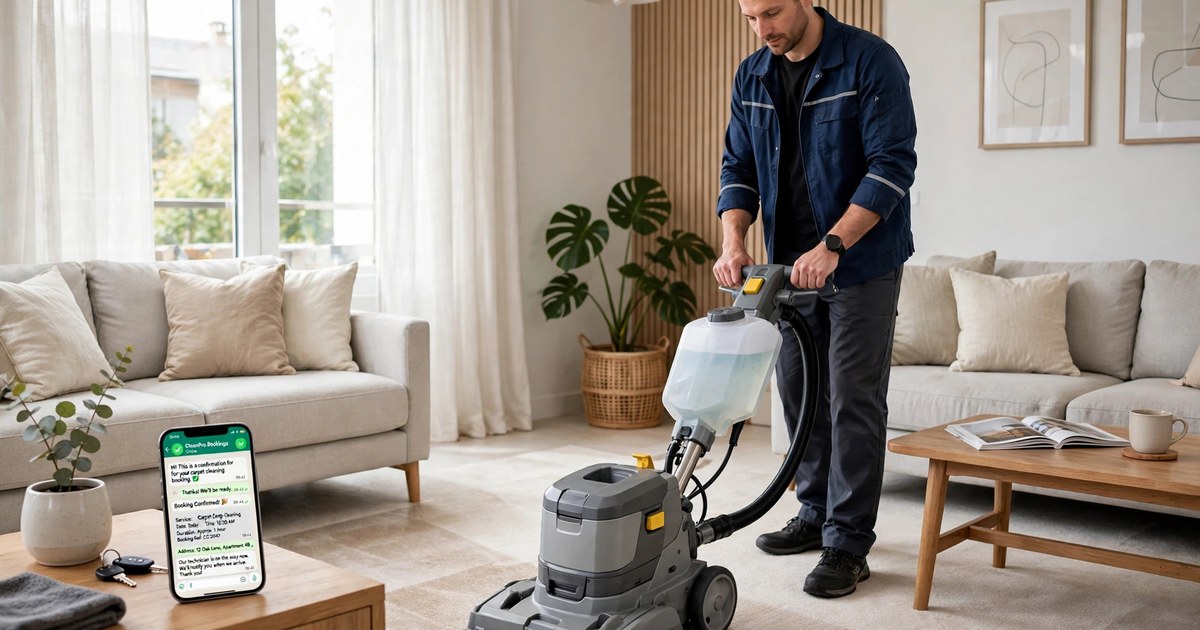
It is Saturday morning. A mum stands in her living room, staring at a red wine stain spreading across a pale carpet. Guests arrive at six. She does not look for a carpet cleaning company website and fill in a long contact form. She opens WhatsApp and messages the first carpet cleaner whose number she can find, with a photo of the stain and one line: can you come today.
You are on a job across town, machine running, phone in the van. You see her message at lunch. By then she has booked whoever answered first, a cleaner who was also on a job, but whose WhatsApp answered for him while he worked.
That Saturday-morning pattern decides who gets the job. The owner is usually mid-clean with wet hands, hauling furniture down a hallway, or driving between houses — exactly the moments a phone goes unanswered. An automated WhatsApp reply closes that gap: the customer hears back at once, while you are still finishing the job in front of you.
Quick answer: WhatsApp automation for carpet cleaning companies answers every customer message within seconds, day or night. It quotes jobs by photo and room count, adds stain and pet treatments, books the clean, sends drying-time reminders, asks for reviews, and brings customers back for their next clean.
What WhatsApp automation actually is for a carpet cleaning company
Picture a front-desk helper who picks up every message the second it lands, knows your room prices cold, and never clocks off — weekends, evenings, holidays included. When a customer writes to your business on WhatsApp, the helper answers at once with a genuine exchange, not a dead note promising a callback. It figures out the job, gathers the particulars, and either secures the visit or offers a quote range drawn from your own price sheet. You step in only for the human decisions.
Under the hood it uses the official WhatsApp Business Platform, the sanctioned route for software to exchange WhatsApp messages. Your number stays protected, and you gain what the free app cannot offer: genuine two-way conversations, approved templates, and booking links. The platform's own documentation lives here: WhatsApp Business Platform
Here is what it does for a carpet cleaning business:
- Answers every message within seconds, around the clock, even from the van.
- Quotes jobs by room count and by photo, using only the prices you wrote down.
- Adds stain treatments, pet treatments, and protectant as clear options, not surprises.
- Books the clean into your real calendar, with confirmations and reminders.
- Handles no-access visits and reschedules without a string of phone calls.
- Sends drying-time and furniture advice after the job, automatically.
- Asks for Google reviews with before and after photos, at the right moment.
- Brings customers back at six and twelve months, and runs seasonal campaigns.
The automation handles the conversation. Your crew handles the carpet. That split is the whole point.
The missed call problem: wine stains, pet accidents, and quotes sitting unread
Carpet cleaning has two kinds of messages, and both punish slow replies. The first is the emergency. A glass of red wine on a light carpet. A dog that has had an accident on the rug an hour before guests arrive. A child who has been sick on the bedroom floor. These customers are not shopping around for fun. They are standing in a room, looking at a stain, and they will book the first cleaner who sounds like they can help today.
The second kind is quieter, and it costs just as many jobs. A landlord messages about a move-out clean for next week. A mum asks for a price for three bedrooms and a hallway. A renter asks whether you clean wool rugs. These messages arrive while you are working, and they sit unread for hours. By the time you reply, the customer has asked the next company, and the next company answered first. Nobody chose the better cleaner. They chose the faster reply.
The pattern is the same in both cases. The customer already has a phone in hand, already uses WhatsApp every day with family and friends, and expects an answer in the same chat. A missed message is not a small delay. It is a lost job, because the customer does not wait. They move on.
Automation fixes this by answering at once, every time. It does not need to be clever. It needs to be fast, clear, and honest about what you can do. A reply that says, yes, we clean pet stains, here is how it works, and here are the next open slots, beats a perfect reply that arrives four hours later. Speed wins the job. The quality of your cleaning keeps the customer.
Quote by photo and room count, inside WhatsApp
Most carpet quotes die in the same place: the back and forth. The customer asks for a price. You ask how many rooms. They answer. You ask about the size. They guess. You ask for the address. They go quiet. Every extra question is another chance for the customer to drift away.
WhatsApp quoting removes the friction because the customer is already in the chat, and their phone already has a camera. The automation asks two simple things: how many rooms, and can you send a photo of the carpet. A photo of a stained living room tells you more than five messages about the stain. A photo of a hallway tells you whether it is a short run or a long stretch with stairs.
Room count quoting works when your price sheet is simple and written down in advance. For example, a home with three bedrooms, a living room, and a hallway counts as five rooms on your sheet, and the automation adds them up the same way every time. Stairs count as their own item, because stairs take their own time and care. A small rug in one room is not a whole room, and the automation should say so, so the customer is not surprised later.
Three rules keep photo quoting honest. First, the automation quotes only from your own sheet. It never invents a price, and it never guesses a price for a job it cannot see properly. Second, anything unusual gets a human answer. A wool rug, a very large stain, a carpet that smells strongly of pet urine across a whole room, or a job where the customer says the carpet is twenty years old, all get the same honest line: let me have the owner look at this one personally. Third, the quote is a range when it needs to be, with the reason in plain words. For example, the final price depends on how the stain responds to treatment, and the customer hears that before the visit, not after.
Done well, a quote by photo feels like good service, not a robot trick. The customer sent one photo and got a clear answer. You arrive knowing the rooms, the stains, and the layout, instead of walking in blind.
If first messages slipping through is the leak costing you most, our lead capture guide walks the whole journey from first message to confirmed booking: lead capture automation guide
Stain and pet add-ons, and protectant upsells done properly
A basic carpet clean is rarely the whole job. The customer who books three rooms often needs more, and they often do not know how to ask for it. The wine stain needs a stain treatment. The dog accident needs a pet treatment and an odour treatment. The hallway that takes all the foot traffic could use a protectant so the next spill does not soak straight in. The automation can offer these at the right moment, in plain language, without pressure.
Timing matters more than the offer itself. The best moment to mention a stain treatment is when the customer sends a photo of the stain. The automation can say, in simple words, that a stain treatment is an extra step for stains like this, and ask whether they want it added. The best moment to mention a pet treatment is when the customer says the words dog, cat, or pet accident. The best moment to mention protectant is after the clean is booked, when the customer is already thinking about keeping the carpet clean for longer.
Each add-on needs one plain sentence of explanation. A stain treatment targets a marked area with extra care. A pet treatment deals with both the stain and the smell, because a pet accident is two problems, not one. A protectant coats the fibres so future spills sit on top longer and clean up more easily. Customers say yes to things they understand. They say no to jargon, and they get annoyed at surprise charges they never agreed to.
Two rules keep upsells honest. First, never add anything to a booking without the customer saying yes in the chat. The booking message should list every item, so there is no argument at the door. Second, never promise a stain will come out completely. Some stains lift fully, some fade, and some old stains, especially pet urine that has soaked through and dried more than once, may improve but not vanish. The automation should say this plainly. A customer who hears an honest limit before the visit trusts you after it. A customer who was promised perfection and got a faint mark left behind does not book again.
For a close look at how the same quoting and booking flow works in another trade, see our guide for house painters: WhatsApp automation for house painters
Booking, reminders, and the no-access visit
Booking a carpet clean sounds simple until the details pile up. Which rooms. What time. Is anyone home. Is there parking. Is there a dog that needs to be in another room. Is the furniture moving, or does the customer move it before you arrive. A missed detail turns into a wasted trip, and a wasted trip is a lost morning.
The automation collects these details in the same chat, one question at a time. It offers your real open slots, not a vague promise to call back. When the customer picks a slot, they get a confirmation that lists the rooms, the add-ons, the arrival window, and the furniture question, so everyone agrees before the day. The customer can reply to change the time, and the calendar updates without phone tag.
Reminders do the quiet work. A reminder the day before the clean asks the customer to clear small items from the floor and keep pets in another room. A reminder on the morning of the clean gives the arrival window again. These are not nagging messages. They are the difference between a crew that starts work at once and a crew that waits twenty minutes while someone moves toys and shoes.
Then there is the no-access visit, the job that costs carpet cleaners real money. The customer forgot, or went out, or the gate code changed. The old way is a wasted drive and an awkward phone call later. The automation handles it better. If the crew arrives and cannot get in, the customer gets a message straight away with a one-tap reschedule and the next open slots. The crew moves on to the next job instead of waiting around. The customer rebooks while the missed visit is still fresh, instead of drifting away and calling someone else next month.
Want this for your carpet cleaning companies?
ReplyPilot builds a custom whatsapp automation setup for your carpet cleaning companies — answering customer questions instantly, taking orders and bookings, and handing off to you when a human is needed.
Ask on WhatsApp — it's freeThe same system handles the small changes that eat afternoons: a customer who wants to add a room, a customer who needs to move the visit by one day, a landlord who wants the invoice sent to a different address. Each one gets a same-minute reply drawn from your genuine availability, and the booking stays tidy in one thread.
Want WhatsApp automation answering your carpet cleaning messages while you are on the floor? Message ReplyPilot on WhatsApp and we will show you how the quote, booking, and review flows would work for your own business: chat with ReplyPilot on WhatsApp
Before and after photos, and reviews that win the next job
Carpet cleaning has a natural advantage that most trades would love: the result is visible. A stained carpet that comes up clean is a story in two photos. Yet most carpet cleaners never collect that story, because the crew leaves, the customer is happy, and nobody asks for anything in that moment. A week later, the moment is gone.
The automation asks at the only time that works: right after the job, while the carpet is still drying and the customer is still pleased. The crew takes a before photo when they arrive and an after photo when they finish, with the customer's permission. The automation sends the pair to the customer with a short message and a review link. The customer sees their own carpet, clean, in their own home, and the review almost writes itself.
Permission matters here, and it should be simple. The crew asks, in plain words, whether they can take before and after photos of the carpet, and whether the photos can be used for reviews. If the customer says no, the crew takes no photos, and the review request still goes out without them. Photos of a customer's home are personal, and treating them with care is part of the service.
Reviews matter more in this trade than many owners realise. A carpet clean is a trust job: you are in someone's home, around their children and pets, handling something they walk on every day. When a new customer searches for a carpet cleaner, they are not only comparing prices. They are asking, can I trust this person in my house. A long list of recent reviews, many mentioning pet stains, move-out cleans, and careful crews, answers that question before anyone picks up the phone.
This compounds over time. Every review makes the next search cheaper to win. More calls come from the same listings, fewer paid clicks are needed, and a reputation for careful work lets you hold your prices without apology. Firms that systematise the ask gather in twelve months what manual asking gathers over several years.
Rebooking at six and twelve months, and seasonal campaigns
A carpet clean is not a one-time purchase, even though most customers treat it like one. Carpets get dirty again. Pets have more accidents. Children spill more drinks. Hallways take more feet. The customer who was delighted in spring will need you again, but they will not remember your number in autumn. They will search again, and they may find your competitor first.
The automation remembers for them. Six months after a clean, the customer gets a friendly message: it has been a while since your last clean, would you like to book the same rooms again. Twelve months after a clean, the same customer gets another nudge, with the rooms from last time already listed, so rebooking takes one reply. These messages work because they are personal: they name the rooms, they name the last visit, and they offer a real slot, not a vague reminder to call sometime.
Seasonal campaigns work the same way, with timing doing half the selling. Before the holiday season, when guests are coming and carpets need to look their best, the automation messages past customers about a pre-holiday clean. In spring, when homes get a deep clean, the same list gets the spring message. For landlords, the campaign lands before the busy move-out season, when empty homes need a fast turnaround clean between tenants.
Two ground rules keep these campaigns welcome rather than irritating. First, they reach only people who said yes to hearing from you, sent through approved templates, so your number and your name stay in good standing. Second, every campaign has a real offer attached: a booking slot, the same rooms as last time, a clear next step. A message that only says hello gets ignored. A message that says your living room and hallway are due, and here are two open days this week, gets replies.
Here is the plain arithmetic: winning each customer already cost you once. A message that pulls them back for a second or third clean is about the cheapest marketing a carpet cleaning firm will ever run.
What WhatsApp automation does NOT do
Plain speaking first — this is the section no vendor prints in a brochure. Automation cannot clean a carpet, cannot judge whether a stain will lift, and cannot tell from one fuzzy photo whether a wool rug calls for a different method. Anything out of the ordinary still wants your own eyes on it, and a sound setup admits that rather than guessing. A photo can mislead: a stain that looks small on screen may run deep, and a carpet that looks dirty may simply need a standard clean. A wrong guess committed to writing costs you the customer quicker than a slow reply ever would.
It will not drum up customers on its own. It works the conversations already coming in, so an empty inbox means fixing your visibility first. A quiet inbox is a marketing problem, not an automation problem, and no chatbot fills an empty pipeline on its own.
It will not survive on stale prices. When your room rates or add-on prices change, update them the same day, or the automation will quote last year's numbers with total confidence. It also will not fix a messy calendar. If your bookings live on sticky notes and memory, tidy the booking system first, then automate the conversations around it.
Nor can it stand in for judgment when a customer is upset. A homeowner staring at a mark that survived the clean, or a landlord with tenants arriving tomorrow and a carpet still damp, needs a real person quickly. The automation's part is to spot that conversation and push it to your phone within seconds — not to calm anyone down itself. Owners who grasp that split, machine for routine, human for exceptions, extract the full value. Owners who expect magic get disappointment.
DIY, hiring a developer, or done-for-you automation
There are three ways to get WhatsApp automation running for a carpet cleaning company, and the right one depends on your time, your comfort with software, and how busy you already are.
Going the do-it-yourself route means paying a monthly tool fee and setting aside two or three afternoons. You link your number, draft the conversation flows, load in your room prices and add-ons, and trial everything with real messages. This suits owners who are comfortable with software and have a quiet week. The trap is the setup that never quite finishes, because the busy season arrived and the half-built flows sit untouched.
Bringing in a freelancer means a single build payment on top of the monthly tool cost. In return you get flows shaped to your business, your calendar wired in, and your price sheet mapped across. This suits companies with unusual needs, such as several crews, commercial contracts with offices and hotels, or a landlord list that needs its own booking flow. The trap is the builder who vanishes once the system goes live, leaving you with machinery nobody understands when it fails on a Saturday morning.
Done-for-you means a specialist constructs it, teaches it your rooms, stains and prices, trials it against genuine customer questions, and stays with it through the first busy stretch. You spend no afternoons on it. This suits owners who are on the floor all day, which is most carpet cleaning owners. The trap is any provider unable to show you genuine conversation samples from earlier work. Insist on seeing them before you pay.
Our candid take: if you have a slow week and enjoy working software out yourself, the do-it-yourself route is worth trying, since you will discover precisely what your business needs. If you are quoting jobs from a hallway while the phone keeps buzzing, done-for-you earns its fee the first Saturday it answers the wine stain message while you are on another job.
If getting onto the platform is the part that trips you up, our step by step guide covers it: WhatsApp Business API setup guide
Setup roadmap: from first message to a working system
The whole project fits into a clear sequence, and skipping steps is how most setups fail. Start with your price sheet, not with software. Write down your room count method, your stairs item, your stain treatment, your pet treatment, and your protectant, in plain words a customer would understand. Add the rules for what goes to a human: wool rugs, very large stains, whole-room pet odour, commercial jobs, and anything the photo cannot show clearly.
Next, move your business number onto the official WhatsApp Business Platform, either directly or through an approved provider. Plan this for a quiet day, because the number cannot live on the free app and the platform at the same time. Tell your regular customers nothing needs to change on their end: they keep messaging the same number.
Then build the flows that carry the most weight, in this order. First, the quote flow: room count, photo, add-ons, and a clear booking offer. Second, the booking flow: real slots, confirmation, reminders, furniture notes, and the no-access reschedule. Third, the after-job flow: drying-time advice, before and after photos with permission, and the review request. Fourth, the rebooking flow: six-month and twelve-month nudges with the last rooms already listed.
After the flows are built, test them hard before you go live. Message your own business as a stranger with a wine stain photo. Message again as a landlord with a move-out clean. Message again as a customer with a wool rug question, and check that it goes to a human instead of guessing. Fix every wrong answer, every loop, and every invented price before a real customer sees it.
Finally, read the real conversations for a short while each day for the first month. Coach the automation on the answers it fumbled. Add the questions customers genuinely ask, such as whether you move heavy furniture, how long a carpet takes to dry, and whether pets need to stay out of the room. By the second month, you will have an office helper who works the nights, the weekends, and the Saturdays, and never asks for a raise.
Want this running for your carpet cleaning company before the next busy stretch? Message us on WhatsApp and we will map your rooms, your stains, and your prices into an automation that answers while you are on the floor: chat with ReplyPilot on WhatsApp
Mistakes that kill carpet cleaning bookings
Most carpet cleaning automations fail for dull, fixable reasons. Here are the mistakes that cost the most bookings.
Mistake one: quoting prices the automation invented. Nothing loses a customer faster than a chat that quotes one price and a crew that charges another at the door. The cause is simple: nobody wrote the real price sheet down. The fix is a written sheet, used by the automation and the crew alike, with a hard rule that anything unusual goes to the owner personally.
Mistake two: promising a stain will vanish. A customer who was told a pet stain would disappear completely, and then sees a faint mark after drying, feels misled, even if the clean was good. The cause is over-promising in the chat. The fix is honest language from the start: some stains lift fully, some fade, and the crew will tell you honestly on the day.
Mistake three: no furniture answer. The customer books a clean, the crew arrives, and nobody agreed who moves the sofa. The job starts late, the crew works around heavy furniture, and the customer is unhappy with the result in the corners. The cause is a booking flow that never asked. The fix is one question in the booking chat: what furniture needs moving, and who moves it.
Mistake four: no drying-time advice. The customer walks on a damp carpet in shoes, or puts furniture back too soon, and blames the clean for marks that follow. The cause is silence after the job. The fix is an automatic message after every clean, in plain words, about drying time, airflow, and when furniture can go back.
Mistake five: treating every customer like a subscriber. Sending promotions to people who only agreed to booking reminders gets your number flagged, and flagged numbers stop delivering messages at all. The cause is confusing a customer list with a marketing audience. The fix is simple: booking and service messages for customers, promotions only for people who opted in, and a regular check of your number quality rating.
Mistake six: the invisible handover. A customer with a real problem, such as a stain that did not lift or a carpet that is still wet a day later, gets stuck in a loop with no way to reach a person. The cause is a flow with no human exit. The fix is a human option in every flow, and handover messages that land on a phone you actually check.
Mistake seven: going live in your busiest week, then abandoning it. That first month calls for you scanning conversations briefly each day, correcting answers and adding the questions customers genuinely ask. The cause is set and forget thinking. The fix is coaching through one real month, then letting it run. Companies that skip the coaching blame the tool. Companies that do it end up with an assistant that sounds like their best office helper.
A similar quoting and seasonal pattern works in pool service, where emergency triage and route signups decide the season: WhatsApp automation for pool service companies
Frequently asked questions
Question: How much does WhatsApp automation cost for a carpet cleaning company? Answer: The software is billed monthly, and the true figure hinges on message volume and on whether you connect directly to the platform or via an approved provider. Before signing, ask exactly which messages get billed, and double-check current prices, since providers revise them. A single rescued emergency job or one returning customer typically pays for the month.
Question: Can WhatsApp automation really quote a carpet clean from a photo? Answer: Yes, for standard jobs. The automation asks for the room count and a photo of the carpet, then quotes from your own written price sheet. It works well for bedrooms, living rooms, hallways, and stairs. Anything unusual, such as wool rugs, very large stains, or whole-room pet odour, goes to you personally instead of getting a guessed price.
Question: Will customers trust a chatbot with their home and their carpets? Answer: Customers already trust WhatsApp for personal conversations, and the automation only handles the booking conversation, not the cleaning itself. A clear quote, a confirmation listing every room and add-on, a reminder before the visit, and a crew that arrives on time build trust quickly. Anything sensitive or unusual goes to a human, which builds more trust than a chatbot that pretends to know everything.
Question: What happens if a customer is not home when the crew arrives? Answer: The customer gets a message straight away, with a one-tap reschedule and your next open slots. The crew moves on to the next job instead of waiting around, and the customer rebooks while the missed visit is still fresh. A reminder the day before, asking the customer to confirm access and gate codes, prevents most no-access visits in the first place.
Question: Does WhatsApp automation work for wool rugs, delicate carpets, and commercial jobs? Answer: It works as a careful front door, not as a final answer. The automation gathers the particulars, asks for photos, and flags wool, delicate, and commercial jobs for your personal review, because these jobs need your judgment about method and care. That honest handover protects both the carpet and your reputation, and the customer still gets a fast first reply instead of silence.